
How do you grow water lettuce safely? Water lettuce is a free-floating plant that grows fast in warm, bright, still water. Grow it only where it is legal, keep it in a closed tub or tank with no outflow, thin it often, and bag and trash extras. Never dump it in ponds or streams.
Key takeaway: Texas and Florida prohibit it, and USGS lists it among the world’s worst weeds. Where it is allowed, treat it like a contained aquarium or tub plant, not a pond plant you can let loose.
| Fact | Detail (USGS) |
|---|---|
| Scientific name | Pistia stratiotes |
| Growth form | Free-floating rosette with hanging roots |
| Rosette size | About 2.5–12 in (6–30 cm) across |
| Roots | Can hang about 20 in (50 cm) |
| Temperature tolerance | About 59–95°F (15–35°C) |
| Spread | Daughter plants on stolons, plus seed |

What Is Water Lettuce?
Water lettuce (Pistia stratiotes) is a floating aquatic plant with velvety, ridged, pale green leaves arranged in a rosette that looks like a small head of lettuce. Its feathery roots hang in the water and absorb nutrients directly. It is not edible lettuce and should not be eaten.
USGS notes it has become established in several southern states, including Alabama, Arizona, California, Florida, Louisiana, Mississippi and Texas. Aquarium keepers like it for shading fish and soaking up nutrients.
Is Water Lettuce Legal Where You Live?
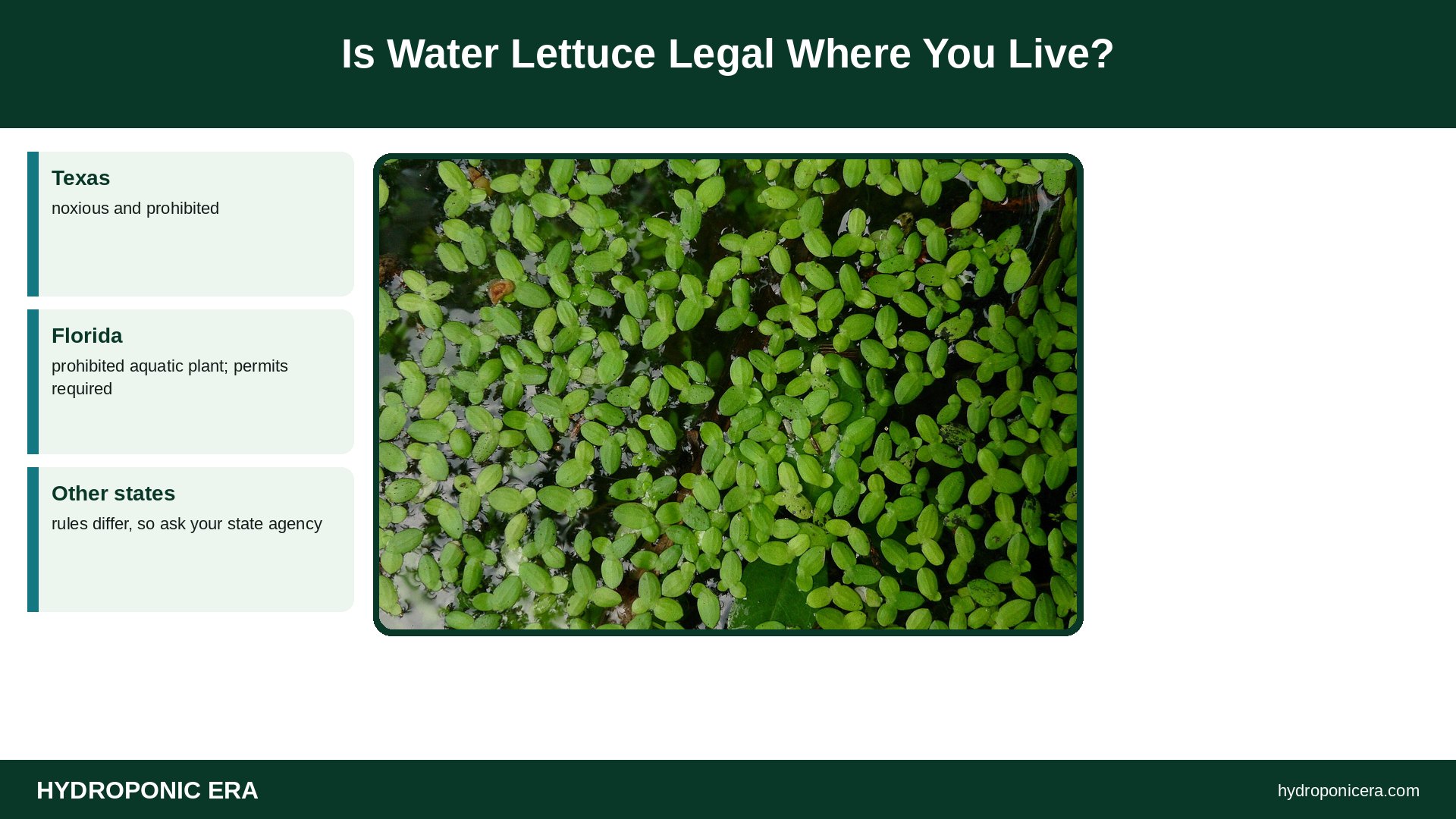
Water lettuce is illegal to possess in some states. Texas lists it as a noxious and prohibited plant, and Florida’s Rule 5B-64.011 prohibits possession and cultivation without a permit. The US Fish and Wildlife Service rates it high risk. Check your state agriculture or natural resources agency before buying it or accepting cuttings.
- Texas: noxious and prohibited.
- Florida: prohibited aquatic plant; permits required.
- Other states: rules differ, so ask your state agency.
Why Is Water Lettuce Invasive?
Water lettuce is invasive because it multiplies quickly through daughter plants on runners and forms dense floating mats. USGS reports these mats block sunlight, change dissolved oxygen, crowd out native plants, and can harbor mosquito larvae. Florida spent about $1.4 million managing it in 2005–06 alone.
That is why the most important rule is containment. Even a few escaped plants can start a new population in warm water.
How Do You Grow It in a Tub or Tank?
To grow it in a tub or tank, float it on warm, calm water with bright light and a little nutrient from fish or a weak plant food. Keep a gap between leaves and any lid so condensation doesn’t rot them. Thin the rosettes often so they never cover the whole surface.
- Confirm it is legal in your state.
- Use a closed container with no overflow to the outdoors.
- Float rosettes gently; don’t bury the roots.
- Give bright light, either sun or a grow light.
- Keep water warm, ideally above 59°F (15°C).
- Thin weekly, leaving open water for oxygen exchange.
- Bag and trash extras; don’t compost them outdoors.
For indoor lighting, see our guide to light schedules.
How Do You Care for Water Lettuce in an Aquarium?
In an aquarium, water lettuce needs a strong light above it, gentle surface flow, and enough space between the water and the lid. Strong filter currents push it under or into corners, and cold water slows it down. Its long roots give shy fish and fry cover and soak up nitrate.
| Need | Tip |
|---|---|
| Light | Bright light directly over the surface |
| Flow | Calm; ring floaters with airline tubing |
| Lid gap | Leave air space so leaves stay dry |
| Nutrients | Fish waste is usually enough |

Why Is Water Lettuce Turning Yellow?
The plant usually turns yellow from low light, cold water, low nutrients, or wet leaves under a lid. Older outer leaves also yellow and die as new ones form. Move it closer to light, warm the water, remove dying leaves, and make sure the top surfaces stay dry.
- Melting leaves: condensation or splashing.
- Pale and small: low light or nutrients.
- Brown roots: stagnant or very warm water.
How Do You Start New Plants From Runners?
New rosettes form at the ends of short runners, called stolons, that grow out from the parent plant. Once a daughter has a few leaves and its own roots, snip the runner with clean scissors and float the young plant on its own. Most growers need to do the opposite, though, and remove extras.
- Keep only as many rosettes as cover about half the surface.
- Pick out the largest, oldest plants when thinning.
- Share only with growers in states where it is legal.
Can Floating Plants Help a Small Pond’s Water Quality?
Floating plants can help balance a small water garden by shading the surface and competing with algae for nutrients, a point Kansas State University Extension makes about water garden plants in general. They are not a filter, though. Fish waste, leaves and uneaten food still need removing, and too many floaters can lower oxygen at night.
Leave open water between plants, and add an air stone in heavily stocked tubs. Our guide to air pumps and air stones covers sizing.
How Do You Remove and Dispose of Floating Plants?
Remove extra rosettes with a net or by hand, let them dry in a sealed bag, and put them in the household trash. Never toss them in a creek, storm drain, or backyard pond that overflows. Clean nets and buckets before using them elsewhere so tiny daughter plants don’t hitch a ride.
Duckweed and other floaters need the same care; see our guide to growing duckweed.
What Are Safer Alternatives?
Safer alternatives depend on your state, but contained duckweed, native floating plants sold by local nurseries, or rooted aquarium plants can provide shade and nutrient uptake. Ask a local extension office which floating plants are native to your area, and contain any floater the same way.

Floating mats also hide mosquito larvae, so check still water often. Our guide to mosquito larvae covers safe controls. For algae control in open tubs, see our guide to algae in reservoirs.
FAQ About Water Lettuce
Can you eat water lettuce?
No. It is not a salad plant.
Does it need a filter?
No, but it needs calm water and light.
Will it survive winter outdoors?
It dies back in cold water, but seed can survive.
Is it good for goldfish?
Goldfish often nibble the roots; keep extras contained.
How fast does it spread?
Fast in warm, bright water; thin it weekly.
See more contained options in our list of plants that grow in water.
Sources
- US Geological Survey Nonindigenous Aquatic Species — Water Lettuce Species Fact Sheet
- Texas Invasives — Plant Database Profile
- Florida Administrative Code — Rule 5B-64.011 Prohibited Aquatic Plants
- Kansas State University Research and Extension — Water Gardening: Biological Balance (MF2911)
- Photo credits (Wikimedia Commons, edited with titles): At La Orotava 2023 130 by Photograph by Mike Peel (www.mikepeel.net). (CC BY-SA 4.0); Common Duckweed (Lemna minor) by Mokkie (CC BY-SA 3.0); Fountain with goldfish in Jardí del Bisbe 03 by Kritzolina (CC BY-SA 4.0); Pond-edge plants at Achamore Garden – geograph.org.uk – 5446824 by M J Richardson (CC BY-SA 2.0)