
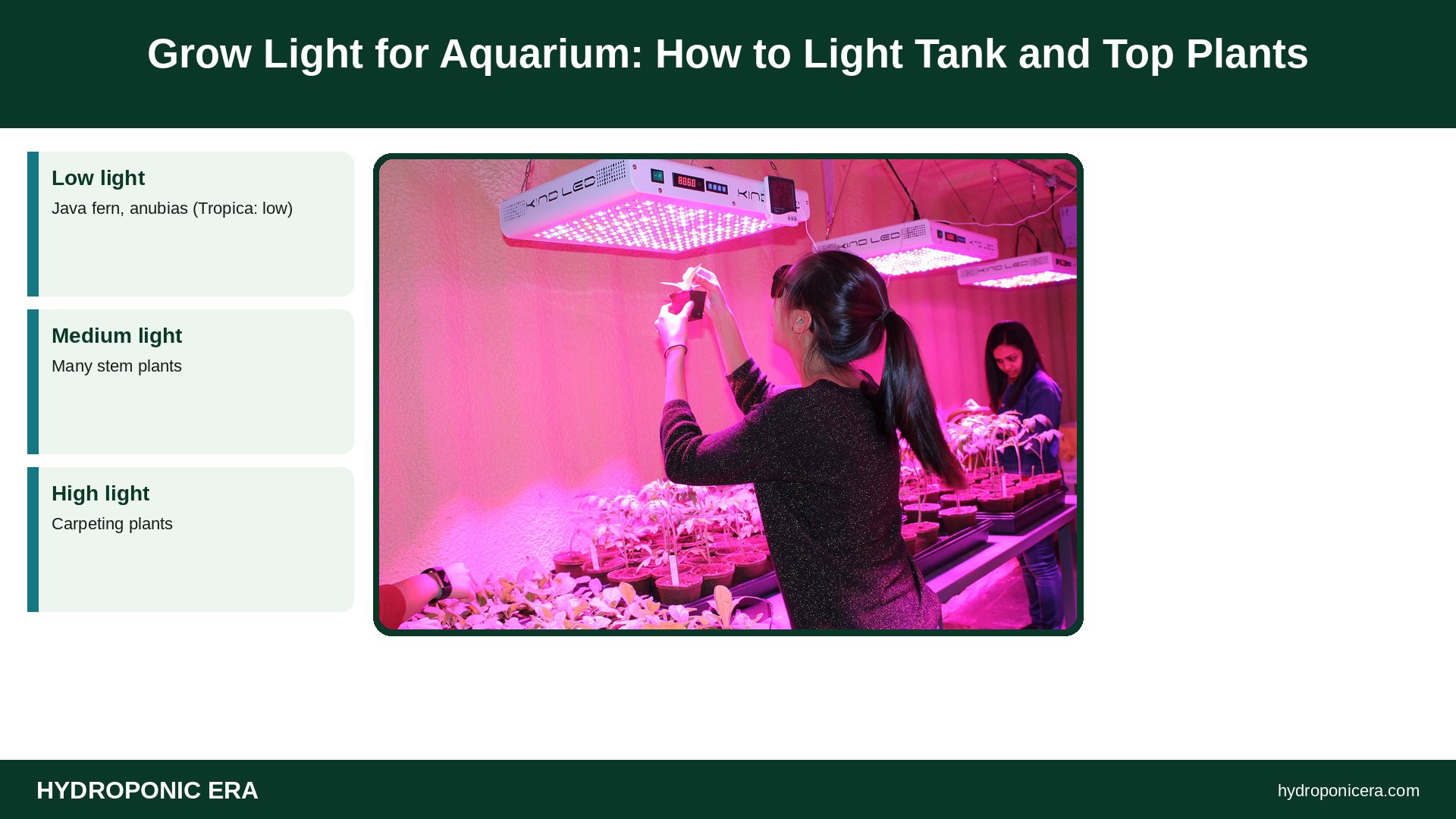
What is the best grow light for aquarium plants? The best grow light for aquarium setups is a full-spectrum LED sized to your plants’ needs and run on a timer. Low-light plants such as java fern and anubias need only a basic fixture, while carpeting plants need brighter light. Top plants growing above the rim need their own light.
Key takeaway: Match light to your plants, not the other way around, and keep the photoperiod steady to limit algae.
| Plant group | Light level | Examples |
|---|---|---|
| Low light | Basic aquarium LED | Java fern, anubias (Tropica: low) |
| Medium light | Brighter planted-tank LED | Many stem plants |
| High light | Strong LED, often with CO2 | Carpeting plants |
| Top plants | Separate room or clip-on light | Pothos, spider plant, herbs |
Do Aquarium Plants Need a Grow Light?
Most aquarium plants need more light than a dim room provides, so a fixture over the tank acts as a grow light for aquarium plants. Low-light species can manage with a simple LED, but faster stem plants and carpets need stronger, more even light. Fish do not need intense light; it is mainly for plants.
Tropica, a large aquarium plant grower, rates each plant’s light demand as low, medium or high and describes medium demand as about 0.5 W per liter (about 1.9 W per gallon) under its reference lighting. Treat that as a rough guide, since modern LEDs vary in efficiency.
How Do You Choose a Grow Light for Aquarium Tanks?
To choose a grow light for aquarium tanks, match the fixture length to the tank, pick full-spectrum LEDs, check that output suits your plants’ light demand, and look for a built-in or separate timer. Dimmable fixtures are helpful because you can start low and raise intensity as plants adapt.
- Measure the tank length and depth.
- List your plants and their light demand.
- Choose full-spectrum LED that covers the tank length.
- Prefer dimmable output with a timer.
- Check the mount fits your lid or rim.
- Start at lower intensity and increase slowly.
How Long Should a Grow Light for Aquarium Plants Run?
Many planted-tank keepers run lights about 6–8 hours a day on a timer, starting at the lower end in new tanks. Long or irregular photoperiods often lead to algae. Consistency matters more than exact hours, so automate it. Our guide to light schedules explains timers in detail.
- New tank: start short and lengthen slowly.
- Algae showing: shorten hours or lower intensity.
- Plants stretching: light may be too weak.
What Grow Light for Aquarium Top Plants Works Best?
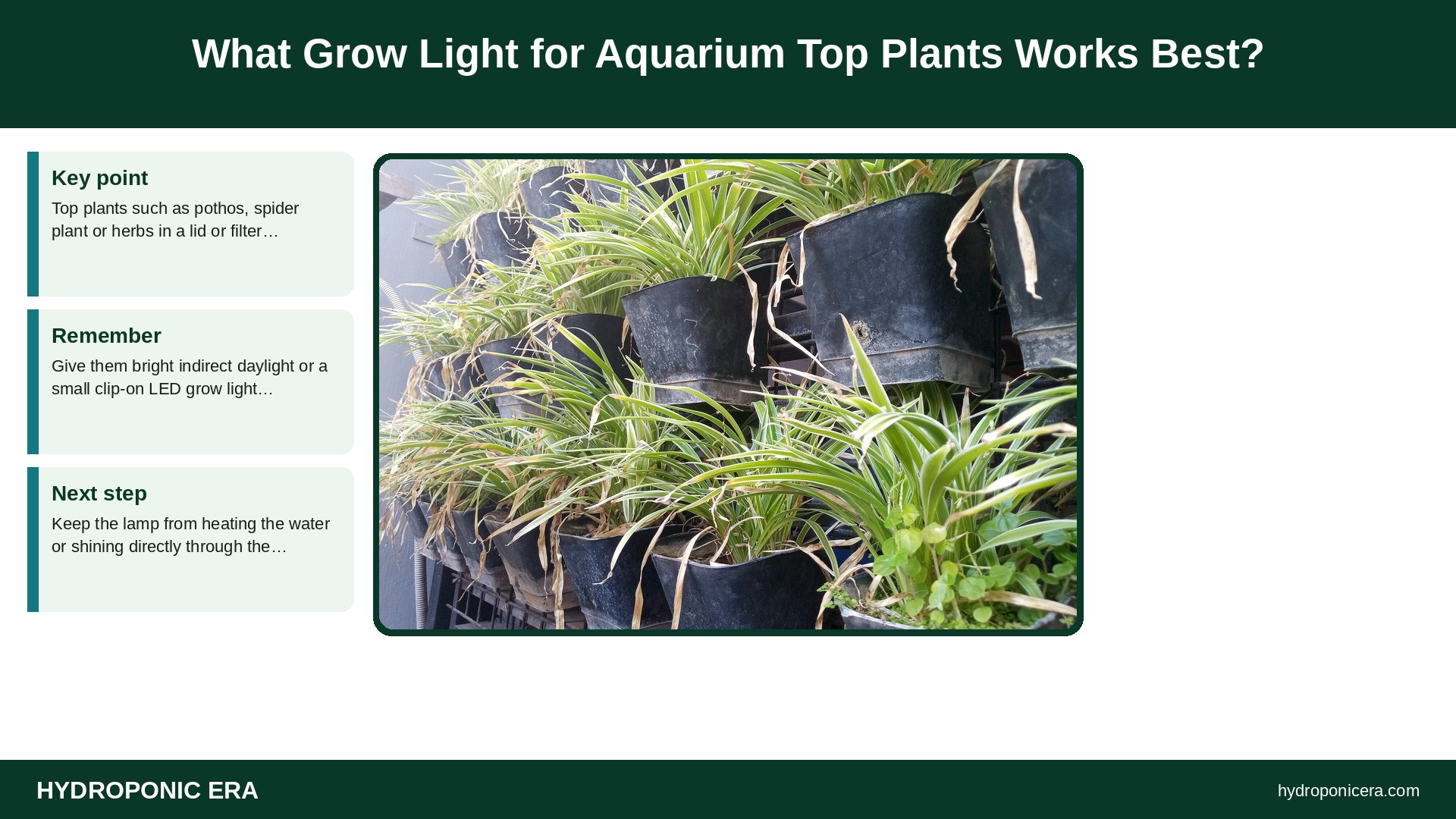
Top plants such as pothos, spider plant or herbs in a lid or filter planter get little benefit from a tank light pointed down into the water. Give them bright indirect daylight or a small clip-on LED grow light above the leaves. Keep the lamp from heating the water or shining directly through the glass all day.
See our guides to pothos in water and grow lights for hydroponics.
What Specs Matter in Aquarium Lighting?
The specs that matter most in aquarium lighting are how much usable light reaches the plants, how evenly it spreads, and whether you can control it. Watts and lumens alone say little about plant growth. Many planted-tank makers publish PAR readings at set depths, which is the most useful number for comparing fixtures.
- PAR at depth: light plants can use, measured at the substrate.
- Spread: even coverage without dark corners.
- Spectrum: full spectrum looks natural and grows plants well.
- Control: dimming, timers and sunrise ramps.
- Build: splash resistance and a secure mount.
Deeper tanks lose more light before it reaches the bottom, so a tall tank may need a stronger fixture than a shallow tank of the same volume. When comparing a grow light for aquarium use against a general plant lamp, check that it is rated for use over water and fits your lid. Read reviews from planted-tank keepers with similar tank depths before buying.
Can a Grow Light for Aquarium Tanks Cause Algae?
Light alone does not cause algae, but too much light compared with nutrients, CO2 and plant mass tips the balance toward it. Tropica notes that bright light over slow plants such as java fern can let algae grow on their leaves. Fix the balance by lowering intensity, shortening the photoperiod, adding plants, or changing water.
| Problem | Likely cause | Fix |
|---|---|---|
| Green water | Too much light and nutrients | Shorten hours; water change |
| Algae on slow plants | Light too strong | Dim light or shade them |
| Plants stretching | Light too weak | Brighter fixture |
| Melting leaves | Sudden change | Change light gradually |
Our guide to algae control covers the same balance in reservoirs.
Is LED Better Than Fluorescent for Aquariums?
LEDs are now the usual choice because they run cooler, use less energy and often allow dimming and color control. Older fluorescent tubes still grow plants but lose output with age and need periodic replacement. If you buy one new fixture, a full-spectrum LED made for planted tanks is the simplest pick.
How Do You Mount a Grow Light for Aquarium Use Safely?
Keep fixtures and power strips above and away from water, form a drip loop in each cord so water runs off before reaching the outlet, and plug aquarium gear into a GFCI-protected outlet. Unplug lights before cleaning or reaching into the tank. Our guide to aquarium heaters covers the same safety habits.
Can You Use a Grow Light for Aquarium Aquaponics?
Yes. In a small indoor aquaponics setup, one light can serve fish tank plants while a second light serves the grow bed above. Leafy greens and herbs need much more light than most aquarium plants, so use a proper LED grow light for the bed. Our aquaponics for beginners guide covers setup.
FAQ About Aquarium Grow Lights
Can I use a household LED bulb?
It may grow low-light plants, but planted-tank LEDs spread light better.
Do fish need darkness?
Yes; give a regular dark period each night.
Should lights match room daylight?
A steady timer schedule matters more.
Do I need CO2 with strong light?
High-light setups often use CO2 to avoid algae.
How high should the light sit?
Follow the fixture maker’s guidance for your tank depth.
Sources
- Tropica Aquarium Plants — Microsorum pteropus Plant Details (light demand scale)
- Tropica Aquarium Plants — Plant Care Guide
- Photo credits (Wikimedia Commons, edited with titles): Terramera scientists working in a climate-controlled growth chamber located in Vancouver, BC. The space uses LED lighting, which supports plant growth. (50188965171) by Simon Fraser University – Communications & Marketing (CC BY 2.0); Low-key photograph of light bulb, Straume, Norway julesvernex2 by Jules Verne Times Two (CC BY-SA 4.0); Spider Plant (Chlorophytum Comosum) by S.samsamyang (CC BY 4.0); Fish farming on Øksfjorden in Loppa, Troms og Finnmark, Norway, 2022 August by Ximonic (Simo Räsänen) (CC BY-SA 4.0)