
How do you make quinoa sprouts? Rinse ⅔ cup of whole quinoa under cool running water for about a minute to wash off bitter saponins. Soak 20–30 minutes, drain, then rinse and drain every 8–12 hours. Quinoa sprouts are ready in about 1–3 days, as soon as most seeds show tiny roots. Drain well and refrigerate.
Key takeaway: Quinoa sprouts are among the fastest sprouts you can grow, often showing roots within a day. The keys are a thorough pre-rinse to remove soapy saponins, a short soak, very good draining, and harvesting early while the sprouts are still crunchy.
| Quinoa sprouts step | Guideline | Source |
|---|---|---|
| Seed | ⅔ cup whole quinoa per quart (1 L) sprouter | Sprout People |
| Pre-rinse | Run cool water through it for about 1 minute | Sprout People |
| Soak | 20–30 minutes in cool 60–70°F (16–21°C) water | Sprout People |
| Rinse/drain | Every 8–12 hours, 2–3 cycles | Sprout People |
| Harvest | 1–3 days; tiny roots | Sprout People |
| Yield | About 1.5:1 (about 1 cup) | Sprout People |

What Are Quinoa Sprouts?
Quinoa sprouts are whole quinoa seeds that have soaked and pushed out a tiny white root. Quinoa is a pseudo-grain from the Andes, related to amaranth and beets. Sprout People describes the sprouts as light and crunchy with a mild, beet-like and nutty flavor. Because the seed is small and needs only a brief soak, quinoa sprouts are one of the quickest sprouting crops.
Why Do You Need to Rinse Quinoa Before Sprouting?
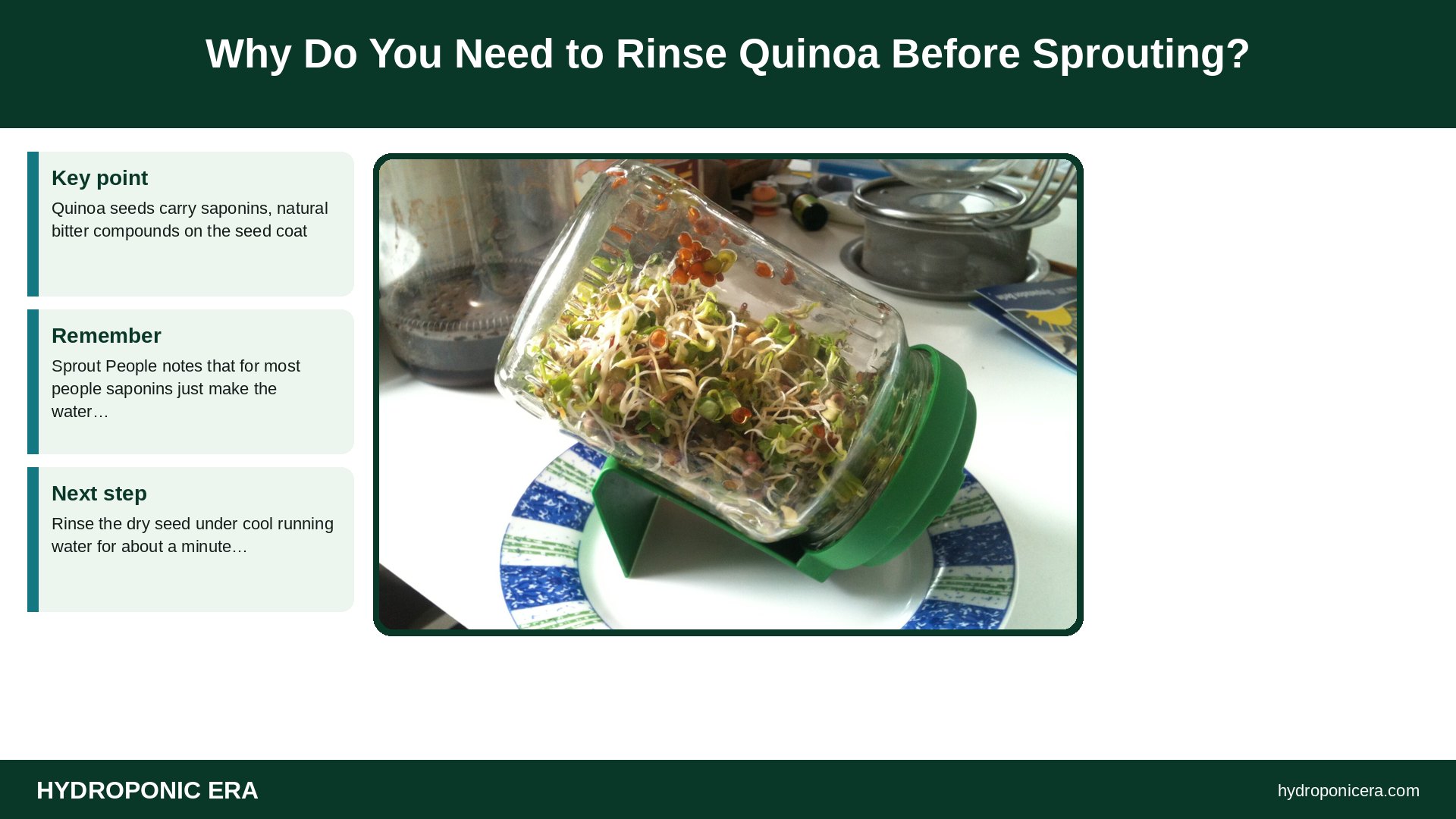
Quinoa seeds carry saponins, natural bitter compounds on the seed coat. Sprout People notes that for most people saponins just make the water sudsy and a bit thick, which makes sprouting harder, but they can cause a reaction or make some people feel ill. Rinse the dry seed under cool running water for about a minute, swishing it in a fine strainer, until the water no longer foams. Many grocery brands are pre-rinsed, but a quick extra rinse costs nothing.
How Do You Sprout Quinoa Step by Step?
- Sanitize your jar or sprouter, as UC ANR describes.
- Measure ⅔ cup of whole quinoa; Sprout People says this yields about 1 cup (½ lb).
- Rinse well under cool running water for about 1 minute.
- Soak 20–30 minutes in 2–3 times as much cool water. Sprout People notes soaking is optional but speeds things up.
- Drain and rinse very thoroughly.
- Use a fine mesh lid or a fine strainer so seeds don’t escape.
- Rest out of direct sun at about 70°F (21°C).
- Rinse and drain every 8–12 hours for 2–3 cycles.
- Harvest when most seeds show tiny roots, then refrigerate.
New to sprouting? Start with how to grow sprouts in a jar.
How Long Do Quinoa Sprouts Take?
Usually 1–3 days, and sometimes roots appear within 24 hours. Sprout People typically stops after 2–3 rinse cycles, when most seeds have tiny roots. Longer sprouting changes the texture from soft-crunchy to very soft, and long sprouts don’t keep as well. Seed quality matters: Sprout People noted one lot took 3–4 days and only about 65% germinated, so slow results may simply be the seed.
| Time after soak | What you see | Task |
|---|---|---|
| 12 hours | Swollen seeds, some tails | Rinse and drain |
| 24 hours | Most seeds show tiny roots | Taste; harvest if you like |
| 36 hours | Roots longer, softer texture | Final rinse, drain, dry |
Can You Sprout Quinoa Without a Jar?
Yes. Because the seeds are tiny, a fine-mesh strainer set over a bowl is one of the easiest tools. After soaking, leave the seeds in the strainer, cover loosely with a clean plate or damp towel, and run cool water through them at each rinse. Shake out excess water and let them drain over the bowl, making sure the strainer bottom never sits in the drip water. A tray sprouter with a fine screen also works. Avoid coarse mesh lids; quinoa slips through them.
What Is the Difference Between Sprouted and Cooked Quinoa?
Sprouted quinoa has a short root and a crunchy, fresh texture, while cooked quinoa is soft and fluffy. You can also cook sprouted quinoa; it softens faster than dry seed because it has already absorbed water. Sprout People suggests using the sprouts in salads or as a side dish with olive oil. Cooking is also the safer way to serve sprouts to children, older adults, pregnant people or anyone with a weakened immune system.
Do Quinoa Sprouts Need Light?
No. Sprout People explains that these sprouts never form leaves during sprouting, so light has little effect. Keep the sprouter out of direct sun, which heats it, but don’t hide it in a closed cupboard; sprouts like air circulation.
Are Quinoa Sprouts Safe to Eat Raw?
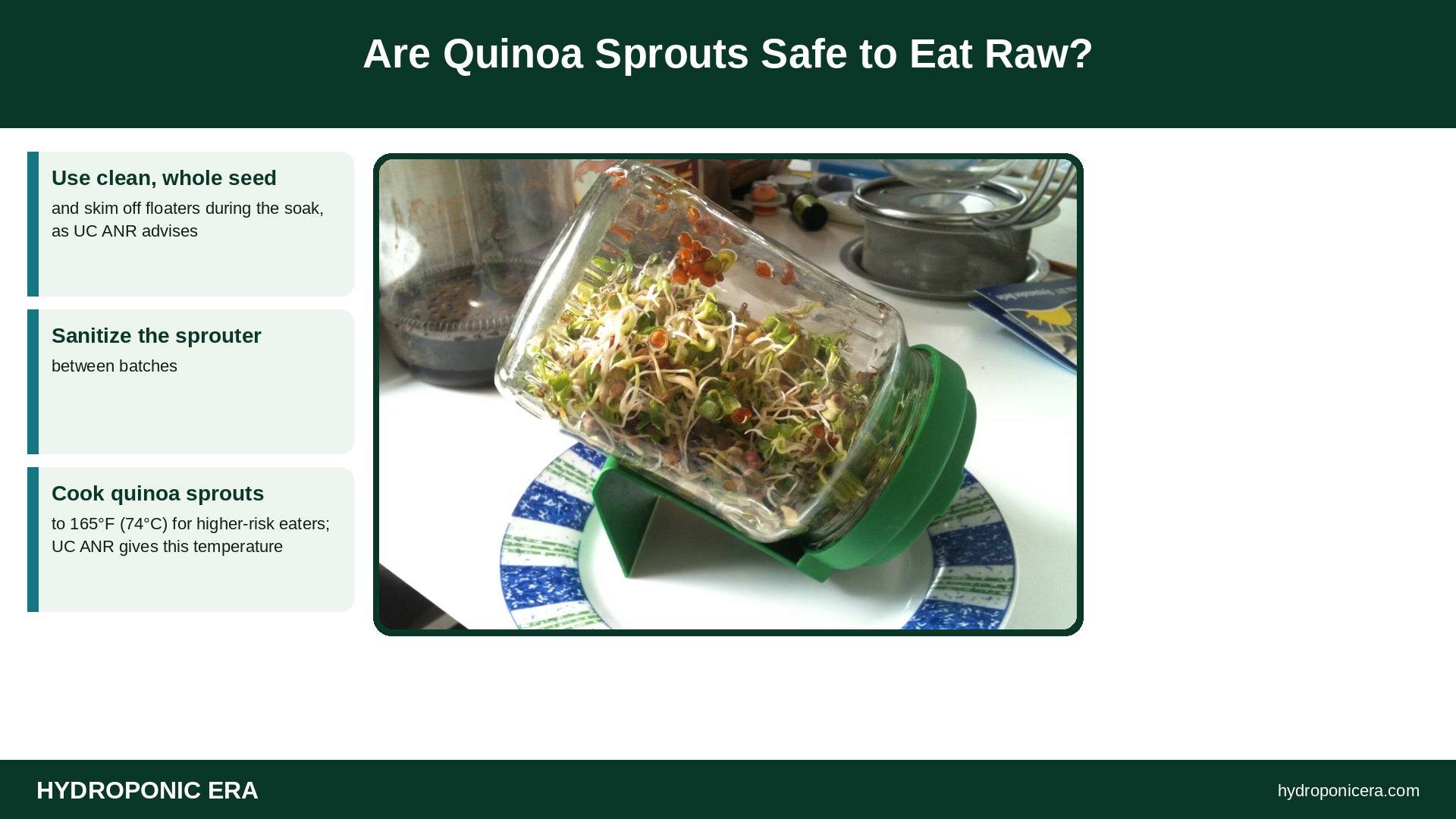
Raw sprouts of any kind carry a food-safety risk because sprouting conditions also favor bacteria. The FDA advises children, older adults, pregnant people and anyone with a weakened immune system to avoid raw or lightly cooked sprouts.
- Use clean, whole seed and skim off floaters during the soak, as UC ANR advises.
- Sanitize the sprouter between batches.
- Cook quinoa sprouts to 165°F (74°C) for higher-risk eaters; UC ANR gives this temperature.
- Discard any batch that smells sour or looks slimy.
How Do You Store Quinoa Sprouts?
Drain thoroughly after the last rinse and let the sprouts sit 8–12 hours so they are dry to the touch. Then refrigerate in a sealed bag or container. Sprout People says very short quinoa sprouts can last up to 2 weeks in the fridge, while longer ones keep for less time. NC State suggests a fridge at 38–50°F (3–10°C). Fresher is better for flavor.
How Do You Use Quinoa Sprouts?
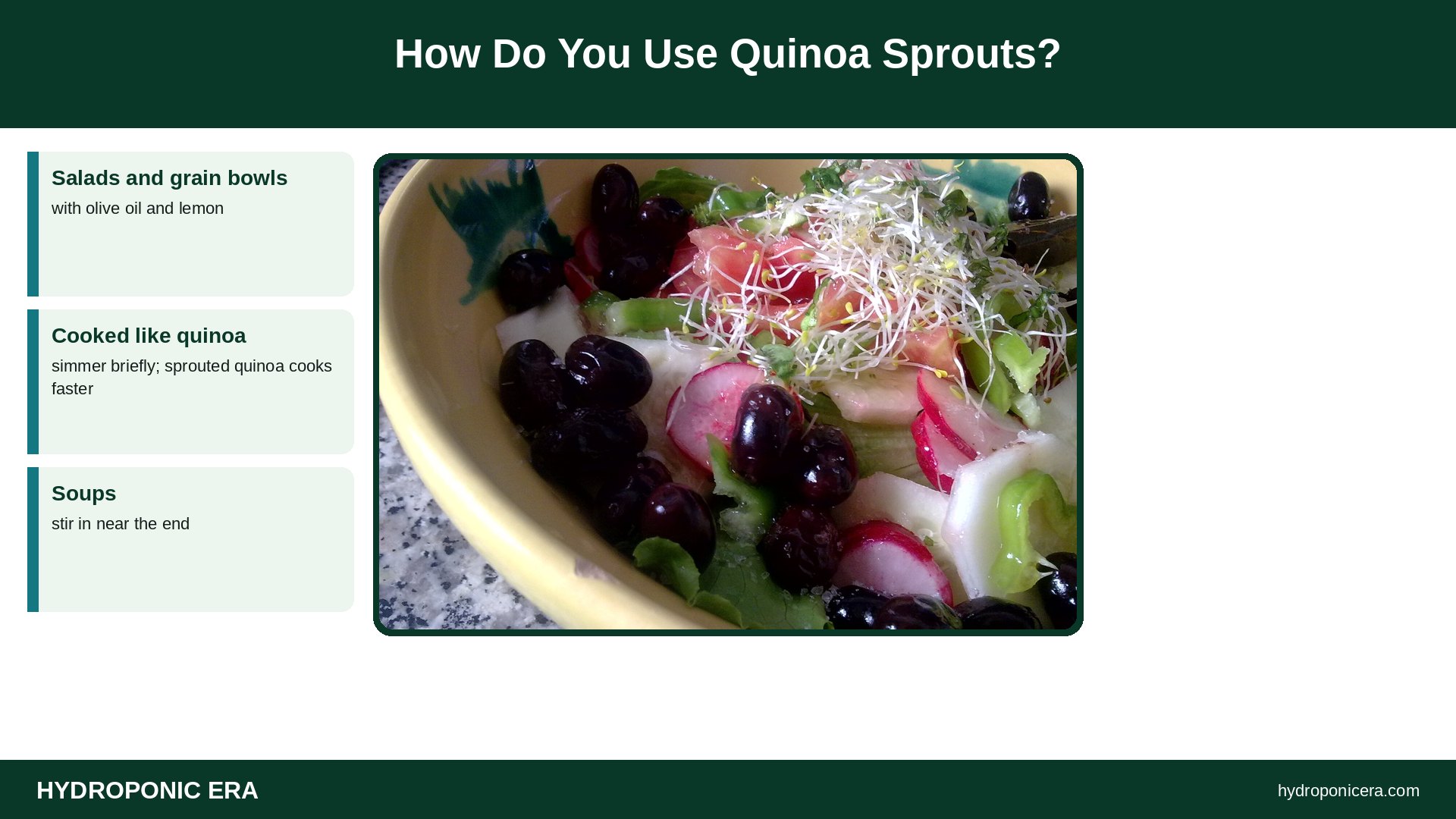
- Salads and grain bowls with olive oil and lemon.
- Cooked like quinoa: simmer briefly; sprouted quinoa cooks faster.
- Soups: stir in near the end.
- Breakfast bowls with fruit and yogurt.
- Veggie patties or stuffed peppers.
Why Won’t My Quinoa Sprout?
- Processed seed: some grocery quinoa sprouts poorly; buy seed sold for sprouting or test a small batch.
- Old seed: Sprout People lists a 2-year seed shelf life and suggests freezing for longer storage.
- Over-soaking: long soaks are not needed; 20–30 minutes is enough.
- Soapy water: rinse more to remove saponins.
- Poor drainage: small seeds trap water; use a fine mesh and drain well.
FAQs
Can I sprout red or black quinoa?
Yes. Whole quinoa of any color can sprout.
Do quinoa sprouts taste bitter?
Not if you rinse off the saponins first.
Can I eat quinoa sprouts raw?
Many people do, but higher-risk eaters should cook them.
How much does ⅔ cup make?
About 1 cup, at a 1.5:1 yield.
Can I grow quinoa microgreens?
Yes, on a tray under light; see our microgreens guide.
Sources
- Sprout People — Quinoa Sprouts growing guide
- UC ANR — Growing Seed Sprouts at Home (Publication 8151)
- U.S. FDA — Selecting and Serving Produce Safely
- NC State Extension — Bean Sprouts and Other Vegetable Seed Sprouts
- Photo credits (Wikimedia Commons, edited with titles): Chenopodium quinoa -red faro- MHNT.BOT.2007.43.66 by Roger Culos (CC BY-SA 3.0); Growing bean sprouts by User:tlcoles (CC BY-SA 3.0); Growing bean sprouts by User:tlcoles (CC BY-SA 3.0); Salad, Romaine lettuce, cucumber, tomato, green pepper, radish, alfalfa sprouts, black olives, lemon juice, salt & olive oil (7765310086) by Lablascovegmenu from London (CC BY 2.0); Oats dewdrop by Ross Berteig from Monrovia, California, USA (CC BY 2.0)