
When do you need cal mag hydroponics supplements? You need cal mag hydroponics supplements when your water or nutrient base is short on calcium and magnesium. That usually means reverse osmosis, rainwater or very soft tap water, or plants grown in coco coir. Test your water first, because many nutrients and hard tap water already supply enough.
Key takeaway: Cal mag hydroponics is a correction, not a routine add-on. Extension guidance says to test your water, match calcium to magnesium at roughly 3 to 5 parts calcium per 1 part magnesium by mass, and add only what your base nutrient is missing. Too much of either blocks the other and potassium.
| Water type | Likely calcium and magnesium | Cal mag hydroponics action |
|---|---|---|
| Reverse osmosis or distilled | Near zero | Supplement, or use a nutrient that includes both |
| Rainwater | Very low | Test, then supplement as needed |
| Soft tap water | Low | Test hardness, supplement small amounts |
| Hard tap or well water | Often high | Test first, often no supplement needed |

What Is Cal Mag Hydroponics and Why Does It Matter?
Cal mag hydroponics refers to supplying calcium and magnesium in a soluble form because plants need them in large amounts. Calcium builds cell walls and helps new growth and fruit quality. Magnesium sits at the center of the chlorophyll molecule, so without it leaves lose green color between the veins.
Neither nutrient moves easily inside the plant, which is why symptoms show in specific places. Calcium shortages hit new leaves, growing tips and fruit, while magnesium shortages usually show on older leaves first. Our guide to calcium and magnesium deficiency in hydroponics shows the patterns side by side.
Does Your Water Need Cal Mag Hydroponics Supplements?
The only reliable way to know is to test. Ask your water utility for a report or use a lab test that lists calcium, magnesium, hardness and alkalinity. If your base nutrient already lists calcium and magnesium and your water is moderately hard, a cal mag hydroponics product may just add imbalance.
Greenhouse water guidance from UMass and the Vegetable Crops Hotline suggests alkalinity near 30–60 ppm calcium carbonate for good pH control, and levels above about 150 ppm cause problems. Very high alkalinity pushes pH up and locks out nutrients, which is a different problem from a calcium shortage. Read well water for hydroponics: a test decision tree before you buy anything.
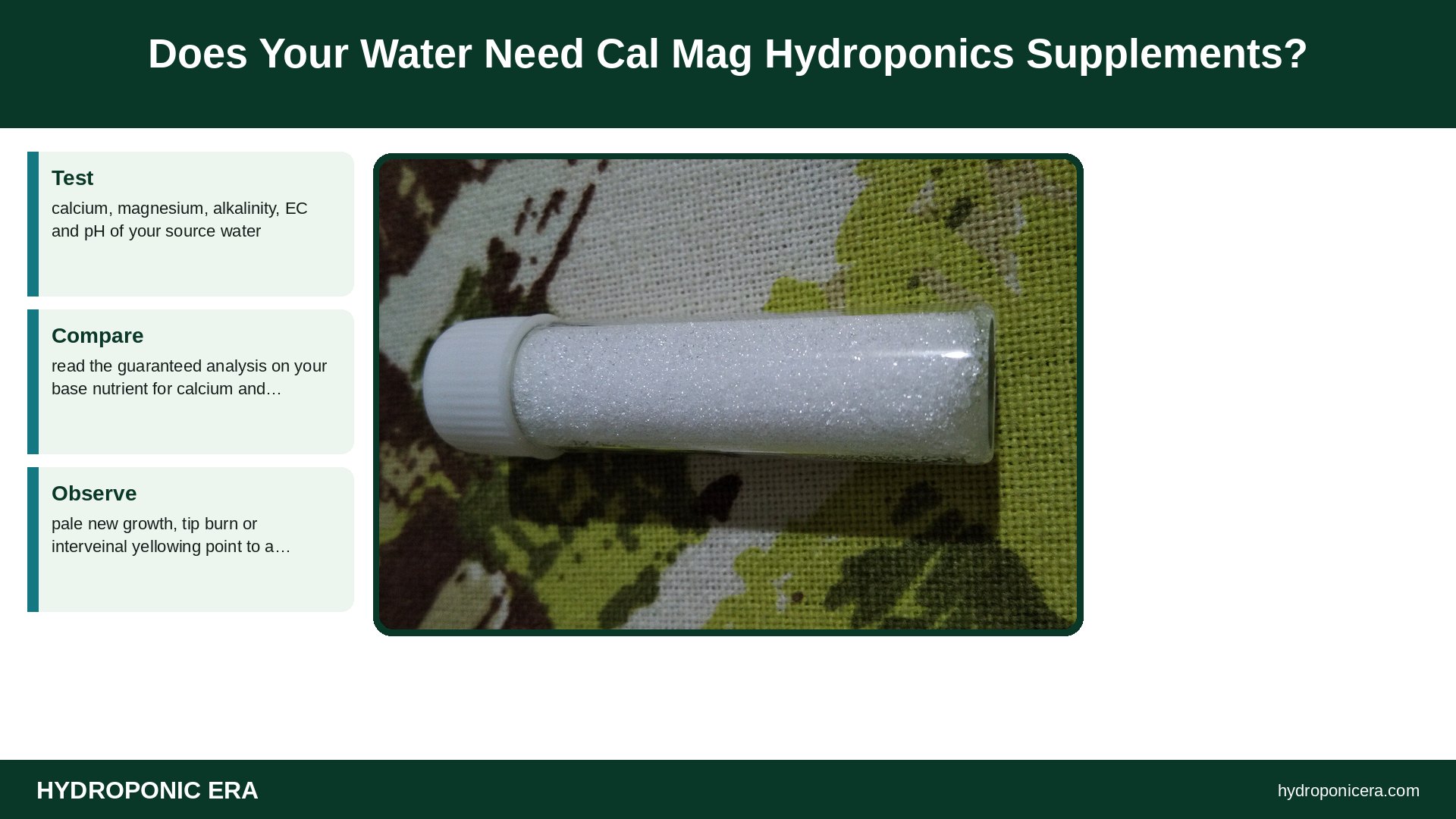
- Test: calcium, magnesium, alkalinity, EC and pH of your source water.
- Compare: read the guaranteed analysis on your base nutrient for calcium and magnesium.
- Observe: pale new growth, tip burn or interveinal yellowing point to a possible gap.
- Change one thing at a time: add a small amount and watch new growth for a week.
How Much Cal Mag Hydroponics Dosing Is Right?
Aim for calcium and magnesium in roughly a 3:1 to 5:1 ratio by mass, then follow the product label for your water type. For example, a solution with 150 ppm calcium would want about 30–50 ppm magnesium. Start at a fraction of the label dose and adjust after testing EC and watching the plants.
Do not add cal mag hydroponics products on top of a base nutrient without checking the combined EC. Many supplements raise EC noticeably, and your target for most crops is still set by the crop, not by the bottle. See our guide to EC and TDS in hydroponics for targets.
| Source | Approximate content | Notes |
|---|---|---|
| Calcium nitrate | About 19% calcium, 15.5% nitrogen | Also adds nitrate nitrogen |
| Epsom salt (magnesium sulfate) | About 10% magnesium | Adds sulfur, no nitrogen |
| Commercial cal mag liquids | Varies by label | Check ratio and EC impact |
Can You Make Your Own Cal Mag Hydroponics Mix?
Yes. Many growers use calcium nitrate for calcium and Epsom salt for magnesium instead of a bottled cal mag hydroponics product. This keeps costs low and gives you control of the ratio. Add them to the reservoir in the right order and keep calcium separate from sulfates and phosphates in concentrated stocks.
- Fill the reservoir with water and add calcium nitrate first, stirring until dissolved.
- Add magnesium sulfate next, only after the calcium has dispersed.
- Add the rest of the base nutrient following the label.
- Check EC and adjust pH last.
The nutrient mixing order to prevent precipitation, the calcium nitrate guide and the Epsom salt guide explain each step.

What Are the Signs You Need Cal Mag Hydroponics Help?
Look for pattern, not just color. New leaves that are twisted, small or have burned tips suggest low calcium. Yellowing between the veins on lower leaves suggests low magnesium. Both can also be caused by pH problems or a hot, dry room, so rule those out before adding supplements.
- Low calcium: tip burn on lettuce, distorted new leaves, blossom end rot on tomatoes and peppers.
- Low magnesium: interveinal yellowing on older leaves, with green veins.
- Not a deficiency: high EC, heat or low humidity can mimic calcium problems.
For leafy greens, see tip burn in hydroponics, where airflow and humidity are often the cause as much as calcium.
Can You Overdo Cal Mag Hydroponics Supplements?
Yes. Too much calcium can block magnesium, and too much magnesium can block calcium and potassium. The result looks like a deficiency even though the nutrients are in the tank. If EC climbs and leaves curl or mottle after a supplement, stop adding it and replace part of the solution with fresh water.
A good habit is to record the date, dose and EC each time you adjust. Over a few weeks you will see how your water and plants respond, and you can drop the supplement entirely if the base nutrient is balanced.
FAQ About Cal Mag Hydroponics
Do I need cal mag with reverse osmosis water?
Often yes, because RO water has almost no calcium or magnesium. Many nutrients still supply both, so check the label and the plants.
Do I need cal mag in coco coir?
Coco can bind calcium and magnesium, so growers often pre-buffer it or add a cal mag product. Follow your nutrient’s coco instructions.
What ratio of calcium to magnesium is best?
About 3 to 5 parts calcium to 1 part magnesium by mass is a common target.
Can I add cal mag to every reservoir change?
Only if testing shows a gap. Otherwise you risk imbalance and high EC.
Is Epsom salt a replacement for cal mag?
It supplies magnesium only. You still need a calcium source such as calcium nitrate.
Sources
- Vegetable Crops Hotline — Taking care of plant nutrition in your high tunnel: water hardness and unwanted ions
- UMass Extension — Water quality for crop production
- Purdue Controlled Environment Agriculture — Nutrient management presentation (Petrus Langenhoven)
- Photo credits (Wikimedia Commons, edited with titles): Rotary filter for extracting cyanamide from calcium cyanamide – DPLA – 5431aa52ac85c036ef1705486f18476f by Unknown (Public domain); Epsom salt by Chandrajit Karmakar (CC BY-SA 4.0); Calcium nitrate, waste water treatment by Cjp24 (CC BY-SA 4.0); Epsomite by WTucker (talk) (CC BY-SA 3.0)