
When should you use Bt spray? Use Bt spray on young, actively feeding caterpillars, and choose the strain that matches your pest: Bt kurstaki for caterpillars and Bt israelensis (Bti) for fungus gnat and mosquito larvae. Spray in a dry morning, cover leaf undersides, and reapply after rain. Caterpillars stop eating within hours and die in one to five days.
Key takeaway: Bt spray is a stomach poison made from a soil bacterium, so the pest must eat it. It works on small larvae, not adults, eggs or pupae. Match the strain to the pest, cover both sides of leaves, reapply after rain, and avoid spraying where butterflies you want to protect feed.
| Strain | Targets | Common use |
|---|---|---|
| Bt kurstaki | Moth and butterfly caterpillars | Cabbage worms, hornworms, loopers |
| Bt israelensis (Bti) | Fungus gnat, mosquito and black fly larvae | Media drench, standing water |
| Bt tenebrionis | Certain beetle larvae | Check the label for target beetles |
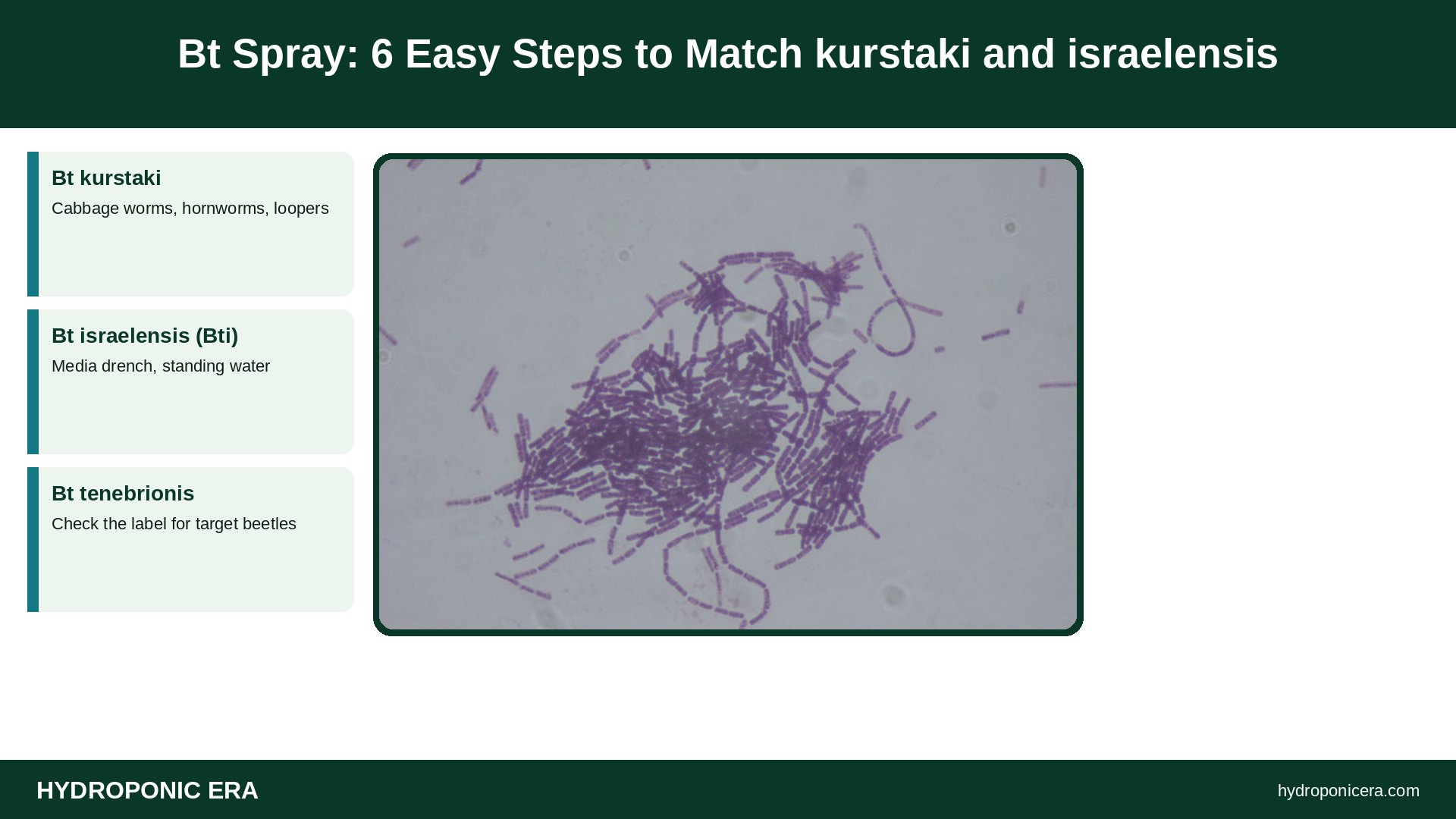
What Is Bt Spray?
Bt spray is an insecticide made from Bacillus thuringiensis, a soil bacterium that produces proteins toxic to certain insects when eaten. Different strains kill different pests, which is why labels list the target. It is considered low risk to people, pets, bees and fish, but it still has a label that must be followed.
UConn’s home and garden fact sheet explains that Bt must be ingested by feeding larvae and does not act on contact like other sprays. That makes timing and coverage important, and it explains why Bt does nothing to adult moths or to pests that do not chew leaves. For hydroponic growers, the same family of products includes mosquito bits, covered in mosquito bits for fungus gnats.
Which Strain of Bt Spray Should You Choose?
Pick the product whose strain matches your pest. Bt kurstaki works on caterpillars of moths and butterflies, Bti works on fungus gnat and mosquito larvae, and Bt tenebrionis works on some beetle larvae. A kurstaki product will not control fungus gnats, and Bti will not stop cabbage worms.
- Kurstaki: cabbage worms, tomato hornworms and cabbage loopers.
- Israelensis (Bti): fungus gnat larvae in media and mosquito larvae in water.
- Check the label: the strain and target pests are printed on the front.
If you are unsure whether you have caterpillars or fungus gnats, read fungus gnats in hydroponics and compare the symptoms before you spray anything.
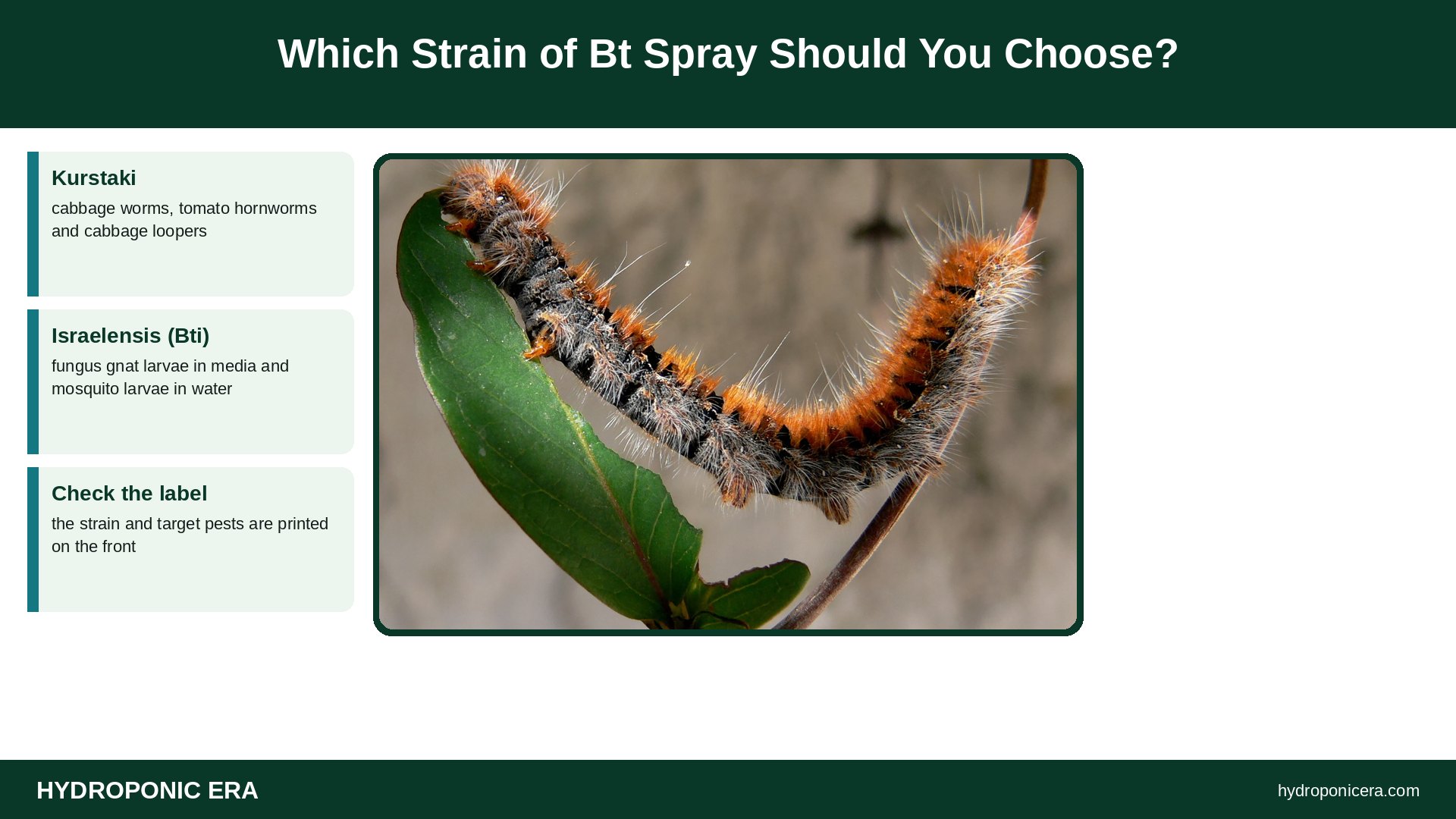
How Do You Apply Bt Spray on Caterpillars?
Spray Bt kurstaki when caterpillars are small and feeding, in a dry, calm period, and cover both sides of the leaves. Sunlight breaks Bt down, so evening or early morning is best. Reapply after rain or every 5–7 days if the label allows. The University of Missouri stresses timing and the right target.
- Scout for chewed leaves, droppings and young caterpillars.
- Mix the product at the rate on the label, using clean water.
- Spray the tops and undersides of leaves where larvae feed.
- Do it on a dry day or evening, away from open flowers.
- Repeat after rain or at the label interval until feeding stops.
Caterpillars stop feeding within hours and die in about one to five days, so give it time before spraying again. If you see sluggish, shrinking larvae, the treatment is working.
How Do You Use Bt Spray as a Fungus Gnat Drench?
For fungus gnat larvae, use a Bti product. Mix Bti in water at the label rate and drench the medium, so larvae eat it. Bti must be eaten by young larvae, so repeat as directed to catch new hatches. Keep the medium slightly drier between waterings to reduce egg laying.
Compare this with biological controls such as nematodes, and with traps. Together, Bti drenches, drier surfaces and sticky traps give good control of gnats without chemicals.
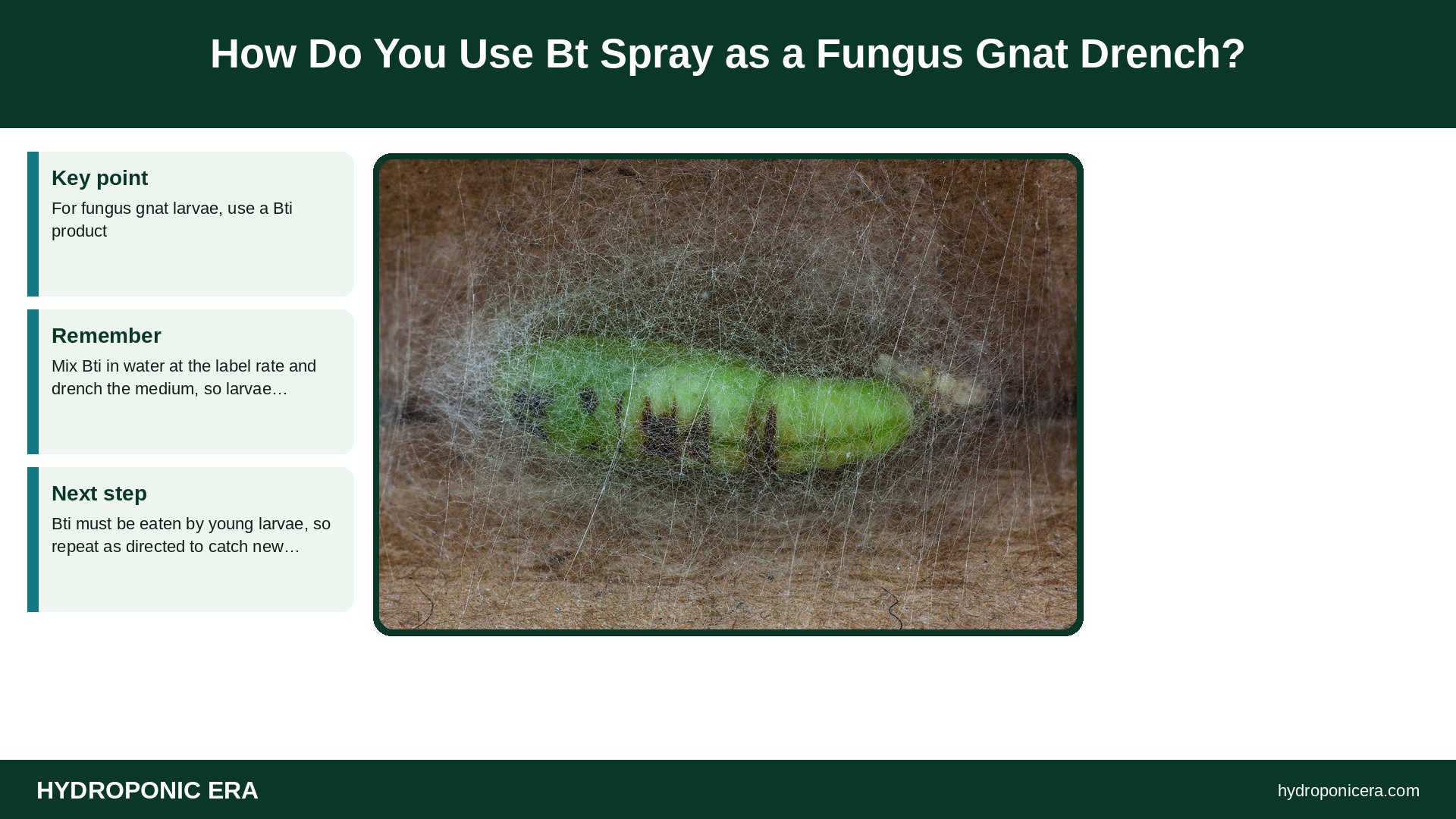
Is Bt Spray Safe for Beneficial Insects and Pollinators?
It is much safer for bees and most beneficial insects than broad-spectrum sprays, because it only affects certain larvae that eat it. But Bt kurstaki can kill butterfly and moth caterpillars you want, such as swallowtails and monarchs. Do not spray host plants where those caterpillars are feeding.
| Concern | Bt spray | Broad-spectrum insecticide |
|---|---|---|
| Honey bees | Low risk | Often high risk |
| Ladybugs and lacewings | Low risk | Often harmed |
| Butterfly caterpillars | Harmed by kurstaki | Harmed |
| Adult pests | No effect | Often killed |
How Should You Store and Mix the Product?
Store Bt in a cool, dry place in its original container, and use it within the shelf life on the label. Mix only what you need on the day, because the bacteria and spores weaken in stored dilutions. Use clean water and a clean sprayer that has not held herbicide.
Add a spreader-sticker only if the label allows it, since good leaf coverage helps larvae eat a lethal dose. Wear basic protection such as gloves and avoid breathing the mist, as with any spray. Keep records of the date, strain and crop so you can track what worked and when to repeat.
How Do You Scout for Caterpillars Before Spraying?
Check plants every few days, looking at leaf undersides for tiny holes, dark droppings and small green larvae. Early detection matters, because large caterpillars are harder to kill. Set a simple threshold, such as treating when you find several small larvae on a plant, and handpick a few when the count is low.
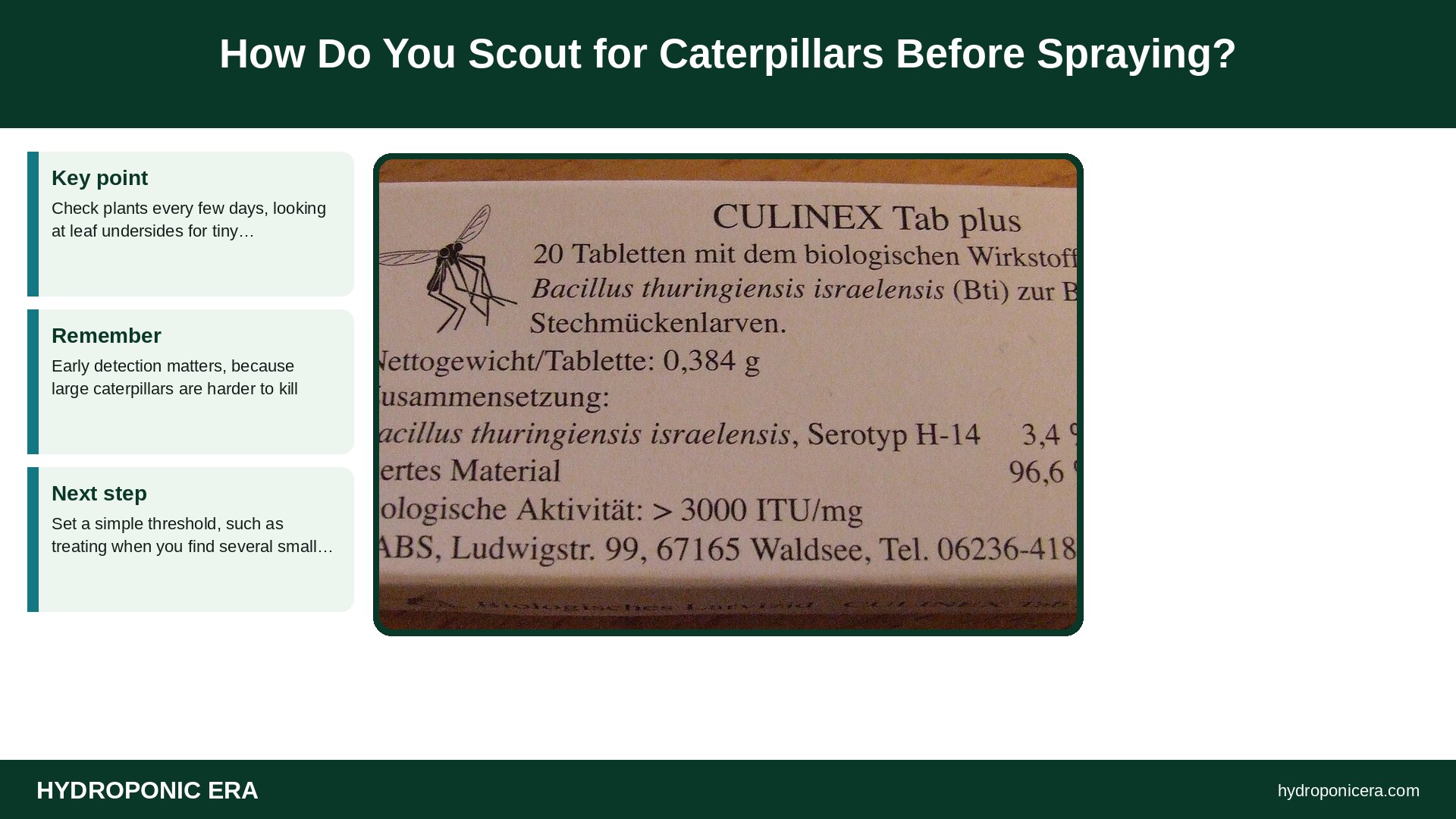
Why Does Bt Spray Sometimes Fail?
Treatment fails when the strain is wrong, larvae are too large, coverage is poor or sunlight has broken the product down. Older caterpillars eat less and tolerate more. Always scout early, treat small larvae, and stay consistent with reapplication. Hand-picking large caterpillars is a good backup.
If the problem is aphids, mites or whiteflies, Bt will not help, because they are not caterpillars. Read hydroponic pests such as aphids and mites and neem oil for plants for other options.
FAQ About Bt Spray
Is it safe on vegetables?
Products are labeled for many vegetables with a short wait before harvest. Always read the label and follow it.
How fast does it work?
Caterpillars stop feeding within hours and die within about one to five days.
Does Bt spray kill fungus gnats?
Only Bti does, not Bt kurstaki.
Is it organic?
Many Bt products are allowed in organic growing, but check for an OMRI listing on the label.
Can I use Bt spray in a hydroponic system?
Use Bti for gnat larvae in media and follow the label. Do not add kurstaki to nutrient reservoirs.
Sources
- UConn Home and Garden Education Center — Bacillus thuringiensis (Bt) fact sheet
- UF/IFAS Gardening Solutions — Bt and spinosad
- University of Missouri Extension — Bt biological insecticide: timing and target matter
- New England Vegetable Management Guide — Insecticides labeled for insects and mites
- Photo credits (Wikimedia Commons, edited with titles): Bacillus thuringiensis by Dr. Sahay (CC BY-SA 3.0); Chenille chevrefeuille by Jodelet/Lépinay (CC BY-SA 2.5); Cabbage looper in cocoon by مانفی (CC BY-SA 4.0); Culinex Tab plus by Claus Ableiter (CC BY-SA 3.0)