
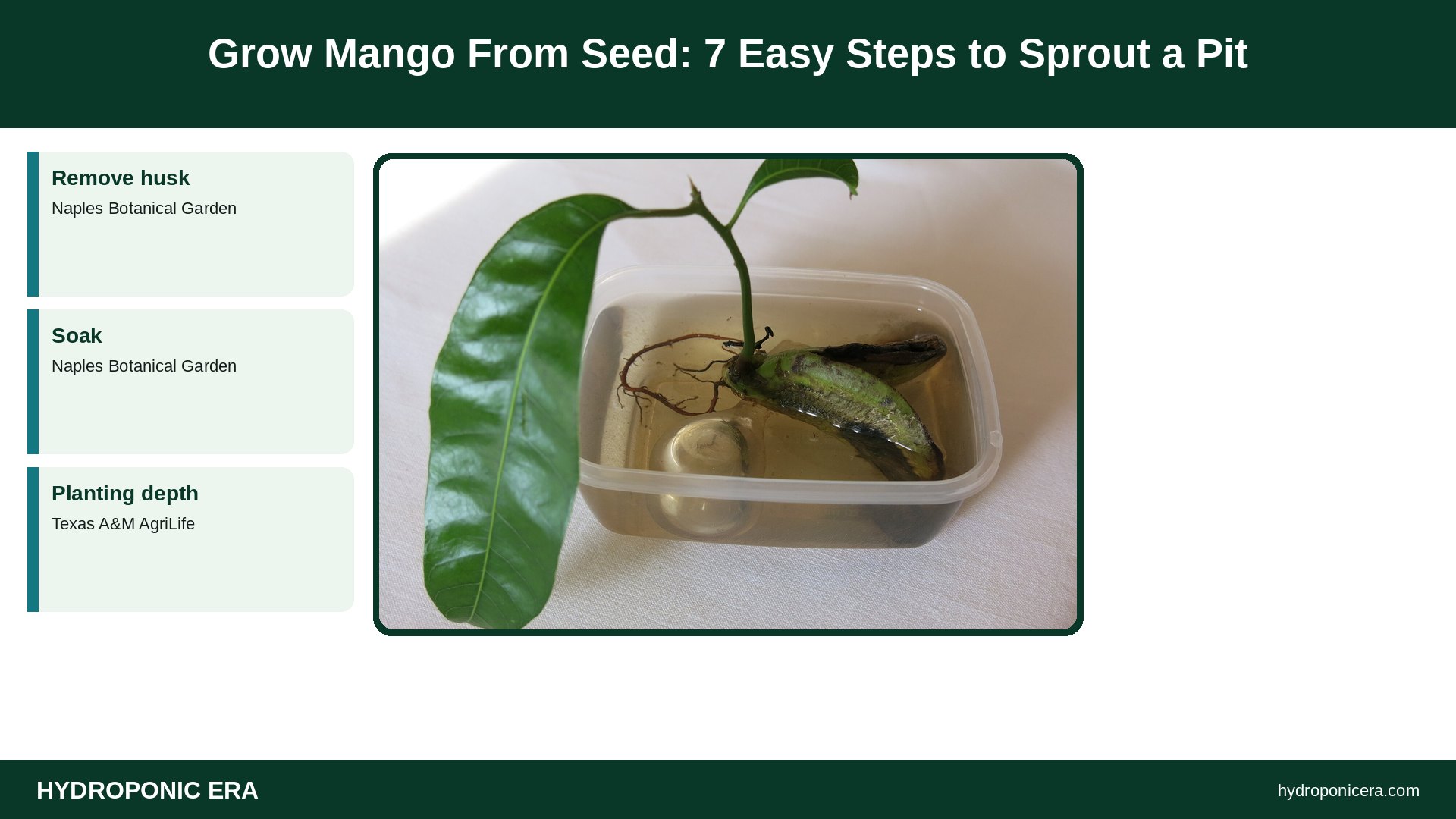
How do you grow mango from seed? To grow mango from seed, cut the woody husk open, remove the seed, soak it 24 hours, and either sprout it in a damp paper towel or plant it concave edge down about 1 in (2.5 cm) deep in potting soil. Germination takes about 2–3 weeks. Polyembryonic varieties usually come true from seed.
Key takeaway: A mango pit from the grocery store can grow into a handsome tree, but young plants are very cold sensitive, and fruit from a seedling is never guaranteed.
| Step or factor | Target | Source |
|---|---|---|
| Remove husk | Cut the edge with strong scissors | Naples Botanical Garden |
| Soak | 24 hours in water | Naples Botanical Garden |
| Planting depth | About 1 in (2.5 cm), concave edge down | Texas A&M AgriLife |
| Germination time | About 2–3 weeks | Texas A&M AgriLife |
| Starter pot | 0.5–1 gallon (2–4 L) | Naples Botanical Garden |
| Cold limit for young trees | Killed at 29–30°F (-1.7 to -1.1°C) | UF/IFAS |
Can You Really Grow Mango From Seed?
Yes, you can grow mango from seed. Seed is a common way to grow mangoes in many parts of the tropics, according to UF/IFAS Extension. Results depend on the seed type. Polyembryonic seeds contain several embryos, and most are genetically identical to the mother tree, so the seedling is usually true to type. Monoembryonic seeds produce a hybrid that will differ from its parent.
Texas A&M AgriLife explains that Indochinese-type mangoes usually have polyembryonic seeds, while Indian types, including many brightly colored commercial fruit, are typically monoembryonic.
How Do You Remove the Husk to Grow Mango From Seed?
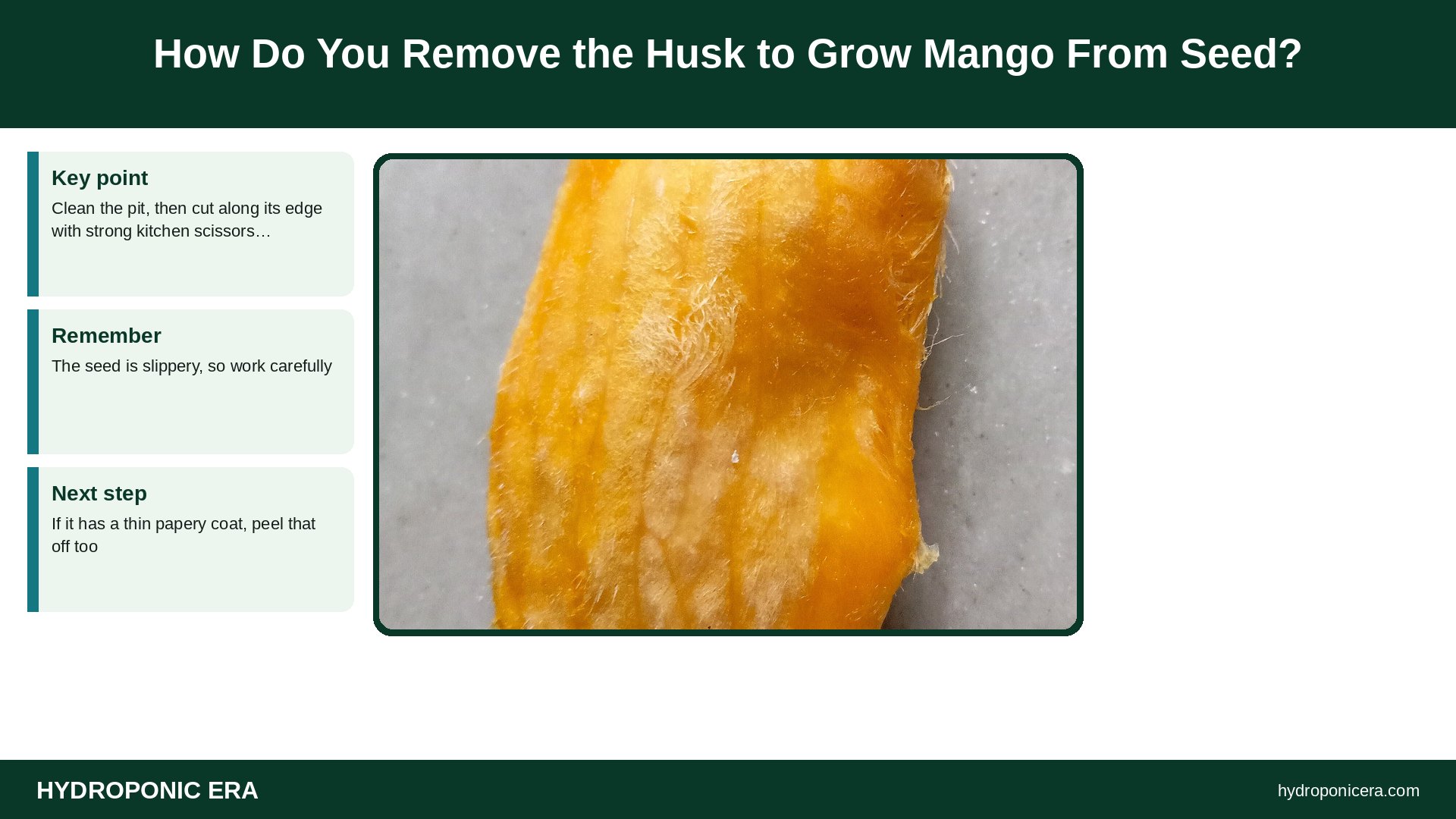
Clean the pit, then cut along its edge with strong kitchen scissors, as Naples Botanical Garden describes, and open the husk to lift out the seed. The seed is slippery, so work carefully. If it has a thin papery coat, peel that off too. Texas A&M AgriLife also advises removing the fibrous stone before planting.
- Eat the mango and scrape off most of the flesh.
- Rinse and dry the husk so you can grip it.
- Snip carefully along the outer edge.
- Pry the husk open and remove the kidney-shaped seed.
- Peel off any papery skin.
Is a Paper Towel or Soil Better to Grow Mango From Seed?
Both methods grow mango from seed well. For the paper towel method, Naples Botanical Garden soaks the seed for 24 hours, wraps it in a damp towel, places it in a sandwich bag and keeps it warm, checking every few days. For direct planting, Texas A&M AgriLife sets the seed concave edge down about 1 in (2.5 cm) deep in good potting soil.
Germination time depends on air temperature and how ripe the fruit was, says Naples Botanical Garden. Texas A&M lists about 2–3 weeks. If you like this kind of kitchen scrap project, try an avocado seed in water next.
What Do You Do When Several Sprouts Appear?
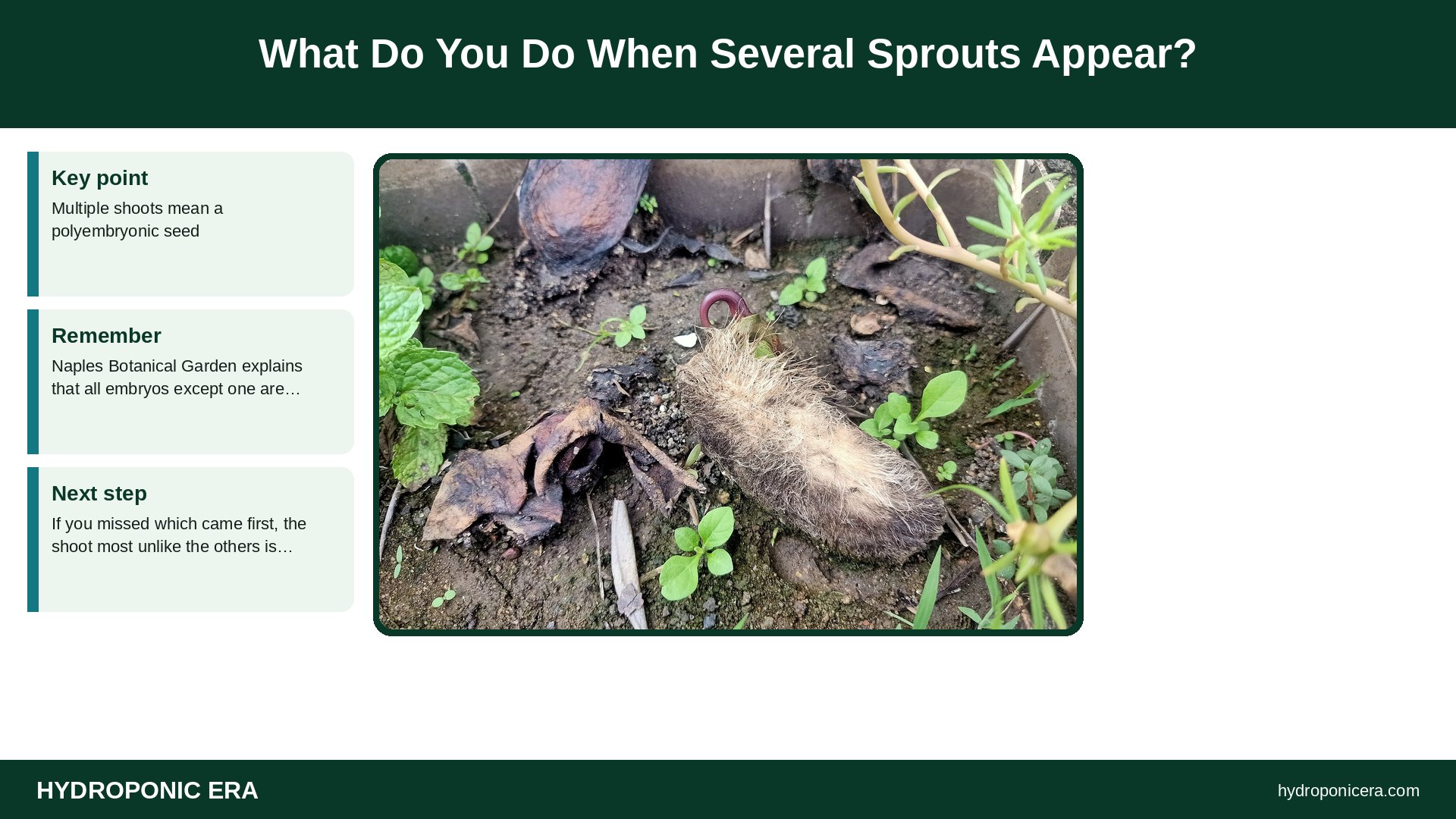
Multiple shoots mean a polyembryonic seed. Naples Botanical Garden explains that all embryos except one are clones of the parent, and the single fertilized seedling usually sprouts first. If you missed which came first, the shoot most unlike the others is probably the non-clone. Remove it for a true-to-type tree, or keep it to try something new.
How Do You Care for a Mango Seedling After It Sprouts?
Pot the sprouted seed without burying the new leaves, then step it up to larger pots as it grows. UF/IFAS says mango trees need full sun for best growth and fruit, and soils with good drainage. Use a fast-draining potting mix and a pot with holes. Texas A&M notes graftable seedlings reach a quarter inch (6 mm) thick in about six months.
- Give the brightest window or strong grow lights.
- Water when the top of the mix starts to dry.
- Keep the plant warm and out of cold drafts.
- Move outdoors in summer only in frost-free weather.
- See our lemon tree guide for similar potted fruit tree care.
How Cold Can a Young Mango Tree Get?
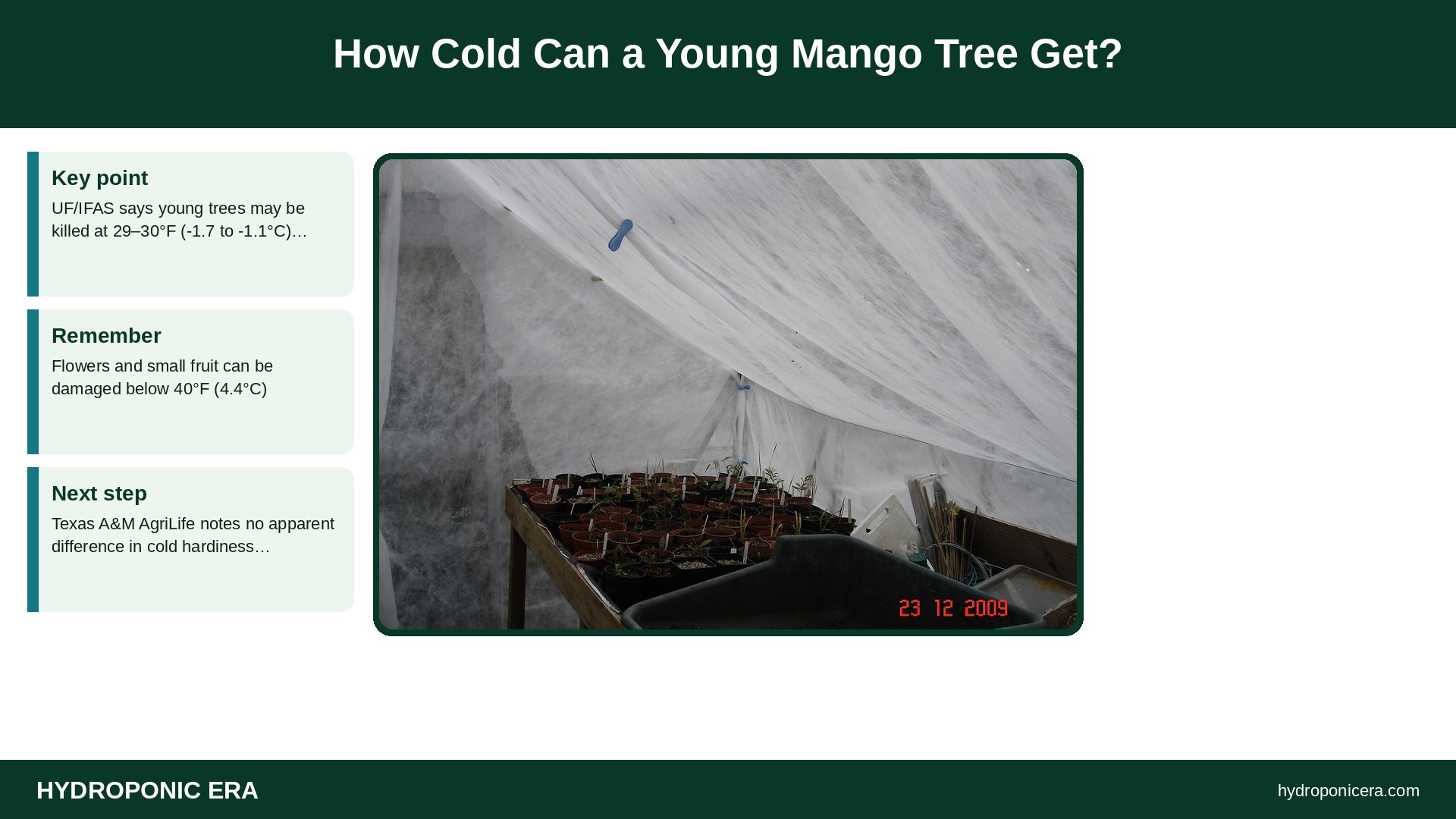
UF/IFAS says young trees may be killed at 29–30°F (-1.7 to -1.1°C), while mature trees survive 25°F (-3.9°C) for a few hours with leaf and twig injury. Flowers and small fruit can be damaged below 40°F (4.4°C). Texas A&M AgriLife notes no apparent difference in cold hardiness among varieties.
Outside the tropics, keep the tree in a container and bring it indoors well before frost. Our dwarf fruit trees guide covers other potted tropicals.
Will a Tree You Grow Mango From Seed Produce Fruit?
It can, but when you grow mango from seed, fruit takes patience. UF/IFAS says grafted mango trees begin to bear 3–5 years after planting, and seedlings of monoembryonic fruit will not match the parent. Treat a pit-grown tree as a long-term project. Texas A&M AgriLife adds that fruit takes 100–150 days from flower to maturity.
For a surer harvest, many growers graft a known variety onto their seedling. Texas A&M lists veneer grafting and chip budding as the most successful methods. A seedling can also make a good rootstock, and UF/IFAS notes most varieties are grafted onto polyembryonic rootstocks.
FAQ About Growing Mangoes From a Pit
Can I grow mango from seed from a store-bought fruit?
Yes, if the seed is fresh and not damaged.
Which way up do I plant a mango seed?
Concave edge down, about 1 in (2.5 cm) deep.
How long does a mango seed take to sprout?
About 2–3 weeks, depending on warmth.
Can a mango tree grow indoors?
Yes as a young plant in strong light, but fruit needs much more sun.
Why did my seed grow several shoots?
It is polyembryonic; most shoots are clones of the parent.
Sources
- UF/IFAS Extension — Mango Growing in the Florida Home Landscape (MG216)
- Texas A&M AgriLife Extension — Mango Fact Sheet
- Naples Botanical Garden — Planting a Mango Seed
- Photo credits (Wikimedia Commons, edited with titles): Mango indica seedling D150418 by Tangopaso (Public domain); ‘Chaunsa’ mango stone (seed) by Salil Kumar Mukherjee (CC BY-SA 4.0); Germination of mango tree in a tray by Suyash.dwivedi (CC BY-SA 4.0); Fleece lined greenhouse potting tray and seed pots – Flickr – peganum by peganum from Small Dole, England (CC BY-SA 2.0)
1 thought on “Grow Mango From Seed: 7 Easy Steps to Sprout a Pit”