
A hydroponic lemon tree is possible: grow a dwarf lemon, usually a Meyer, in a large container of well-drained soilless media such as coco and perlite, fed by drip or careful hand watering with a dilute, complete nutrient. It needs at least 6 hours of direct sun (8–12 is better), 65–75°F days and protection below 32°F. Before you buy or move a tree, know the law: citrus quarantines in states such as Florida, California, Texas and Arizona restrict moving citrus plants. Buy from a licensed local nursery and never ship or carry citrus across state lines without checking.
| Need | Target | Source |
|---|---|---|
| Light | 6+ hours direct sun; 8–12 preferred; LED if indoors | UMD Extension |
| Temperature | 65–75°F day, 55–65°F night; damage below 32°F | UMD Extension |
| Humidity | About 50% RH | UMD Extension |
| Container | Start at 5 gallons; move up to 15 and 25 | OSU Extension |
| Fertilizer ratio | Nitrogen-heavy, such as 2-1-1 or 3-1-1 | UMD Extension |
| Pollination | Hand-pollinate indoors | UMD Extension |

Legal First: Citrus Quarantines and Your Hydroponic Lemon Tree
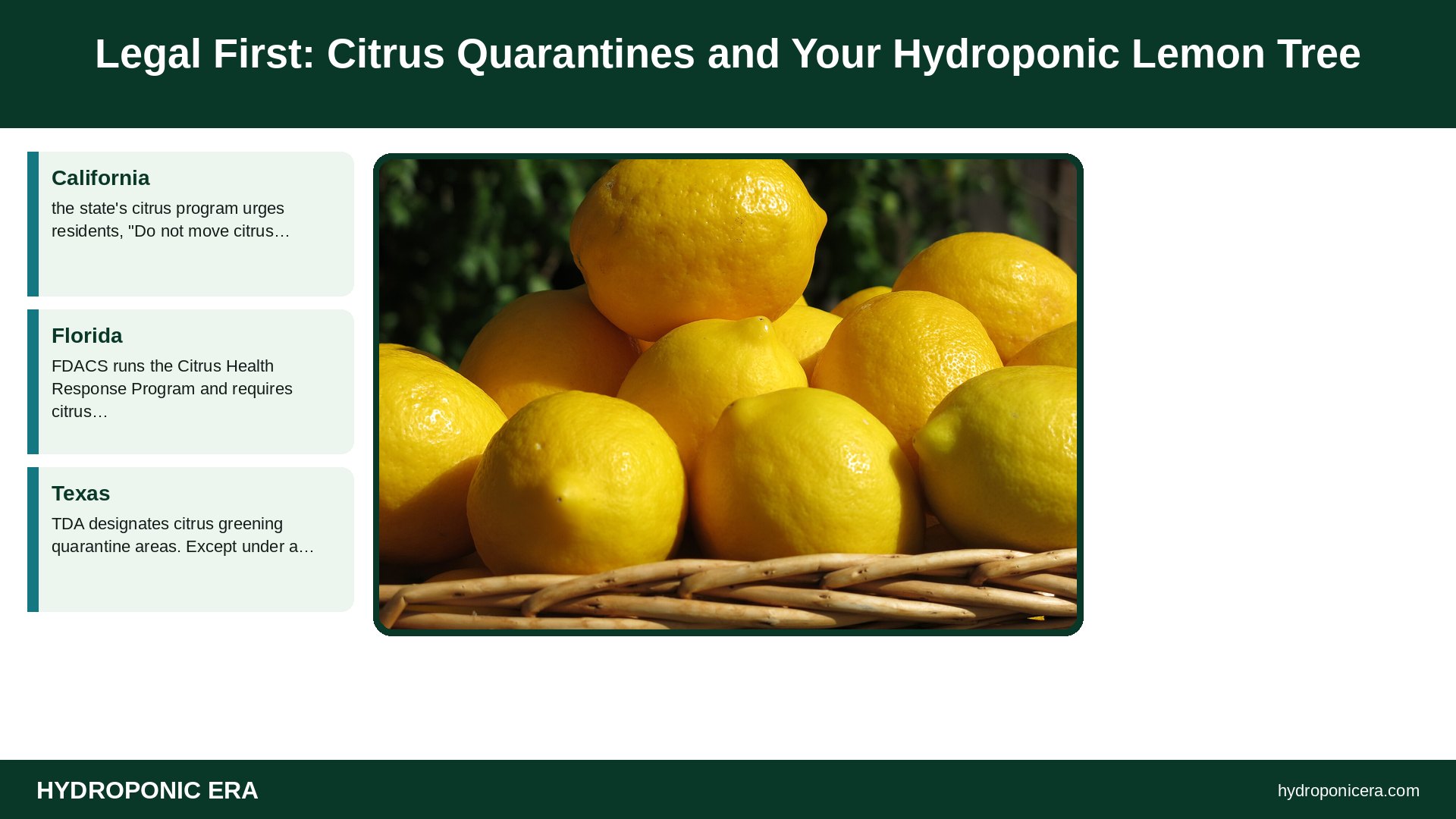
Citrus greening (huanglongbing, or HLB) is an incurable bacterial disease spread by the Asian citrus psyllid, according to UF/IFAS Extension. To slow it and other citrus diseases, several states regulate how citrus plants move. Rules change, so check with your state department of agriculture before buying, moving or shipping a tree. This is general information, not legal advice.
- California: the state’s citrus program urges residents, “Do not move citrus plants, foliage or fruit into or out of your area, and especially across state or international borders,” and to buy from “a reputable, licensed nursery in your local area.” CDFA maintains ACP and HLB quarantine boundaries.
- Florida: FDACS runs the Citrus Health Response Program and requires citrus greening host plants to be produced in approved structures that exclude the psyllid.
- Texas: TDA designates citrus greening quarantine areas. Except under a compliance agreement or permit, no citrus nursery trees inside a quarantined area may be moved, and none may be moved in from outside.
- Arizona: Arizona’s rule on citrus nursery stock treats every other US state as a quarantine area and requires certification for shipments. It also states that a person “shall not ship a Meyer lemon plant or plant part, except fruit, into Arizona,” with an exception for the ‘Improved Meyer’ selection.
Getting the source right is the most important step for any hydroponic lemon tree. UF/IFAS advises buying from a certified nursery; certified trees carry a tag with the nursery name, registration number, variety and rootstock.
Why a Hydroponic Lemon Tree Is Different From Lettuce
A lemon is a woody perennial. UMD Extension notes a young citrus plant “may not bear fruit until after a few years of growth,” and some varieties take six to nine months to ripen fruit. Dwarf citrus grafted onto cold-hardy rootstock can be kept as 3- to 6-foot houseplants. That’s still a big plant for a grow tent, so plan for a sunny room, greenhouse or patio.
Citrus roots also dislike sitting wet, which shapes how you build a hydroponic lemon tree setup. UMD says citrus likes “consistent moisture but not waterlogged soil.” That rules out deep water culture and points to drained containers of soilless media.
How to Grow a Hydroponic Lemon Tree: 8 Steps
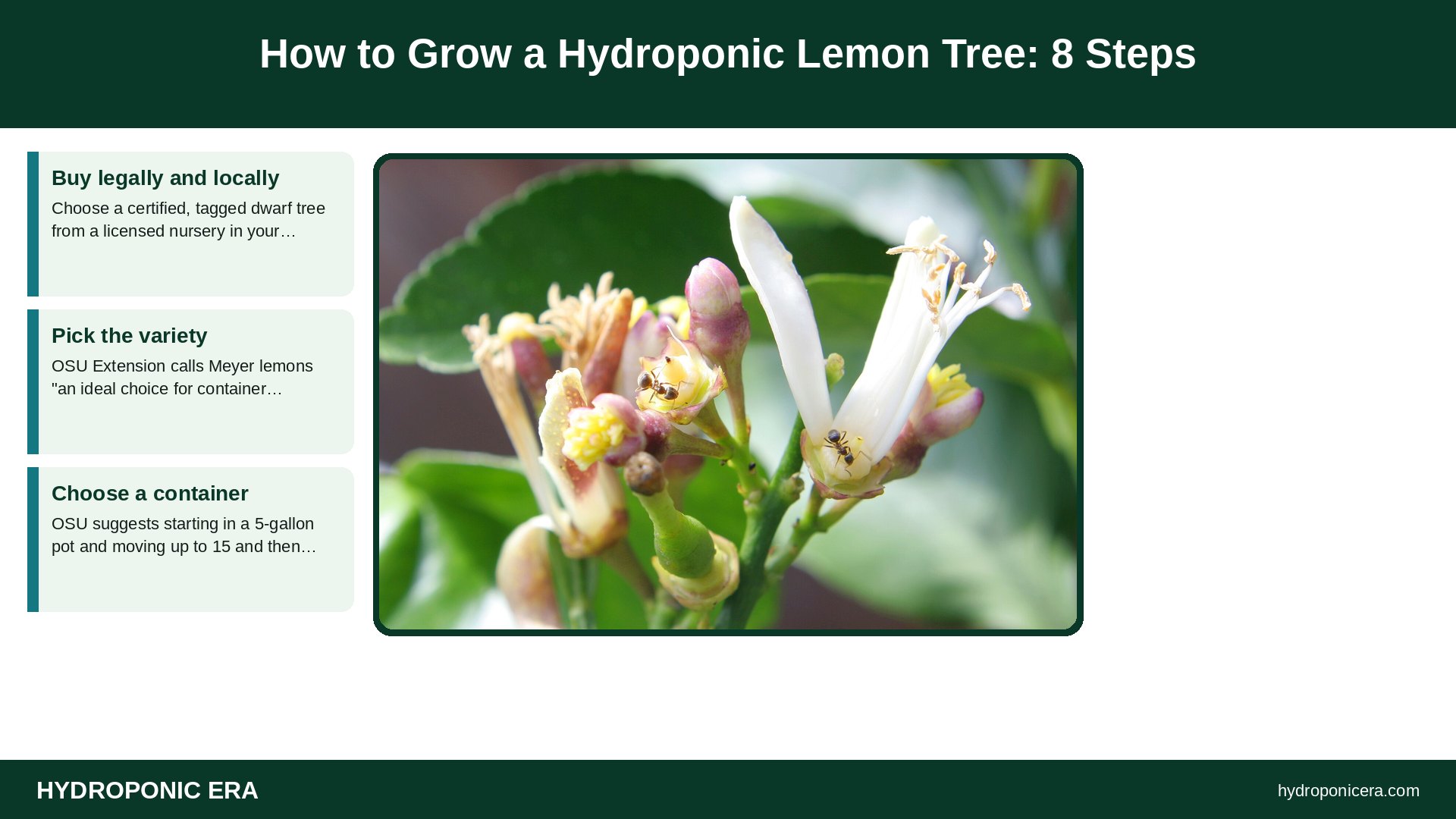
- Buy legally and locally. Choose a certified, tagged dwarf tree from a licensed nursery in your state.
- Pick the variety. OSU Extension calls Meyer lemons “an ideal choice for container gardening” and the easiest to find. It’s a lemon–mandarin hybrid, hardy outdoors only in zones 9–10.
- Choose a container. OSU suggests starting in a 5-gallon pot and moving up to 15 and then 25 gallons. Make sure it drains freely.
- Fill with soilless media. Coco coir with perlite drains well. See our growing media guide.
- Water by drip or by hand, drain-to-waste. Apply nutrient solution until a little runs out, and empty the saucer. UMD warns plants “should not sit in standing water.”
- Feed a dilute, complete nutrient. UMD recommends nitrogen-heavy ratios like 2-1-1 or 3-1-1 for potted citrus. Commercial “open hydroponics” trials in Florida kept solution nitrogen near 100–150 ppm, according to UF/IFAS scientist Arnold Schumann. Monitor runoff EC; see our runoff EC guide.
- Give strong light. At least 6 hours of direct sun; a south window plus an LED grow light in winter. See our grow light guide.
- Hand-pollinate indoors. Use a small brush to move pollen between open flowers.
Commercial Citrus and “Open Hydroponics”: Lessons for a Hydroponic Lemon Tree
Florida growers facing HLB have tested advanced citrus production systems (ACPS). Growing Produce reports these combine “elements of open hydroponics or intensive fertigation,” high planting density and compact rootstocks. One grower described daily dilute fertigation that keeps the root ball near field capacity. These are research and commercial systems in soil beds, not a home recipe, but they show citrus responds to frequent, dilute feeding.
Seasonal Care for a Hydroponic Lemon Tree
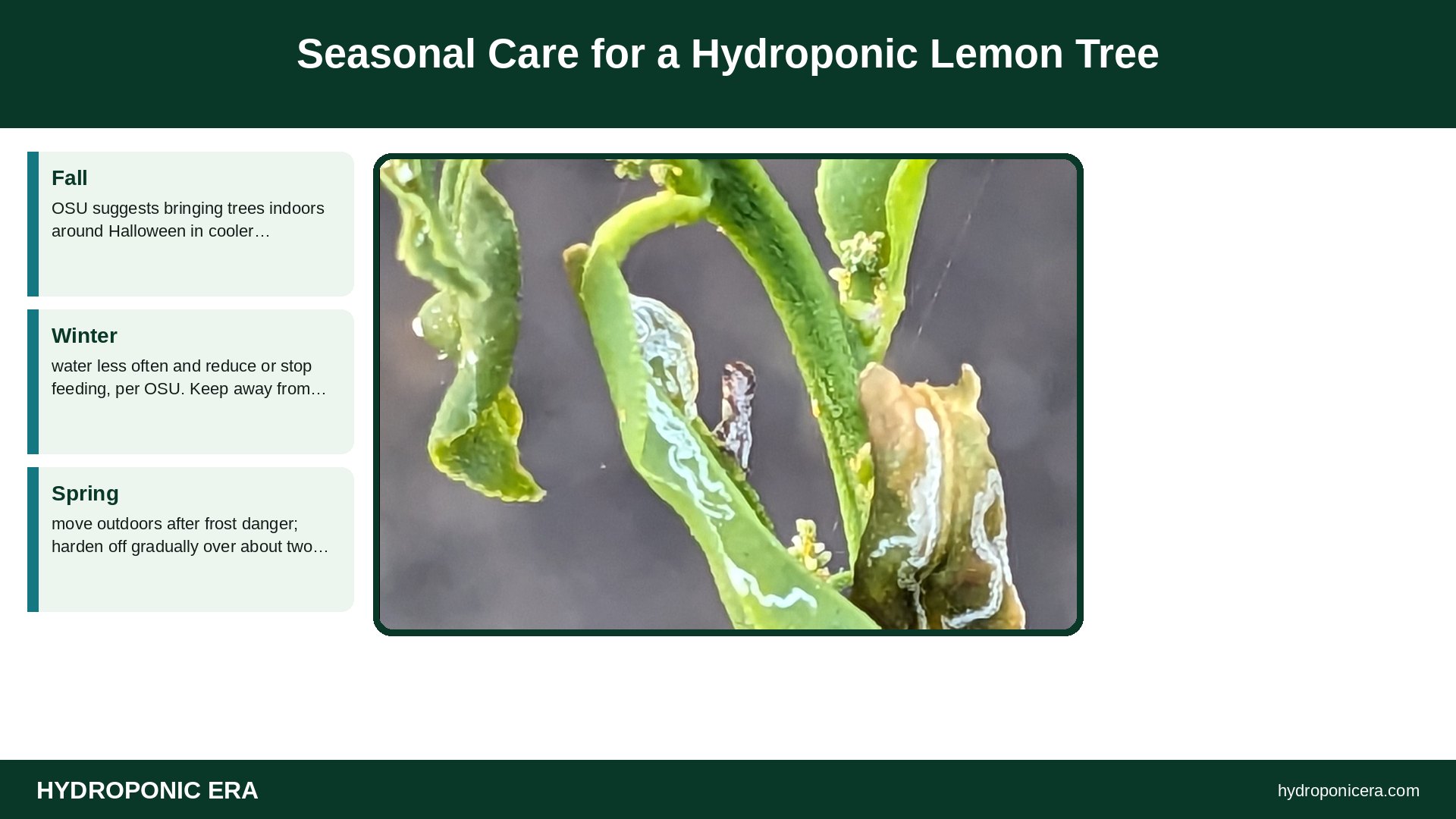
- Fall: OSU suggests bringing trees indoors around Halloween in cooler regions, before frost.
- Winter: water less often and reduce or stop feeding, per OSU. Keep away from heat vents.
- Spring: move outdoors after frost danger; harden off gradually over about two weeks (UMD).
- Summer: outdoor containers may need daily watering. Feed through late summer.
Troubleshooting a Hydroponic Lemon Tree
| Symptom | Likely cause | Fix |
|---|---|---|
| Lots of small fruit dropping | Normal thinning; UMD says up to 75% may fall | Be patient; avoid temperature swings |
| Leaf drop | Too much or too little water, cool nights, swings (OSU) | Check media moisture and drainage |
| Yellow new leaves | Iron or nitrogen shortage, or high pH | Check pH and nutrient strength; see our iron guide |
| Sticky leaves, curled new growth | Sap-feeding pests | Inspect closely; in quarantine areas, report suspected psyllids to your state |
| Fungus gnats | Constantly wet surface | Let the surface dry between waterings |
Is a Hydroponic Lemon Tree Worth It?
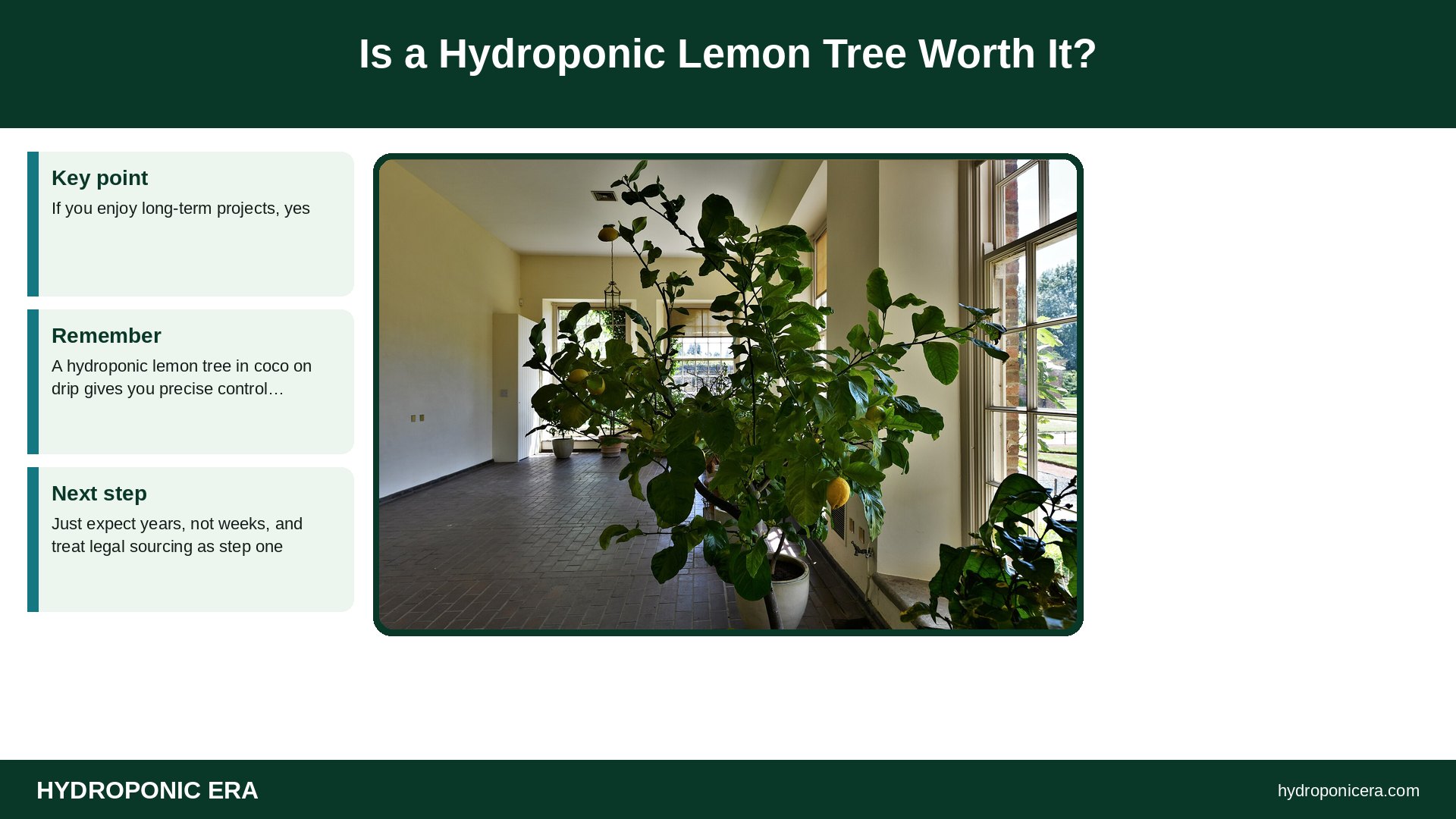
If you enjoy long-term projects, yes. A hydroponic lemon tree in coco on drip gives you precise control over feeding and drainage. Just expect years, not weeks, and treat legal sourcing as step one. If you want faster citrus flavor, our lemon balm and lemongrass guides are quick alternatives.
FAQs: Hydroponic Lemon Tree
Can you grow a hydroponic lemon tree indoors?
Yes, with a dwarf variety, a large drained container, 6+ hours of direct light or a strong LED, and hand pollination.
Can I order a lemon tree online?
Check your state’s rules first. Some states restrict citrus shipments; Arizona prohibits shipping Meyer lemon plants in, except ‘Improved Meyer.’
How long until a hydroponic lemon tree fruits?
Young trees may take a few years, and fruit can take six to nine months to ripen (UMD).
Can I grow a lemon tree from seed hydroponically?
Seedlings can take many years to fruit and may not match the parent. A grafted dwarf tree is faster.
Related HydroponicEra Guides
- Quarantine new plants and clones
- Indoor pollination
- Coco coir hydroponics
- How to grow blueberries hydroponically
Sources
- University of Maryland Extension — Growing Citrus Plants Indoors
- Oregon State University Extension — How to grow Meyer lemons successfully in the Pacific Northwest
- UF/IFAS Extension EDIS — PP336: Citrus Tree Care for the Home Gardener in the HLB Era (PDF)
- Growing Produce — Push Early Yield With Advanced Citrus Production Systems
- California Citrus Threat (CDFA program) — Protect Your Citrus
- CDFA — Citrus Pest and Disease Prevention Division
- FDACS — Citrus Health Response Program
- Texas Department of Agriculture — Citrus Greening Quarantine
- Arizona Administrative Code via Cornell LII — R3-4-220 Citrus Nursery Stock Pests
- Photo credits (Wikimedia Commons, edited with titles): Tredegar House, The Orangery, Potted lemon tree – geograph.org.uk – 6890072 by Michael Garlick (CC BY-SA 2.0); Meyers Zitrone (Citrus × meyeri) 1 by Burkhard Mücke (CC BY-SA 4.0); Lemon tree flowers with ant by (CC BY-SA 3.0); Asian citrus psyllid (Diaphorina citri) on Citrus × aurantiifolia by Chaetodipus (CC BY-SA 4.0)
1 thought on “Hydroponic Lemon Tree: Growing Citrus Without Soil”