
You can grow raspberries hydroponically, but it’s a long-term project, not a quick countertop crop. Raspberries have a perennial root system with biennial canes, they want full sun and good drainage, and many types need winter chilling to fruit. Commercial growers succeed with “long-cane” plants in coco coir or bark-filled pots under high tunnels, fed by drip. At home, the most realistic route is a compact or everbearing variety in a large container of soilless mix on drain-to-waste drip, outdoors or in a greenhouse.
| Question | Honest answer |
|---|---|
| Can it be done? | Yes. Commercial long-cane production uses soilless substrate in pots |
| Is it easy indoors? | No. Light, plant size, chilling and pollination are hard to provide |
| Best system | Drip-fed containers of coco coir or similar (not deep water culture) |
| Best plant type | Everbearing (primocane-fruiting) or a compact patio variety |
| Time to fruit | Months, not weeks; depends on cultivar and plant stock |

Why Raspberries Are Hard in Hydroponics

Oregon State University Extension explains that raspberry plants “have a perennial root system and crown,” but “the canes are biennial.” A first-year cane (primocane) usually doesn’t fruit, unless the variety is everbearing. A second-year cane (floricane) fruits and then dies. Red raspberry plants can live 10 to 15 years.
That growth cycle means you’re managing a small shrub for years. Raspberries also want full sun, are sensitive to wet roots and are susceptible to root rot, according to OSU. Most summer-bearing types also need enough winter cold to fruit well, which a heated room doesn’t provide.
How Commercial Growers Grow Raspberries Hydroponically
NC State University researchers study “long-cane” raspberry production, a soilless system used where raspberries aren’t normally grown commercially. As NC State describes it:
- Plants are grown for their first year in a nursery in a cool climate and trained as two long canes.
- Canes are shipped to the grower in winter and set out in pots in high tunnels.
- Tunnels push early growth so growers harvest in spring, before summer heat hurts berry size and quality.
- Containers with soilless substrate let growers avoid soil-borne diseases and control the root zone and fertility.
In an Acta Horticulturae study, NC State’s team grew ‘Kwanzaa’ long canes from a Canadian nursery, held in cold storage and planted in January in high tunnels. Coco coir is the industry standard substrate, and they evaluated pine bark as a local alternative. Fertility was managed by daily monitoring of input and output EC and percent drainage.
How to Grow Raspberries Hydroponically at Home: 7 Steps

- Pick the right type. Choose an everbearing (primocane-fruiting) cultivar, or a compact patio variety such as Raspberry Shortcake, which its breeder lists as thornless, 2–3 feet tall, zones 4–9 and 800 chill hours.
- Use a big container. A 5- to 10-gallon pot or grow bag with excellent drainage gives roots room.
- Fill with soilless media. Buffered coco coir, or coco with perlite, mirrors commercial practice. See our coco coir guide.
- Set up drip, drain-to-waste. Small, frequent feedings with runoff keep roots moist but not soggy. See our recirculating vs drain-to-waste guide.
- Monitor EC and drainage. Like the NC State researchers, check input and runoff EC. Our runoff EC guide explains how.
- Give full sun. Outdoors, a sunny patio is ideal. A greenhouse or high tunnel is better still.
- Support and prune canes. Remove floricanes after they fruit. Everbearing types can be managed for a fall crop on new canes.
Can You Grow Raspberries Hydroponically Indoors?
It’s possible but difficult, and we’d call any attempt to grow raspberries hydroponically indoors an experiment. Indoors you’ll fight four problems:
- Light: a fruiting cane crop needs far more light than lettuce. See our PPFD and DLI guide.
- Size: even compact plants spread 2–3 feet.
- Chilling: varieties with chill-hour needs require a cold dormant period.
- Pollination: outdoors, bees do the work. Indoors, you’ll need to help; see our indoor pollination guide.
If you want berries from a small indoor system, hydroponic strawberries are a much easier start.
Best Systems to Grow Raspberries Hydroponically
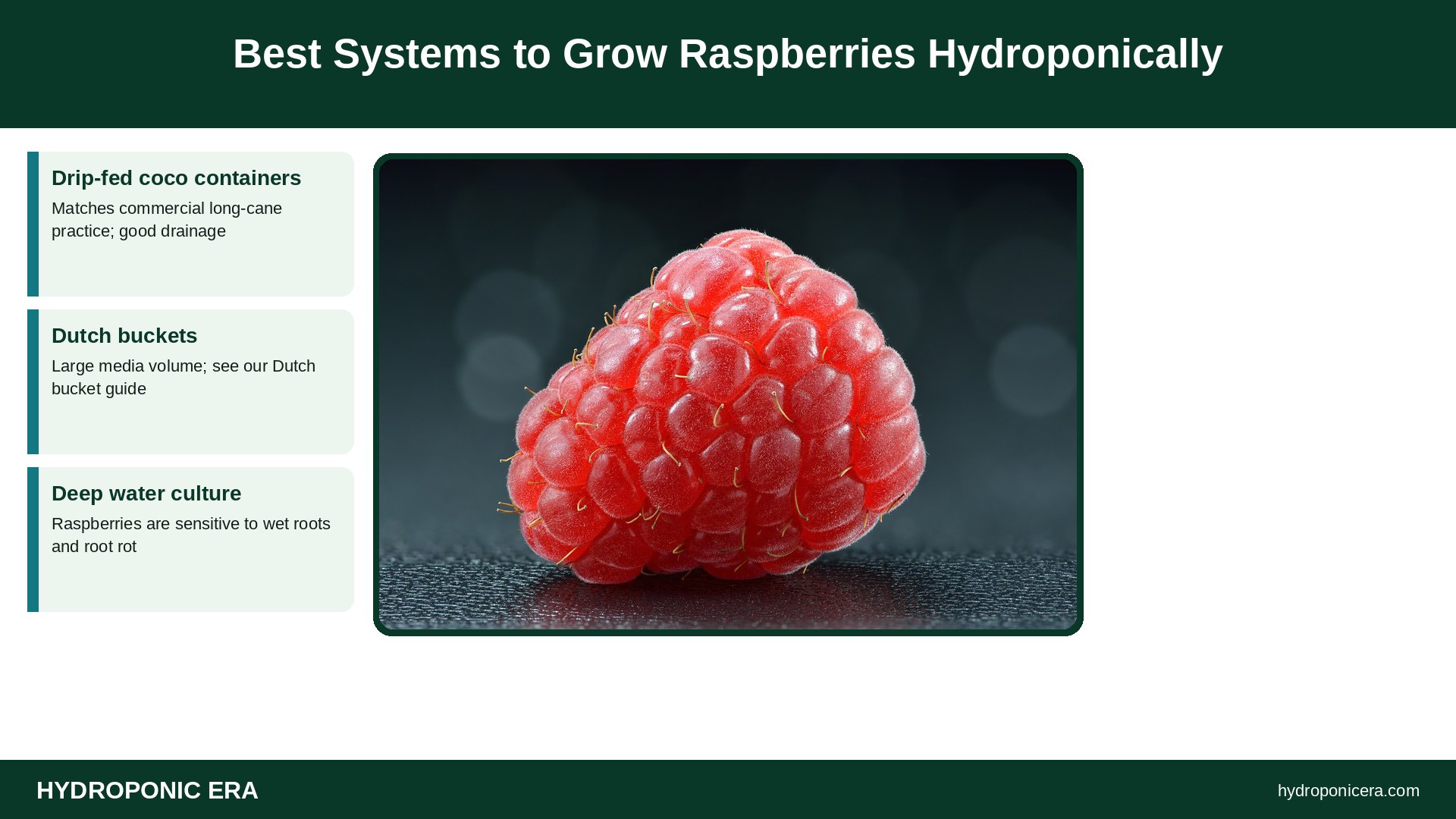
| System | Fit for raspberries | Why |
|---|---|---|
| Drip-fed coco containers | Best | Matches commercial long-cane practice; good drainage |
| Dutch buckets | Good | Large media volume; see our Dutch bucket guide |
| Deep water culture | Poor | Raspberries are sensitive to wet roots and root rot |
| NFT channels | Poor | Too small for a woody, multi-year root system |
Tunnels Help, Even for Home Growers
NC State Extension’s caneberry guide reports that in North Carolina and Arkansas studies, primocane-fruiting raspberries in tunnels yielded 30% or more above field-grown plants, depending on location and conditions. Tunnels also reduce moisture on foliage and disease, and can extend the season into fall. A small hoop house over potted plants applies the same idea at home. Results vary, so treat this as a direction, not a promise.
A Realistic First-Year Plan
If you want to grow raspberries hydroponically for the first time, keep the scope small and the expectations honest:
- Spring: buy one or two healthy plants from a nursery and pot them into coco on a simple drip timer.
- Summer: focus on roots and canes. Watch runoff EC and keep the media from staying soggy.
- Fall: everbearing types may give a small crop on new canes.
- Winter: let chill-requiring varieties go dormant in a sheltered, cold spot rather than a warm living room.
Treat year one as practice. Many growers who grow raspberries hydroponically find the second season is when the system and the plants settle in.
Common Mistakes When You Grow Raspberries Hydroponically

- Expecting fruit in a few weeks, like leafy greens.
- Using deep water culture for a crop that hates wet roots.
- Growing a high-chill summer-bearing variety in a warm room.
- Undersizing the container.
- Skipping runoff checks, so salts build up in the media.
FAQs: Grow Raspberries Hydroponically
How long until hydroponic raspberries fruit?
It depends on the plant stock. Commercial long canes are planted in winter and harvested in spring. Young plants from a nursery usually take longer.
What media is best to grow raspberries hydroponically?
Coco coir is the commercial standard for long-cane production, and NC State has tested pine bark as an alternative.
Can I grow raspberries hydroponically in a Kratky jar?
No. The plant is too large and long-lived, and it doesn’t tolerate constantly wet roots.
Do hydroponic raspberries need a dormant period?
Many varieties need winter chilling to fruit well. Check the cultivar’s chill-hour rating.
Related HydroponicEra Guides
- How to grow blueberries hydroponically
- Plants that struggle in home hydroponics
- Hydroponic greenhouse for beginners
- Hydroponic trellising and pruning
Sources
- Oregon State University Extension — Growing Raspberries in Your Home Garden (EC 1306)
- NC State Horticultural Science — Lisa Rayburn: Long-Cane Raspberry Production with Pine Bark Alternative
- Rayburn et al. (2024), Acta Horticulturae 1388 — Pine bark as an alternative to coco coir for substrate production of long-cane raspberry
- NC State Extension — Southeast Regional Caneberry Production Guide: Tunnel Production
- Bushel and Berry — Raspberry Shortcake
- Photo credits (Wikimedia Commons, edited with titles): Raspberry – whole (Rubus idaeus) by Ivar Leidus (CC BY-SA 4.0); Raspberry canes Easton Lodge Gardens walled garden 01 by Acabashi (CC BY-SA 4.0); Oregon High Tunnel, NRCS EQIP (20260611-NRCS-KLS-0001) by USDAgov (Public domain); 366 Highbush Blueberry – Vaccinium corymbosum, Leesylvania State Park, Woodbridge, Virginia by Judy Gallagher (CC BY 2.0)