
Hydroponic grapes are experimental, not a proven home crop. The most advanced work comes from Australia’s CSIRO, where researchers grew dwarf table-grape “microvines” in coco coir bags under LED light and harvested first fruit 145 days after transplanting. Microvines have mostly been research plants. Regular grapevines are large, long-lived woody vines that usually need winter chilling, so at home the realistic approach is a container vine in soilless media on drip, grown outdoors or in a greenhouse. Treat any attempt as a trial, with no yield guarantees.
| Question | Honest answer |
|---|---|
| Has it been done? | Yes, in research (CSIRO microvines in LED-lit hydroponics) |
| Can I buy microvines? | They’ve mostly been used as research plants, not home products |
| Can regular vines grow in soilless media? | Yes, in large drip-fed containers, but they need space, sun and usually chilling |
| Chilling need | From about 250 hours (non-hardy V. vinifera) up to 1,000+ for many temperate fruit crops (UMN) |
| Best system | Drain-to-waste drip in coco coir bags or Dutch buckets |
| Yield expectations | Unproven for home systems; plan for learning, not harvest targets |

The Research: Hydroponic Grapes Under LEDs
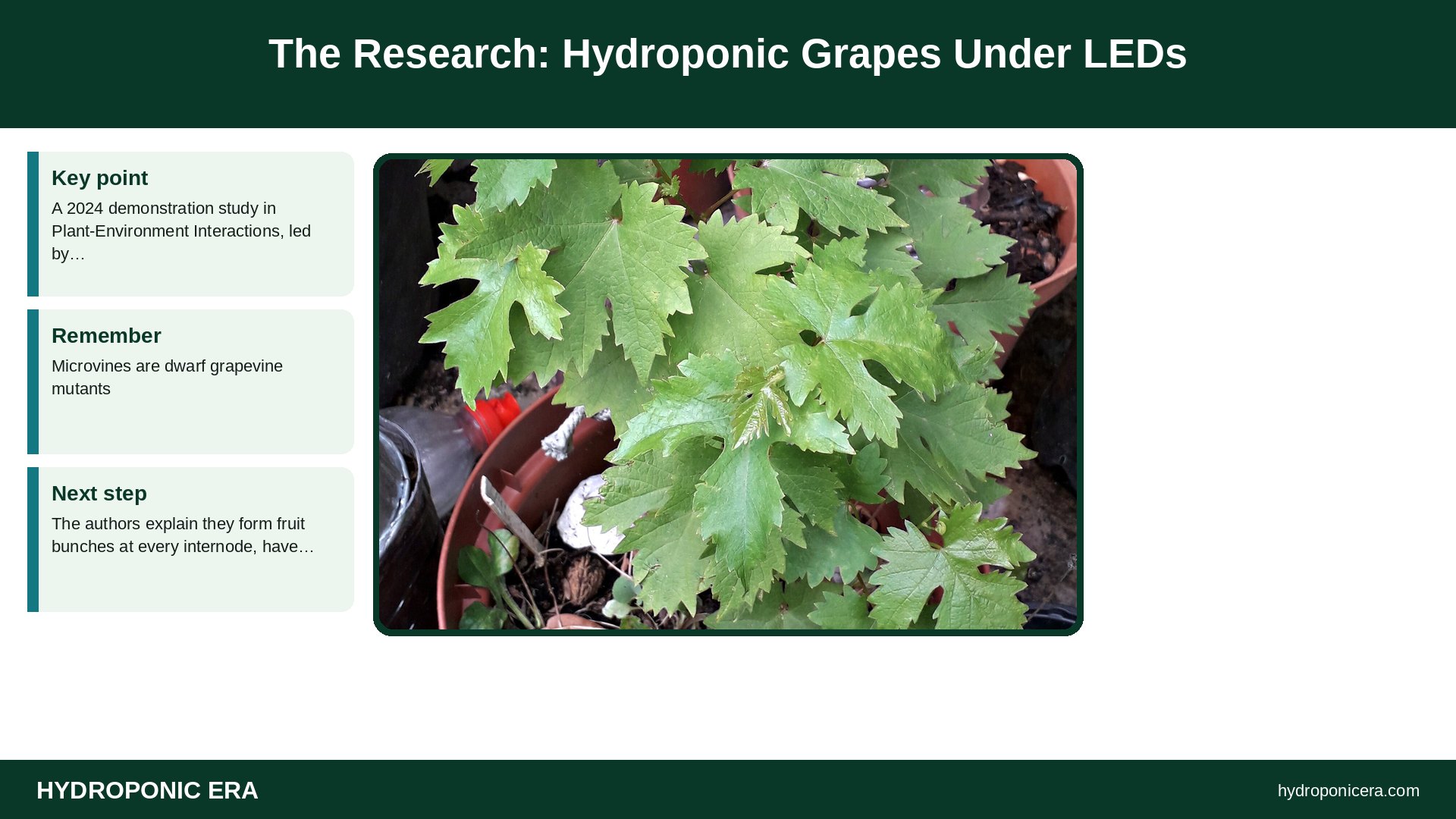
A 2024 demonstration study in Plant-Environment Interactions, led by researchers at CSIRO and the University of Queensland, tested table-grape microvines in a fully indoor, LED-lit controlled environment. Microvines are dwarf grapevine mutants. The authors explain they form fruit bunches at every internode, have a short juvenile phase, and flower and fruit continuously once flowering starts.
Key findings:
- Cuttings rooted under misting, then were transplanted into 8-liter coco coir bags with drip fertigation.
- Establishment after transplanting to hydroponics was 100%.
- The crop cycle was 208 days from planting to first harvest: 63 days of plantlet production and 145 days from transplant to first harvest.
- Vines flowered after an average of 33.9 days, and berries began ripening (veraison) after about 116 days.
- Fruit exceeded the minimum sugar content (total soluble solids) required for the Australian market.
The authors also noted that sprouting frequency needs further research before commercial production. It’s a promising demonstration, not a ready-made system.
Microvines vs Standard Grapevines
| Trait | Microvine (research) | Standard vine |
|---|---|---|
| Plant size | Dwarf | Large, vigorous vine |
| Where fruit forms | At every internode (per the CSIRO authors) | On fruiting shoots after pruning |
| Flowering | Continuous after onset | Seasonal, once per year |
| Dormancy needs | Grown continuously indoors in the study | Most need winter chilling |
| Availability | Mainly research and breeding | Widely sold by nurseries |
This comparison explains why hydroponic grapes in a vertical farm may one day be practical, while a standard backyard vine in a basement tent is not.
Why Regular Hydroponic Grapes Are Hard at Home
- Size: standard vines are vigorous and need training on a trellis. See our trellising guide.
- Dormancy: University of Minnesota Extension defines chilling hours as time between 32°F and 45°F. Non-hardy V. vinifera varieties may need as few as about 250 hours, while many temperate fruit crops need 1,000 or more.
- Light: grapes are full-sun crops. UT Extension advises full sun for productivity and plant health.
- Disease: UT notes European V. vinifera grapes are susceptible to disease and pests and have low yield potential for Tennessee home growers, while American and French-American hybrids are better suited there.
- Time: a woody vine is a multi-year project.
How to Try Hydroponic Grapes: 7 Steps
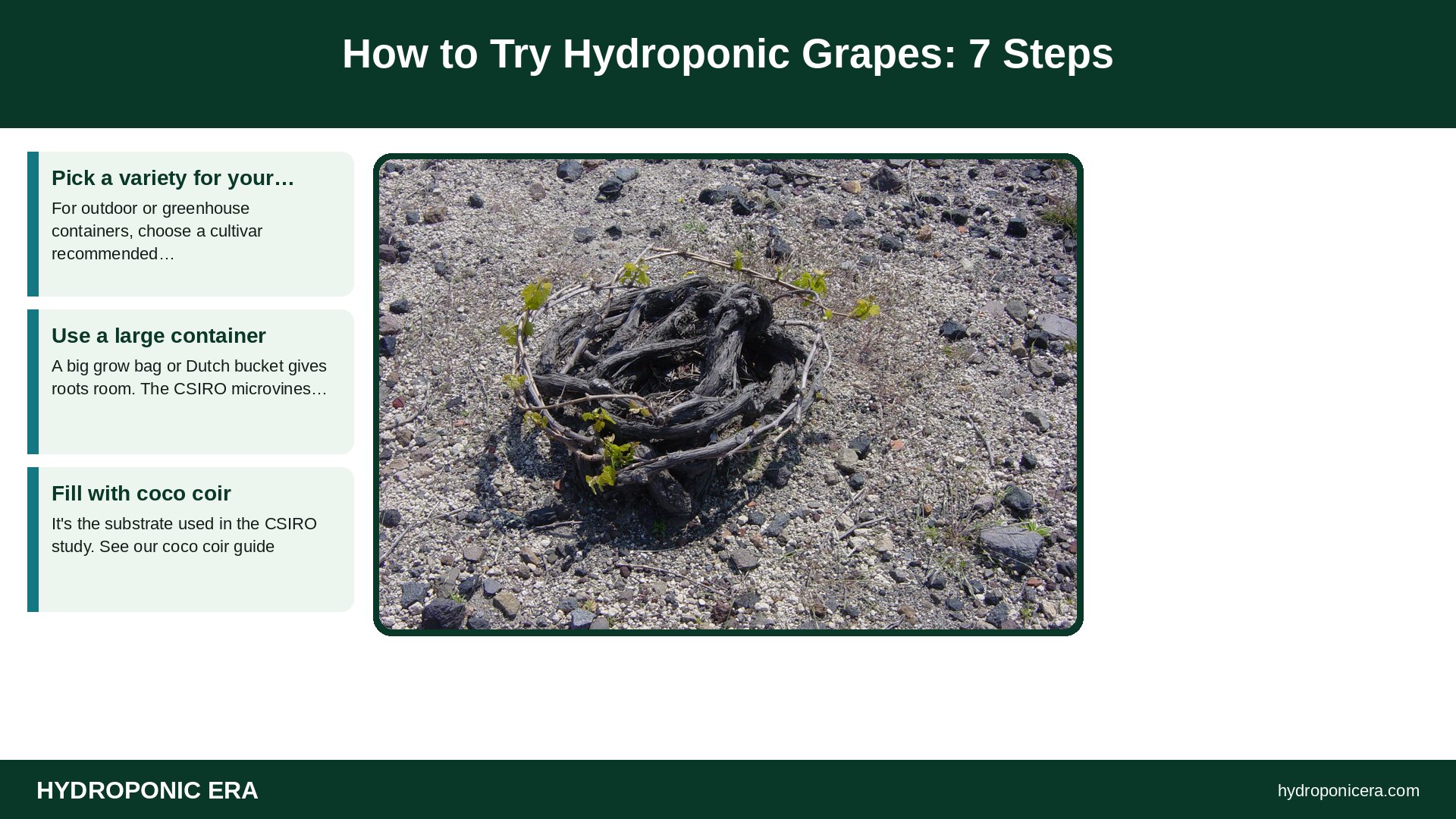
- Pick a variety for your climate. For outdoor or greenhouse containers, choose a cultivar recommended by your state extension service. UT lists four US grape types: European (V. vinifera), American, French-American hybrids and muscadines.
- Use a large container. A big grow bag or Dutch bucket gives roots room. The CSIRO microvines used 8-liter (about 2-gallon) bags, but standard vines are far larger.
- Fill with coco coir. It’s the substrate used in the CSIRO study. See our coco coir guide.
- Run drip, drain-to-waste. Small, frequent feedings with runoff. See our drain-to-waste guide.
- Feed gently and monitor. In the study, established plantlets were fed at EC 0.6–1.2 mS/cm and pH 5.8–6.0. Use that as a reference point, not a recipe, and check runoff EC.
- Provide full sun or strong supplemental light. See our PPFD and DLI guide.
- Plan for dormancy. Let chill-requiring vines go dormant in a cold, protected spot in winter.
Hydroponic Grapes Systems Compared
| System | Fit for grapes | Why |
|---|---|---|
| Coco bags with drip | Best | Used in CSIRO research; good drainage |
| Dutch buckets | Good | Large media volume; easy to trellis; see our Dutch bucket guide |
| Deep water culture | Poor | Woody, long-lived roots and a big canopy |
| NFT | Poor | Channels too small for a multi-year vine |
What to Expect From Hydroponic Grapes
We won’t promise yields, because there isn’t solid data for home hydroponic grapes. Expect the first season to be about establishing roots and a trellis framework. Fruit may come in later seasons, depending on variety, light, chilling and care. Keep notes on EC, pH, light and pruning so each season improves on the last.
If you want faster results from a fruiting perennial, hydroponic strawberries are far easier, and our hydroponic blueberries guide covers another woody fruit in containers.
Common Mistakes With Hydroponic Grapes
- Expecting lettuce-speed results from a woody vine.
- Growing a high-chill variety in a warm room with no dormancy.
- Using a small, recirculating system for a large vine.
- Skipping pruning and training, so the vine sprawls.
- Buying seed-grown vines; named cultivars are propagated from cuttings or grafts for predictable fruit.
FAQs: Hydroponic Grapes
Can you grow hydroponic grapes indoors?
Researchers have, using dwarf microvines under LEDs. With standard vines at home, it’s very difficult because of size, light and dormancy needs.
How long do hydroponic grapes take to fruit?
In the CSIRO microvine study, first harvest came 145 days after transplanting. Standard vines usually take longer, and there’s no reliable home benchmark.
What media is best for hydroponic grapes?
Coco coir, as used in the CSIRO research, in a large drip-fed container.
Do hydroponic grapes need a winter?
Many varieties need chilling hours (32–45°F) to break dormancy well. Microvines were grown continuously indoors in the study, but those are specialized research plants.
Related HydroponicEra Guides
- How to grow raspberries hydroponically
- Hydroponic lemon tree
- Plants that struggle in home hydroponics
- Vertical farming for beginners
Sources
- Malai et al. (2024), Plant-Environment Interactions — Propagation, Establishment, and Early Fruit Production of Table Grape Microvines in an LED-Lit Hydroponics System
- University of Minnesota Extension — Understanding dormancy and chilling hours in perennial fruit crops
- University of Tennessee Extension — Grapes (W895-E, PDF)
- Photo credits (Wikimedia Commons, edited with titles): DFC 3937 Bunches of plump juicy red grapes piled together ready to snack on by PattayaPatrol (CC BY-SA 4.0); Vitis vinifera – 2-year-old grape vine grown from seed by Eiku (CC BY-SA 4.0); SantoriniGrapeVine06679 by User:Leonard G. (Public domain)