
Rooftop farming means growing food on a building’s roof, either in soil beds laid over a green-roof system or in a rooftop greenhouse, which is often hydroponic. In the US, Brooklyn Grange farms soil on three New York City rooftops, while Gotham Greens grows leafy greens hydroponically in rooftop greenhouses in New York and Chicago. Every project starts with the same step: a licensed structural engineer must confirm the roof can carry the load.
| Type | How it grows | US example | Season |
|---|---|---|---|
| Rooftop soil farm | Lightweight green-roof soil over root barrier and drainage layers | Brooklyn Grange, NYC | Outdoor season (about April–October in NYC) |
| Rooftop hydroponic greenhouse | Hydroponic systems inside a climate-controlled greenhouse | Gotham Greens, Brooklyn, Queens and Chicago | Year-round |
| Container or raised-bed roof garden | Pots, grow bags or small hydroponic units | Restaurants, schools, apartment buildings | Mostly outdoor season |

What Is Rooftop Farming?
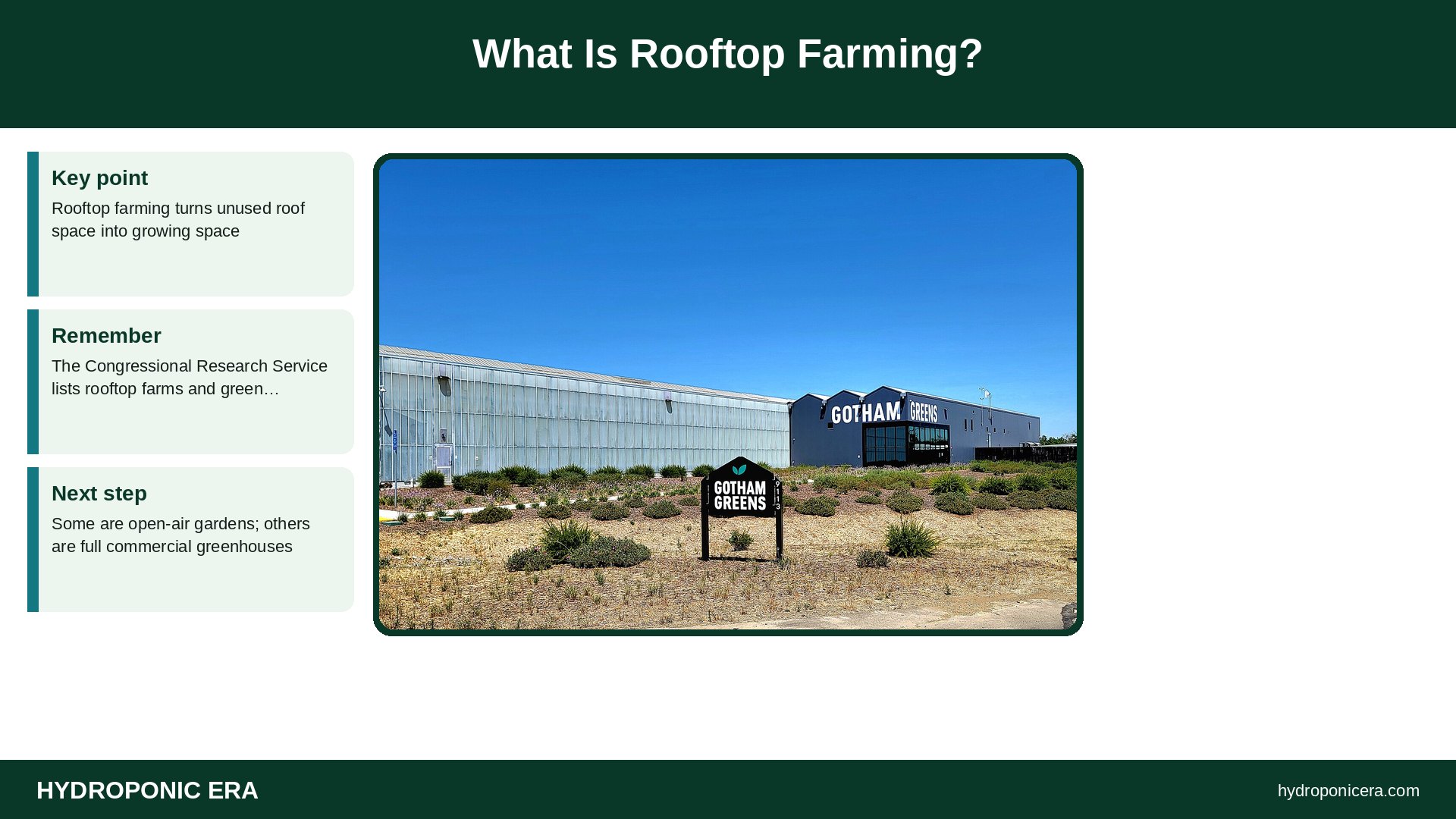
Rooftop farming turns unused roof space into growing space. The Congressional Research Service lists rooftop farms and green walls among the newer types of outdoor vertical production linked to controlled environment agriculture. Some are open-air gardens; others are full commercial greenhouses.
The two main models work very differently. A soil farm is basically a deep green roof planted with vegetables. A rooftop greenhouse is a building on top of a building, with its own heating, cooling and irrigation. Hydroponics is popular in that second model because it can be lighter than deep soil and allows year-round production.
Do Rooftop Farms Use Hydroponics?
Many do, especially the year-round ones. Gotham Greens’ first site, a 15,000 square foot greenhouse on a two-story building in Brooklyn completed in April 2011, was described in a NYSERDA report as “the nation’s first commercial hydroponic rooftop farm.” The company later built a rooftop greenhouse of over 20,000 square feet on a Whole Foods Market in Brooklyn, a 60,000 square foot greenhouse on the roof of a former toy factory in Queens, and a greenhouse of over 75,000 square feet on the Method Products factory in Chicago’s Pullman neighborhood.
Soil-based rooftop farming exists too. Brooklyn Grange calls itself the world’s largest soil-based rooftop farm, and even it added hydroponics: NYC’s Department of Environmental Protection says its Sunset Park farm includes a 4,800 square foot greenhouse “fitted with a hydroponic growing system” for winter production.
Roof Load: The Rule You Can’t Skip

Soil, water, plants, people, snow and equipment are heavy. Brooklyn Grange says its Long Island City farm holds roughly 1.2 million pounds of soil across 43,000 square feet, and its Navy Yard farm about 3 million pounds. It says its farms “were designed and installed with the support of engineers who assessed and approved the sites.”
Gotham Greens did the same for its first greenhouse. NYSERDA’s report says the company hired an independent structural engineering firm “to fully ascertain existing structural loads and how to minimize structural reinforcement” before setting the greenhouse footprint.
Safety note: we don’t give load numbers as advice. Every roof is different, and saturated media, ponding water and snow change the math. Hire a licensed structural engineer before placing any beds, tanks or greenhouse on a roof, even a small rooftop farming project.
How to Start Rooftop Farming: 8 Steps
- Get permission. Confirm the owner, landlord, condo board or HOA allows it, in writing.
- Hire a structural engineer to evaluate capacity, drainage and access.
- Check zoning and building codes. Chicago’s 2011 urban agriculture ordinance, for example, lists rooftop operations and rooftop commercial farms as permitted or special uses depending on the district.
- Plan permits. Gotham Greens reported spending over two years working with NYC’s Department of Buildings and other agencies on approvals for its first project.
- Protect the roof membrane with root barriers and drainage layers, as Brooklyn Grange describes.
- Plan water and power. You’ll need a reliable water source, drainage and safe electrical service.
- Design for wind and access. Secure structures, add guardrails, and keep fire-code access clear.
- Start small and expand once you’ve proven the crops and the market.
Benefits of Rooftop Farming
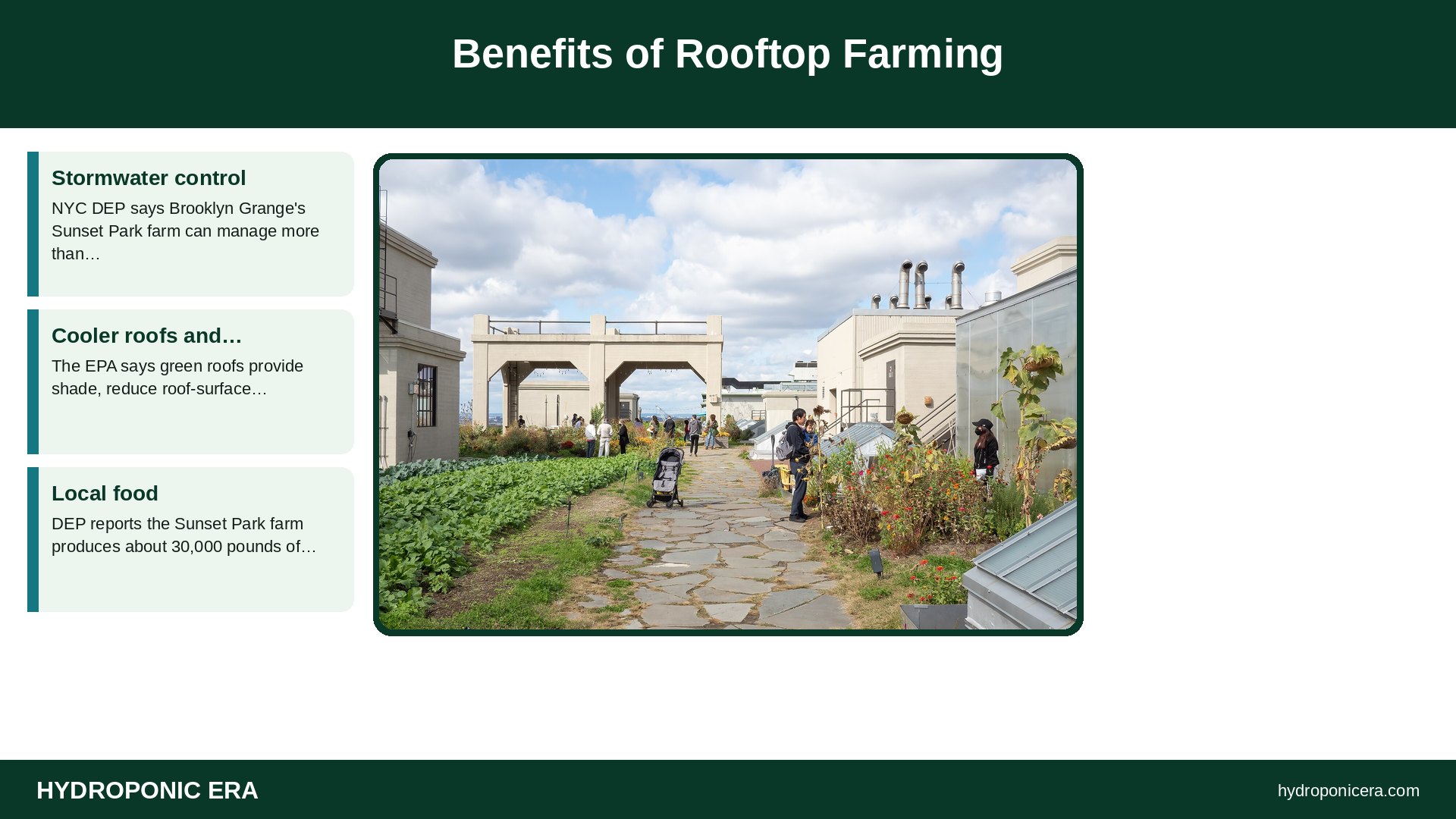
Cities support rooftop farming because the benefits reach beyond food:
- Stormwater control. NYC DEP says Brooklyn Grange’s Sunset Park farm can manage more than 175,000 gallons of stormwater in a single rainfall.
- Cooler roofs and buildings. The EPA says green roofs provide shade, reduce roof-surface temperatures and can reduce energy needed for heating and cooling.
- Local food. DEP reports the Sunset Park farm produces about 30,000 pounds of vegetables a year.
- Jobs and education. Rooftop farms often host tours, workshops and community programs.
- Use of idle space. No new land is needed in dense cities.
Challenges and Costs
Rooftop farming has real hurdles, and most of them show up before the first seed is planted.
| Challenge | Why it matters |
|---|---|
| Structural limits | Reinforcement can be expensive or impossible on older roofs |
| Permits and approvals | Can take months or years in big cities |
| Wind and heat | Roofs are hotter, windier and more exposed than ground plots |
| Access and safety | Moving soil, harvests and people up and down takes planning |
| Leases | Brooklyn Grange holds 15- to 20-year leases on its main farms; short leases are risky |
| Energy (greenhouses) | Year-round greenhouses need heating and cooling |
Small-Scale Rooftop Farming at Home
Most homeowners and renters won’t build a greenhouse on the roof, but a balcony or terrace garden borrows the same ideas. Lightweight containers, self-watering planters, or a small hydroponic rack can grow herbs and greens. If you rent, ask first, and never put heavy water tanks or soil-filled beds on a roof or deck without professional sign-off. Our hydroponics for apartments guide suggests compact setups.
Common Mistakes
- Skipping the engineer because the roof “looks strong.”
- Forgetting that wet soil weighs far more than dry soil.
- Blocking roof drains with beds or debris.
- Choosing tall crops that catch wind without staking.
- Ignoring summer roof heat, which can stress greens and dry out containers fast.
FAQs: Rooftop Farming
Is rooftop farming legal in the US?
It depends on your city’s zoning and building codes. Some cities, like Chicago, list rooftop farms in their zoning rules. Always check locally.
How much weight can a roof hold for rooftop farming?
Only a licensed structural engineer can tell you for a specific building. Don’t rely on general numbers.
Are rooftop farms profitable?
Some are, often by combining produce sales with events, education and green-roof services. Many depend on grants, long leases or partnerships.
What grows best on a rooftop?
Leafy greens, herbs, tomatoes and peppers are common. Hydroponic greenhouses mostly grow greens and herbs.
Related HydroponicEra Guides
- Controlled environment agriculture, explained
- Vertical farming for beginners
- Hydroponic farms in the US
- Grants for hydroponic farming
Sources
- NYSERDA — Gotham Greens Farms, LLC: Sustainable Urban CEA (PDF)
- Brooklyn Grange — FAQ
- NYC Department of Environmental Protection — Brooklyn Grange Opens Largest Rooftop Farm in the City
- Gotham Greens — Our Farms
- City of Chicago — Urban Agriculture Zoning Ordinance, 2011 (PDF)
- US EPA — Using Green Roofs to Reduce Heat Islands
- Congressional Research Service — Controlled Environment Agriculture (CEA) Production (PDF)
- Photo credits (Wikimedia Commons, edited with titles): Brooklyn Grange (75908) by Rhododendrites (CC BY-SA 4.0); Gotham Greens in Davis, California by Cullen328 (CC BY-SA 4.0); Lufa Farms Montreal rooftop greenhouse in Sunlight by Lufa Farms (CC BY-SA 2.0)