
Can creeping jenny grow in ponds and aquariums? Yes. Creeping jenny (Lysimachia nummularia) grows in moist to wet soil at pond edges and can be grown submerged in aquariums. Give it full sun to part shade outdoors or medium light indoors, and trim stems often. In the US, plant it with care: extension services flag it as invasive in wetlands.
Key takeaway: Creeping jenny is a low, fast-spreading primrose-family perennial for wet pond edges, bog gardens and some aquariums. It stays under 4 inches (10 cm) tall but spreads 1–3 feet (30–90 cm), roots wherever stem nodes touch soil, and escapes into wetlands, so contain it and never dump trimmings outdoors.
| Need | Creeping jenny range | Source |
|---|---|---|
| Light | Full sun to part shade | NC State, RHS |
| Soil | Moist to wet; occasional flooding | NC State |
| Height | 2–4 in (5–10 cm) | NC State, RHS |
| Spread | 1–3 ft (30–90 cm) | NC State, RHS |
| Hardiness | USDA zones 3a–8b | NC State |
| Propagation | Stem cuttings or division | RHS, NC State |
What Is Creeping Jenny?
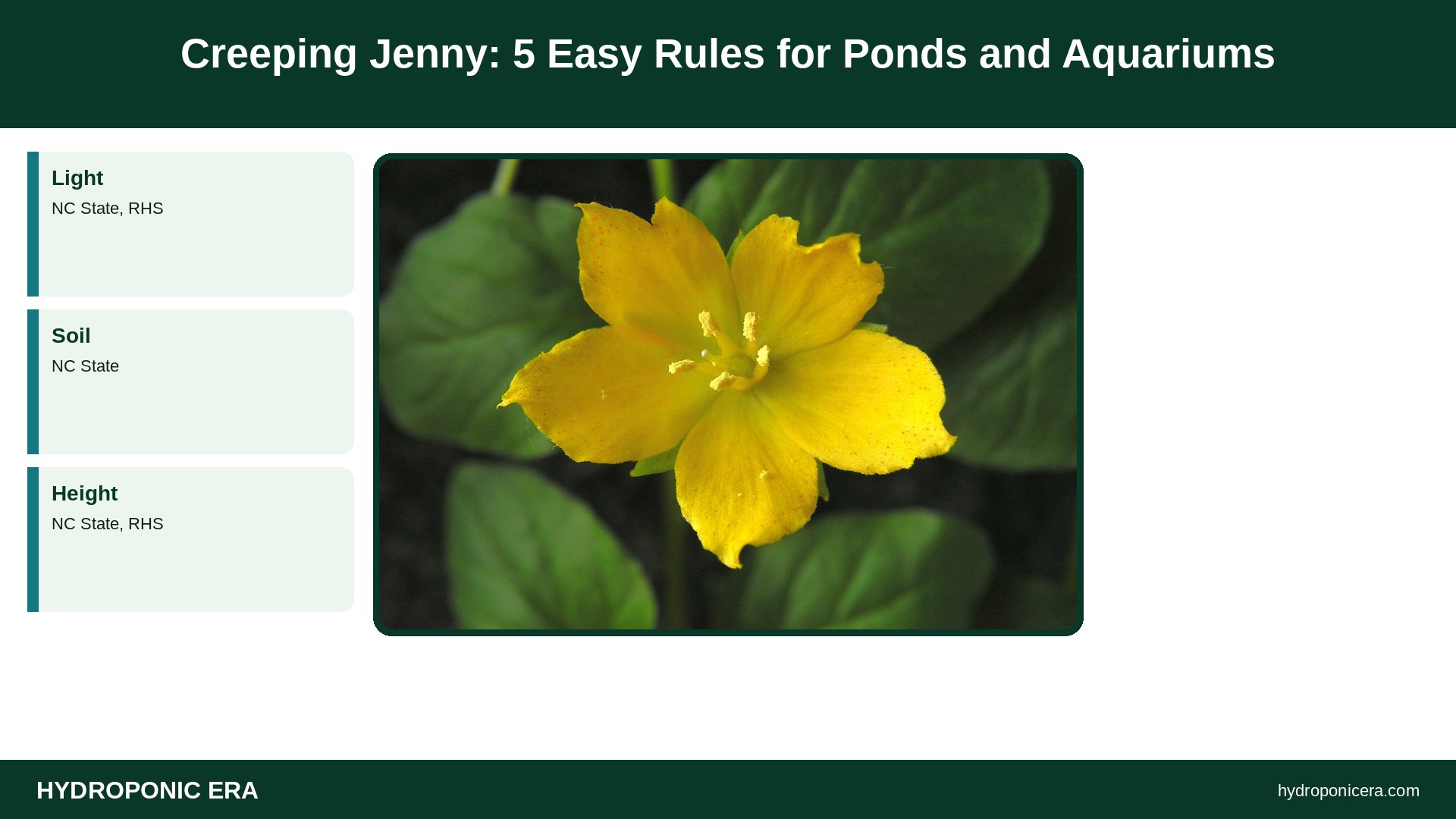
Creeping jenny is Lysimachia nummularia, a herbaceous, semi-evergreen perennial in the primrose family. NC State Extension says it is native to Europe and temperate Asia and was introduced to North America as an ornamental ground cover before it naturalized. It is also sold as moneywort, and the golden form is called ‘Aurea’.
RHS describes the golden form with cup-shaped, bright yellow flowers about 3/4 inch (2 cm) wide. NC State rates its growth as rapid and its maintenance as high, mostly because it needs regular trimming.
How Do You Grow Creeping Jenny at a Pond Edge?
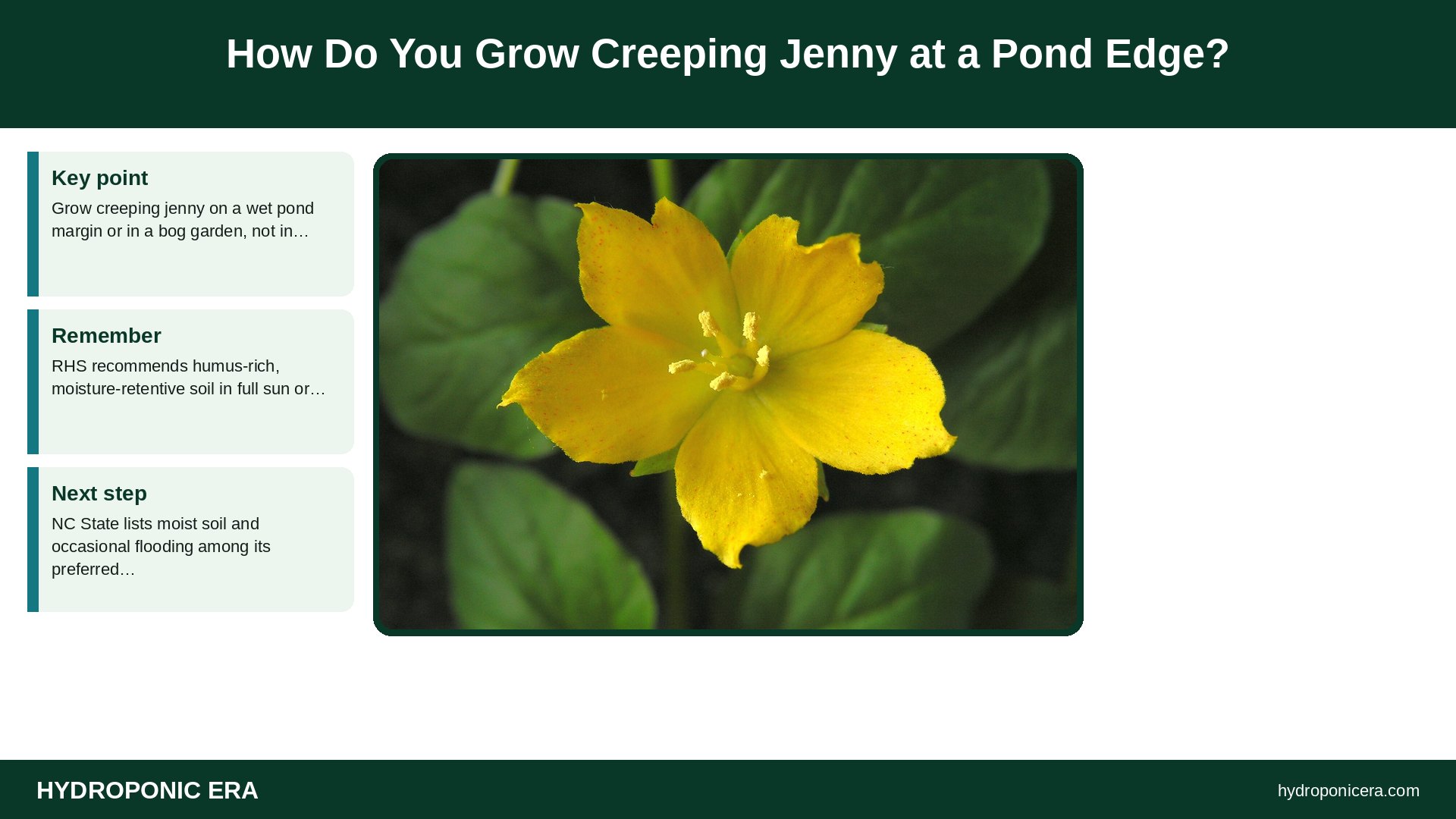
Grow creeping jenny on a wet pond margin or in a bog garden, not in deep water. RHS recommends humus-rich, moisture-retentive soil in full sun or partial shade and calls it useful as an edging plant near bog gardens. NC State lists moist soil and occasional flooding among its preferred conditions.
- Plant in spring in an aquatic basket or a contained bed at the pond edge.
- Keep the crown at or just above the waterline.
- Let stems trail over rocks to soften the edge.
- Trim wandering stems, as RHS advises, before they root beyond the bed.
It pairs well with a bog filter and taller marginals in koi pond plants designs.
Can Creeping Jenny Grow Underwater in an Aquarium?
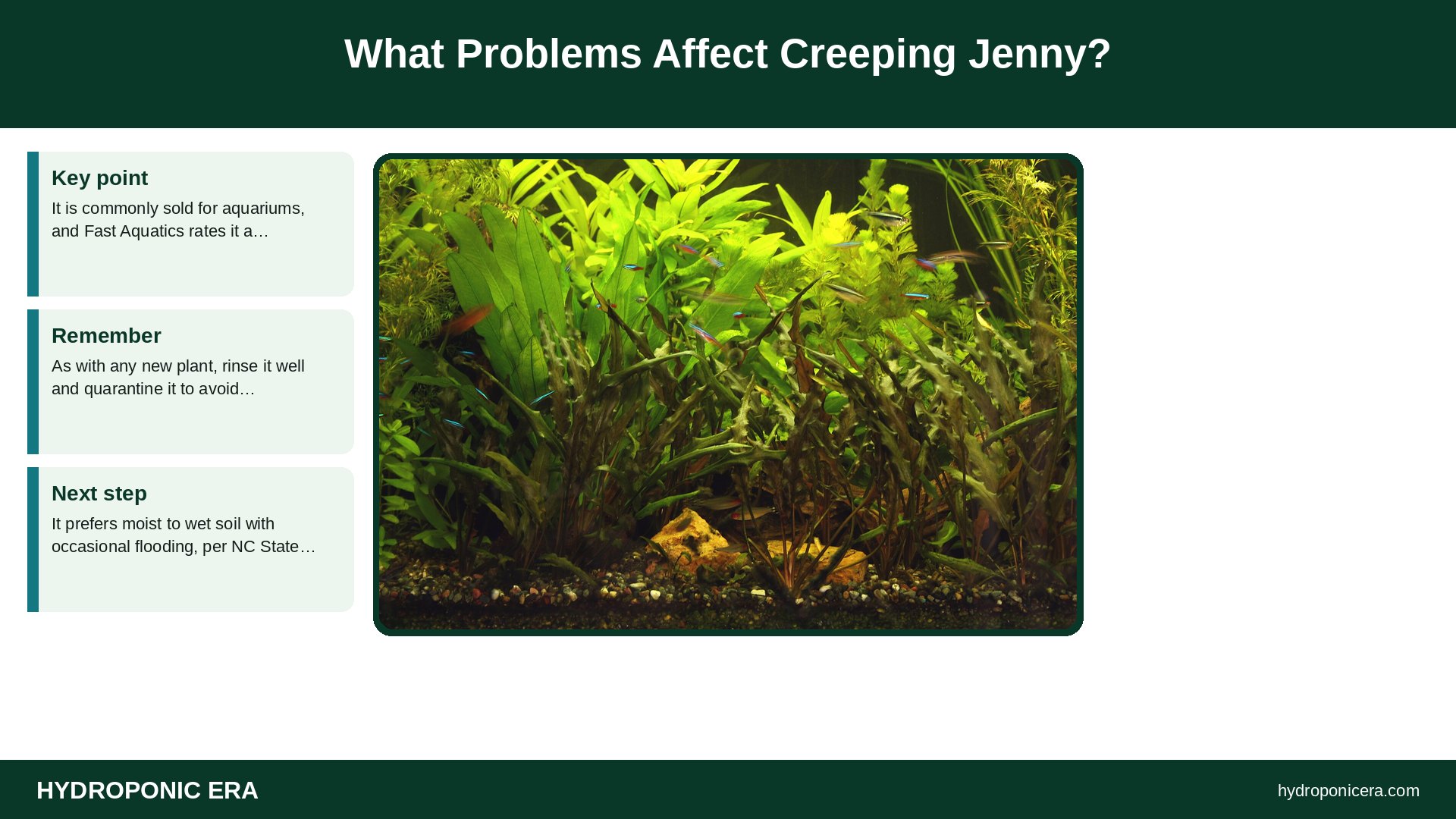
It can grow submerged, and aquarium sellers offer it as Lysimachia ‘Aurea’. Fast Aquatics rates it a beginner plant that needs medium light, with CO2 optional and occasional root tabs in inert substrate. It is a temperate garden plant first, so treat aquarium growth as a trial and watch for decline.
- Light: medium; golden leaves fade in low light.
- CO2: optional, per Fast Aquatics.
- Feeding: root tabs in plain gravel or sand.
- Planting: push stems into the substrate, a few nodes deep.
For lighting help, see our grow light for aquarium guide.
How Do You Propagate Creeping Jenny?
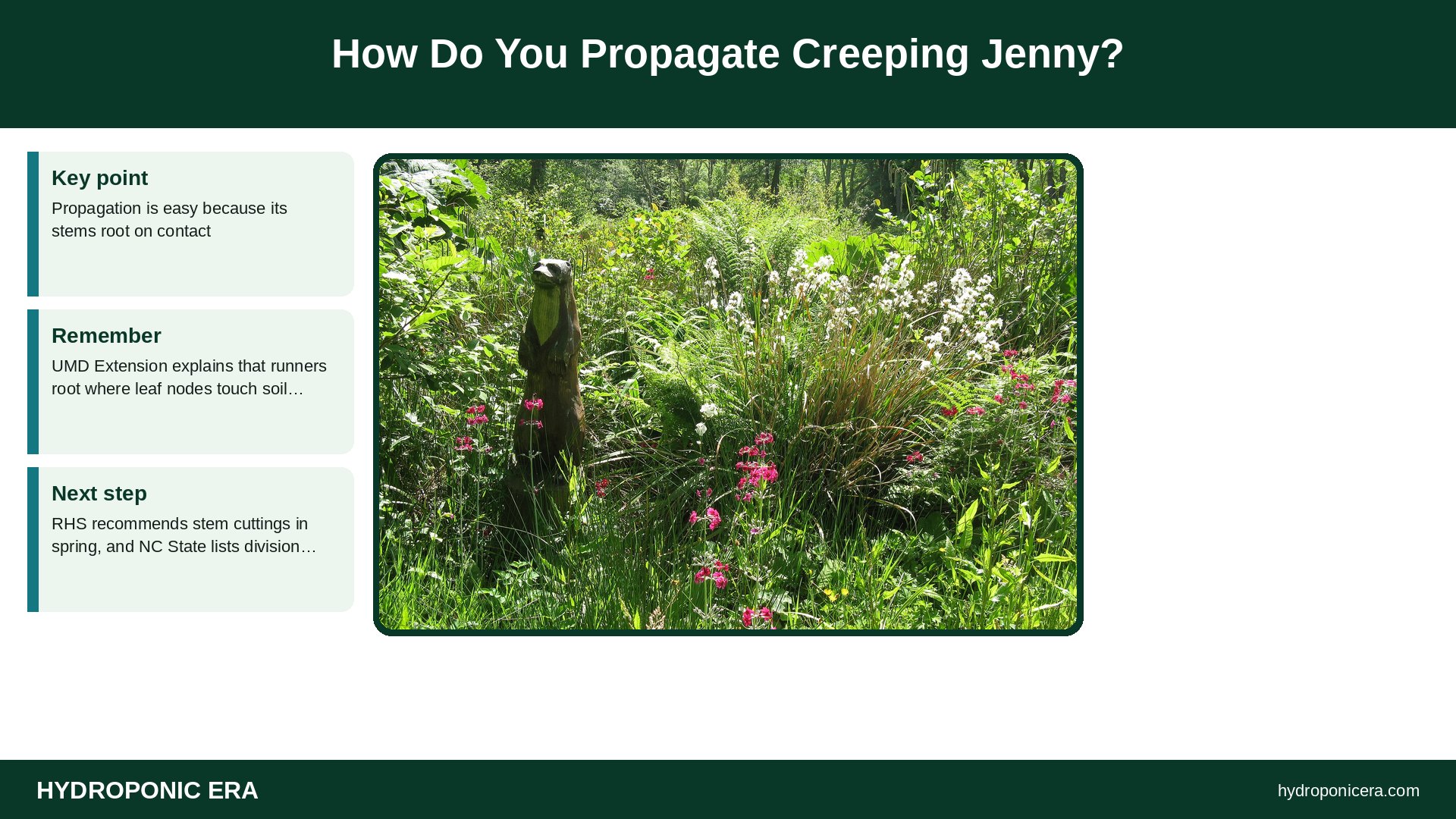
Propagation is easy because its stems root on contact. UMD Extension explains that runners root where leaf nodes touch soil and that it also spreads underground by rhizomes. RHS recommends stem cuttings in spring, and NC State lists division as its main propagation method.
- Cut a 4–6 inch (10–15 cm) stem just below a node.
- Strip leaves from the lower node or two.
- Press the stem into moist soil or aquarium substrate.
- Keep it wet; new roots form at the buried nodes.
Learn how roots form at nodes in our plant node guide.
Is Creeping Jenny Invasive?
Creeping jenny is invasive in many US wetlands, so plant it responsibly. UMD Extension reports it is widespread in wetlands, forested floodplains and moist soils across much of the eastern US, the Great Plains and the Pacific Northwest, where its low mats keep native plants from thriving. RHS also warns it can become a nuisance.
- Contain it in baskets or edged beds.
- Never plant it beside streams or ditches that drain to wild wetlands.
- Bag trimmings; fragments can re-root.
- Choose a native groundcover if your state lists it as invasive.
UMD Extension says hand-pulling is the first-choice control, but every stem and fragment must be removed to stop re-rooting.
What Problems Affect Creeping Jenny?
This plant has few serious problems. RHS lists the golden form as generally pest-free and disease-free, while NC State notes susceptibility to rust and leaf spots. The most common issue is overgrowth, so trim it regularly. In aquariums, pale or leggy growth usually means it needs more light or nutrients. Remove yellowing or rotting lower leaves so they do not foul the water, and replant healthy tips. Outdoors, cut back stems that smother nearby marginals, and thin dense mats in late summer so air can reach the crowns and leaves dry faster after rain.
Is creeping jenny safe for fish?
It is commonly sold for aquariums, and Fast Aquatics rates it a beginner plant. As with any new plant, rinse it well and quarantine it to avoid snails or pesticides.
Can creeping jenny grow in standing water?
It prefers moist to wet soil with occasional flooding, per NC State, so grow it at the waterline or on a shallow shelf rather than in deep water.
How fast does creeping jenny spread?
NC State rates its growth as rapid, with a spread of 1–2 feet (30–60 cm) or more. RHS gives a spread of about 1.5–3 feet (0.5–1 m) for the golden form.
Does creeping jenny come back every year?
Yes. It is a perennial, hardy in USDA zones 3a to 8b according to NC State, and stays semi-evergreen in mild winters.
How do I remove creeping jenny?
UMD Extension recommends hand-pulling first, removing every stem and fragment, because pieces left behind re-root.
Sources
- NC State Extension Gardener Plant Toolbox. Lysimachia nummularia.
- University of Maryland Extension. Invasives in Your Woodland: Creeping Jenny.
- Royal Horticultural Society. Lysimachia nummularia ‘Aurea’.
- Fast Aquatics. Lysimachia Aurea Care Guide.
- Photo credits (Wikimedia Commons, edited with titles): Lysimachia nummularia20140609 48 by Bff (CC BY-SA 4.0); Lysimachia nummularia20140609 48 by Bff (CC BY-SA 4.0); Pond-edge plants at Achamore Garden – geograph.org.uk – 5446824 by M J Richardson (CC BY-SA 2.0); Planted Tank 03 – Flickr – The Wandering Angel by The Wandering Angel from Makati City, Philippines (CC BY 2.0)