
How does greenhouse evaporative cooling work? Exhaust fans pull outside air through wet pads on the opposite wall. Evaporating water absorbs heat, so the air enters cooler. UMass Extension says it can cool a greenhouse 10–20°F (6–11°C) below outdoor temperature, working best in dry air. Size fans at 8 cfm per square foot of floor.
Key takeaway: Greenhouse evaporative cooling, usually a pad-and-fan system, is the standard way to keep summer greenhouse temperatures down.
| Design item | Rule of thumb | Source |
|---|---|---|
| Fan airflow | 8 cfm per sq ft of floor (2.4 m³/min per m²) | UMass |
| Air changes | 1 to 1.5 per minute | NC State |
| Aspen pad face velocity | 150 cfm per sq ft of pad | UMass, NC State |
| 4 in (10 cm) cellulose pad | 250 cfm per sq ft, 1/2 gpm per ft of length | UMass |
| 6 in (15 cm) cellulose pad | 350 cfm per sq ft, 3/4 gpm per ft of length | UMass |
| Sump size, 4 in (10 cm) pad | 3/4 gal per sq ft of pad (about 30 L per m²) | UMass |
| Pad height | 2–8 ft (0.6–2.4 m) | UMass |
| Best efficiency | Up to 85% | UF/IFAS |
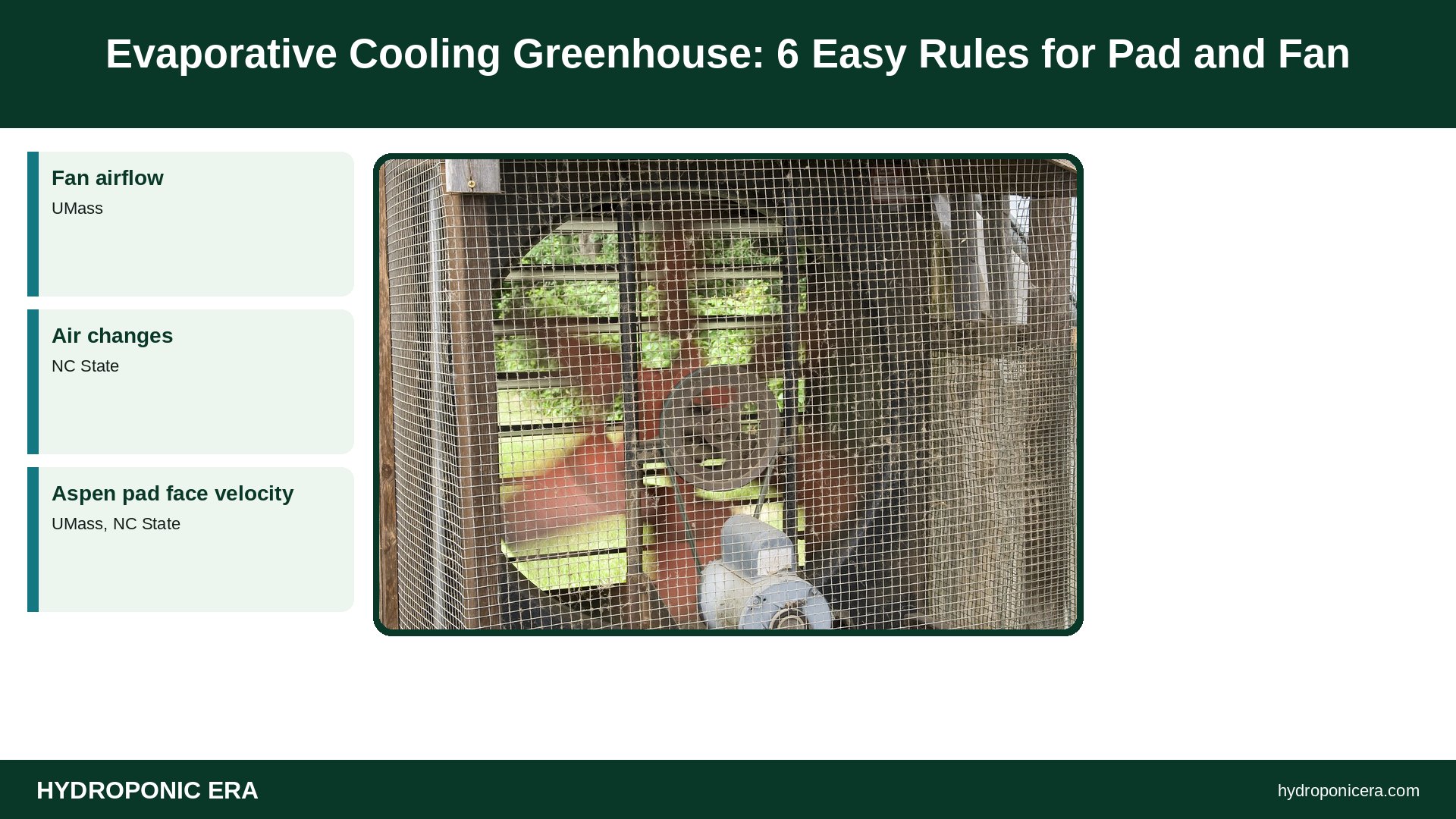
How Does a Pad and Fan Greenhouse Evaporative Cooling System Work?
Pads of aspen or cellulose sit in one endwall or sidewall, fed with water from a pipe above and drained by a gutter below. UMass Extension explains that fans on the opposite wall pull air through the wet pads. Evaporation absorbs about 8,700 Btu per gallon of water evaporated, and the warmed air is exhausted outside.
How Much Can Greenhouse Evaporative Cooling Lower the Temperature?
Greenhouse evaporative cooling depends on outdoor humidity. UMass reports that on a 90°F (32°C) day, air leaving the pads cools to about 67°F (19°C) at 30% relative humidity but only to about 82°F (28°C) at 70%. UF/IFAS says a well-run system reaches up to 85% efficiency, cooling 90°F (32°C) air at 50% humidity to 76.5°F (24.7°C).
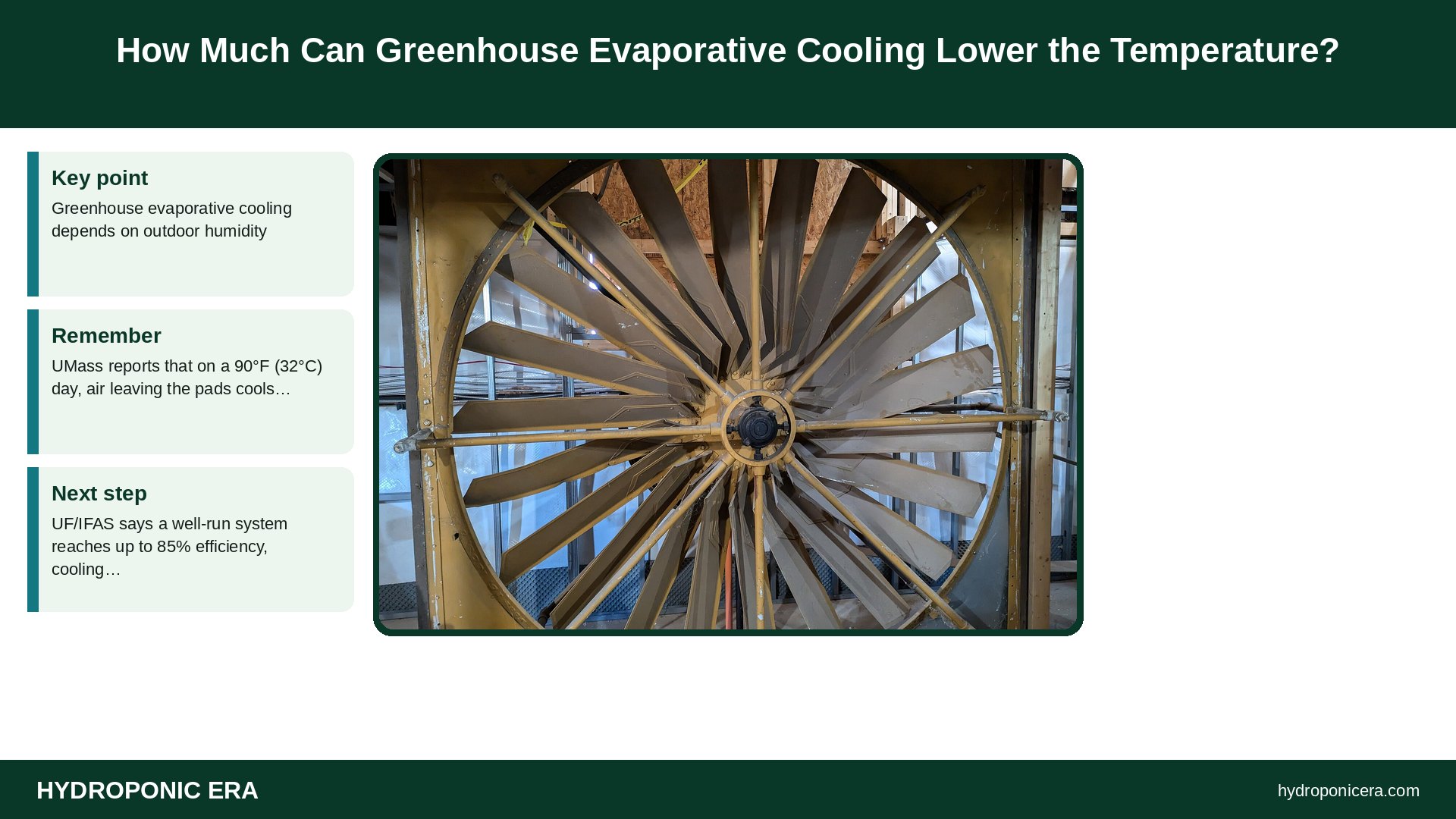
How Do You Size Fans and Pads for a Greenhouse?
Start with floor area. For greenhouse evaporative cooling, UMass uses 8 cfm per square foot of floor, then divides that airflow by pad face velocity. Its example: a 30 x 100 ft (9 x 30 m) house needs 24,000 cfm and 96 sq ft (8.9 m²) of 4 in (10 cm) cellulose pad, such as 4 x 24 ft (1.2 x 7.3 m).
- Multiply floor area by 8 cfm to get total fan capacity.
- Adjust upward for unshaded houses above 5,000 foot-candles (about 54,000 lux), sites above 1,000 ft (305 m) or pad-to-fan distances under 100 ft (30 m).
- Divide fan capacity by 150, 250 or 350 cfm for aspen, 4 in (10 cm) or 6 in (15 cm) pads.
- Size the pump by pad length, for example 1/2 gpm per foot (about 6 L/min per m) for 4 in (10 cm) pads.
- Size the sump by pad area and add makeup water of 1 gpm (3.8 L/min) per 100 sq ft (9.3 m²) of pad.
Why Is the Fan End of the Greenhouse Warmer?
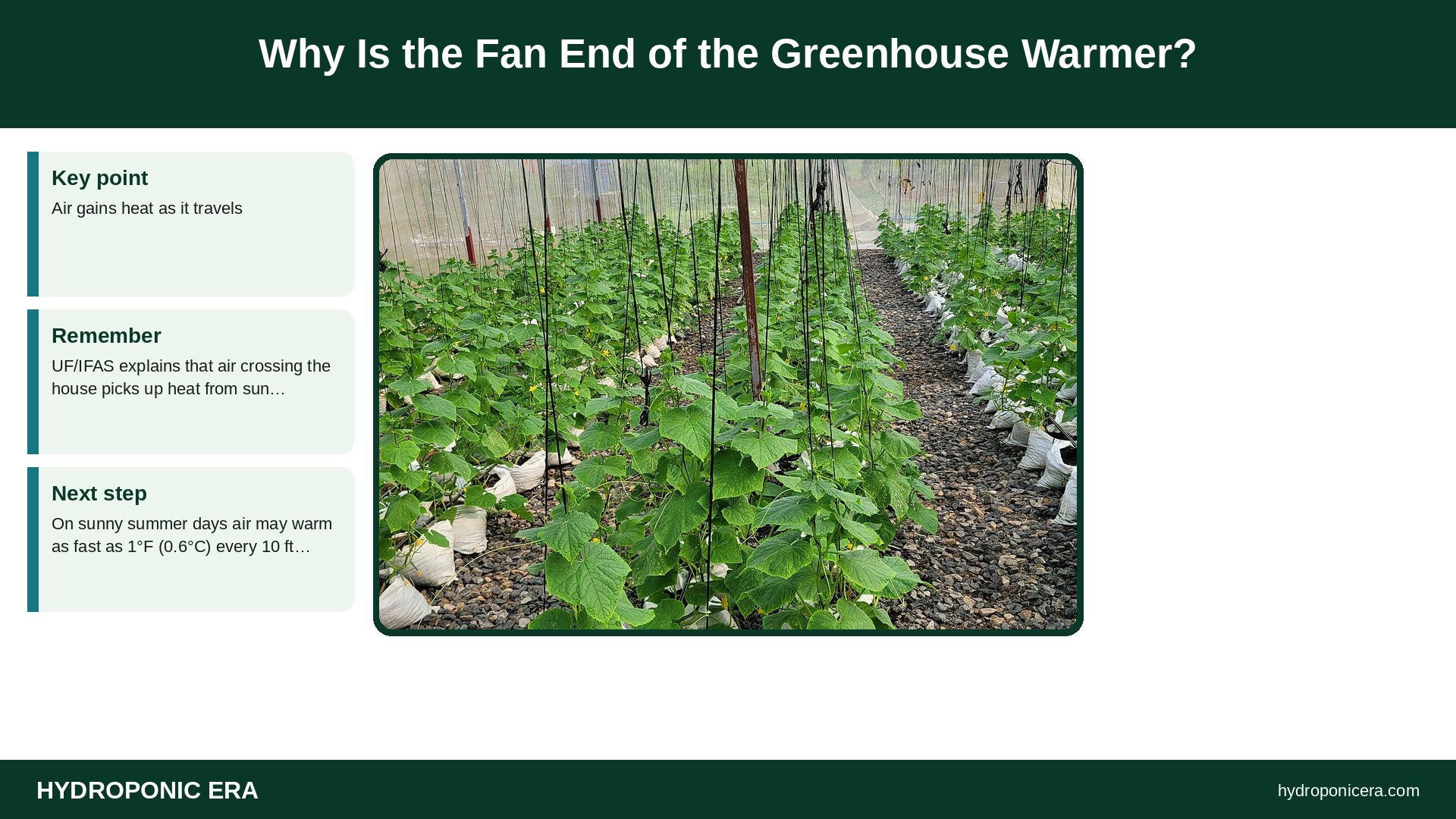
Air gains heat as it travels. UF/IFAS explains that air crossing the house picks up heat from sun, plants and soil, so the pad side is coolest and the fan side warmest. On sunny summer days air may warm as fast as 1°F (0.6°C) every 10 ft (3 m), and slower airflow means a bigger rise.
Does Greenhouse Evaporative Cooling Work in Humid Climates?
Yes, but greenhouse evaporative cooling has less effect there. UF/IFAS notes evaporative cooling has limits in Florida’s hot, humid climate, and NC State found that in a full house with transpiring crops, pads gave exit air only about 3°F (1.7°C) cooler than fans alone on a 90°F (32°C) day. Pads help more where outside air is dry.
Is Fogging Better Than Pad and Fan Cooling?
Sometimes. NC State’s D.H. Willits suggests fogging for rooting houses, seedlings and young plants, where little crop transpiration is available. In a nearly empty house, his estimates show exit air of 90°F (32°C) with fog and fans versus 100°F (38°C) with pads. For full houses of mature plants, fogging performs about the same as pads.
Seedling and propagation growers should also read our humidity and VPD guide, since fogging raises humidity.
How Do You Control and Maintain Greenhouse Evaporative Cooling?
Run greenhouse evaporative cooling as the last cooling stage. UMass advises turning on the pads only when fans alone cannot hold the setpoint, with a multistage controller preferred. Keep doors closed, screen return water at 50 mesh, flush or bleed salty water, use black sump and piping, and run fans 30 minutes after shutoff to dry pads and limit algae.
For other seasons, see our guides to greenhouse heating, heat stress in plants and hydroponic greenhouses for beginners.
FAQ About Greenhouse Evaporative Cooling
How many cfm does a greenhouse need for cooling?
About 8 cfm per square foot of floor area.
How cold can evaporative cooling make a greenhouse?
Often 10–20°F (6–11°C) below outside air.
What thickness of cooling pad is common?
Cellulose pads 4 in (10 cm) or 6 in (15 cm) thick, or aspen.
Should pads run in winter?
No; UMass says pads are sometimes removed in winter for more light.
What efficiency can a cooling pad reach?
Up to 85% when well designed and maintained.
Sources
- UMass Extension — Fan and Pad Evaporative Cooling Systems
- UF/IFAS EDIS — Fan and Pad Greenhouse Evaporative Cooling Systems
- NC State University, D.H. Willits — Greenhouse Cooling
- Photo credits (Wikimedia Commons, edited with titles): Greenhouse Vent Fan (2737319720) by Dwight Sipler from Stow, MA, USA (CC BY 2.0); Aledo Opera House evaporative cooling fan by Dentree2 (CC BY-SA 4.0); Cucumber in the greenhouse 3 by Pascal Kings (CC BY 4.0); Greenhouse interior in Parham House Walled Garden by Acabashi (CC BY-SA 4.0)