
Is spring water good for plants? Usually yes, but it is not automatically better than tap water. The FDA defines spring water by where it comes from, not by its mineral level, so one brand can be soft and another hard. Test spring water for plants for pH, alkalinity and EC before you use it, especially in hydroponics.
Key takeaway: Spring water for plants is safe to drink water with an unknown mineral load, so treat it like any other source and test it.
| Water type | What defines it | Plant notes |
|---|---|---|
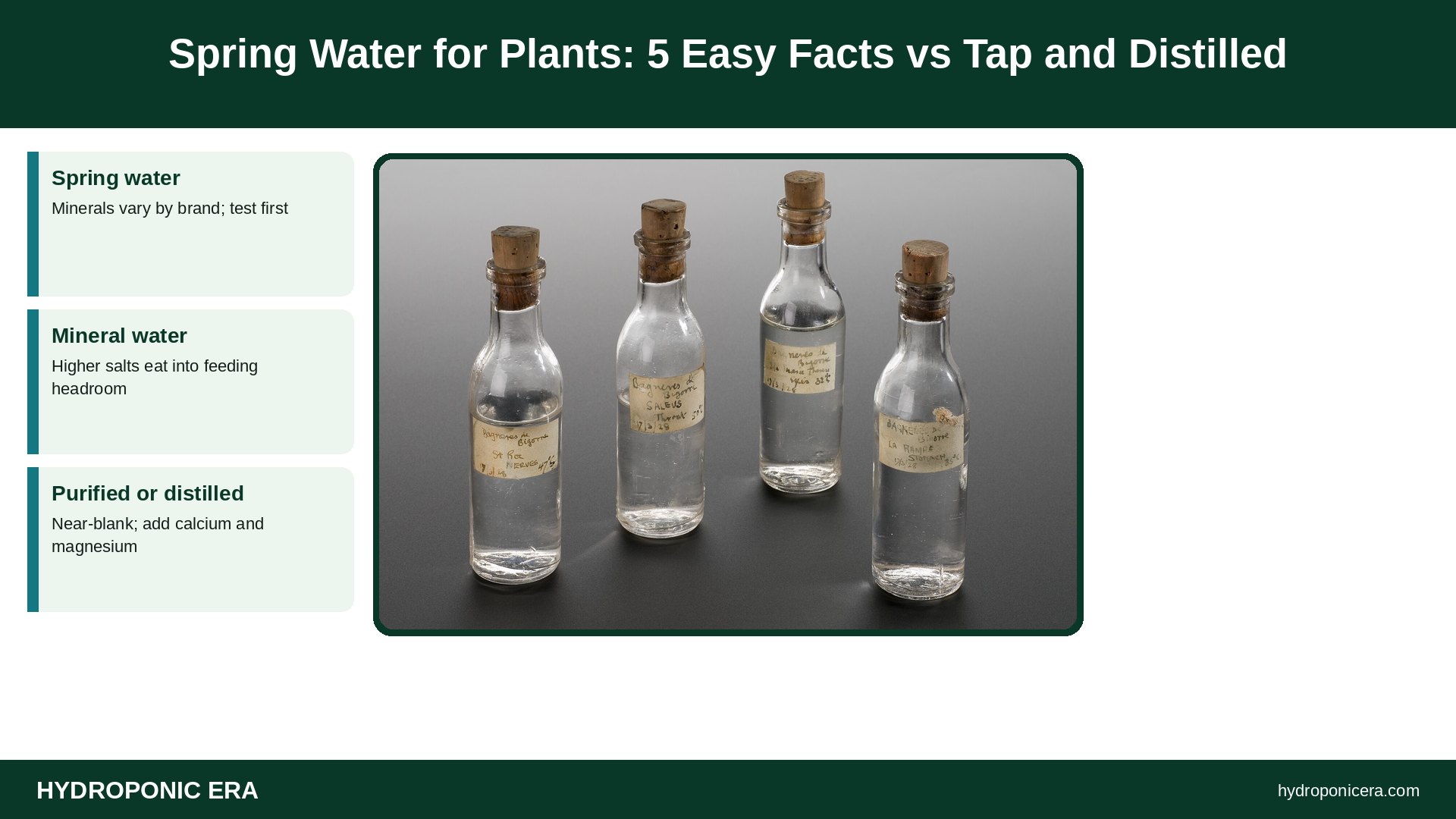
| Spring water | Underground source that flows naturally to the surface (FDA) | Minerals vary by brand; test first |
| Mineral water | At least 250 ppm TDS from the source (FDA) | Higher salts eat into feeding headroom |
| Purified or distilled | Distillation, reverse osmosis or similar (FDA) | Near-blank; add calcium and magnesium |
| Tap water | Municipal supply, treated | Steady quality; check chlorine and alkalinity |
| Target pH | 5.4–7.0 for greenhouse use | Penn State Extension |
| Alkalinity limit | 100 mg/L (ppm) as CaCO3 | Penn State Extension |
| Hardness limit | 150 mg/L as CaCO3 | Penn State Extension |
| Salinity flag | EC above 1.0 mS/cm | Penn State Extension |
What Counts as Spring Water?
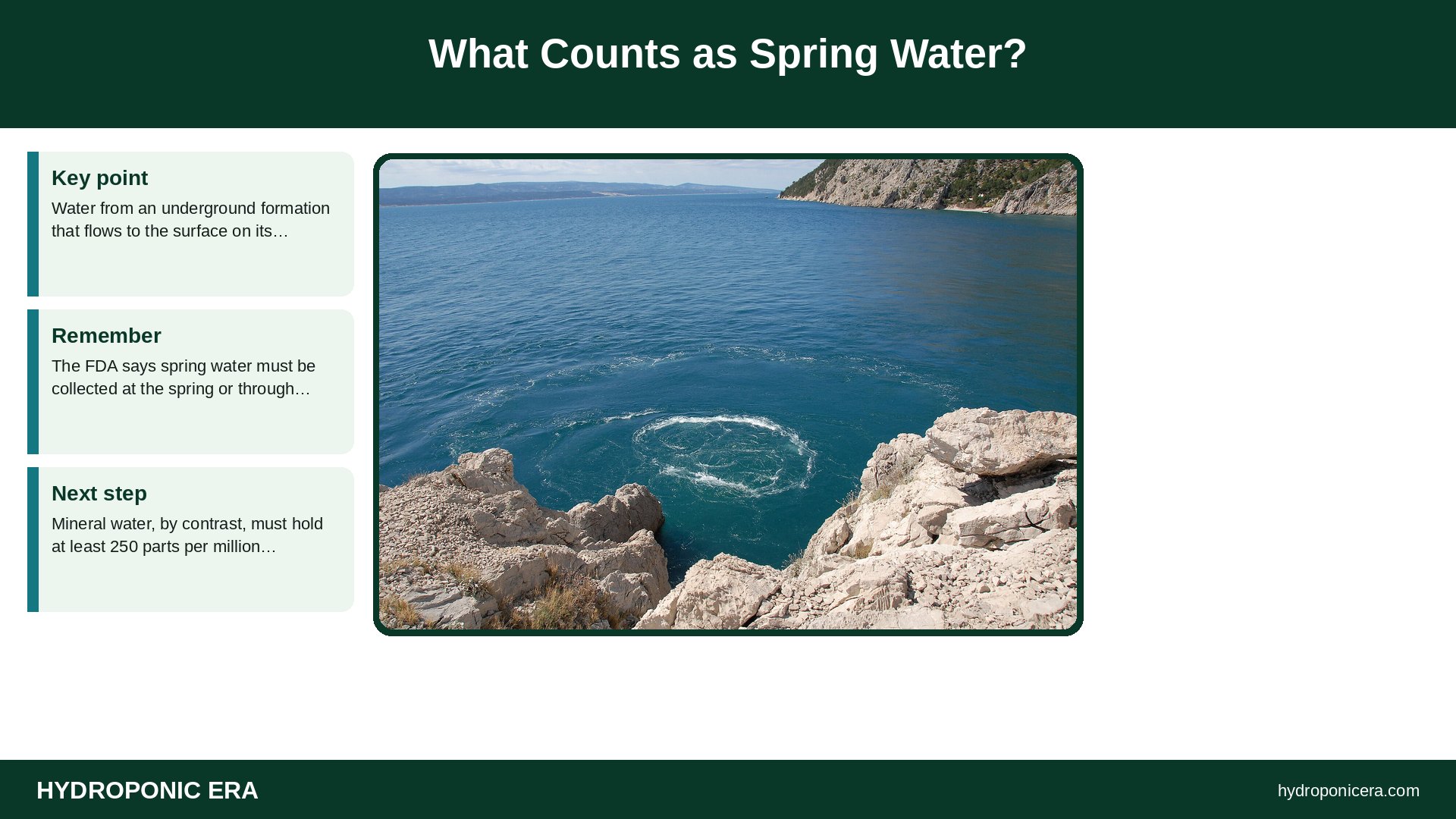
Water from an underground formation that flows to the surface on its own. The FDA says spring water must be collected at the spring or through a borehole tapping the same formation, with the same composition. Mineral water, by contrast, must hold at least 250 parts per million total dissolved solids from the source.
The label tells you the source, not the mineral load, so spring water for plants can range from very soft to fairly hard.
Is Spring Water Better Than Tap Water for Plants?
Not by default. GrowerTalks notes that municipal water is treated to protect pipes and varies less by season, while ground water can vary widely even locally. Spring water is ground water, so its pH, alkalinity and salts depend on the rock it passed through. Tested tap is often as good as spring water for plants.
If chlorine is your worry, our guide to chlorine and chloramine in tap water explains which one lingers.
Is Spring Water Better Than Distilled Water?
For soil plants, either works; for hydroponics, it depends on your recipe. FDA says distilled and reverse osmosis treatments remove minerals, which leaves a near-blank base. Spring water for plants keeps its natural calcium, magnesium and bicarbonate, which can help or hurt. See our guide to distilled water in hydroponics for the blank-base approach.
Why Does Alkalinity Matter More Than pH?
Because alkalinity decides where pH drifts. Penn State Extension says water pH alone often matters little; high alkalinity is what pushes media pH up and makes acid less effective. It sets an upper limit of 100 mg/L. GrowerTalks adds that very low alkalinity water does not buffer against acid-forming fertilizers.
Our alkalinity and bicarbonate guide shows how to correct a high reading.
How Do You Test Spring Water for Plants Before Use?
Check four numbers: pH, alkalinity, hardness and EC. Penn State Extension recommends exactly those, using strips, titration kits or meters, and suggests keeping records to spot changes. Basic TDS and EC meters start around $20. Labs can run a full analysis of spring water for plants used long term.
- Measure pH with a calibrated meter or strips.
- Test alkalinity with strips or a titration kit.
- Test hardness; above 150 mg/L can leave residue.
- Read EC; above 1.0 mS/cm flags salinity risk.
- Log results and retest each new batch or brand.

Can You Use Spring Water in Hydroponics?
Yes, if you subtract its starting EC. GrowerTalks explains that a high starting EC limits how much fertilizer you can add, and knowing it lets you calculate the right rate. In hydroponics, it adds, solution pH equals root zone pH, so water chemistry matters more than in soil. Low-EC spring water for plants beats mineral water as a base.
Pair your test with our pH and EC meter guide to read the base water accurately.
When Is Spring Water Worth It?
Mainly for a few sensitive houseplants or when your tap is very hard or alkaline. If spring water for plants tests low in EC and alkalinity, it makes a gentle base. For a large reservoir, buying bottles adds up, so tested tap, rain or filtered water is usually more practical. Our rainwater guide covers one free alternative.
FAQ About Spring Water for Plants
Is spring water good for houseplants?
Usually, if it tests low in salts and alkalinity.
Does spring water have nutrients?
Some calcium and magnesium, but not a complete feed.
Is mineral water good for plants?
Not ideal; its 250+ ppm solids reduce feeding headroom.
Should I use spring water for seedlings?
It works if EC is low; test it first.
Do I need to dechlorinate spring water?
Rarely; FDA says bottlers typically use ozone, not chlorine.
Sources
- U.S. Food and Drug Administration — Bottled Water Everywhere: Keeping it Safe
- Penn State Extension — A Water Quality Toolkit for Greenhouse and Nursery Production
- GrowerTalks (Griffin GGSPro) — Wondering About Your Water?
- Photo credits (Wikimedia Commons, edited with titles): Bottle of medicinal water, France, 1928 Wellcome L0057444 by Unknown (CC BY 4.0); Submarine-spring Vrulja-Bay Brela Biokovo Croatia by Rainer Pinhack (CC BY-SA 3.0 de); TDS Water meter, (2025) by Gpkp (CC BY-SA 4.0); Woman with watering can, Dent de Man by FBilula (CC BY-SA 4.0)