
Does the FSMA Produce Safety Rule apply to hydroponic farms? Yes, above the sales cutoff. The FDA Produce Safety Rule covers raw fruits and vegetables whatever the growing method, so hydroponic farms selling more than $25,000 of produce a year (inflation adjusted) must meet standards for water, worker hygiene, equipment and buildings, unless an exemption applies.
Key takeaway: Coverage depends on sales and crop; nutrient solution that touches produce counts as agricultural water.
| Question | Short answer | Source |
|---|---|---|
| Who is covered? | Farms selling more than $25,000 of produce a year (adjusted) | FDA |
| Qualified exemption? | Food sales under $500,000 and mostly to qualified end-users | FDA |
| Is nutrient solution covered? | Yes, if it is intended or likely to contact produce | FDA FAQ |
| Water assessment? | At least once a year for pre-harvest water | FDA |
| Hydro-specific risks? | Recirculation, rafts, troughs and heavy handling | UVM Extension |
| Training? | PSA Grower Training with hydroponic supplements | PSA, UVM |

What Is the Produce Safety Rule?
A federal food safety standard for farms. FDA says the produce safety rule, part of the FDA Food Safety Modernization Act (FSMA), sets standards for growing, harvesting, packing and holding fruits and vegetables for people. It took effect January 26, 2016. Key areas include agricultural water, soil amendments, sprouts, animals, worker training and hygiene, and equipment, tools and buildings.
Which Hydroponic Farms Does the Produce Safety Rule Cover?
Most commercial ones above the sales cutoff. FDA states the rule does not apply to farms averaging $25,000 or less in annual produce sales over the previous three years, produce for personal or on-farm use, or crops FDA lists as rarely consumed raw, such as eggplant, okra and potatoes. FDA publishes inflation-adjusted cutoffs, so check the current figures.
Selling locally? Start with our guide to selling hydroponic produce locally.

What Is the Produce Safety Rule Qualified Exemption?
Lighter rules for small, direct sellers. FDA says a farm qualifies under the produce safety rule if three-year average food sales stay under $500,000 and most sales go to qualified end-users. Qualified end-users are consumers, or restaurants and retail stores in the same state or within 275 miles. They must still list the farm name and address and keep records.
Is Nutrient Solution Agricultural Water Under the Produce Safety Rule?
It can. FDA’s agricultural water FAQ defines agricultural water as water intended to, or likely to, contact covered produce or food-contact surfaces. The University of Vermont Extension notes hydroponic systems hold large volumes of recirculating “production water,” so the chance of contact with the edible crop is higher, and contamination in one spot can spread through the whole system.
What Changed in the Pre-Harvest Water Rule?
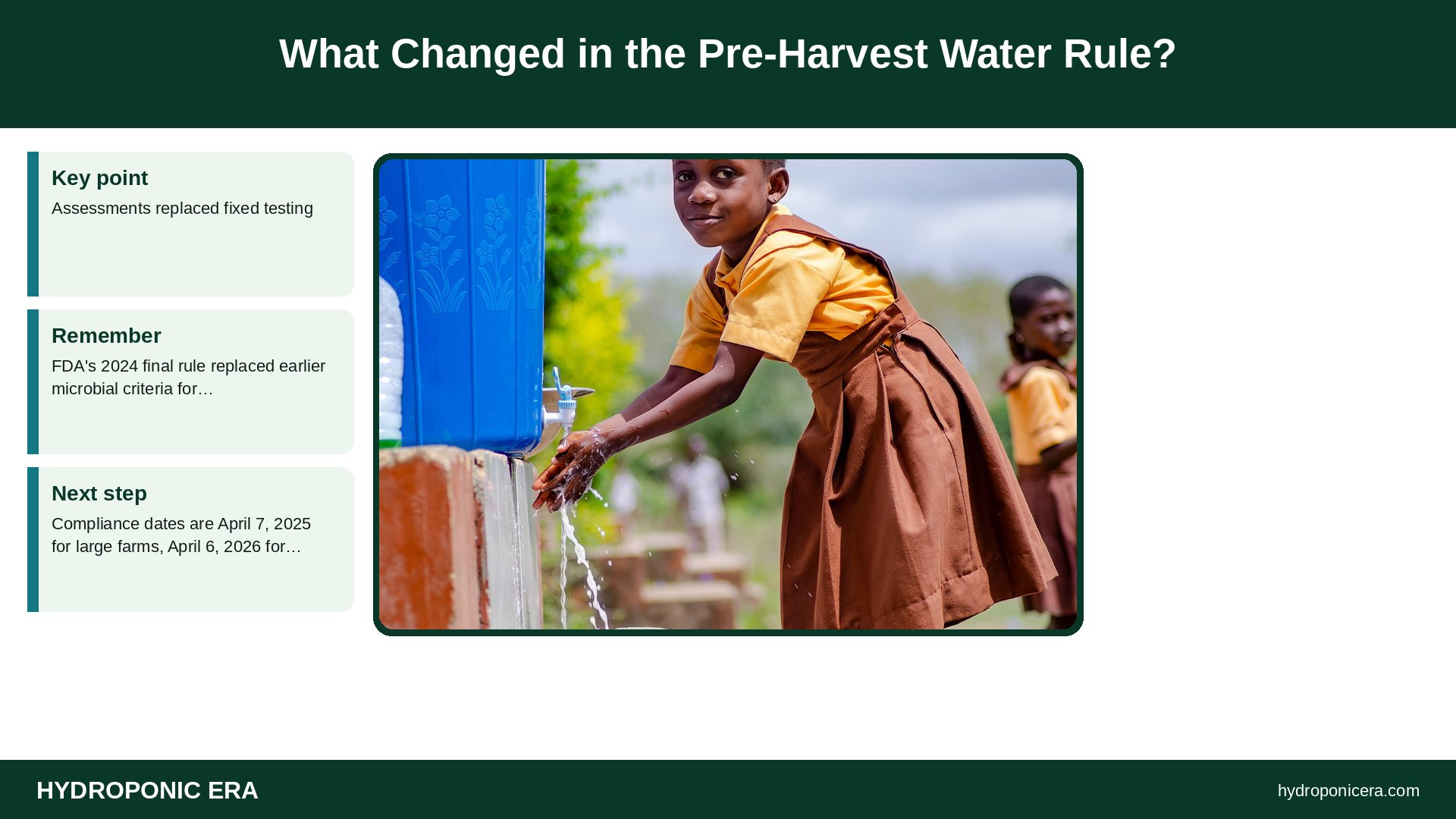
Assessments replaced fixed testing. FDA’s 2024 final rule replaced earlier microbial criteria for pre-harvest water with systems-based agricultural water assessments, done at the start of the season and at least once a year. Compliance dates are April 7, 2025 for large farms, April 6, 2026 for small farms and April 5, 2027 for very small farms.
Build a water baseline with our well water test decision tree.
Which Hydroponic Risks Does the Produce Safety Rule Target?
Water, surfaces and people. UVM Extension says rafts, troughs and media can become food-contact surfaces that need cleaning and sanitizing procedures. Lift rafts so production water does not drip onto produce or other rafts. Because hydroponics involves heavy handling during growth, worker hygiene, handwashing and staying home when sick are key controls.
- Track nutrient solution quality over time.
- Write cleaning and sanitizing SOPs for rafts and troughs.
- Train every worker on hygiene and handwashing.
- Keep records of inspections and corrective actions.
See our hydroponic food safety guide for home growers for the basics.

What Do Workers Need Under the Produce Safety Rule?
Training and hygiene. The produce safety rule requires farm workers who handle covered produce or food-contact surfaces, and their supervisors, to be trained, including on health and hygiene. Farms must keep ill workers from contaminating produce and provide accessible toilet and handwashing facilities, including for visitors. Standards for equipment, tools and buildings also cover greenhouses and germination chambers.
Where Can Growers Get Produce Safety Rule Training?
Through the Produce Safety Alliance. The PSA, a Cornell University, FDA and USDA partnership, offers the standard grower course, and UVM’s Northeast Center to Advance Food Safety lists PSA trainer resources with hydroponic and aquaponic supplements, plus topic guides and grower case studies. This article is general guidance, not legal advice; confirm details with FDA or your state.
FAQ About the Produce Safety Rule
Is hydroponic eggplant covered?
No. FDA lists eggplant among crops rarely consumed raw, which are exempt.
Are sprouts treated differently?
Yes. Sprouts have their own Subpart M requirements.
Do I need to test water?
Pre-harvest water now relies on an annual assessment; harvest water must meet a no detectable generic E. coli per 100 mL criterion.
When did small farms have to comply?
For most standards, FDA set January 28, 2019 for small businesses.
Is it legal advice?
No. Check FDA and state guidance for your farm.
Sources
- U.S. Food and Drug Administration — FSMA Final Rule on Produce Safety and Pre-Harvest Agricultural Water
- FDA — FAQ: Agricultural Water Requirements
- University of Vermont Extension, NECAFS — Produce Safety in Hydroponic and Aquaponic Operations
- Produce Safety Alliance, Cornell University — Produce Safety Rule Resources
- Photo credits (Wikimedia Commons, edited with titles): Deepwater Aquaponics Floating Rafts Growing Lettuce, Basil and Arugula by Alabama Extension (CC0); Deep water culture by ArcadiYay (CC BY-SA 4.0); Pupil washes hands during COVID-19 pandemic in Ghana by Amuzujoe (CC BY-SA 4.0); Lettuce harvest in Nobeyama by On-chan (CC BY-SA 3.0)