
How do you control cabbage loopers? Control a cabbage looper problem by checking leaf undersides weekly, handpicking caterpillars, covering crops with floating row covers or screening greenhouse vents, and spraying Bacillus thuringiensis (Bt) while larvae are small. Extension guides from UC IPM, Utah State and Maryland agree that early action matters, because older loopers bore into heads.
Key takeaway: Scout leaf undersides, exclude moths with covers or screens, handpick, and use Bt on young larvae.
| Method | How it works | Source |
|---|---|---|
| 1. Scout | Check leaf undersides for eggs and small larvae weekly | USU, UC IPM |
| 2. Handpick | Remove caterpillars on small plantings | USU, UMD |
| 3. Cover | Floating row covers held above the leaves | UC IPM, USU |
| 4. Screen | Mesh on greenhouse vents and seedling flats | UC IPM |
| 5. Bt spray | Bt kurstaki on young larvae, full coverage | UW-Madison, USU |
| 6. Conserve | Protect parasitic wasps and flies | UC IPM |
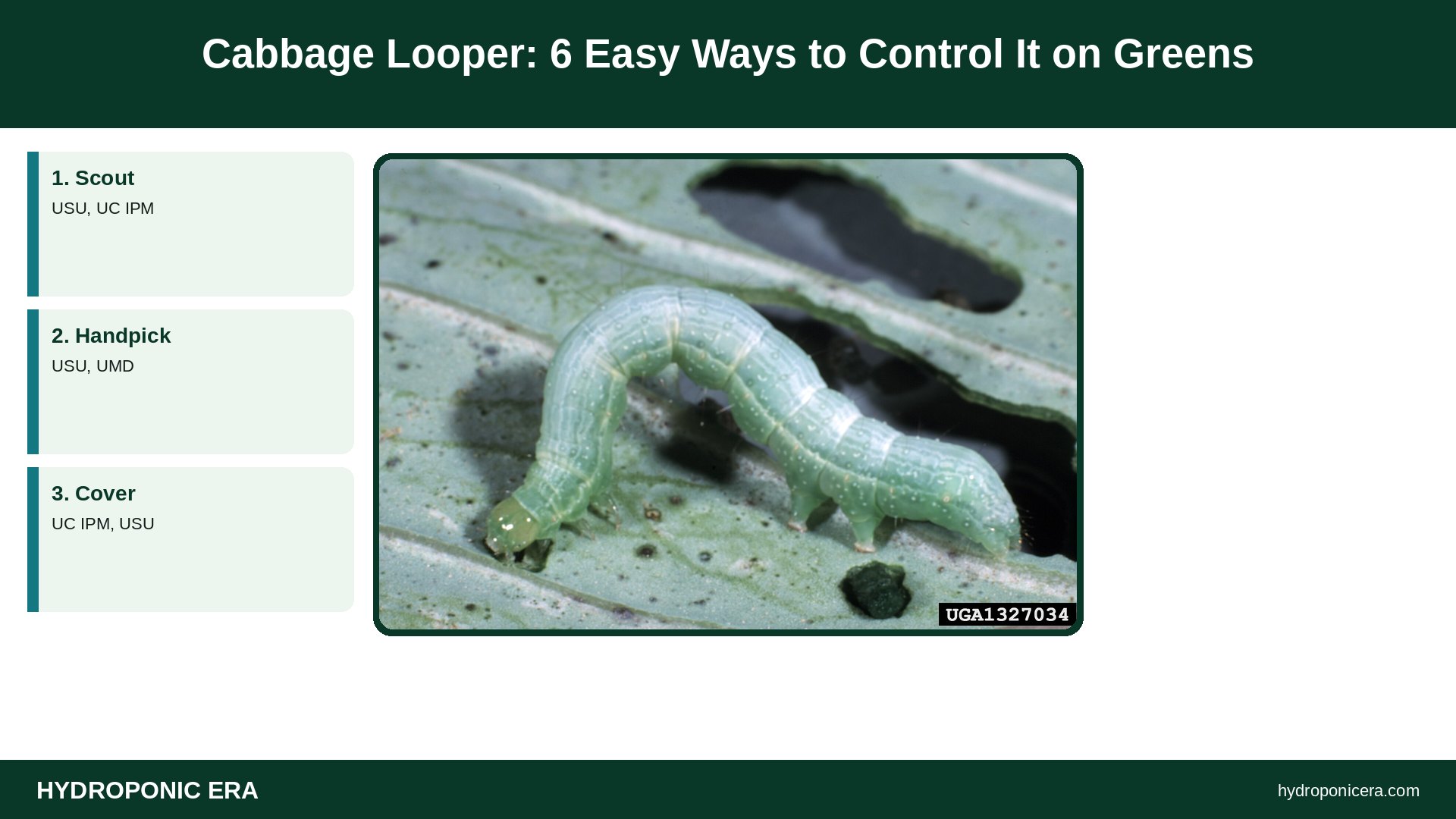
What Does a Cabbage Looper Look Like?
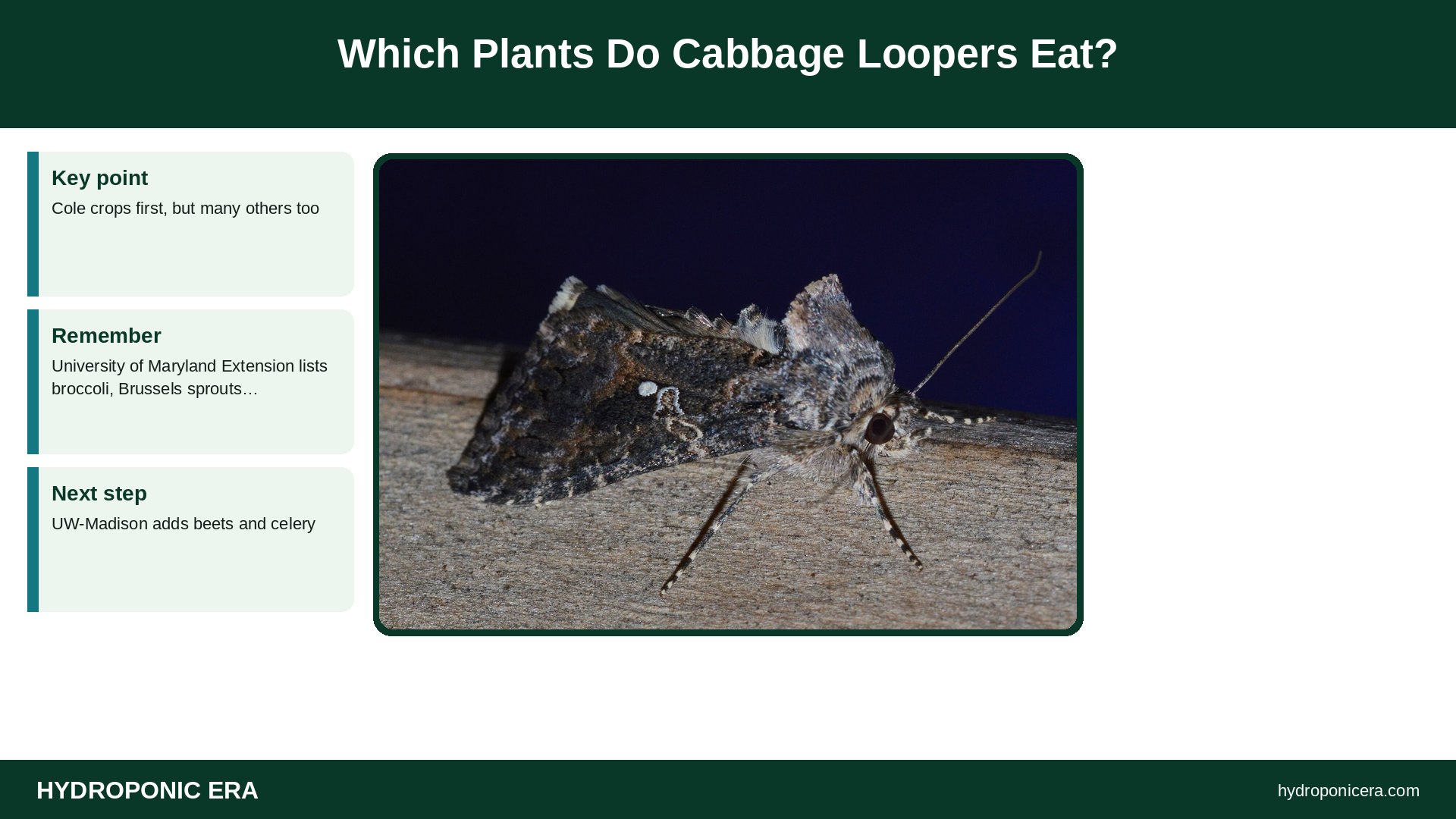
A green caterpillar that loops as it walks. UC IPM says larvae grow up to 1.5 inches (3.8 cm) long, are green with a narrow white stripe on each side, and arch their middle body to move. They have two pairs of mid-body prolegs. The adult is a mottled gray-brown moth with a silvery figure-8 mark on each forewing.
Which Plants Do Cabbage Loopers Eat?
Cole crops first, but many others too. University of Maryland Extension lists broccoli, Brussels sprouts, cabbage, cauliflower, collards, kale and turnips, plus potato, tomato, pea, lettuce and spinach. UW-Madison adds beets and celery. That range makes loopers a real risk for hydroponic leafy greens such as kale and lettuce.
What Damage Do Cabbage Loopers Cause?
Ragged holes and dirty heads. Maryland Extension explains that young larvae feed on leaf undersides, leaving thin “windowpane” patches, while older larvae chew ragged holes and may bore into cabbage and broccoli heads. UC IPM notes loopers also contaminate leaves with their bodies and frass, the moist droppings that ruin market quality.
How Fast Do Cabbage Loopers Develop?
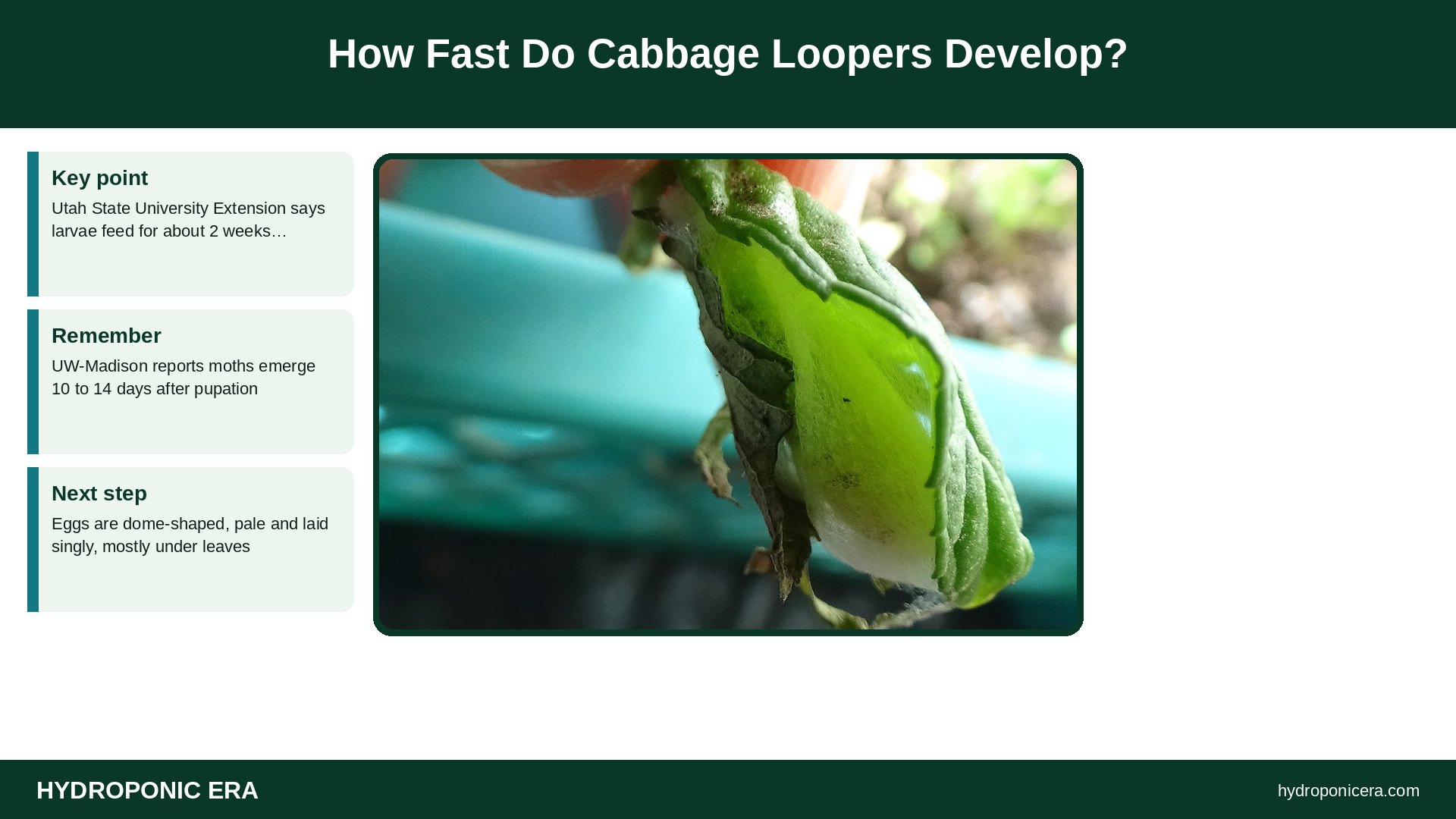
Quickly. Utah State University Extension says larvae feed for about 2 weeks before pupating, and the time from egg to adult is about 30 days, with three to four generations per year in Utah. UW-Madison reports moths emerge 10 to 14 days after pupation. Eggs are dome-shaped, pale and laid singly, mostly under leaves.
How Do You Scout for Loopers in Hydroponic Greens?
Look under leaves every week. USU suggests checking one of every ten plants (10 percent) in small plantings, searching leaf undersides for eggs and small larvae, and looking inside damaged heads. Pheromone traps baited for Trichoplusia ni catch male moths and show when egg laying starts. UW-Madison advises relying on larvae counts rather than holes alone.
- Flip lower leaves and check the undersides.
- Follow fresh holes and frass to find the larva.
- Record counts so you can see trends.
How Do You Keep Cabbage Loopers Out of a Greenhouse?
Exclude the moths. UC IPM advises screening greenhouse vents with mesh that still allows airflow, covering seedling flats, and fully screening shade houses, especially when lights are on at night, because artificial lighting attracts some moths. Hood lamps downward and use motion-sensor security lights. Maryland Extension also says to inspect transplants carefully before bringing them in.
Pair screening with sticky traps placed for pest pressure to track flying pests.
Do Row Covers Stop Cabbage Loopers?
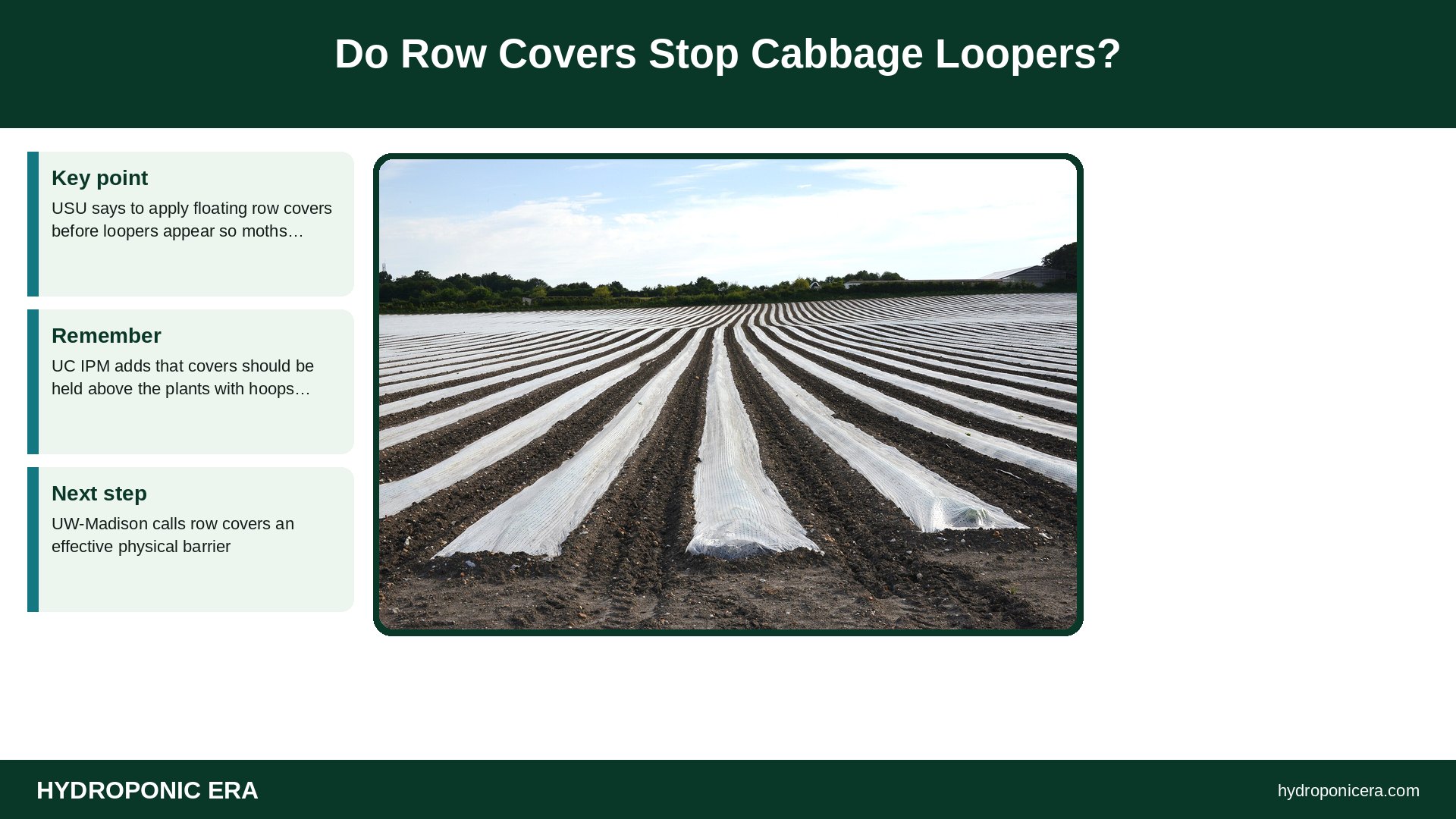
Yes, if installed early. USU says to apply floating row covers before loopers appear so moths cannot lay eggs, then remove them during flowering for pollination. UC IPM adds that covers should be held above the plants with hoops, since moths can lay eggs through mesh touching the leaves. UW-Madison calls row covers an effective physical barrier.
Does Bt Kill Cabbage Loopers?
Yes, when larvae are young. UW-Madison says Bacillus thuringiensis var. kurstaki or aizawai applied to early-instar larvae can be very effective, and coverage must be thorough because caterpillars must eat it. UC IPM prefers Bt because it spares natural enemies. Spinosad also works, and Maryland Extension notes neem is effective. Always follow the label.
For other low-impact options see our guides to neem oil for plants and insecticidal soap.
Which Natural Enemies Attack Cabbage Loopers?
Several parasites help. UC IPM lists the egg parasite Trichogramma, larval parasitic wasps such as Copidosoma truncatellum and Hyposoter exiguae, the tachinid fly Voria ruralis, and a natural virus that turns caterpillars into dark, liquid sacks. Trichogramma wasps are sold for release. Avoid broad-spectrum sprays that kill these allies.
FAQ About the Cabbage Looper
Are cabbage loopers the same as cabbage worms?
No. Imported cabbageworms have four pairs of mid-body prolegs; loopers have two.
When are loopers worst?
UC IPM says numbers often peak in fall in California.
Does Bt harm bees?
UC IPM ranks Bt among the safest choices for natural enemies; follow the label.
Can I just pick them off?
Yes. Handpicking works well in small plantings.
Are any cabbages resistant?
USU lists ‘Green Winter’, ‘Savor’, ‘Savoy Chieftain’ and most red cabbages.
Sources
- UC Statewide IPM Program — Cabbage Looper in Cole Crops and in Floriculture and Nurseries
- Utah State University Extension — Cabbage Looper
- University of Maryland Extension — Cabbage Looper on Vegetables
- University of Wisconsin-Madison, Delahaut — Cabbage Looper
- Photo credits (Wikimedia Commons, edited with titles): Trichoplusia ni larva by Alton N. Sparks, Jr., University of Georgia, United States (CC BY 3.0 us); – 8887 – Trichoplusia ni – Cabbage Looper Moth (14465544274) by Andy Reago & Chrissy McClarren (CC BY 2.0); Cabagge hooper pupa by Lua Eva Blue (CC BY 3.0); Bâches à plat agricoles dans un champ (3) by Jean-Pierre Bazard Jpbazard (CC BY-SA 3.0)