
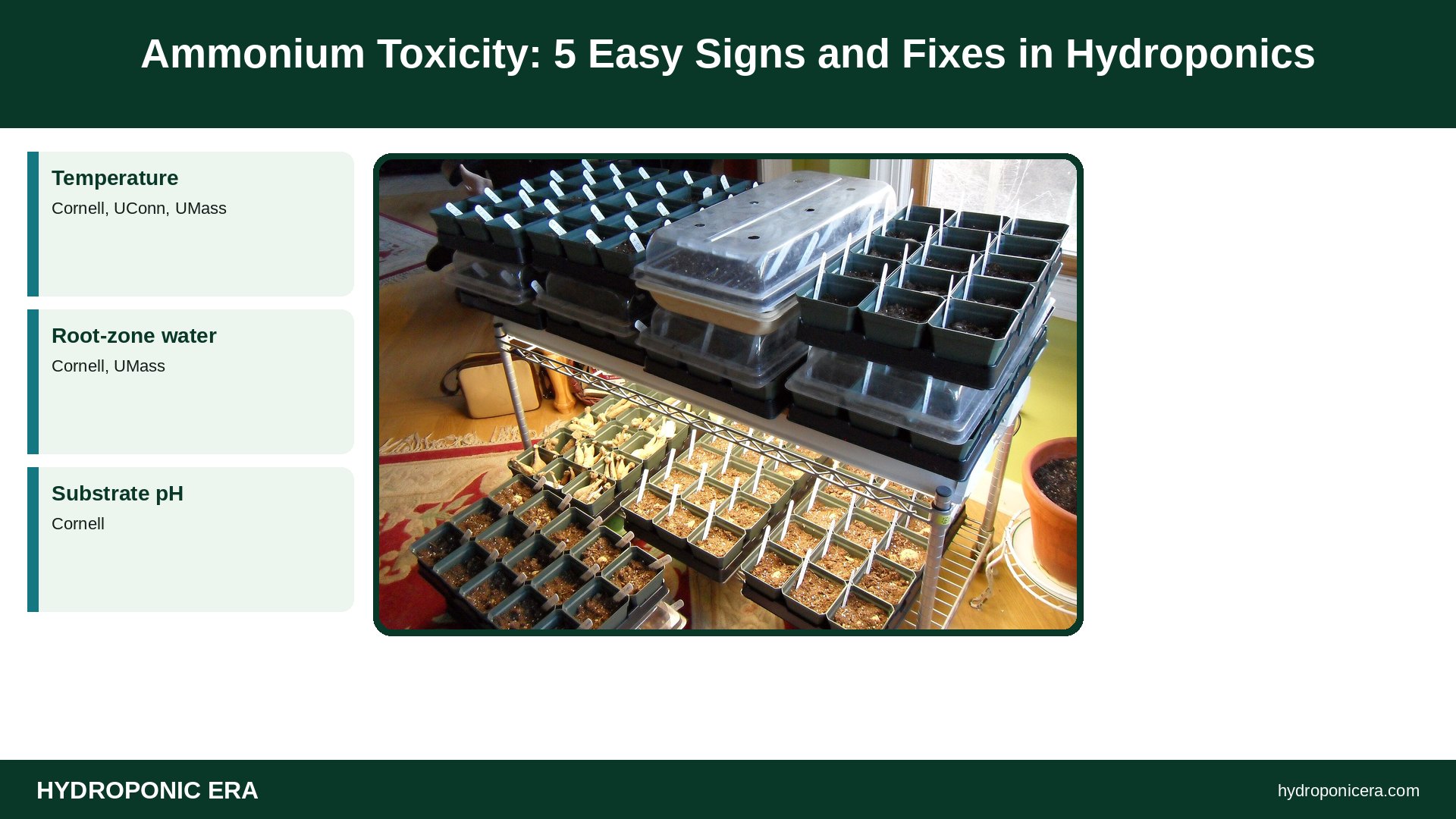
What is ammonium toxicity in plants? Ammonium toxicity is damage from plants absorbing too much ammonium nitrogen. It shows as yellowing between veins, curled leaf edges and dead root tips. Cornell, UMass and UConn say it strikes most in cool, wet, low-oxygen, low-pH conditions below 60°F (15°C), when nitrifying bacteria stop converting ammonium to nitrate.
Key takeaway: Ammonium toxicity follows cold, wet, acidic root zones; fix it with warmth, nitrate feed and leaching.
| Factor | Risk condition | Safer target | Source |
|---|---|---|---|
| Temperature | Below 60°F (15°C) average | Above 60°F (15°C) | Cornell, UConn, UMass |
| Root-zone water | Saturated, low oxygen | Moist, drying between waterings | Cornell, UMass |
| Substrate pH | Low | High end of crop range, e.g. 6.2–6.5 | Cornell |
| Ammoniacal N share | Over 40% of total N | 40% or less, lower in dark weather | Cornell |
What Causes Ammonium Toxicity in Plants?
Excess ammonium the plant cannot safely store. Cornell explains that nitrate can be stored safely, but too much stored ammonium damages cells. Under warm, well-aerated conditions, bacteria called nitrifiers convert ammoniacal nitrogen to nitrate, so build-up is rare. Ammonium toxicity happens when those bacteria are suppressed and ammonium accumulates in the root zone.
What Are the Symptoms of Ammonium Toxicity?
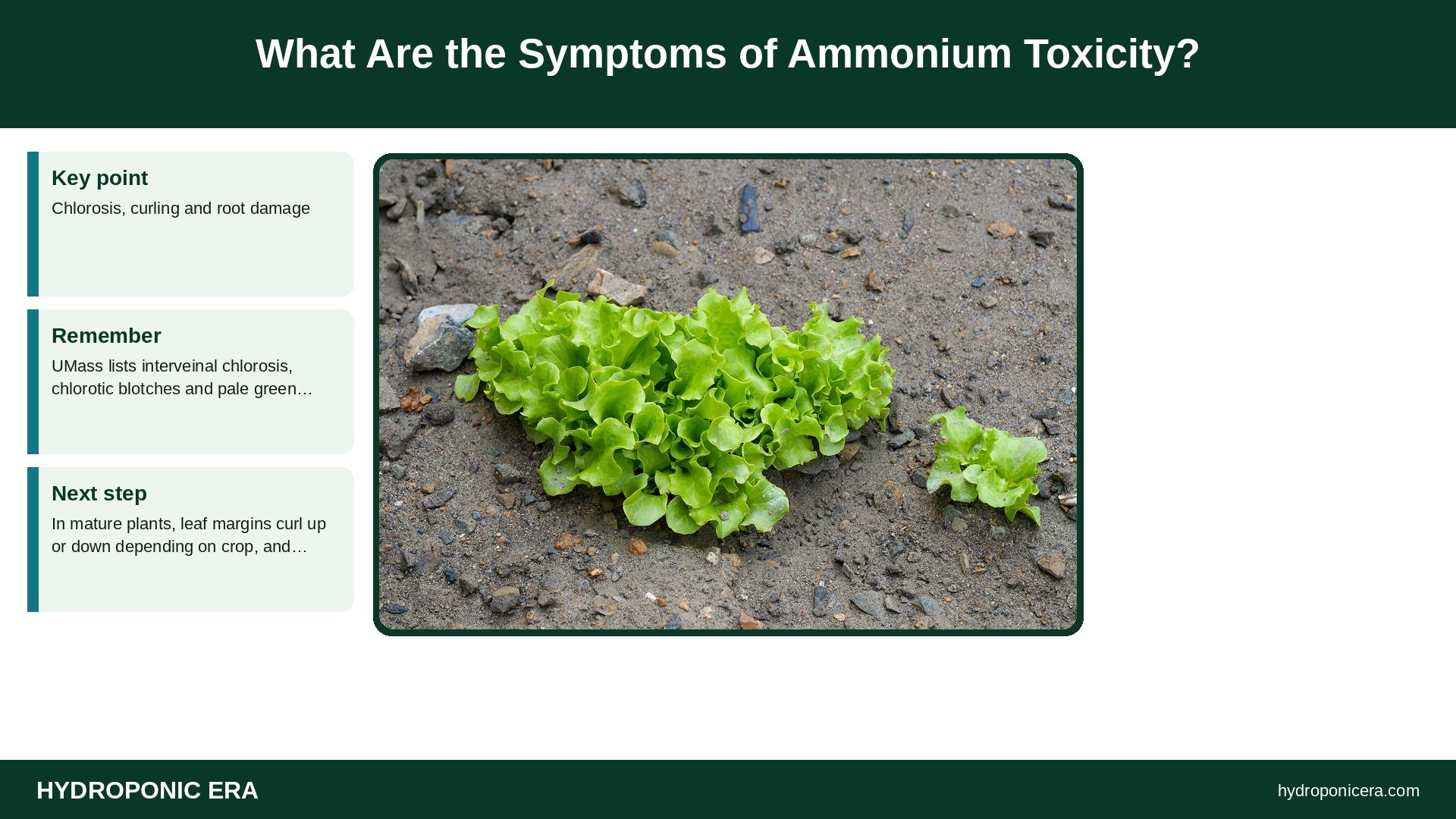
Chlorosis, curling and root damage. UMass lists interveinal chlorosis, chlorotic blotches and pale green foliage that are easily confused with iron deficiency. In mature plants, leaf margins curl up or down depending on crop, and roots become fewer with brown necrotic tips. UConn adds scattered necrotic spots and stunting.
Rule out look-alikes with our iron deficiency in hydroponics guide.
Which Leaves Show Ammonium Toxicity First?
It depends on plant age. Cornell says that in bedding plants and plugs, symptoms appear first in younger leaves, while on more mature crops the mid to older leaves are affected. UConn notes young leaves of transplants are hit first and older leaves show symptoms later. Damaged root tips can become entry points for root diseases.
Which Plants Are Most Sensitive to Ammonium?
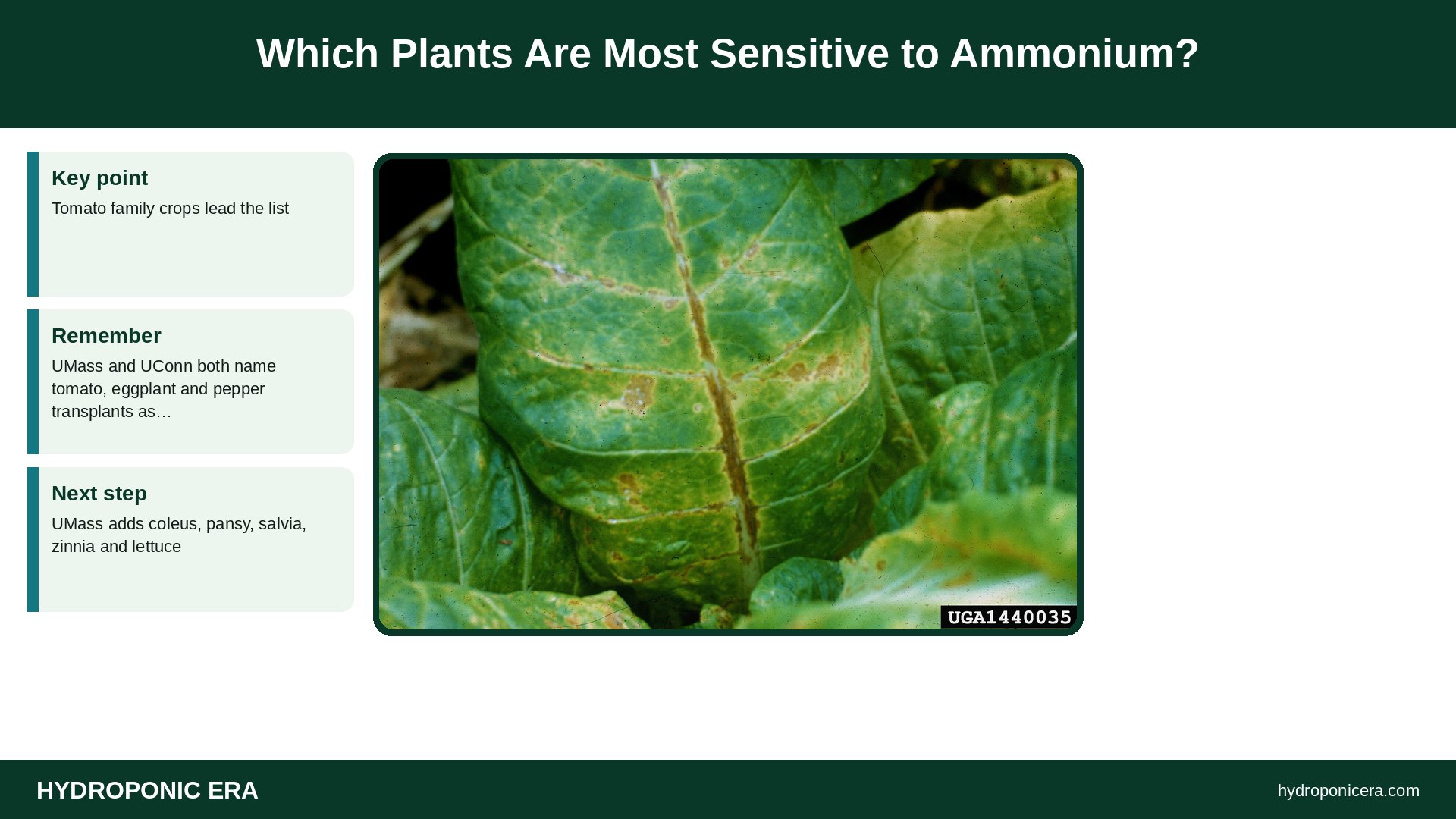
Tomato family crops lead the list. UMass and UConn both name tomato, eggplant and pepper transplants as particularly sensitive to high ammonium. UMass adds coleus, pansy, salvia, zinnia and lettuce. Growers raising these crops in cool seasons should watch closely and favor nitrate-based feeds.
For tomato leaf problems, see our hydroponic tomato yellow leaves guide.
When Is Ammonium Toxicity Most Likely?
In cold, cloudy, wet weather. UMass says extended cold, cloudy periods leave substrates saturated and short of oxygen, which suppresses nitrifying bacteria. Cornell flags average daily temperatures below 60°F (15°C), wet or low-oxygen media and low pH, adding that winter and early spring carry the highest risk.
How Do You Fix Ammonium Toxicity?
Warm up, switch fertilizer and leach. Cornell and UMass give the same core steps. Raise greenhouse or root-zone temperature, stop the ammoniacal fertilizer, then leach with clear water and let the medium dry between irrigations. Cornell says to re-water with a nitrate-based fertilizer and hold to it until conditions improve.
- Raise air and root-zone temperature above 60°F (15°C).
- Stop feeding ammoniacal or urea nitrogen.
- Leach with clear water; let the medium dry down.
- Resume with a nitrate-based feed.
- Recheck pH and EC with a meter.
Learn proper flushing in our when to flush a hydroponic system guide.

Does Gypsum Help Severe Ammonium Toxicity?
Cornell says it can. For severe cases, apply 1 tablespoon (about 15 mL) of gypsum as a top-dress to a 6-inch (15 cm) pot, water in with clear water, then follow two hours later with a 50 ppm calcium nitrate drench. Ammonium binds with sulfate from gypsum and becomes soluble, so it flushes out more easily.
How Do You Prevent Ammonium Toxicity?
Limit ammoniacal nitrogen in cool weather. Cornell advises keeping ammoniacal forms at no more than 40% of total nitrogen, and less in very cold, dark conditions, for example a 15-0-15 feed. UMass suggests balanced feeds such as 15-0-15, 13-2-13 or 15-5-15 Cal-Mag, avoiding overwatering and keeping temperatures above 60°F (15°C).
Calcium nitrate is a common nitrate source; see our calcium nitrate hydroponics guide.
Why Does Ammonium Lower Root-Zone pH?
Plants release protons when they absorb it. Cornell explains that as plants take up ammonium, substrate pH decreases because roots release protons to keep their own pH stable. That is why fertilizer makers blend nitrogen forms to suit water alkalinity. Since low pH also slows nitrifiers, a falling pH can make the problem worse.
FAQ About Ammonium Toxicity
Is ammonium toxicity the same as nitrogen burn?
Not exactly. It is specific to excess ammonium, not total nitrogen or salts.
Can testing catch it early?
Yes. Cornell advises periodic lab tests of substrate ammonium levels.
Does compost cause it?
UConn says compost high in poultry litter or food waste can be high in ammonium.
What temperature prevents it?
Keep growing areas above 60°F (15°C), per UMass and Cornell.
Sources
- Cornell University — Ammonium Toxicity: Avoid Getting Burned This Winter (Neil Mattson)
- UMass Extension — Greenhouse Updates: Cold, Cloudy Weather Can Lead to Ammonium Toxicity
- UConn Extension IPM — Preventing Nutritional Problems in Vegetable Transplants
- Photo credits (Wikimedia Commons, edited with titles): Dahlias started indoors by F. D. Richards from Clinton, MI (CC BY-SA 2.0); Lettuce Closeup Greenhouse Phuktal Zanskar Jun24 A7CR 00442 by This Photo was taken by Timothy A. Gonsalves. Feel free to use my photos, but pl (CC BY-SA 4.0); Tobacco vein mottling virus TVMV by R.J. Reynolds Tobacco Company , R.J. Reynolds Tobacco Company, Bugwood.org (CC BY 3.0 us); Septoria leaf spot symptoms on tomato leaf (Septoria lycopersici on Solanum lycopersicum leaf) by MerielGJones (CC BY-SA 4.0)