
What is a parthenocarpic cucumber? A parthenocarpic cucumber sets fruit without pollination, so fruit is seedless or nearly seedless and needs no bees. That makes it the standard choice for greenhouses, grow tents and hydroponics. Penn State, UF/IFAS and Holmes Seed note that if pollination does occur, fruit can turn seeded, misshapen and bitter, so keep pollinators out.
Key takeaway: Parthenocarpic cucumbers fruit without bees; keep pollen away to avoid seeded, bitter, misshapen fruit.
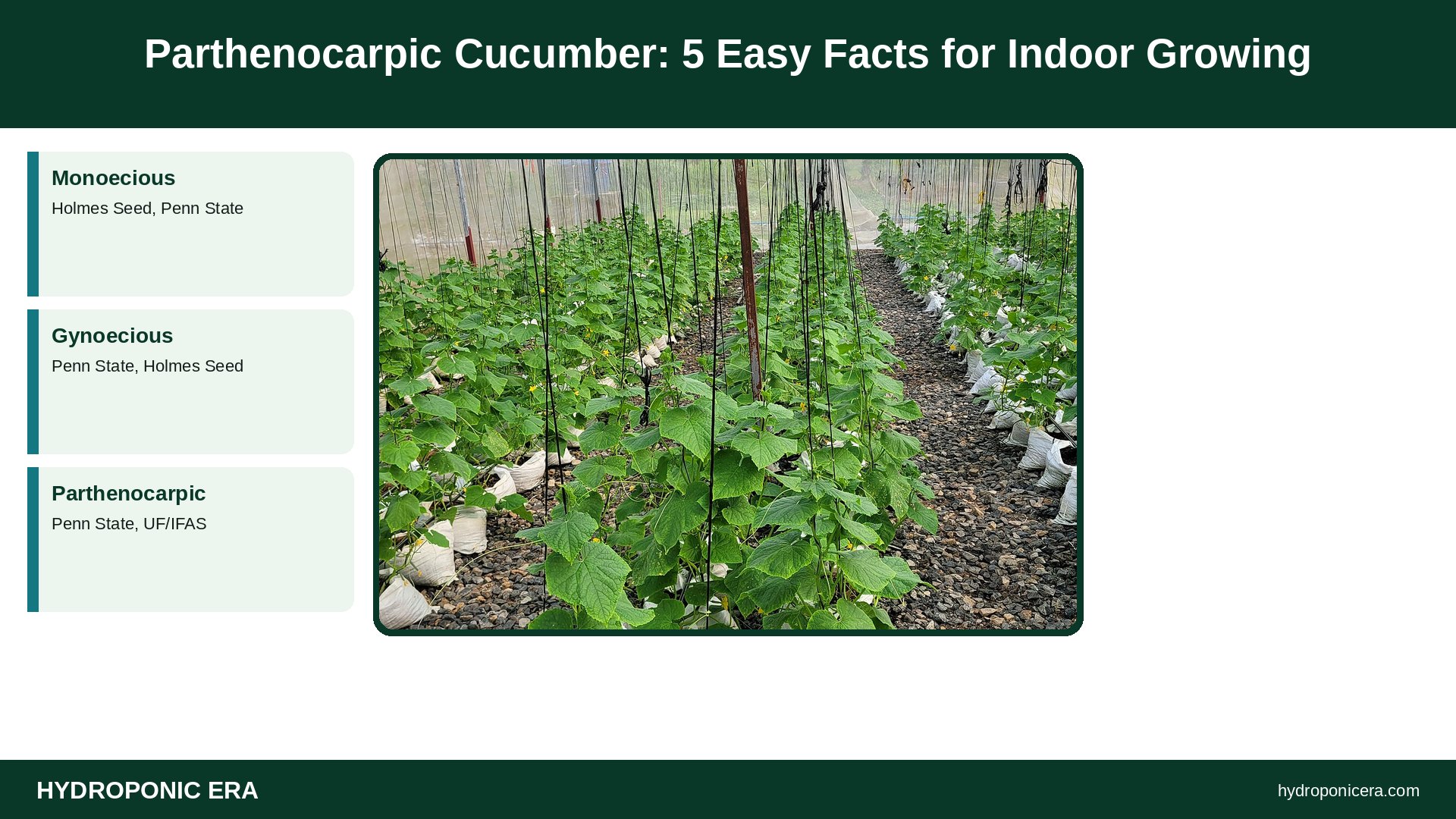
| Term | Meaning | Needs pollination? | Source |
|---|---|---|---|
| Monoecious | Separate male and female flowers on one plant | Yes | Holmes Seed, Penn State |
| Gynoecious | Mostly or only female flowers | Usually, unless also parthenocarpic | Penn State, Holmes Seed |
| Parthenocarpic | Fruit develops without fertilization | No | Penn State, UF/IFAS |
| European type | Long, thin-skinned, seedless | No | Penn State, UF/IFAS |
How Does a Parthenocarpic Cucumber Set Fruit?
Without fertilization. Holmes Seed explains that parthenocarpy describes the ability to develop fruit without pollination and fertilization, so unpollinated fruit stays seedless or nearly seedless. The small ovary behind each female flower simply swells into a cucumber. Penn State adds that parthenocarpic cultivars are also gynoecious, producing mostly female flowers.
Why Grow a Parthenocarpic Cucumber Indoors?
No pollinators needed. Indoors there are no bees, so standard cucumbers need hand pollination to set fruit. Holmes Seed says parthenocarpy is especially valuable in greenhouses and high tunnels where pollinators are limited or excluded. UF/IFAS notes both standard European and mini greenhouse cultivars are parthenocarpic, which suits hydroponic tents and indoor gardens.
If you grow seeded types, see our indoor pollination guide.
What Happens If a Parthenocarpic Cucumber Gets Pollinated?
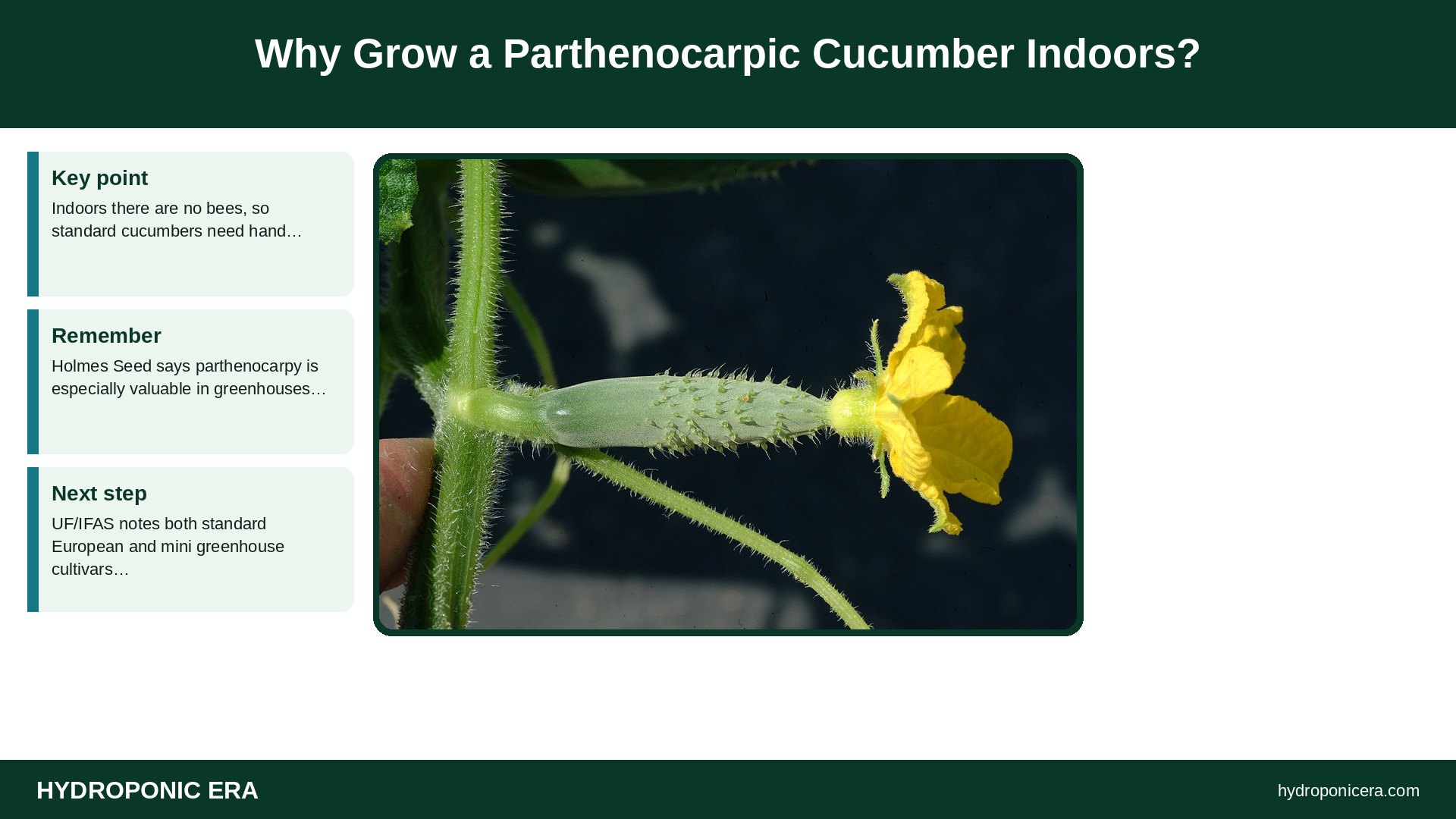
Fruit quality drops. UF/IFAS warns that if pollination occurs, fruit forms seeds, its shape becomes distorted and a bitter taste can develop, so bees and other pollinators must be kept out of the greenhouse. Penn State says seeded, bitter and misshapen fruit can result and suggests insect screening to exclude pollinators.
For other causes of bitterness, read our guide to bitter cucumbers.
Is Gynoecious the Same as Parthenocarpic?
No. Holmes Seed explains gynoecious and monoecious describe flower types, while parthenocarpic describes fruit set, so a cucumber can be both. Penn State notes some gynoecious cultivars still need pollination, and their seed packets include pollinator seed. Only gynoecious cultivars that are also parthenocarpic set seedless fruit with no pollen at all.
Which Cucumber Types Are Parthenocarpic?
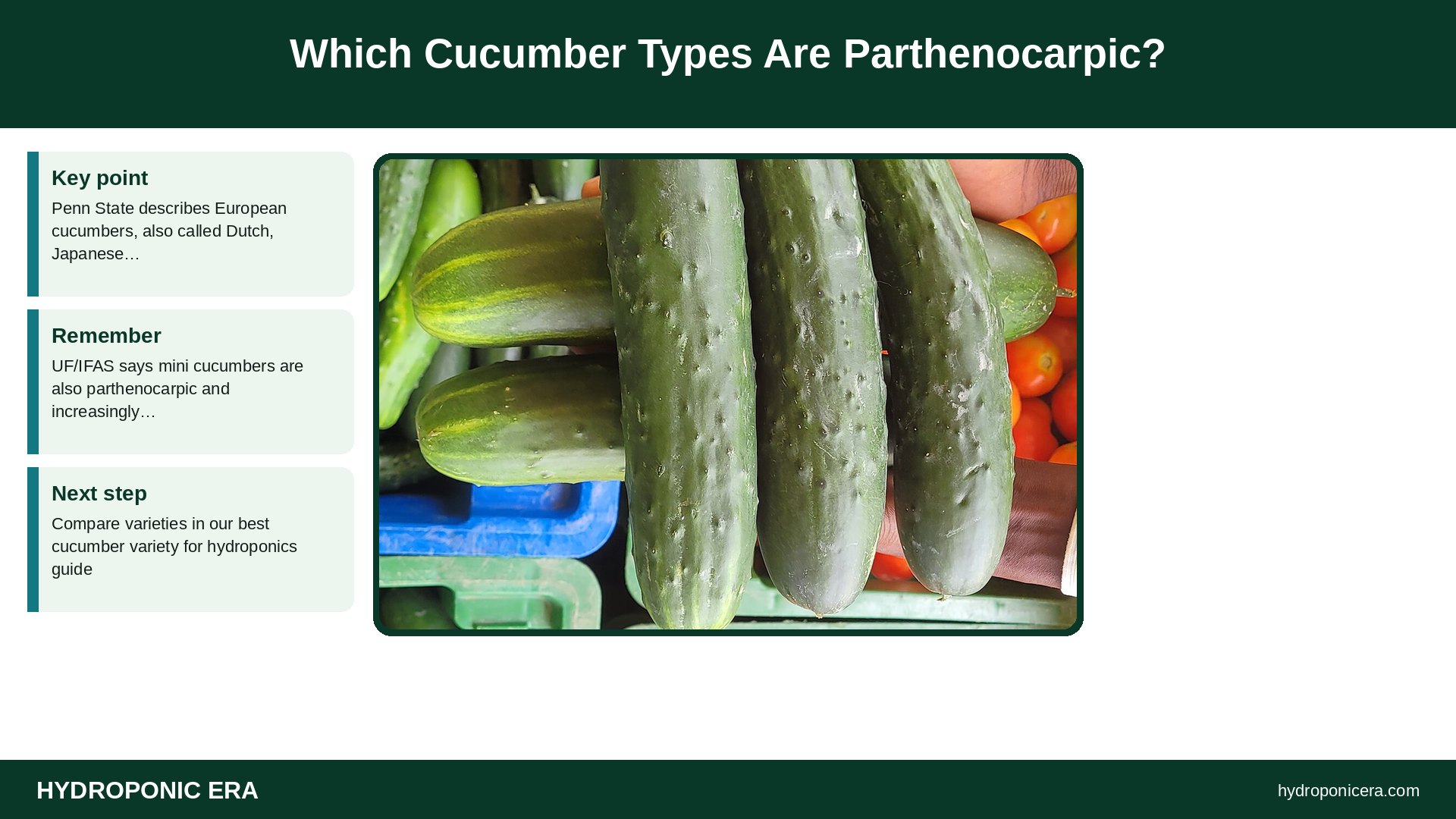
Mainly greenhouse types. Penn State describes European cucumbers, also called Dutch, Japanese or hothouse types, as parthenocarpic and seedless, commonly 12 to 14 inches (30 to 36 cm) long and about 1 pound (0.45 kg). UF/IFAS says mini cucumbers are also parthenocarpic and increasingly popular because they need no shrink wrap.
Compare varieties in our best cucumber variety for hydroponics guide.
How Do You Grow a Parthenocarpic Cucumber in Hydroponics?
Warm, trellised and pruned. UF/IFAS lists NFT, bag culture, upright containers and rockwool among suitable systems, with ideal growing temperatures of 80 to 85°F (27 to 29°C) and minimums no lower than 65°F (18°C). Seed germinates in 2 to 3 days at 84°F (29°C), and transplants are ready at three or four true leaves.
- Start seed at about 84°F (29°C).
- Transplant at three to four true leaves.
- Train one main stem up a string.
- Remove fruit on the lowest 24 to 30 inches (61 to 76 cm).
- Keep bees and outdoor pollen away.
Why Remove the First Fruits?
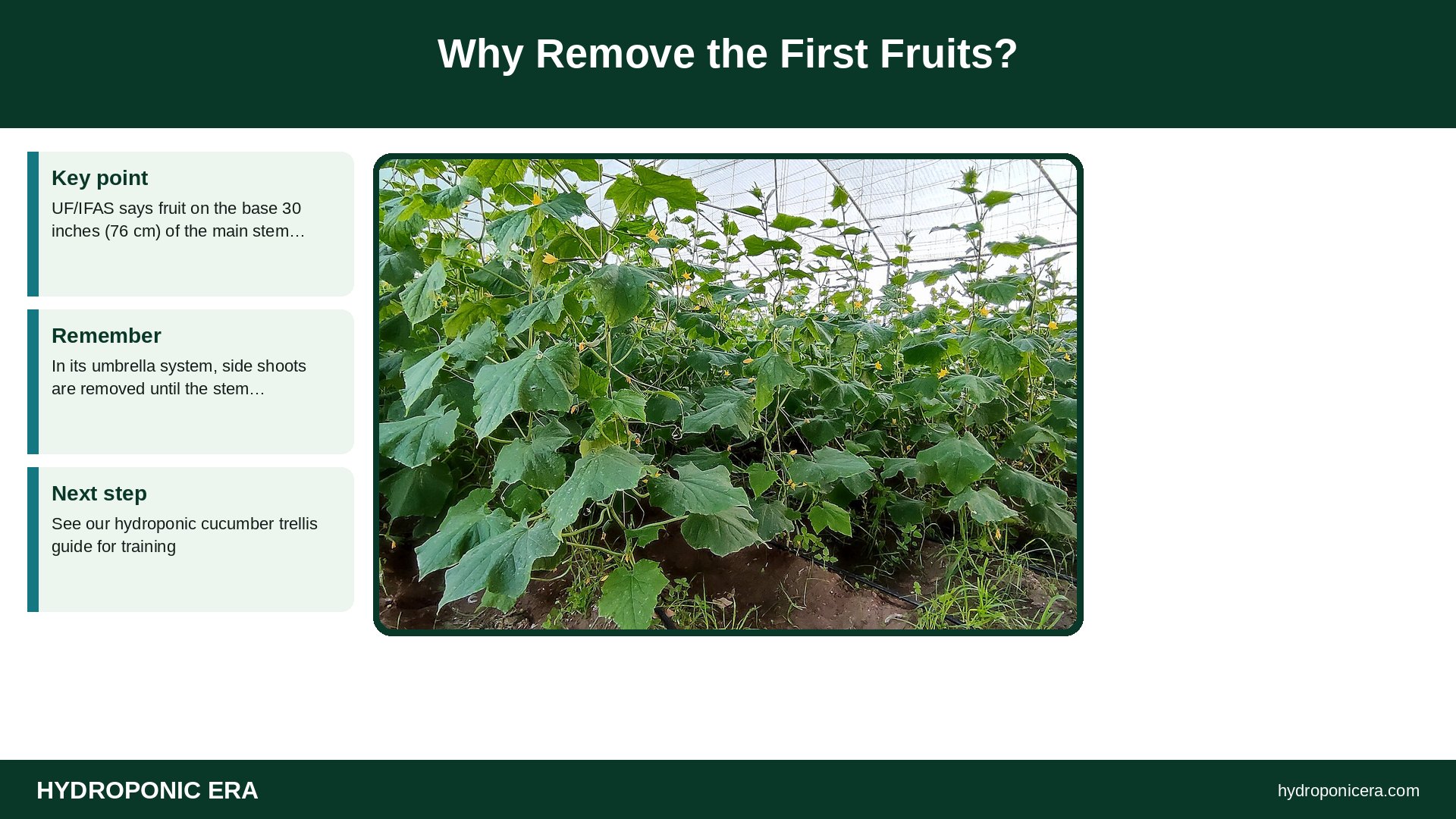
To build the plant. UF/IFAS says fruit on the base 30 inches (76 cm) of the main stem should be pruned off as soon as it appears, letting the plant put early energy into vegetative growth that is essential for maximum production. In its umbrella system, side shoots are removed until the stem reaches the overhead wire.
See our hydroponic cucumber trellis guide for training.
How Do You Tell Male and Female Cucumber Flowers Apart?
Look behind the petals. Holmes Seed says a female flower has a small immature cucumber, the ovary, directly behind it, while a male flower sits on a slender stalk with no miniature fruit. On a gynoecious parthenocarpic cucumber, most flowers are female.
How Far Apart Should Greenhouse Cucumbers Be Spaced?
About 12 to 18 inches (30 to 46 cm) in the row. UF/IFAS gives single vertical cordon rows 4 to 5 feet (1.2 to 1.5 m) apart with plants 12 to 18 inches (30 to 46 cm) apart, and V-cordon rows about 5 feet (1.5 m) apart with plants about 12 inches (30 cm) apart.
Can You Save Seeds From a Parthenocarpic Cucumber?
Usually not. Unpollinated fruit is seedless or has only undeveloped seeds, per Holmes Seed and Penn State. Most greenhouse cultivars are also hybrids bred by seed companies, so buy fresh seed each season. UF/IFAS notes cultivars change frequently and suggests checking current recommendations from Extension agents and seed representatives.
FAQ About Parthenocarpic Cucumber Growing
Do parthenocarpic cucumbers need male flowers?
No. They set fruit without pollen.
Can I grow them outdoors?
Yes, but bees may pollinate them, giving seeded or misshapen fruit.
How hot is too hot?
UF/IFAS says prolonged temperatures above 95°F (35°C) reduce fruit production and quality.
Why are my leaves yellowing?
See our guide to hydroponic cucumber leaves turning yellow.
Sources
- Penn State Extension — Growing Cucumbers in High Tunnels
- UF/IFAS Extension — HS790/CV268 Greenhouse Cucumber Production
- Holmes Seed Company — Understanding Cucumber Flower Types
- Photo credits (Wikimedia Commons, edited with titles): Cucumber in the greenhouse 3 by Pascal Kings (CC BY 4.0); Einlegegurken Weibliche Blüte mit Frucht, Josef Schlaghecken by Schlaghecken Josef (CC BY-SA 4.0); Harvested vegetables(Cucumbers) by Pascal Kings (CC BY 4.0); Cucumber greenhouse plants of Dr. Mahmoud Salem’s farm by Amnsalem (CC BY-SA 4.0)