
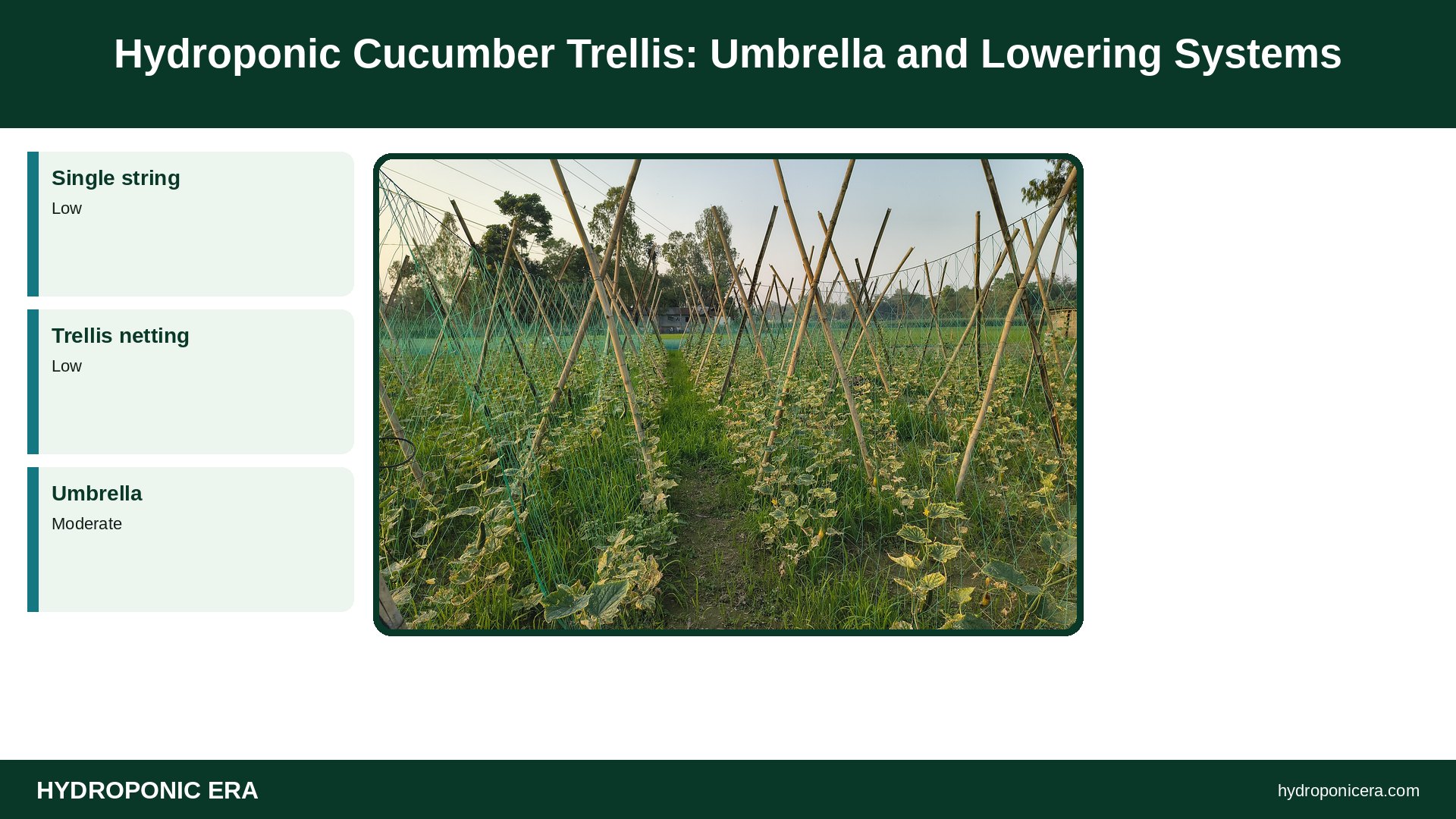
A hydroponic cucumber trellis usually means a vertical string or netting tied to a strong overhead wire 6–8 feet high, with each plant trained to a single main stem. The two common greenhouse systems are the umbrella system, where the stem is stopped at the wire and two side shoots hang down, and the lowering (high-wire) system, where the stem keeps growing and is lowered along the row. In tents and small spaces, a single string or a 6-inch-square trellis net works well for mini and Beit Alpha cucumbers.
Key takeaway: Strong overhead support, one stem per string, no fruit or side shoots in the first 4–5 nodes, and regular training as the vine grows.
| System | Wire height | Best for | Effort |
|---|---|---|---|
| Single string | 6–8 ft | Tents, small greenhouses | Low |
| Trellis netting | 5–7 ft | Buckets, multiple plants | Low |
| Umbrella | 6–7 ft | Home greenhouses, long English | Moderate |
| High-wire lowering | 8–12 ft | Commercial greenhouses | High |
| A-frame or arch | 5–6 ft | Outdoor or wide spaces | Low |
Why a Hydroponic Cucumber Trellis Matters
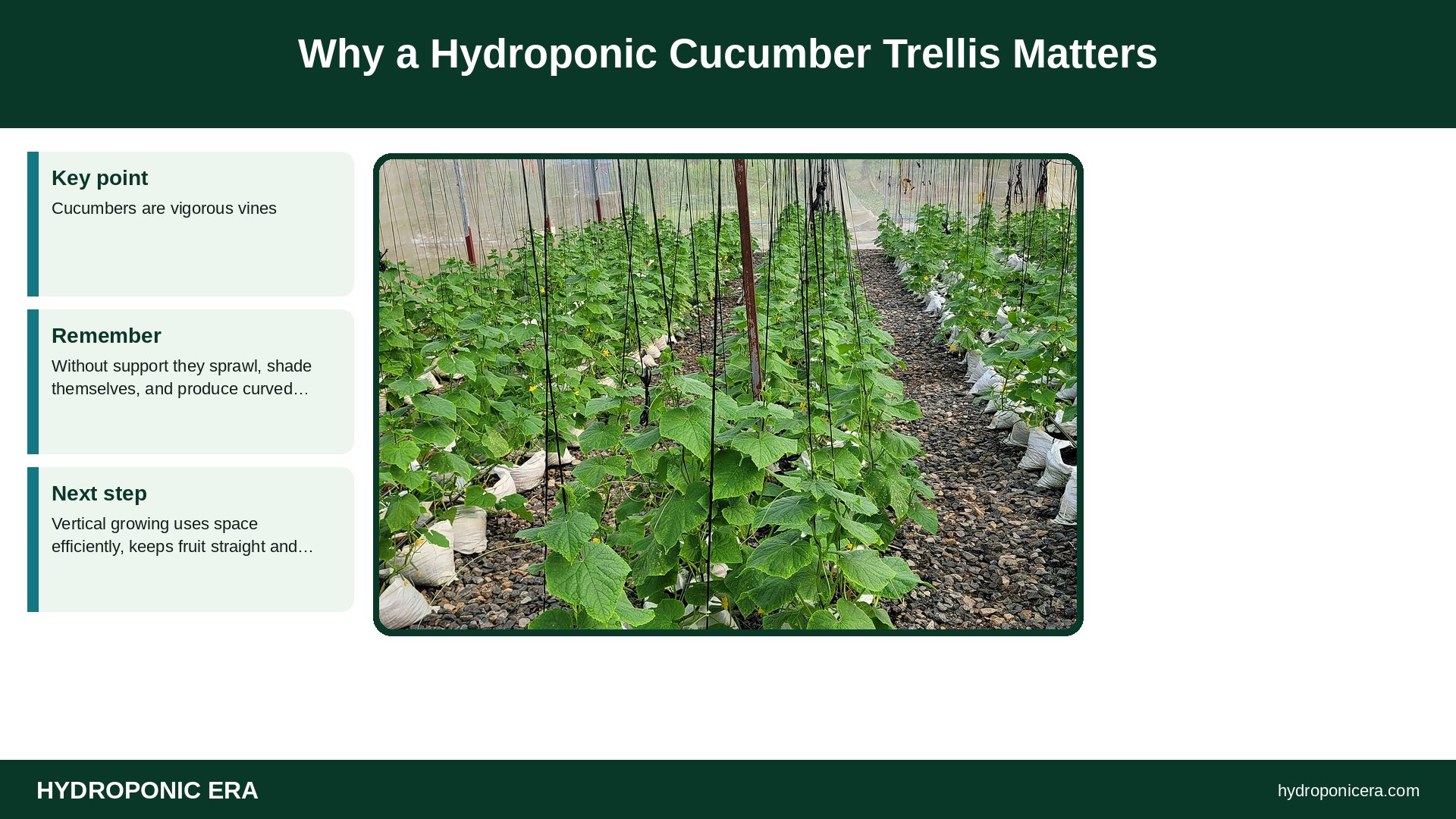
Cucumbers are vigorous vines. Without support they sprawl, shade themselves, and produce curved, dirty, or rotting fruit. Vertical growing uses space efficiently, keeps fruit straight and clean, improves airflow, and makes harvesting easy. UF/IFAS describes vertical training as standard practice in greenhouse cucumber production.
Building a Simple String Trellis
- Install a sturdy overhead support: a steel cable, pipe, or the frame of a grow tent rated for the weight. A mature vine with fruit can weigh 10–15 pounds or more.
- Tie a length of polypropylene twine to the wire above each plant.
- Anchor the bottom of the string with a loose loop around the stem base or a plant clip, or to a stake in the media. Don’t tie it tight around the stem.
- As the vine grows, twist it around the string or attach it with trellis clips every 12 inches.
Trellis clips and hooks are inexpensive and reusable. See trellising and pruning.
The Umbrella System
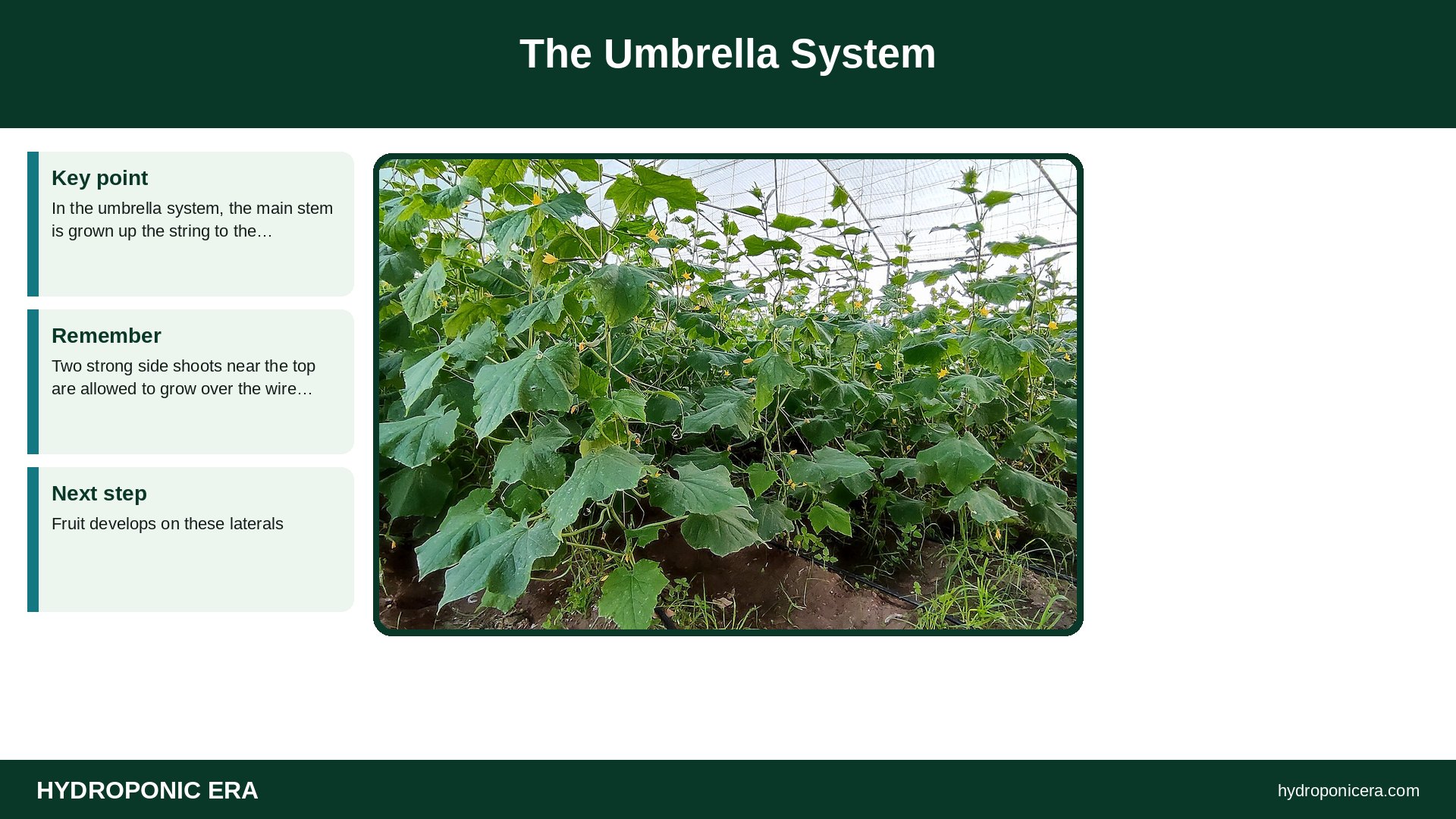
In the umbrella system, the main stem is grown up the string to the wire and then pinched off. Two strong side shoots near the top are allowed to grow over the wire and hang down, forming an umbrella shape. Fruit develops on these laterals. This system is easy to manage in home greenhouses where the wire is 6–7 feet high, and it works well for long English cucumbers.
The Lowering (High-Wire) System
In commercial greenhouses with 8–12-foot wires, the main stem keeps growing. Hooks at the top hold extra string. When the head reaches the wire, growers unwind the string, lower the plant, and move it sideways so the bare lower stem lies along the ground or on a support. All side shoots are removed. This keeps fruit at picking height for months.
Pruning Rules for Any Hydroponic Cucumber Trellis
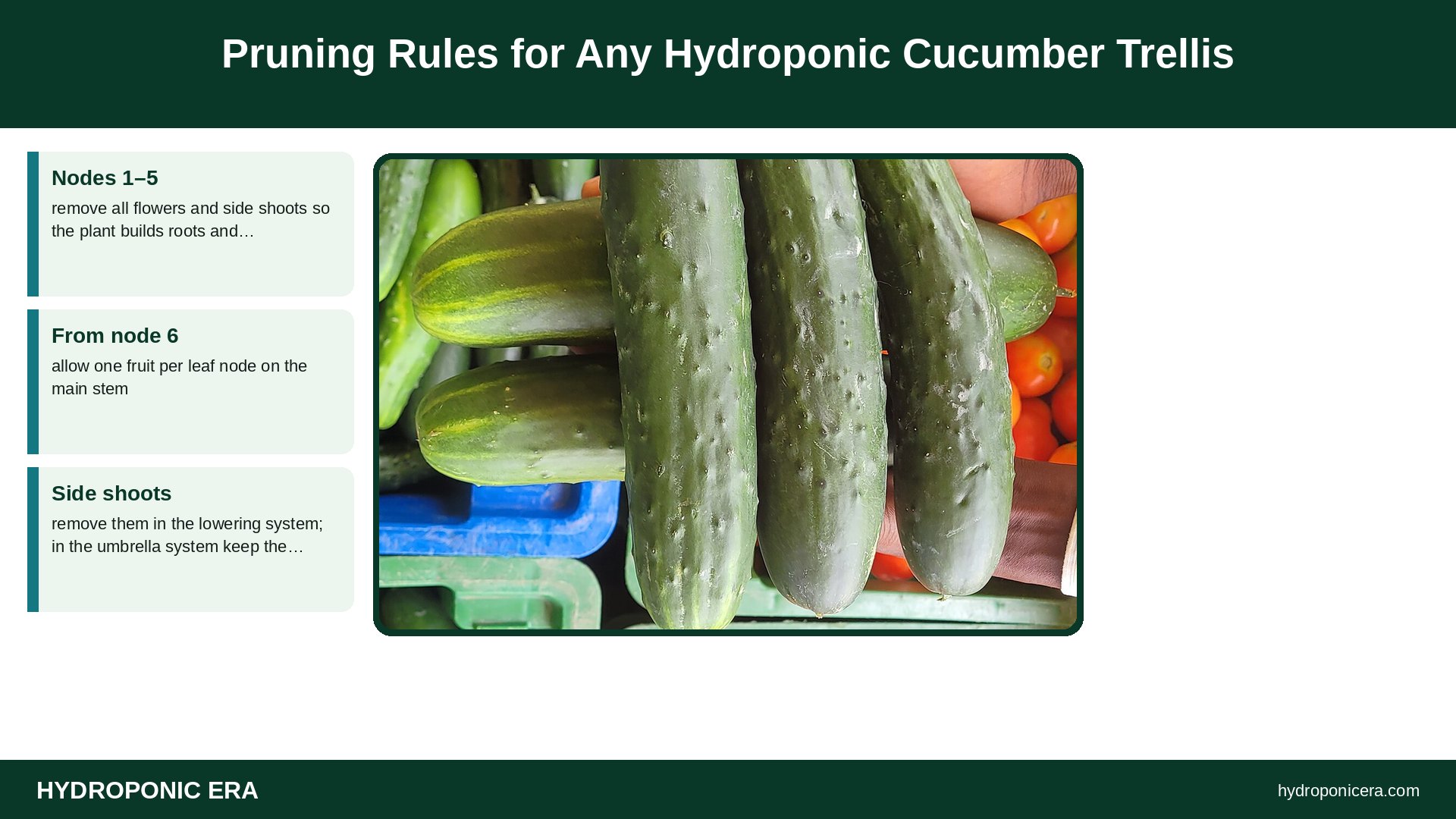
- Nodes 1–5: remove all flowers and side shoots so the plant builds roots and leaves first.
- From node 6: allow one fruit per leaf node on the main stem.
- Side shoots: remove them in the lowering system; in the umbrella system keep the top two.
- Tendrils: optional to remove; they can wrap around fruit and cause curving.
- Old leaves: remove yellow leaves below the harvested zone.
See best cucumber variety for hydroponics for seedless types suited to vertical systems.
Hydroponic Cucumber Trellis Netting for Small Systems
For a row of buckets or a tent with several plants, 6-inch mesh trellis netting stretched vertically between two supports is quick to set up. Weave vines through the netting as they grow. Netting is harder to clean than single strings, so use a new net each crop or wash it well to avoid carrying over disease.
Spacing
Give each vertically trained plant about 3–4 square feet in a greenhouse; long English cucumbers need more space than minis. In a 4-by-4-foot tent, two to four plants on strings is usually the limit. Crowding reduces light and airflow and increases powdery mildew. See plant spacing.
Systems That Work With a Trellis
- Dutch buckets: ideal; buckets sit in a row under the wire. See Dutch bucket hydroponics.
- DWC buckets: good in tents with strings from the tent frame.
- Coco or rockwool slabs: commercial standard.
- Kratky tubs: possible for mini types; anchor the tub well.
Light and Feeding on a Trellis
Vertical plants have leaves at many heights, so make sure light reaches the lower canopy. Remove old shaded leaves. Cucumbers drink heavily, up to about half a gallon per plant per day at peak, and feed at EC 1.7–2.5 mS/cm, pH 5.8–6.0. See how to grow cucumbers hydroponically.
Common Hydroponic Cucumber Trellis Problems
- Vines slipping down the string: add clips every foot.
- Curved fruit: tendrils wrapping fruit, low light, or too many fruits.
- Broken stems: the overhead wire sagged or the vine was twisted roughly.
- Powdery mildew: crowded canopy; thin leaves and add airflow. See powdery mildew.
- Yellow lower leaves: normal with age; remove them. See cucumber leaves yellow.
Weekly Trellis Routine
- Twist or clip new growth to the string.
- Remove side shoots and extra fruit.
- Remove 1–2 old lower leaves.
- Lower plants if they reached the wire.
- Harvest every day or two at peak.
Materials for a Hydroponic Cucumber Trellis
A sturdy hydroponic cucumber trellis needs a strong top support, a way to hold the string or net, and soft ties. Common choices are:
- Top support: a steel conduit, a tent crossbar or a greenhouse wire rated for the full weight of mature vines and fruit.
- Twine: polypropylene horticultural twine, which doesn’t rot in humid air.
- Clips: plastic trellis clips that wrap around the stem without cutting it.
- Hooks: spool hooks that hold extra twine for lowering the plants.
- Netting: 6-inch square plastic trellis netting for small spaces.
How Much Weight a Hydroponic Cucumber Trellis Must Hold
A single long English cucumber vine with leaves, water and fruit can be surprisingly heavy by midseason, and a row of vines adds up fast. Over-build the hydroponic cucumber trellis: tie the top wire to posts or the greenhouse frame rather than to light hooks, and check knots weekly. In a grow tent, check the tent’s weight rating before you hang several vines from its frame.
Cleaning the Hydroponic Cucumber Trellis Between Crops
Cut down old twine and clips at the end of the crop and discard them, because they can carry powdery mildew spores and spider mites. Wash reusable netting and hooks in soapy water, then soak them in a dilute disinfectant and rinse. A clean hydroponic cucumber trellis gives the next crop a better start.
FAQs
How tall should a hydroponic cucumber trellis be?
6–8 feet for home systems; 8–12 feet in commercial high-wire systems.
What is the umbrella system?
The main stem is stopped at the wire and two side shoots hang down.
Should I remove cucumber side shoots?
Yes, in single-stem and lowering systems.
Can I use netting instead of strings?
Yes, for small systems with several plants.
How much weight does a vine put on the wire?
Often 10–15 pounds or more with fruit.
Why remove early flowers?
So the plant builds roots and leaves before fruiting.
Sources
- UF/IFAS Extension — Greenhouse Cucumber Production
- UF/IFAS Extension — Production Systems — Florida Greenhouse Vegetable Production Handbook
- UF/IFAS Extension — Florida Greenhouse Design
- Photo credits (Wikimedia Commons, edited with titles): Cucumber cultivation on a trellis, Kurigram, Bangladesh by Tanvir Rahat (CC BY-SA 4.0); Cucumber in the greenhouse 3 by Pascal Kings (CC BY 4.0); Cucumber greenhouse plants of Dr. Mahmoud Salem’s farm by Amnsalem (CC BY-SA 4.0); Harvested vegetables(Cucumbers) by Pascal Kings (CC BY 4.0); Lettuce Closeup Greenhouse Phuktal Zanskar Jun24 A7CR 00442 by This Photo was taken by Timothy A. Gonsalves. Feel free to use my photos, but pl (CC BY-SA 4.0)