
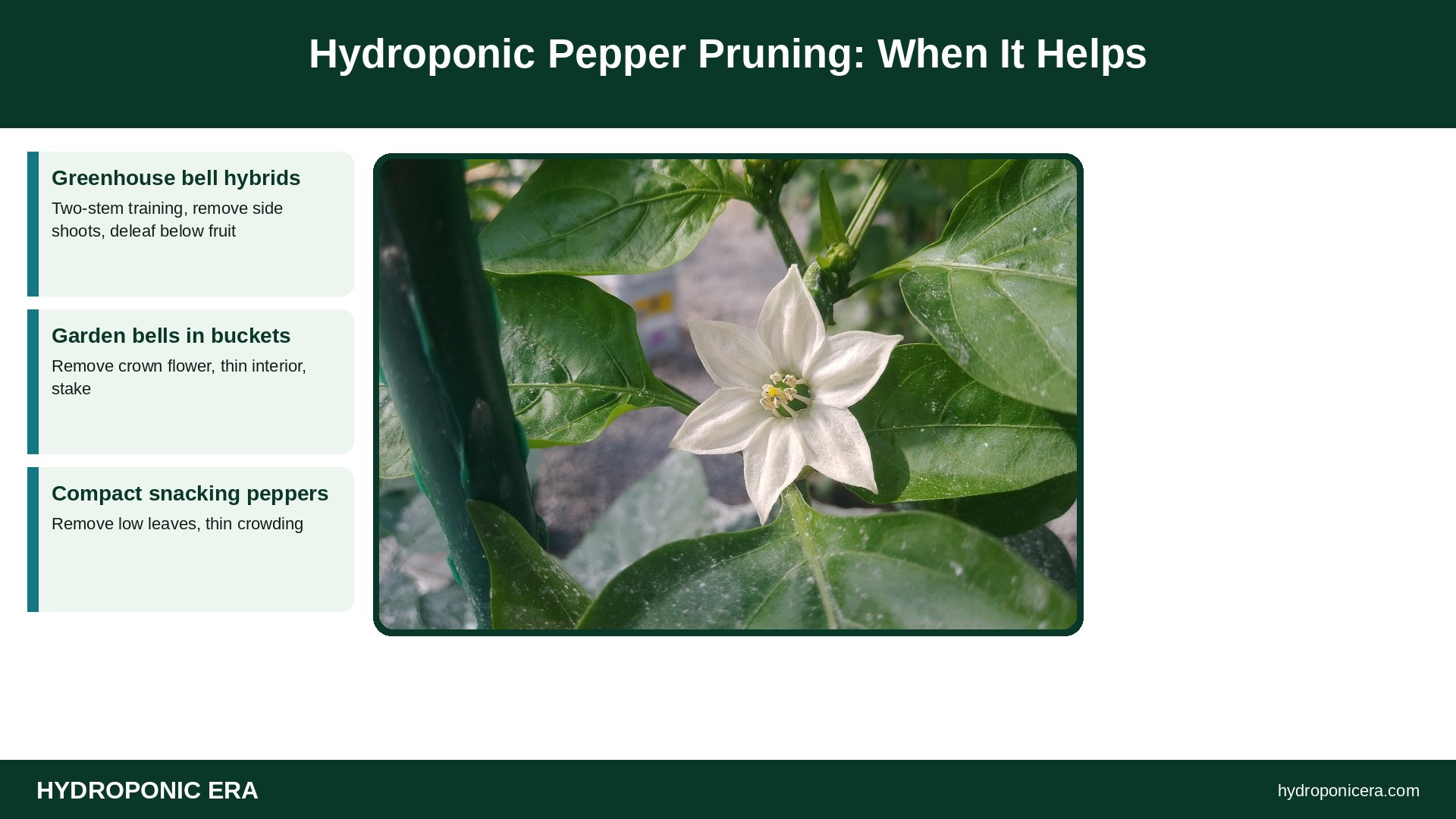
Hydroponic pepper pruning helps most with large greenhouse bell peppers and less with compact or hot varieties. For big bells, train each plant to two (sometimes three) main stems, remove side shoots and the first “crown” flower, and strip leaves below the lowest fruit. For compact sweet and hot peppers in buckets or kits, prune lightly: remove leaves that touch the water, thin crowded interior shoots for airflow, and pinch the tip of young plants once if you want a bushier shape. Over-pruning small peppers usually reduces yield.
Key takeaway: Prune hard only for tall greenhouse bells. For small peppers, prune lightly for airflow and to remove damaged leaves.
| Pepper type | Pruning level | Main tasks |
|---|---|---|
| Greenhouse bell hybrids | High | Two-stem training, remove side shoots, deleaf below fruit |
| Garden bells in buckets | Moderate | Remove crown flower, thin interior, stake |
| Compact snacking peppers | Light | Remove low leaves, thin crowding |
| Hot peppers (jalapeño, cayenne) | Light | Optional early topping, remove low leaves |
| Dwarf ornamental peppers | Minimal | Remove damaged leaves only |
Does Hydroponic Pepper Pruning Increase Yield?
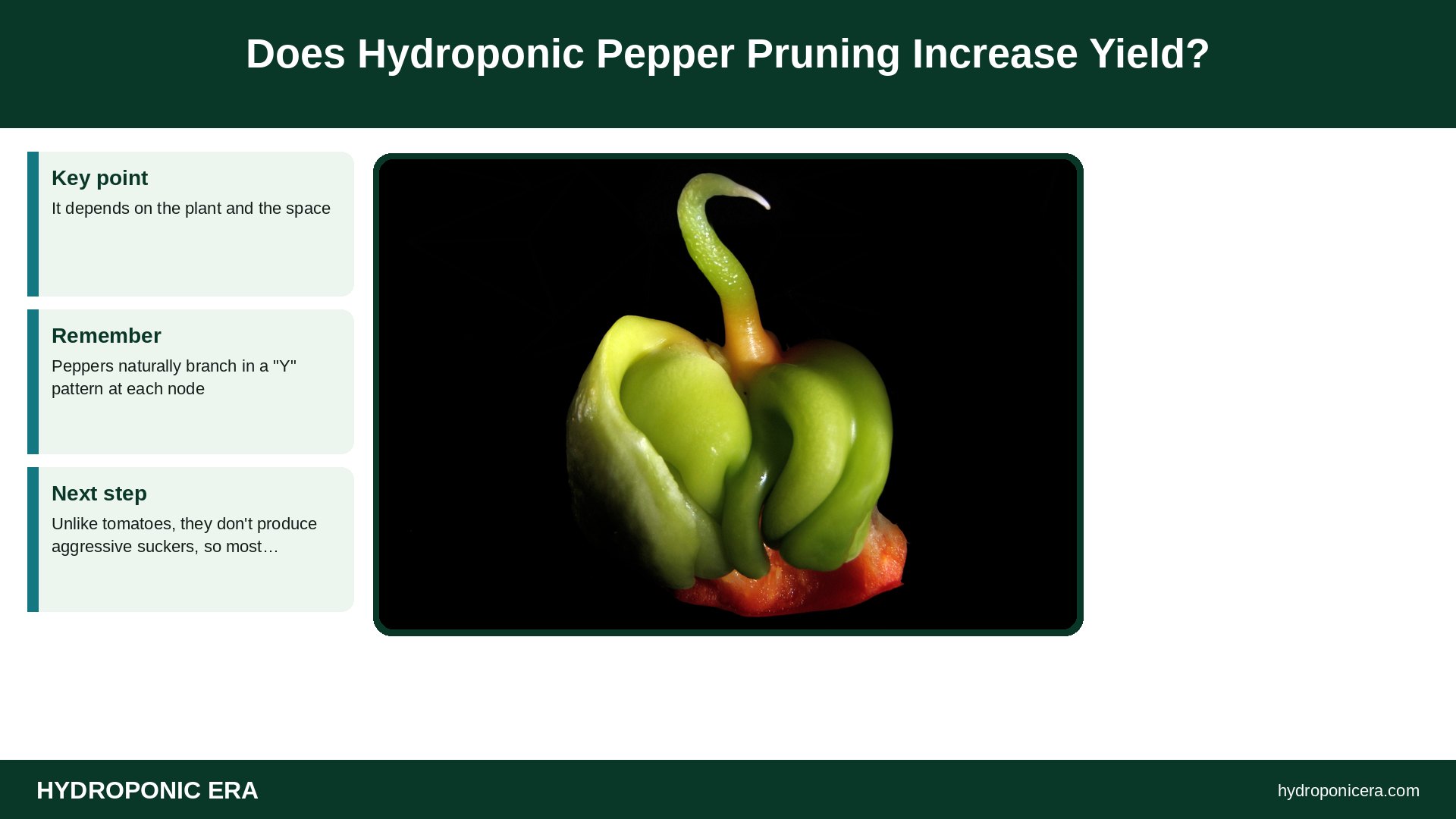
It depends on the plant and the space. Peppers naturally branch in a “Y” pattern at each node. Unlike tomatoes, they don’t produce aggressive suckers, so most compact varieties stay manageable without pruning. Research and commercial practice show that pruning greenhouse bells to two or three stems improves fruit size and makes high-density production possible, as UF/IFAS describes for Florida greenhouse peppers.
For a home grower with one or two plants under a light, the bigger gains come from strong light, warm roots, and steady feeding rather than heavy pruning. See best pepper varieties for hydroponics.
Removing the Crown Flower
The first flower usually forms at the first “Y” where the stem splits, called the crown set. On large bell varieties, removing this flower lets the plant grow more leaves and roots before it starts carrying fruit, which leads to a bigger total harvest. On compact or early varieties, many growers leave it.
Two-Stem Training for Bell Peppers
- Let the plant grow until it splits into two or three stems at the first node.
- Choose the two strongest stems as leaders.
- At each following node, the stem splits again. Keep the stronger branch as the leader and pinch the weaker one after its first leaf and fruit.
- Support each leader with a string or stake.
- Remove leaves below the lowest developing fruit as the plant grows.
This system is typical in greenhouses with Dutch buckets or slabs. See Dutch bucket hydroponics and trellising and pruning.
Topping Young Pepper Plants
Some growers pinch the growing tip when a young pepper has 5–6 leaf sets to encourage branching and a bushier, shorter plant. This works well for hot peppers in tents, where height is limited. It delays the first flowers by a week or two. Don’t top plants that are already flowering.
Light Hydroponic Pepper Pruning for Airflow
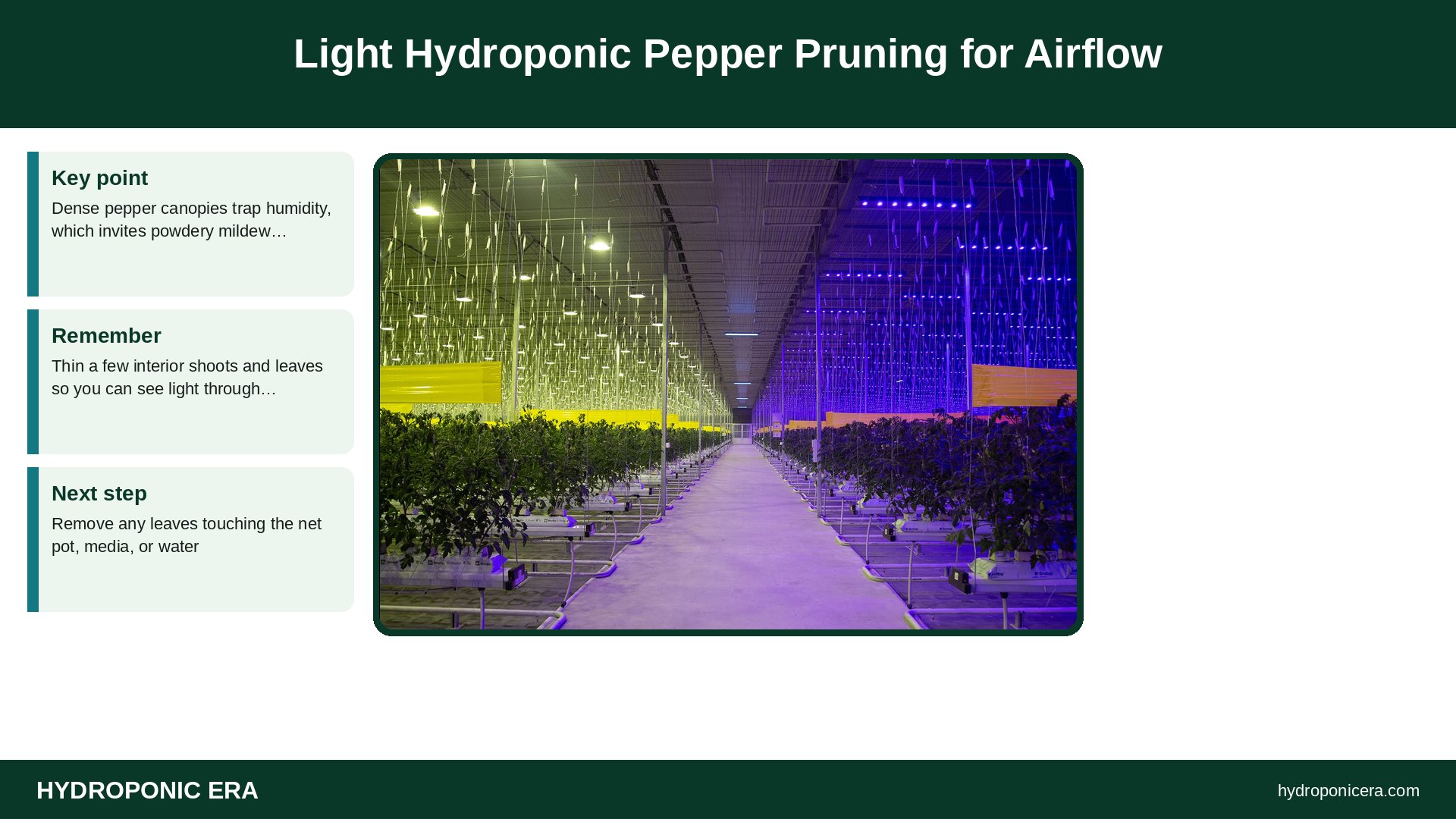
Dense pepper canopies trap humidity, which invites powdery mildew, gray mold, and pests. Thin a few interior shoots and leaves so you can see light through the plant. Remove any leaves touching the net pot, media, or water. See powdery mildew and airflow and fans.
Pruning Late in the Season
About 4–6 weeks before you plan to end the crop, pinch all new flowers and growing tips. The plant will put energy into ripening the fruit already set. Peppers can also be overwintered: cut them back hard to a few nodes, reduce light and feeding, and let them regrow in spring. This works best with hot peppers.
When Not to Prune
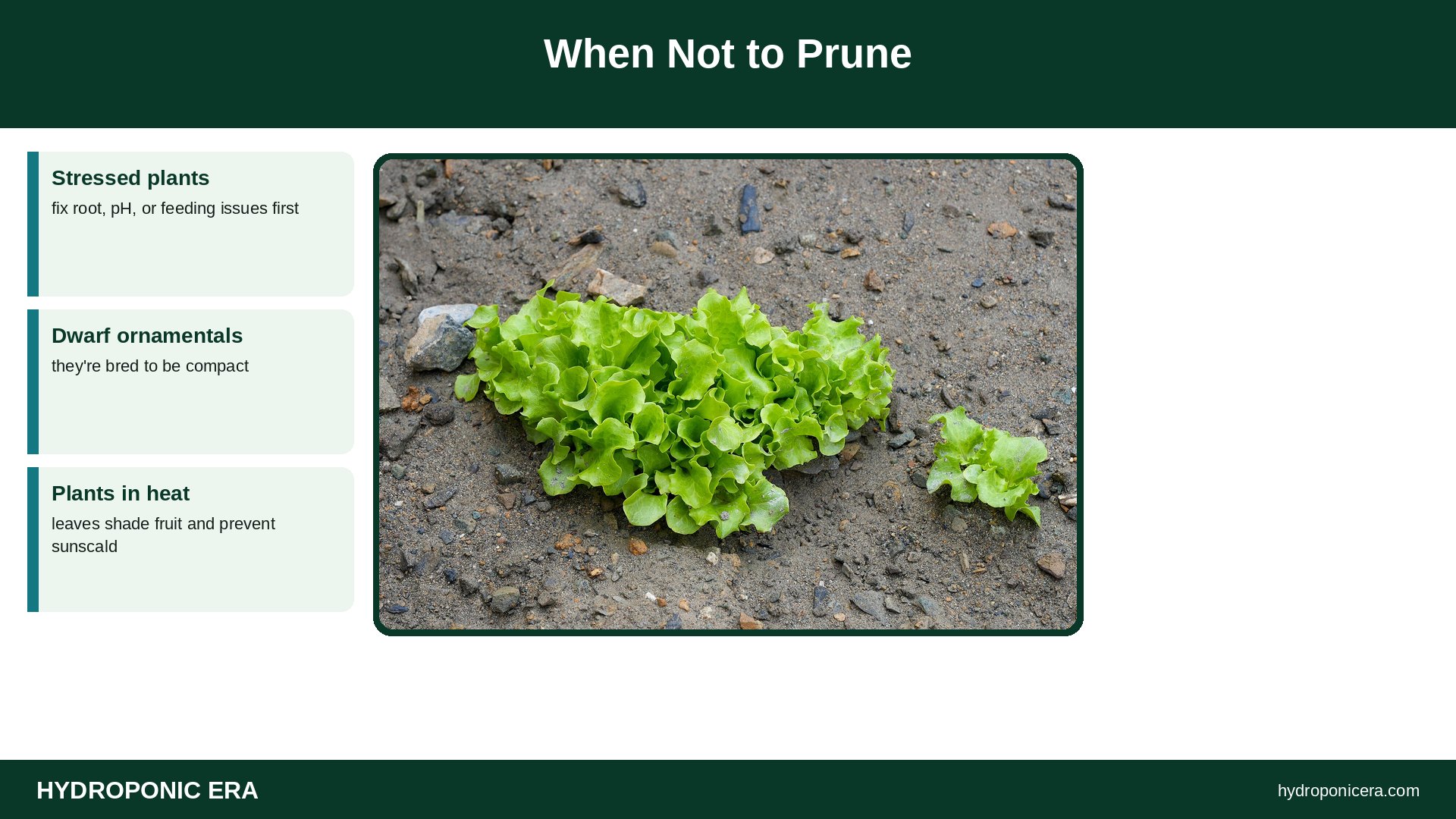
- Stressed plants: fix root, pH, or feeding issues first.
- Dwarf ornamentals: they’re bred to be compact.
- Plants in heat: leaves shade fruit and prevent sunscald.
- Right after transplant: let roots establish first.
Support and Staking
Pepper branches are brittle and snap under heavy fruit. Use a stake, a small cage, or strings tied to a trellis. Greenhouse growers use the same string-and-hook system as tomatoes. Tie loosely so stems can thicken.
Hygiene When Pruning
Tobamoviruses, including pepper mild mottle virus, spread on hands and tools. Sanitize pruners between plants, wash hands, and don’t smoke near plants, since tobacco can carry tobacco mosaic virus. UF/IFAS describes pepper mild mottle virus as an important problem in greenhouse peppers. See tobamovirus precautions.
Feeding Pruned Peppers
Pruned bells put more energy into fewer fruits, so they need steady feeding: EC about 1.8–2.8 mS/cm while fruiting, pH 5.8–6.3, and plenty of calcium to prevent blossom end rot. See nutrients for peppers and blossom end rot.
A Simple Hydroponic Pepper Pruning Schedule
- Weeks 1–3 after transplant: no pruning; let roots establish.
- At first split: remove crown flower on bells; choose leaders.
- Weekly: remove low leaves and weak interior shoots.
- At fruit set: support branches.
- End of season: pinch new flowers and tips.
Common Mistakes
- Pruning compact peppers like tomatoes, which removes fruiting sites.
- Removing too many leaves, exposing fruit to sunscald.
- Cutting branches with dull or dirty tools.
- Pruning when plants are wet.
Tools for Hydroponic Pepper Pruning
Pepper stems are thicker and more brittle than tomato stems, so pinching by hand often tears the bark. For hydroponic pepper pruning, use sharp, clean bypass pruners or herb snips. Cut about a quarter inch above a node so the stub doesn’t split back into the main stem. Dip blades in a disinfectant or wipe them with 70% alcohol between plants. Keep plant ties or soft clips ready, because removing a leader or a heavy branch can change how the plant balances in a net pot.
Hydroponic Pepper Pruning in Tents and Small Systems
Grow tents and countertop kits limit height, so the goal of hydroponic pepper pruning there is shape, not maximum fruit size. Top the plant once when it is young, then let several branches grow under the light. Remove leaves that shade lower flowers, and trim any branch that touches the light. Keep the light at the distance the manufacturer recommends and raise it as the canopy rises. In a 5-gallon bucket, two or three main branches are usually plenty.
Reading the Plant After Pruning
A pepper that responds well pushes new shoots and flowers at the upper nodes within one to two weeks. If leaves curl, flowers drop, or growth stalls, the plant may be short of light or stressed by heat, and more hydroponic pepper pruning will not fix that. Correct the climate and feeding first, then resume light pruning once the plant is growing again.
Pruning Hot Peppers vs Sweet Peppers
Hot peppers such as jalapeño, serrano and cayenne branch heavily and set many small fruit, so hydroponic pepper pruning for them is mostly about removing low leaves and opening the center. Sweet bells set fewer, heavier fruit, so training stems and removing the crown flower matter more.
FAQs
Should I prune hydroponic peppers?
Large bells benefit; compact and hot peppers need only light pruning.
What is the crown flower?
The first flower at the first stem split; remove it on large bells.
Does topping peppers increase yield?
It makes plants bushier and can help in small spaces, but delays flowering.
How many stems should a bell pepper have?
Two or three in greenhouse systems.
Can I prune peppers while fruiting?
Yes, lightly: remove low leaves and crowded shoots.
Why are my pepper branches breaking?
Heavy fruit and no support; stake or string them.
Sources
- UF/IFAS Extension — Pepper Production
- UF/IFAS Extension — Pepper Mild Mottle Virus
- UF/IFAS Extension — Crop Production — Florida Greenhouse Vegetable Production Handbook
- Photo credits (Wikimedia Commons, edited with titles): PepperFlower4K by Bst9jkj (CC0); Baby Bell pepper ”Capsicum annuum” by Brocken Inaglory (CC BY-SA 3.0); Pepper No. 30 by Edward Weston (Public domain); Greenhouse in Kazakhstan by Gakon Netafim (CC BY-SA 4.0); Lettuce Closeup Greenhouse Phuktal Zanskar Jun24 A7CR 00442 by This Photo was taken by Timothy A. Gonsalves. Feel free to use my photos, but pl (CC BY-SA 4.0)