
A hydroponic strawberry tower grows 20–50 plants in stacked pockets around a vertical column, with a pump lifting nutrient solution to the top so it trickles down past the roots and drains back to a reservoir. Use day-neutral varieties such as ‘Albion’ or ‘Monterey’, a light, free-draining medium like coco coir, perlite, or a coco-perlite mix in each pocket, and feed at EC 1.0–1.5 mS/cm and pH 5.5–6.2. Run the pump on a timer, give the tower strong light from all sides, and keep each plant’s crown above the medium.
Key takeaway: Day-neutral plants, airy media, even light on all sides, short frequent watering cycles, and good pollination for full-size berries.
| Factor | Target |
|---|---|
| Varieties | Day-neutral: Albion, Monterey, San Andreas, Seascape |
| Medium | Coco coir, perlite, or 50:50 mix |
| EC | 1.0–1.5 mS/cm |
| pH | 5.5–6.2 |
| Pump cycle | Short, frequent cycles during lights-on |
| Light | 12–16 hours; DLI about 15–20 mol/m²/day |
| Air temperature | 65–75°F day, 55–65°F night |
How a Hydroponic Strawberry Tower Works
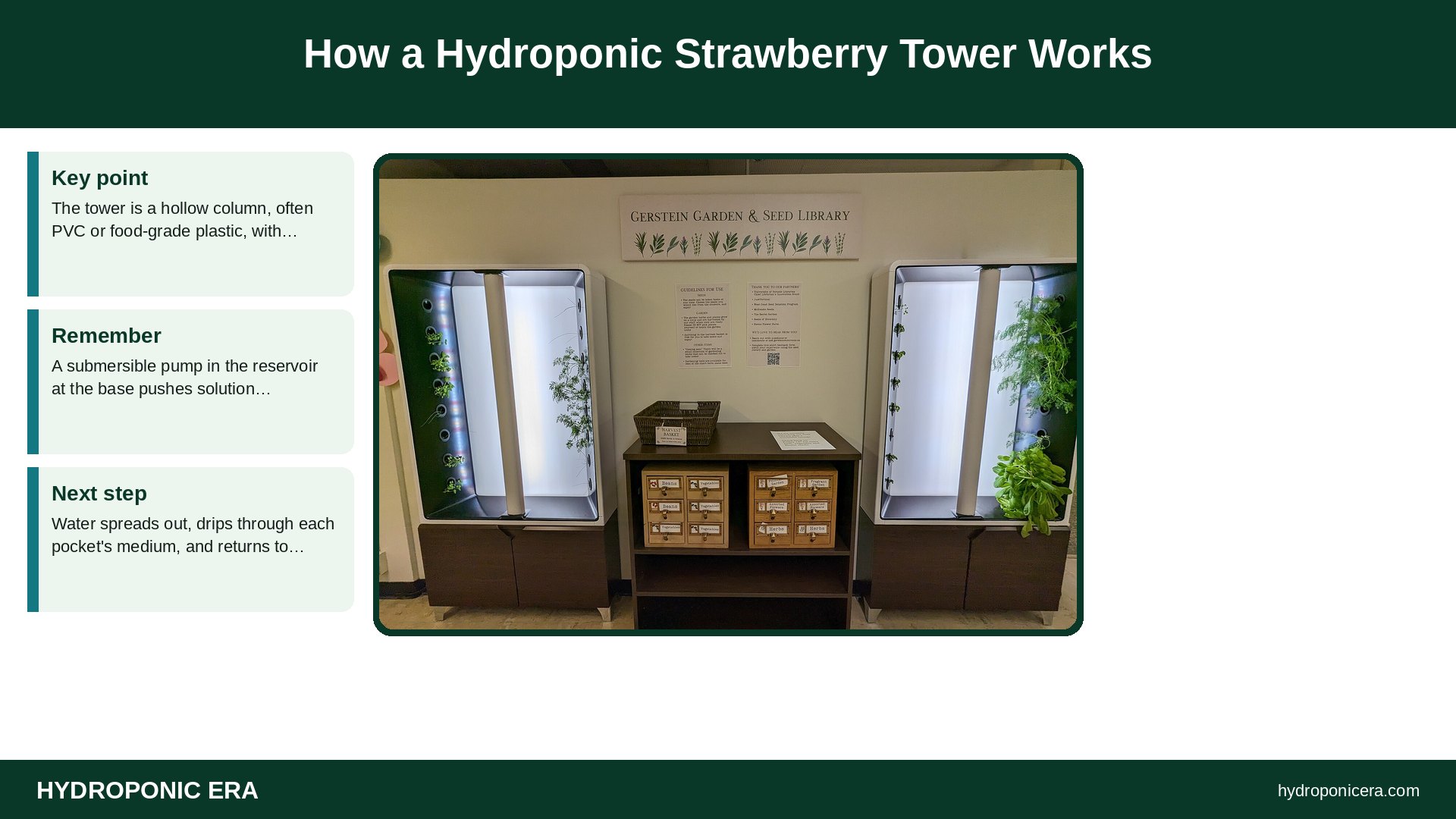
The tower is a hollow column, often PVC or food-grade plastic, with planting pockets cut into its sides. A submersible pump in the reservoir at the base pushes solution through a tube to the top. Water spreads out, drips through each pocket’s medium, and returns to the reservoir. Because each plant sits in only a small amount of medium, it depends on regular watering cycles.
Strawberries suit towers well: they’re compact, they hang their fruit down where it stays clean, and they’re expensive to buy. The Ohio State University indoor berry program studies controlled-environment strawberry production for these reasons.
Buy or Build a Hydroponic Strawberry Tower
- Commercial towers: Tower Garden-style units and stackable pots come with pumps, timers, and reservoirs. They’re quick to set up.
- Stackable planters: plastic pots that stack in a spiral; low cost and easy to clean.
- DIY PVC towers: a 4- or 6-inch food-safe pipe with heat-formed pockets, a 5-gallon bucket reservoir, and a small pump. See DIY hydroponic tower.
Whatever you choose, use food-safe plastics. See safe plastics for DIY hydroponics.
Choosing Plants
Day-neutral strawberries flower and fruit continuously when temperatures are moderate, which is ideal for an indoor or greenhouse tower. Buy certified disease-free bare-root crowns or plugs. Plant one per pocket, with roots spread into the medium and the crown just above the surface. See best strawberry varieties for hydroponics.
Media for Tower Pockets
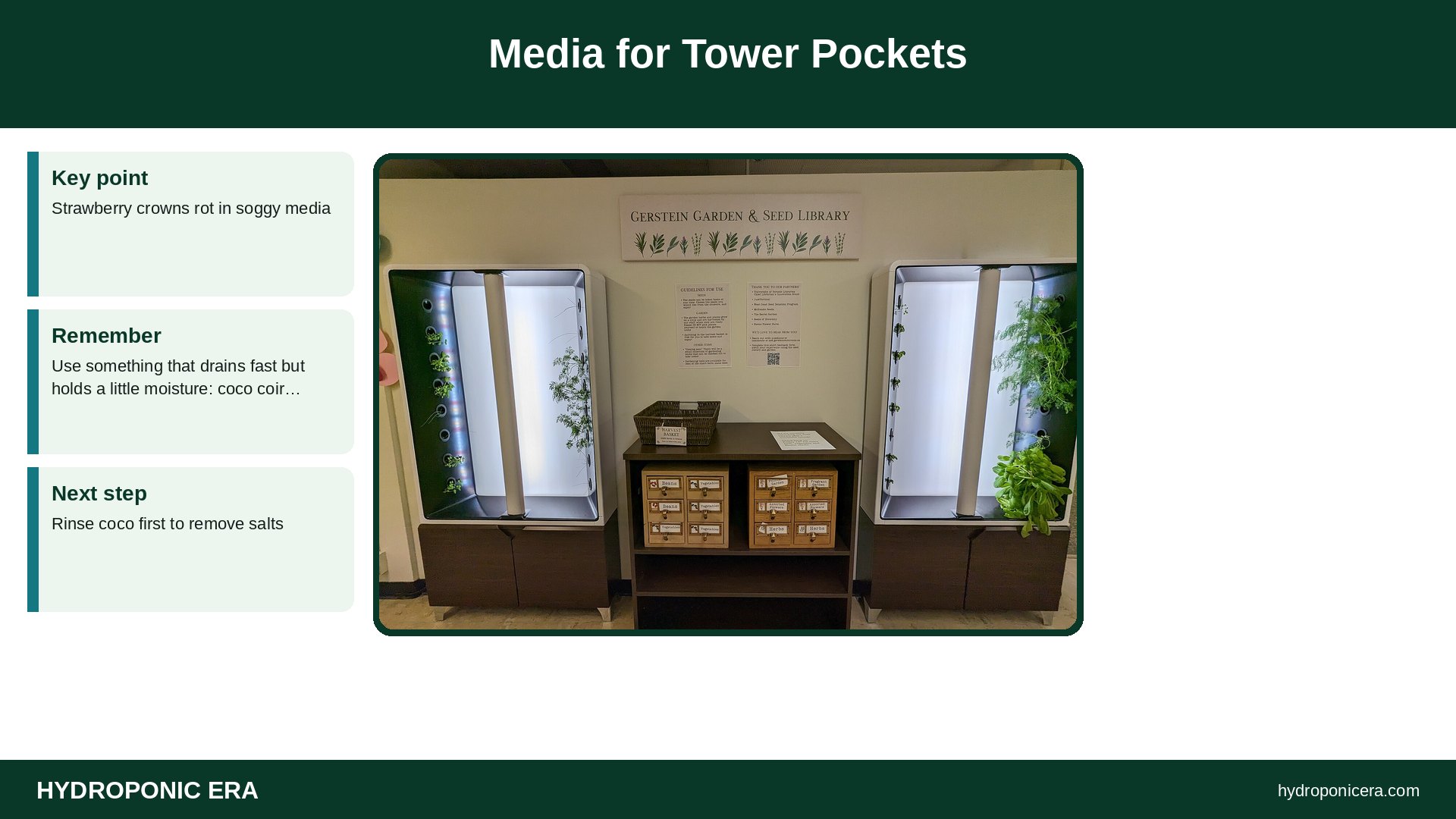
Strawberry crowns rot in soggy media. Use something that drains fast but holds a little moisture: coco coir with 30–50% perlite is a good mix. Rinse coco first to remove salts. Clay pebbles alone drain too fast for small pockets unless watering is very frequent. Rockwool cubes work in some commercial towers but can stay too wet. See coco coir and perlite and vermiculite.
Pump Timing
Small pockets dry out fast, especially at the top of the tower. A common starting point is 15 minutes on and 15–45 minutes off during lights-on, with fewer cycles at night. Watch the top pockets: if they dry out between cycles, shorten the off time. If the medium stays soggy and roots brown, lengthen it. See timers and automation and pump sizing.
Light for a Hydroponic Strawberry Tower
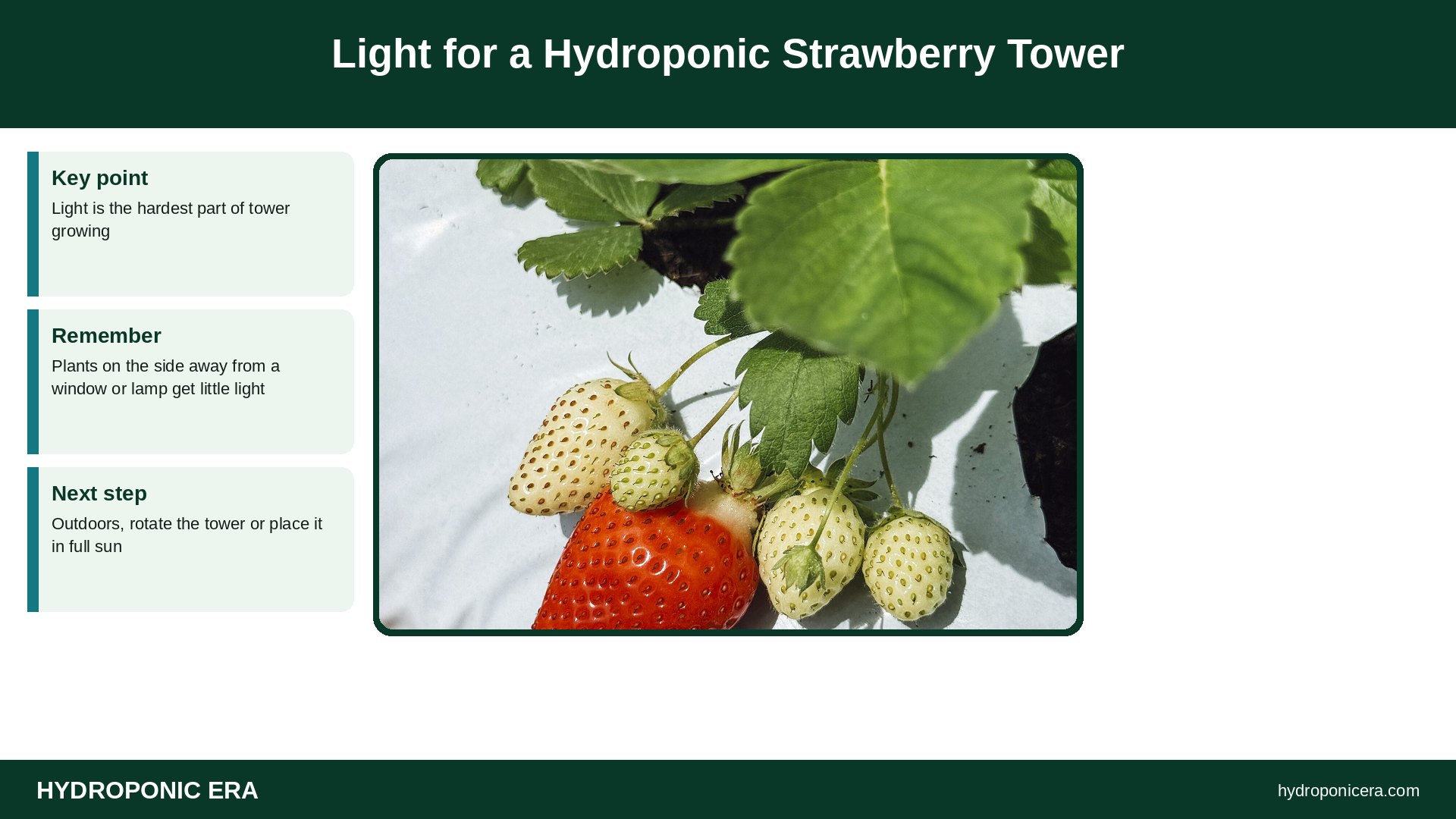
Light is the hardest part of tower growing. Plants on the side away from a window or lamp get little light. Outdoors, rotate the tower or place it in full sun. Indoors, use vertical LED bars around the tower or rotate it daily. Strawberries need much more light than lettuce to make sweet fruit; aim for about 15–20 mol/m²/day. See PPFD and DLI.
Feeding and Water Quality
Feed at EC 1.0–1.5 mS/cm and pH 5.5–6.2. Strawberries are sensitive to salt buildup, so check runoff from the bottom pockets and change the reservoir every 2–3 weeks. Make sure the nutrient includes calcium; deficient plants show tip burn on new leaves. See nutrients for strawberries and the hydroponic ppm chart.
Pollination
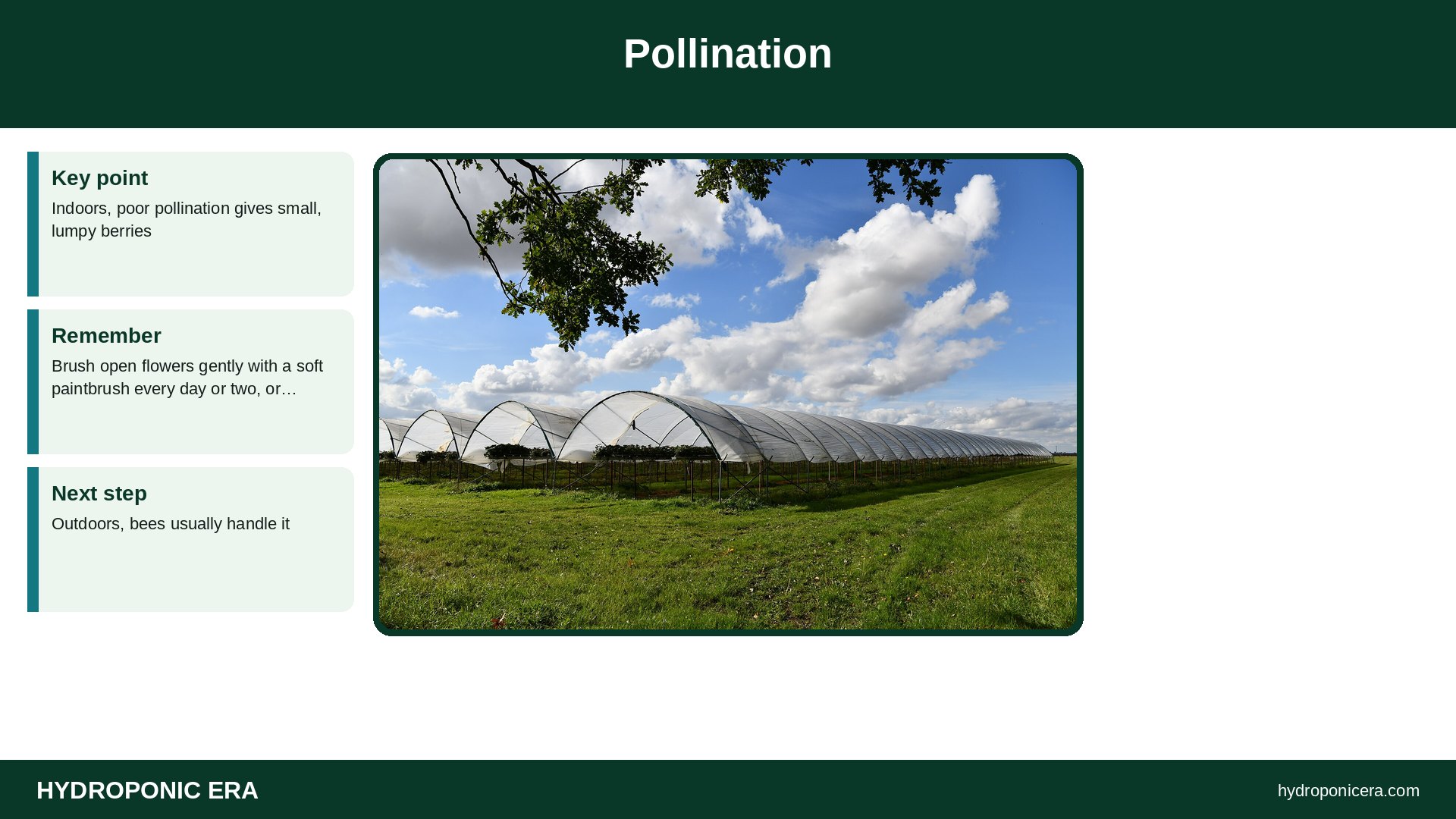
Indoors, poor pollination gives small, lumpy berries. Brush open flowers gently with a soft paintbrush every day or two, or run a fan to move pollen. Outdoors, bees usually handle it. See indoor pollination.
Runners and Plant Renewal
Day-neutral plants make some runners. Cut most of them off so energy goes into fruit. Root a few into new pockets to replace old plants. Most tower growers replace strawberry plants every 12–18 months, when yields fall. See runner management.
Common Tower Problems
- Top pockets dry, bottom pockets soggy: adjust timing; add a spreader at the top.
- Clogged emitters or tubes: use a pump filter and clean monthly. See inline screen filters.
- Crown rot: crown buried or media too wet.
- Uneven growth: one side gets less light; rotate.
- Pests: spider mites and aphids love strawberries. See spider mites.
- Gray mold: remove damaged fruit and improve airflow. See botrytis gray mold.
Yield Expectations
A healthy day-neutral plant can produce about 1/2 to 1 pound of fruit over several months with good light. A 30-pocket tower can therefore give a steady harvest of a few pints a week at peak. Low light is the most common reason towers underperform.
Hydroponic Strawberry Tower Maintenance Schedule
- Daily: check that water reaches the top of the tower and drips through every pocket, and look for wilting plants.
- Twice a week: check EC and pH in the reservoir and top off with plain water or a weaker solution.
- Weekly: pick ripe berries, remove runners and dead leaves, and look under leaves for spider mites and aphids.
- Every 2–3 weeks: change the reservoir and rinse the pump intake filter.
- Every season: flush the tower with clean water, scrub pockets and replace tired plants.
Indoor vs Outdoor Hydroponic Strawberry Tower
Outdoors, a hydroponic strawberry tower gets free sunlight, wind for pollination and natural predators, but it also gets heat. In hot weather, the reservoir can warm quickly, so shade it, use a larger tank or add frozen water bottles. Indoors, you control the climate but must supply strong light and hand-pollinate. Many growers start a tower indoors in late winter and move it outside after the last frost.
Rotating the Tower
Plants on the shaded side of a tower grow more slowly and fruit less. If your hydroponic strawberry tower stands by a window or a single light, turn it a quarter turn every few days so every side gets equal light. Towers with a turntable base make this easy.
FAQs
How many plants fit in a hydroponic strawberry tower?
Usually 20–50, depending on height and pocket spacing.
What medium should I use?
Coco coir mixed with perlite.
How often should the pump run?
Short, frequent cycles during lights-on, adjusted so top pockets stay moist.
Which strawberries are best for towers?
Day-neutral varieties like ‘Albion’ and ‘Monterey’.
Can I grow a strawberry tower indoors?
Yes, with LED bars around the tower and hand pollination.
What EC do tower strawberries need?
About 1.0–1.5 mS/cm.
Sources
- The Ohio State University — Indoor Berry Production
- The Ohio State University — Indoor Berry Fertigation
- UF/IFAS Extension — Strawberry Production
- Photo credits (Wikimedia Commons, edited with titles): Fragaria vesca fruit – Keila by Ivar Leidus (CC BY-SA 4.0); Gerstein Science Information Centre aeroponics towers by Jason Zhang (CC BY-SA 3.0); Gerstein Science Information Centre aeroponics towers by Jason Zhang (CC BY-SA 3.0); Strawberry plants with ripe and unripe fruit growing in a garden by Shixart1985 (CC BY 2.0); Terrington St. Clement, Hydroponic strawberry growing – geograph.org.uk – 7897514 by Michael Garlick (CC BY-SA 2.0)