
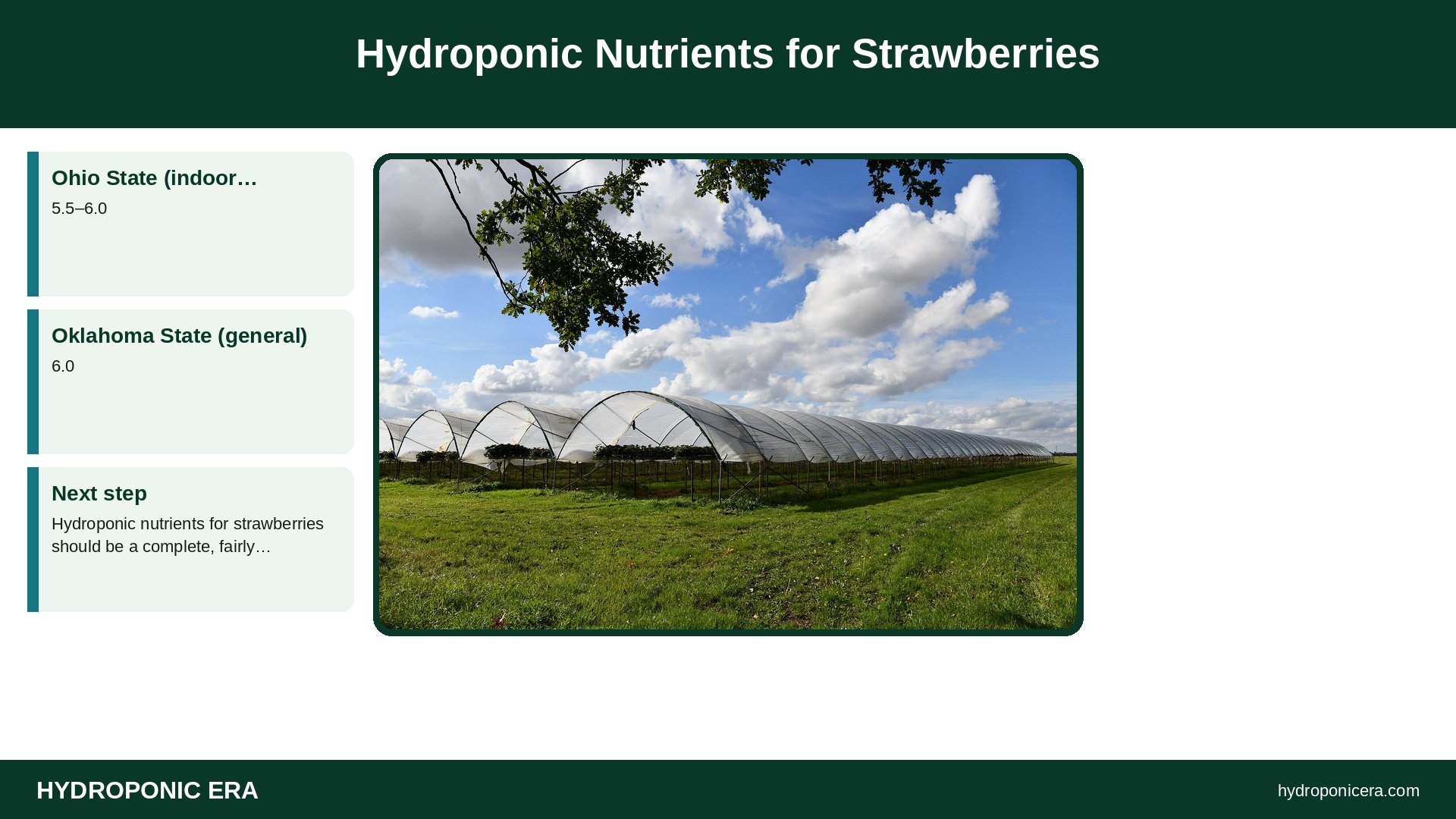
Hydroponic nutrients for strawberries should be a complete, fairly mild mix, because strawberries are sensitive to salt buildup. Ohio State University’s indoor berry program uses strawberry solutions at an EC of about 1.0 dS/m (mS/cm) at full strength, much lower than the roughly 2.4 used for tomatoes, keeps pH at 5.5–6.0, and notes growers often flush the root zone with water when root-zone EC goes above 1.2. Oklahoma State’s general table lists a higher range of 1.8–2.2 and pH 6.0. Start low, watch the plants, and raise strength only if they need it.
Key takeaway: Run strawberries at a modest EC (start around 1.0–1.2), pH 5.5–6.0, avoid salt buildup, and feed more potassium as fruit forms.
| Source | EC (mS/cm) | pH |
|---|---|---|
| Ohio State (indoor berry) | About 1.0 full strength; flush above 1.2 root zone | 5.5–6.0 |
| Oklahoma State (general) | 1.8–2.2 | 6.0 |
Why Hydroponic Nutrients for Strawberries Run Low

Ohio State notes many greenhouse strawberry experts consider strawberries sensitive to salts accumulating in the root zone. That’s why their recipe is much weaker than tomato solutions. Oklahoma State’s higher range shows sources differ, so treat any number as a starting point and watch your plants: burnt leaf edges and stunted growth suggest EC is too high. See how to lower EC.
pH for Hydroponic Nutrients for Strawberries
Ohio State recommends a nutrient pH of 5.5–6.0. It explains that actively growing roots taking up nitrate tend to push root-zone pH up, and that yellow-green new leaves are a typical sign of iron deficiency when pH runs high. Ohio State notes a small share of ammonium nitrogen helps limit pH rise, but too much makes plants overly leafy. See fix high or low pH.
Hydroponic Nutrients for Strawberries: Feeding by Growth Stage
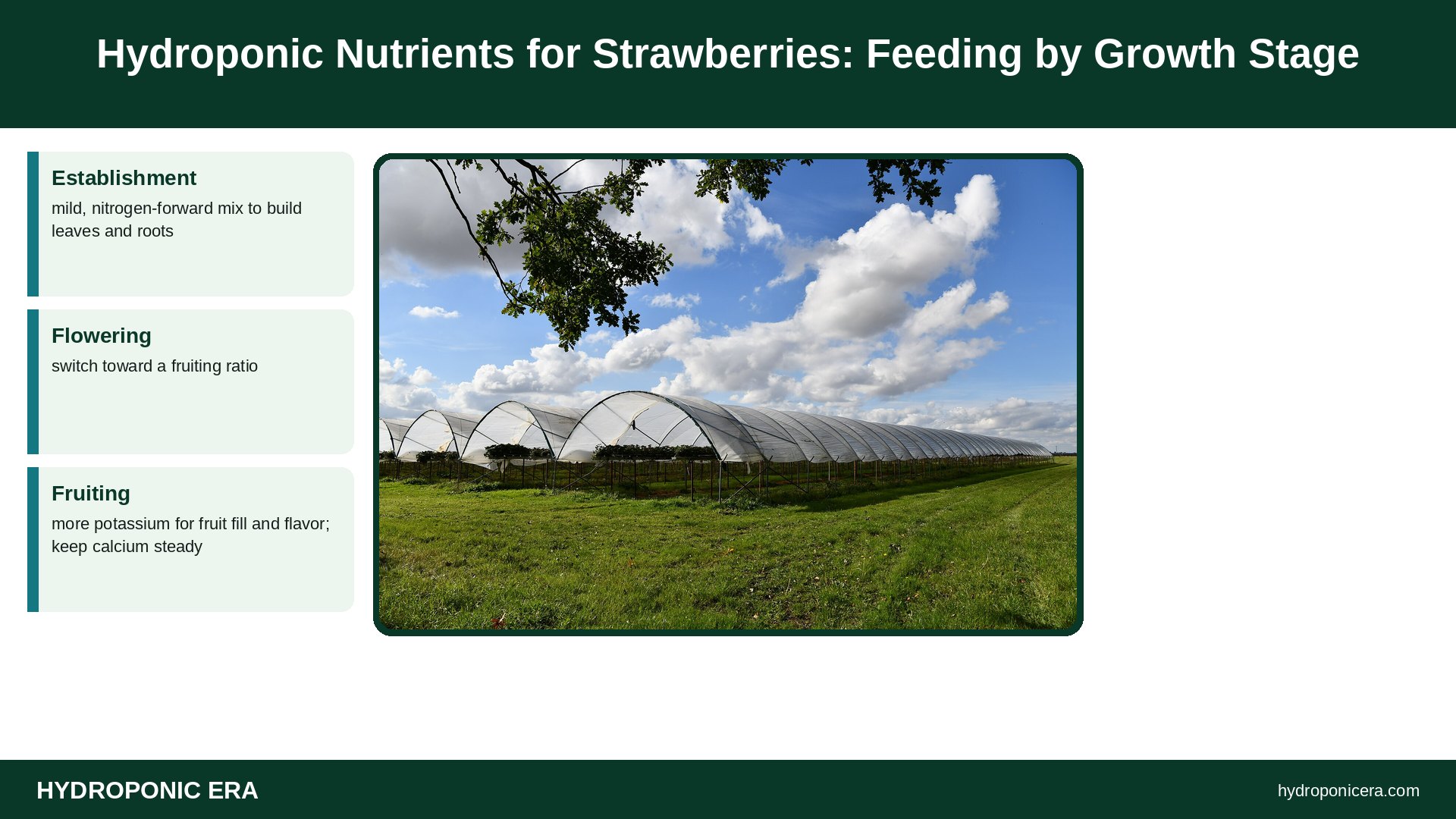
- Establishment: mild, nitrogen-forward mix to build leaves and roots.
- Flowering: switch toward a fruiting ratio.
- Fruiting: more potassium for fruit fill and flavor; keep calcium steady.
Remove runners on fruiting plants unless you want new plants. See runners and day-neutral strawberries.
Hydroponic Nutrients for Strawberries: Best Nutrients to Use
A two- or three-part hydroponic base works well, used at lower strength than the label’s full dose for fruiting crops. Measure EC and adjust doses to your target rather than following tomato schedules. See best hydroponic nutrients.
Hydroponic Nutrients for Strawberries: Monitoring Drip and Drain
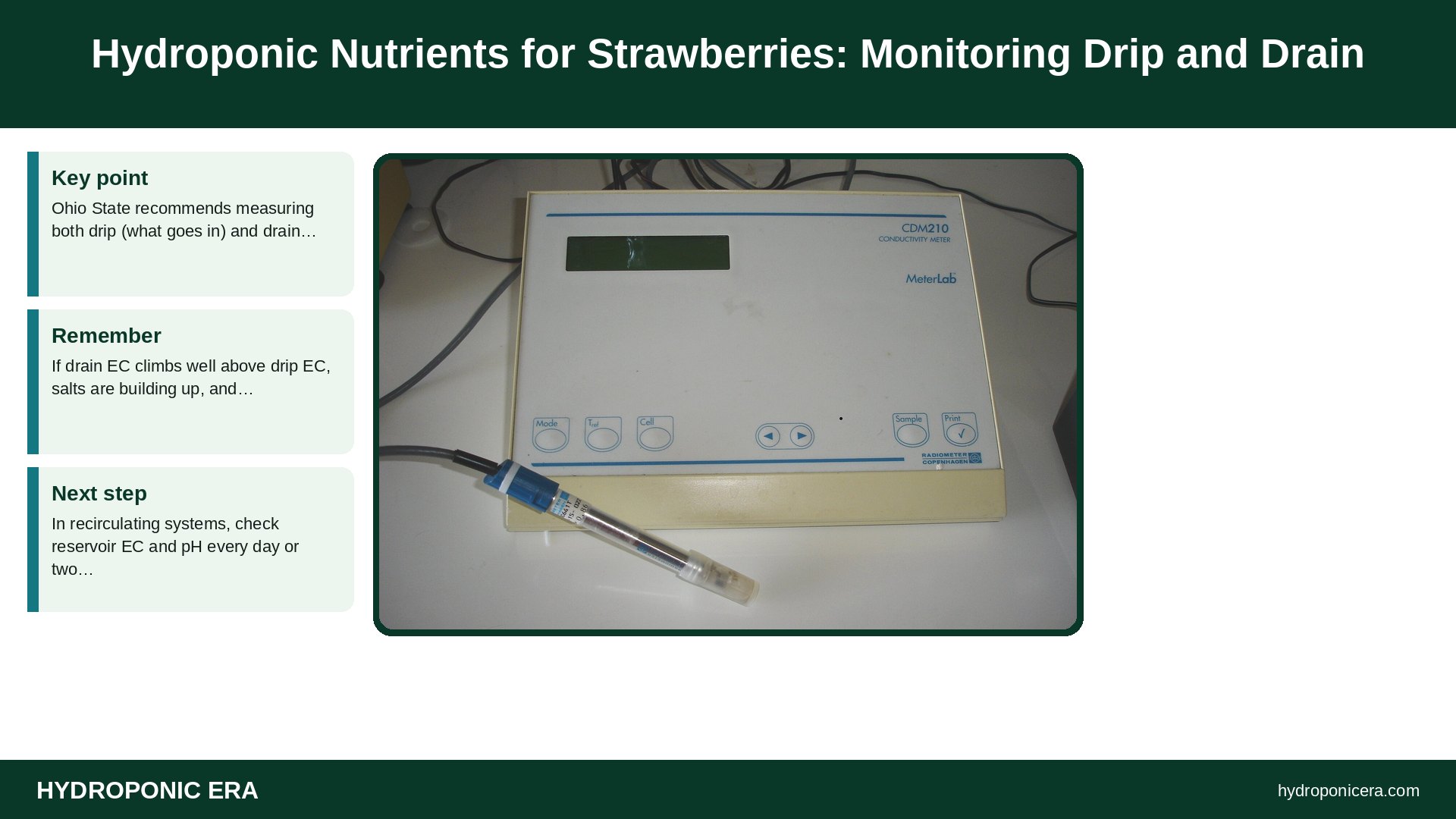
Ohio State recommends measuring both drip (what goes in) and drain (what comes out) solutions daily in substrate systems. If drain EC climbs well above drip EC, salts are building up, and it’s time to flush with water. In recirculating systems, check reservoir EC and pH every day or two and change it regularly.
Hydroponic Nutrients for Strawberries: Signs of Nutrient Problems in Strawberries
- Yellow-green new leaves: iron shortage, often from high pH.
- Burnt leaf margins: salt buildup or EC too high.
- Soft, bland fruit: low potassium or low light.
- Tip burn on new leaves: calcium supply problems.
- Too many leaves, few flowers: excess nitrogen.
Hydroponic Nutrients for Strawberries: Systems for Strawberries

NFT, towers, and drip-fed gutters or troughs with coco all work. Keep the crown above the water line so it doesn’t rot. See how to grow strawberries hydroponically and rain gutter hydroponics.
Weekly Routine
- Check pH and EC every day or two.
- Compare drip and drain EC in media systems.
- Remove runners and old leaves.
- Check new leaves for yellowing.
- Change or flush the system when EC drifts.
Day-Neutral vs June-Bearing Strawberries
Day-neutral and everbearing strawberries suit hydroponics because they keep flowering under steady conditions indoors. June-bearing types fruit once a year and depend on seasonal cues. For nutrients, both follow the same low-EC approach; day-neutral plants simply need steady feeding over a longer fruiting period.
Water Quality and Strawberry Feeding
Because strawberries are salt-sensitive, start with low-salt water. Ohio State notes alkaline source water raises root-zone pH, which can lock out iron. If your tap water is hard or alkaline, consider RO or rain water, or acidify carefully and check pH often.
Strawberry Feeding Log Example
Record the date, stage, drip EC, drain or reservoir EC, pH, and any flush or change. Strawberries respond slowly to salt buildup, so a log shows rising drain EC before leaves scorch. Note the first flowers and first ripe fruit so you can time a switch to a fruiting ratio next crop.
Equipment Checklist for Hydroponic Nutrients for Strawberries
- A calibrated EC meter.
- A pH meter or kit and pH up/down.
- A measuring syringe or cup in milliliters.
- A notebook or app to log readings.
- A clean reservoir with volume marks.
- Plain, low-salt water for top-offs.
Most of this gear is reusable from crop to crop, so the first setup costs the most. Buy reliable meters first; they prevent the majority of problems.
Beginner Mistakes With Hydroponic Nutrients for Strawberries
The biggest mistake is overfeeding. Strawberries are salt-sensitive, so a mix that suits tomatoes can burn them. Start low and watch leaf edges.
Getting Started With Hydroponic Nutrients for Strawberries
Start small, change one thing at a time, and keep a simple log of pH, EC, temperature, and what you changed. Most hydroponic problems show up as patterns in those numbers before they show on the plant. Compare your notes with the sources below, and adjust slowly rather than chasing every small swing. A steady routine matters more than any single product or setting.
FAQs: Hydroponic Nutrients for Strawberries
What EC do hydroponic strawberries need?
Ohio State uses about 1.0 at full strength; other guides go to 1.8–2.2.
What pH is best?
5.5–6.0.
Why are my strawberry leaves yellow?
Often iron shortage from high pH.
Can I use tomato nutrient?
Yes, at a much lower strength.
Should I flush strawberries?
Flush with water if root-zone EC goes above about 1.2, as Ohio State notes.
Do strawberries need bloom nutrients?
A fruiting ratio helps once flowers form.
Sources
- Ohio State University — Controlled Environment Berry Production: Fertigation
- Oklahoma State University Extension — Electrical Conductivity and pH Guide for Hydroponics
- Photo credits (Wikimedia Commons, edited with titles): Terrington St. Clement, Hydroponic strawberry growing – geograph.org.uk – 7897514 by Michael Garlick (CC BY-SA 2.0); Strawberry plants with ripe and unripe fruit growing in a garden by Shixart1985 (CC BY 2.0); Terrington St. Clement, Hydroponic strawberry growing – geograph.org.uk – 7897514 by Michael Garlick (CC BY-SA 2.0); Electrical conductivity meter by Nuno Nogueira (Nmnogueira) (CC BY-SA 2.5); 2009-03-30 Lettuce roots by Ildar Sagdejev (Specious) (CC BY-SA 4.0)