
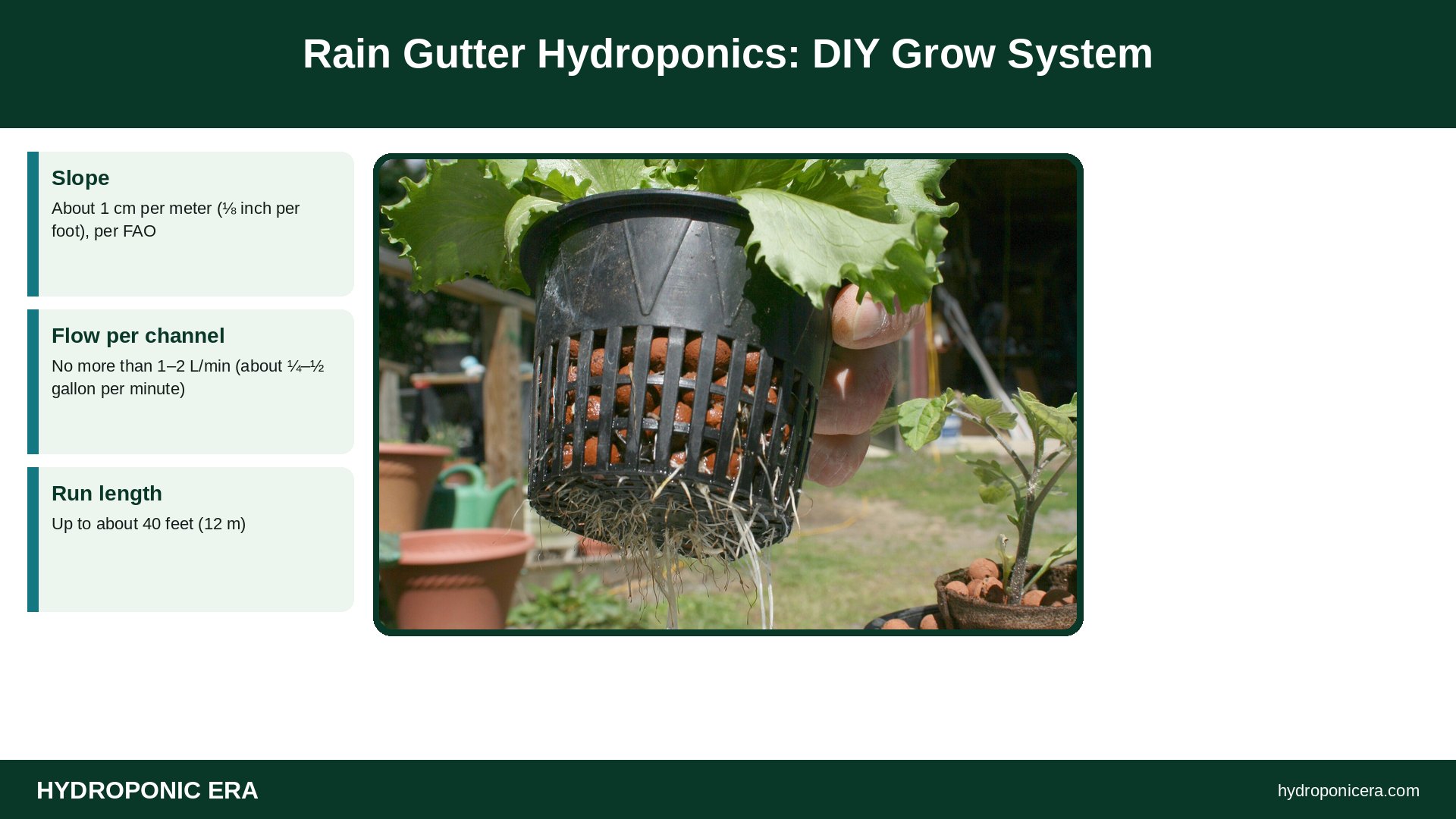
Rain gutter hydroponics turns ordinary vinyl rain gutters into nutrient film technique (NFT) channels or shallow troughs for growing lettuce, herbs, and strawberries.
You mount gutter sections on a slight slope, cut holes in a cover for net cups, and pump nutrient solution in at the high end so it flows as a thin film past the roots and drains back to a reservoir. FAO’s guidance on NFT channels is a good design guide: a slope of about 1 cm per meter (about ⅛ inch per foot), a flow of no more than 1–2 liters per minute per channel, and runs no longer than about 40 feet (12 m) so plants at the end don’t run short of nutrients.
Key takeaway: Use opaque vinyl gutters with covers, a gentle slope, a slow film of solution, and leafy crops with modest roots.
| Design factor | Guideline |
|---|---|
| Slope | About 1 cm per meter (⅛ inch per foot), per FAO |
| Flow per channel | No more than 1–2 L/min (about ¼–½ gallon per minute) |
| Run length | Up to about 40 feet (12 m) |
| Cover | Opaque lid or board with net-cup holes |
| Crops | Lettuce, herbs, strawberries, greens |
How Rain Gutter Hydroponics Works
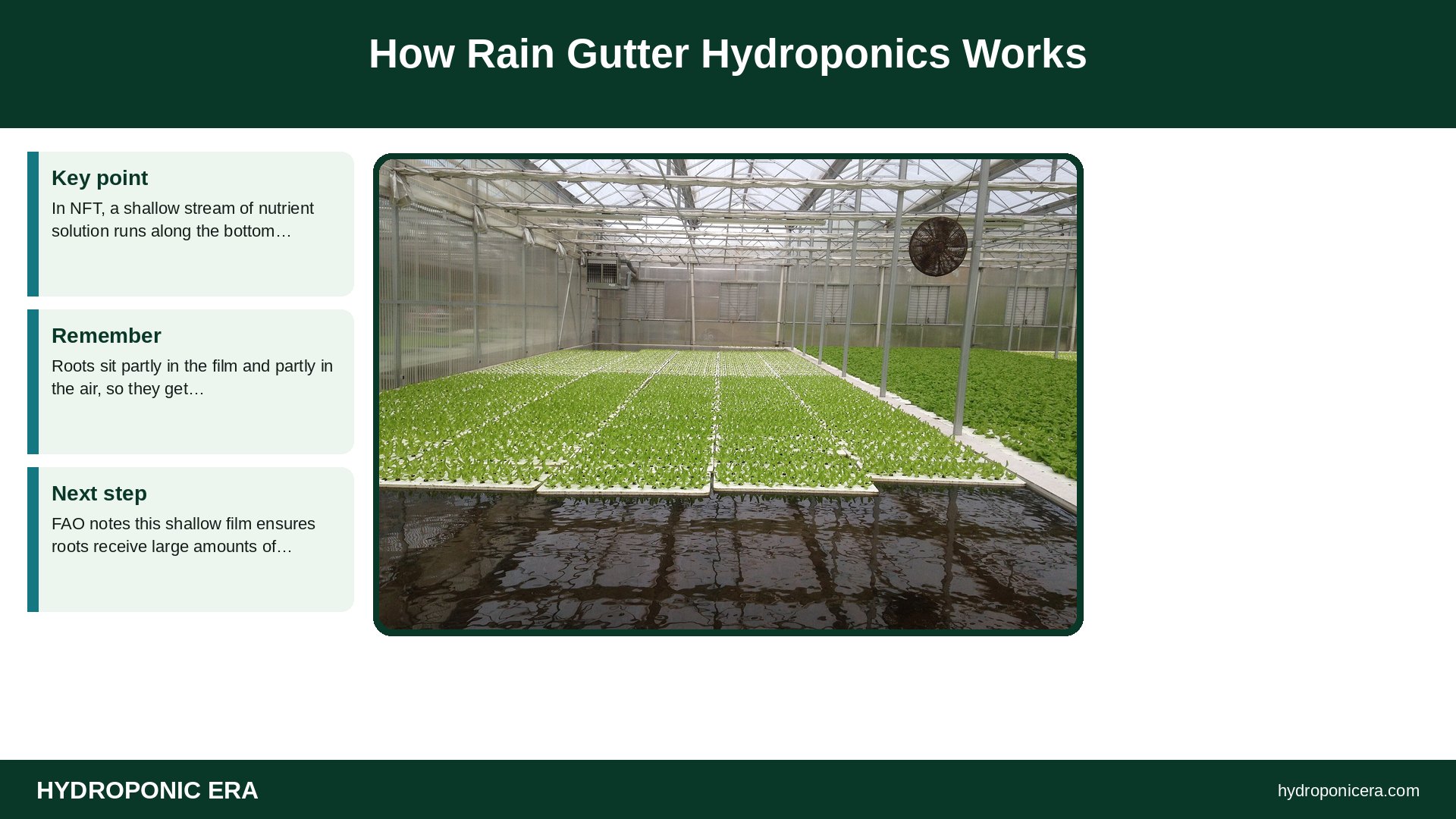
In NFT, a shallow stream of nutrient solution runs along the bottom of a channel. Roots sit partly in the film and partly in the air, so they get water, nutrients, and oxygen at the same time. FAO notes this shallow film ensures roots receive large amounts of oxygen. A gutter is an inexpensive channel with a flat bottom, which helps spread the film evenly. See NFT hydroponics for beginners.
Rain Gutter Hydroponics Materials
- Vinyl gutter sections, end caps, and an outlet drop.
- Opaque covers: gutter guards, vinyl siding strips, or painted boards with holes for net cups.
- 2-inch net cups and starter plugs.
- Reservoir: an opaque tote or bucket with a lid.
- Submersible pump, ½-inch supply tubing, and a valve to adjust flow.
- Brackets or a frame to hold gutters on a slope.
Stick with vinyl gutters made for water, and avoid metal gutters, which can corrode and leach metals. See PVC and tubing mistakes.
Rain Gutter Hydroponics Build Steps
- Frame: build a sturdy frame on a fence, wall, or stand. Leave room under the low end for the reservoir.
- Slope: set gutters at about ⅛ inch per foot. FAO uses shims on the far end to set slope.
- End caps: seal with gutter sealant rated for outdoor use and let it cure fully before planting; rinse well.
- Drain: install the outlet at the low end, running into the reservoir.
- Covers: cut holes about 8 inches apart for lettuce.
- Supply: run tubing to the high end of each gutter with a small valve to set flow.
- Test: run water for a day and check leaks and flow.
Setting Flow in Rain Gutter Hydroponics
FAO advises no more than 1–2 liters per minute per NFT channel. You can check by timing how long the outlet takes to fill a 1-quart container: 1 liter per minute fills a quart in about 57 seconds. Too little flow and the far end dries; too much and roots sit in deep water and the film overflows.
Best Crops for Rain Gutter Hydroponics
- Lettuce and other leafy greens.
- Basil, parsley, cilantro, and chives.
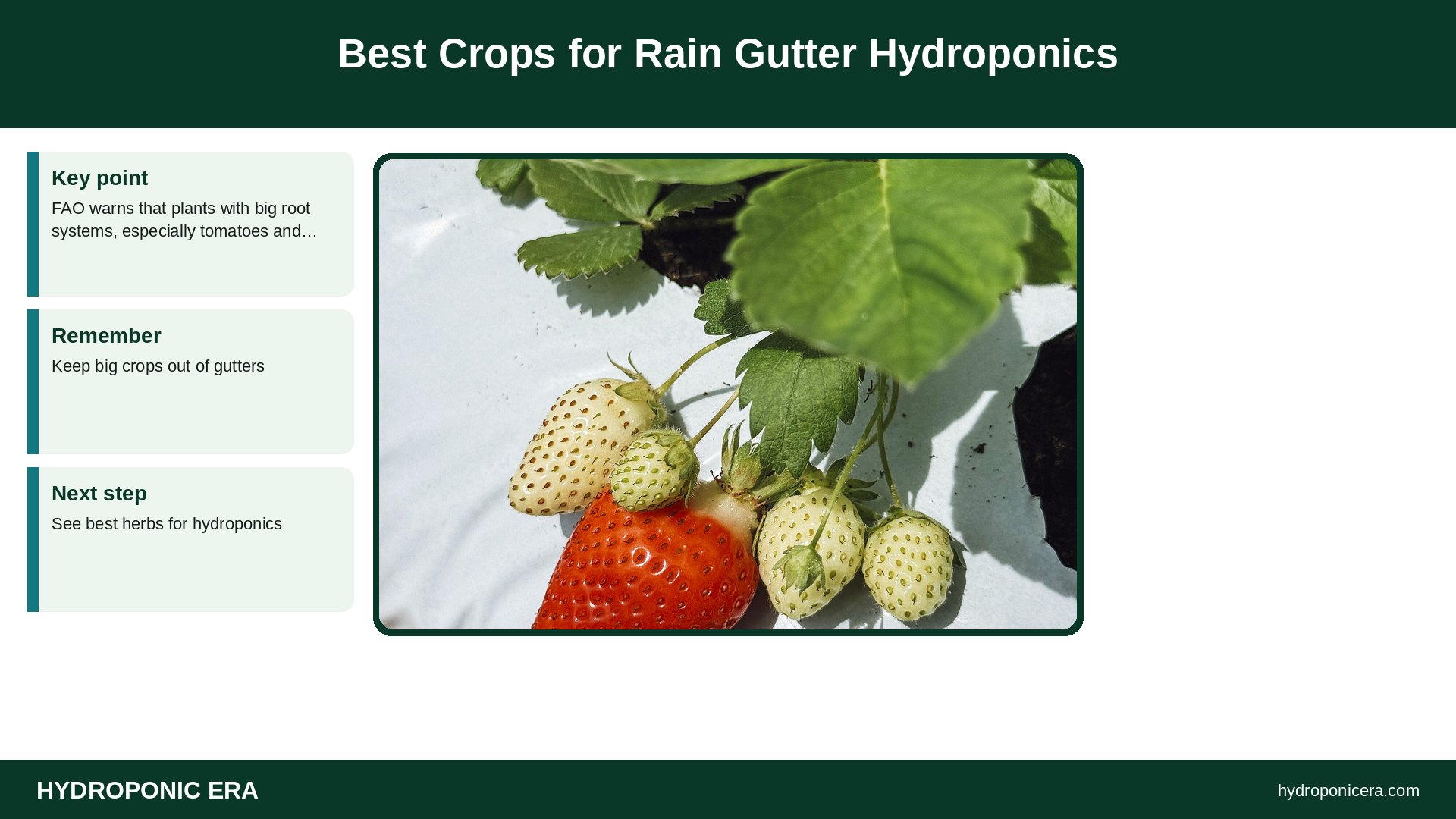
- Strawberries, which suit shallow channels well.
FAO warns that plants with big root systems, especially tomatoes and mint, can clog NFT channels and cause overflows. Keep big crops out of gutters. See best herbs for hydroponics.
Rain Gutter Hydroponics Outdoors
Outdoor gutters heat up in the sun, and FAO notes NFT pipes are prone to high water temperatures in hot seasons. Use white or light-colored gutters and covers, shade the reservoir, and keep the run short. UF/IFAS suggests keeping lettuce solutions between 65 and 80°F. See reservoir temperature.
Power Failure Risk
NFT channels hold very little water, so roots can dry quickly if the pump stops. Check the pump daily, consider a battery backup, and avoid long trips without someone to check the system.
Rain Gutter Hydroponics Maintenance
- Check pH and EC a few times a week.
- Clear roots that build up and block flow.
- Rinse gutters between crops.
- Keep covers tight to stop algae.
Planning Tips: Rain Gutter Hydroponics
Rain gutter hydroponics is a form of NFT, so the same rules apply: a gentle slope, a thin film of nutrient, and channels that drain fully when the pump stops. Seal end caps with food-safe sealant, and check that the gutter material is safe for growing food. Cover the top with a lid or board so light doesn’t reach the nutrient and grow algae.
Leafy greens, herbs, and strawberries suit gutters best because their roots stay small. Heavy, deep-rooted crops can clog the channel and stop the flow.
Weekly Routine for Rain Gutter Hydroponics
- Check pH and EC, and record them.
- Top off the reservoir with plain, pH-adjusted water.
- Look at roots for color and smell.
- Check leaves, especially undersides, for pests.
- Clean filters, emitters, and pump intakes.
- Change the nutrient fully every two to three weeks, or sooner if EC drifts.
Beginner Mistakes With Rain Gutter Hydroponics
The most common mistakes are skipping pH testing, using nutrient that’s too strong, letting light reach the water, and ignoring water temperature. Each one is easy to fix once you know to check for it. Start with fewer plants than you think you need, learn the routine, and expand once the system runs smoothly.
Rain Gutter Hydroponics Layouts
Common layouts stack gutters on a sloped A-frame, hang them on a sunny fence, or run them in parallel rows on a bench. Each gutter drains into a return pipe that flows back to the reservoir. Keep runs short to avoid nutrient warming and depletion at the far end. Stacked rows should be spaced so upper plants don’t shade lower ones.
FAQs: Rain Gutter Hydroponics
Are vinyl gutters safe for hydroponics?
Vinyl gutters are commonly used; rinse well and avoid metal gutters.
What slope do gutters need?
About ⅛ inch per foot, based on FAO’s 1 cm per meter.
How much flow?
No more than 1–2 liters per minute per channel.
Can I grow tomatoes in gutters?
Not well. Their roots clog shallow channels.
How long can a gutter run be?
Up to about 40 feet, per FAO’s 12 m limit.
Can rain gutter hydroponics run without a pump?
A flowing gutter system needs a pump. A Kratky-style static gutter is possible for small greens but is less common.
Do gutters get too hot in sun?
They can. Light-colored gutters and shade in the afternoon help keep nutrient cooler.
Sources
- FAO — Small-scale aquaponic food production (NFT design, section 4.4)
- UF/IFAS Extension — Growing Lettuce in Small Hydroponic Systems
- Photo credits (Wikimedia Commons, edited with titles): 2009-03-30 Lettuce roots by Ildar Sagdejev (Specious) (CC BY-SA 4.0); Deep water culture by ArcadiYay (CC BY-SA 4.0); Romaine lettuce by Rainer Zenz (CC BY-SA 3.0); Strawberry plants with ripe and unripe fruit growing in a garden by Shixart1985 (CC BY 2.0); Click & Grow Smart Garden 27 by Janar Raidla (CC BY-SA 4.0)