
A hydroponic wall garden is a vertical growing system mounted on a wall, where nutrient solution is pumped to the top and drips or trickles down through pockets, channels, or panels before draining back to a reservoir. Indoors, it can grow herbs, lettuce, and trailing houseplants in a few inches of floor space. The big design questions are weight, waterproofing, lighting, and access: a wall garden holds water next to drywall, so you need a sealed backing, a catch tray, and a reliable pump. For edible greens, keep the solution in the ranges UF/IFAS Extension gives for small lettuce systems, about 65–80°F and EC 1.2–1.8 mS/cm.
Key takeaway: Choose a sealed system with a drip tray, add full-coverage LED lighting, and plant compact herbs, greens, or houseplants.
| Wall system type | How it works | Best for |
|---|---|---|
| Pocket or felt panel | Water wicks through fabric pockets | Houseplants, living walls |
| Stacked channels (NFT) | Horizontal channels on a frame | Lettuce, herbs, strawberries |
| Modular planter tiles | Interlocking cells with drip line | Mixed ornamentals, herbs |
| Freestanding wall unit | Self-contained frame with reservoir | Renters, kitchens |

How a Hydroponic Wall Garden Works
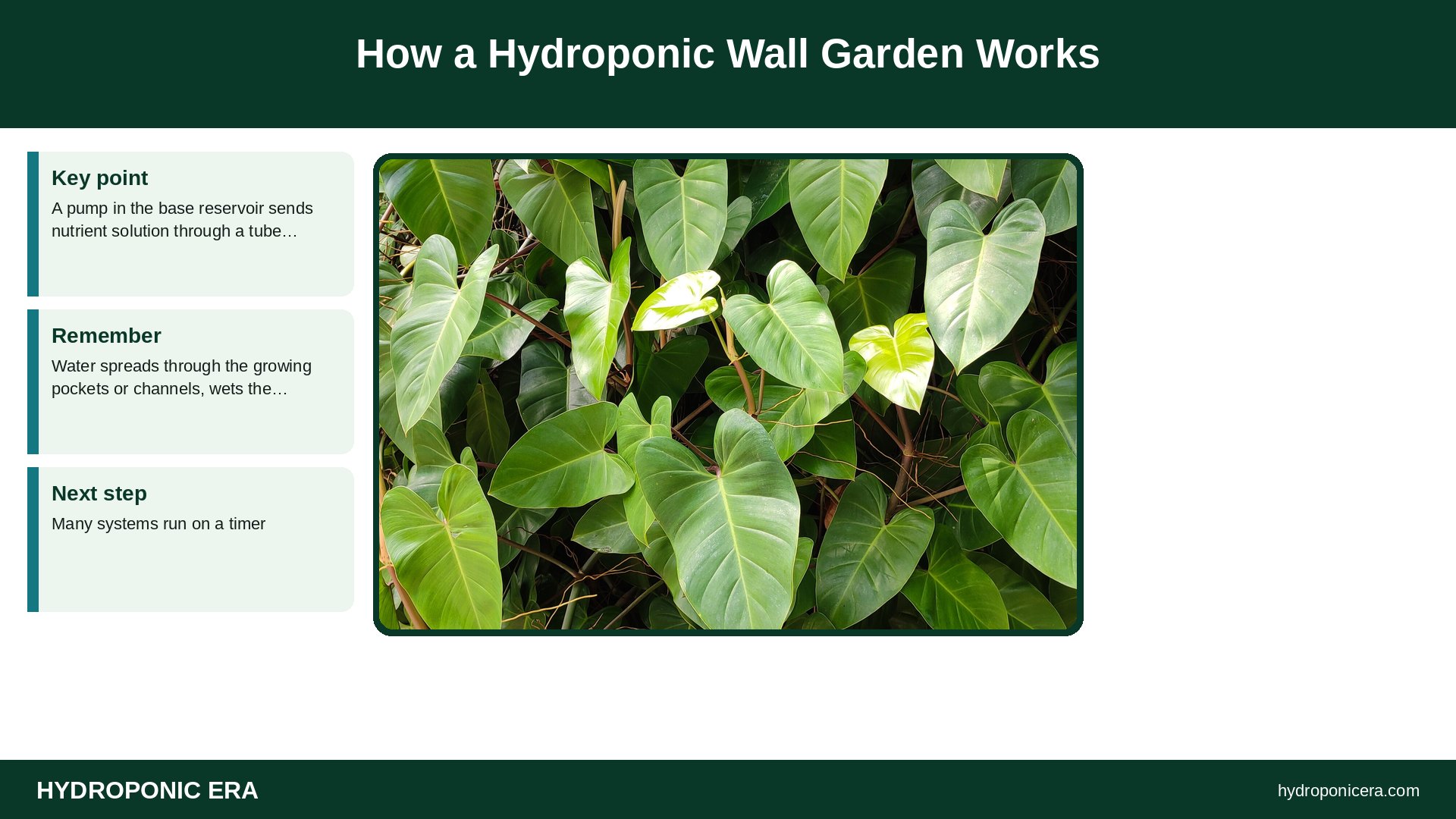
A pump in the base reservoir sends nutrient solution through a tube to a drip line or channel at the top. Water spreads through the growing pockets or channels, wets the roots, and drains to a gutter at the bottom that returns it to the reservoir. Many systems run on a timer. Because the water is exposed to air as it falls, it picks up oxygen. See tower gardens for a freestanding version of the same idea.
Hydroponic Wall Garden Planning
- Weight: water weighs about 8.3 pounds per gallon. Add plants, media, and frame, and mount into studs or use a freestanding frame.
- Waterproofing: use a waterproof backing panel and leave an air gap from the wall.
- Drip tray: a catch tray or gutter at the bottom handles drips and leaks.
- Power: plug pumps and lights into GFCI-protected outlets with drip loops.
- Access: you need to reach the top for planting and the reservoir for refills.
Lighting a Hydroponic Wall Garden
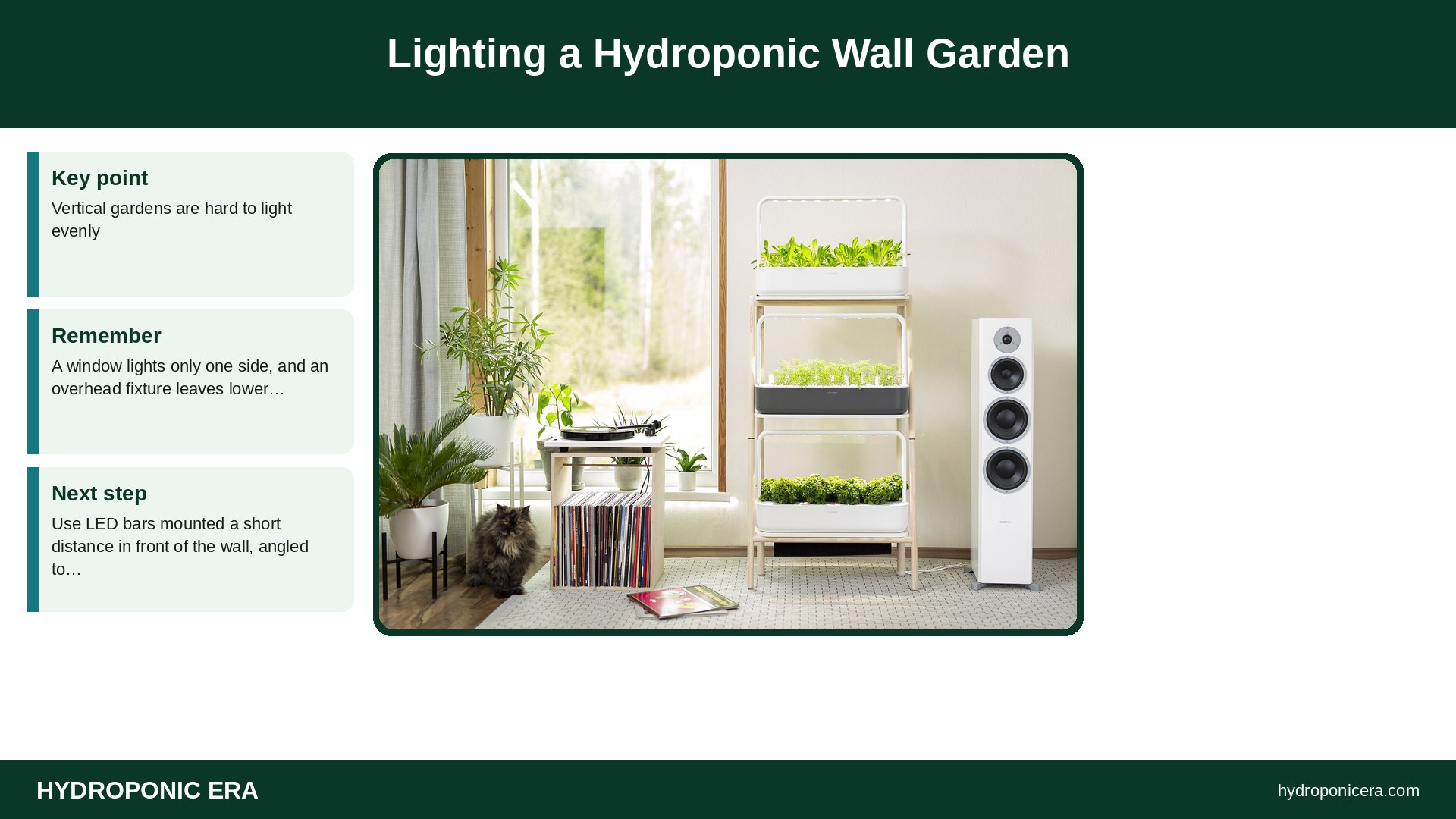
Vertical gardens are hard to light evenly. A window lights only one side, and an overhead fixture leaves lower rows dim. Use LED bars mounted a short distance in front of the wall, angled to cover all rows. Edible greens need much more light than houseplants. See LED watts per square foot and light schedules.
Best Plants for a Hydroponic Wall Garden
- Edible: lettuce, basil, mint, parsley, chives, and strawberries.
- Houseplants: pothos, philodendron, peace lily, and spider plants. See plants that grow in water.
- Avoid: heavy fruiting crops and plants that grow too tall.
Hydroponic Wall Garden Nutrients
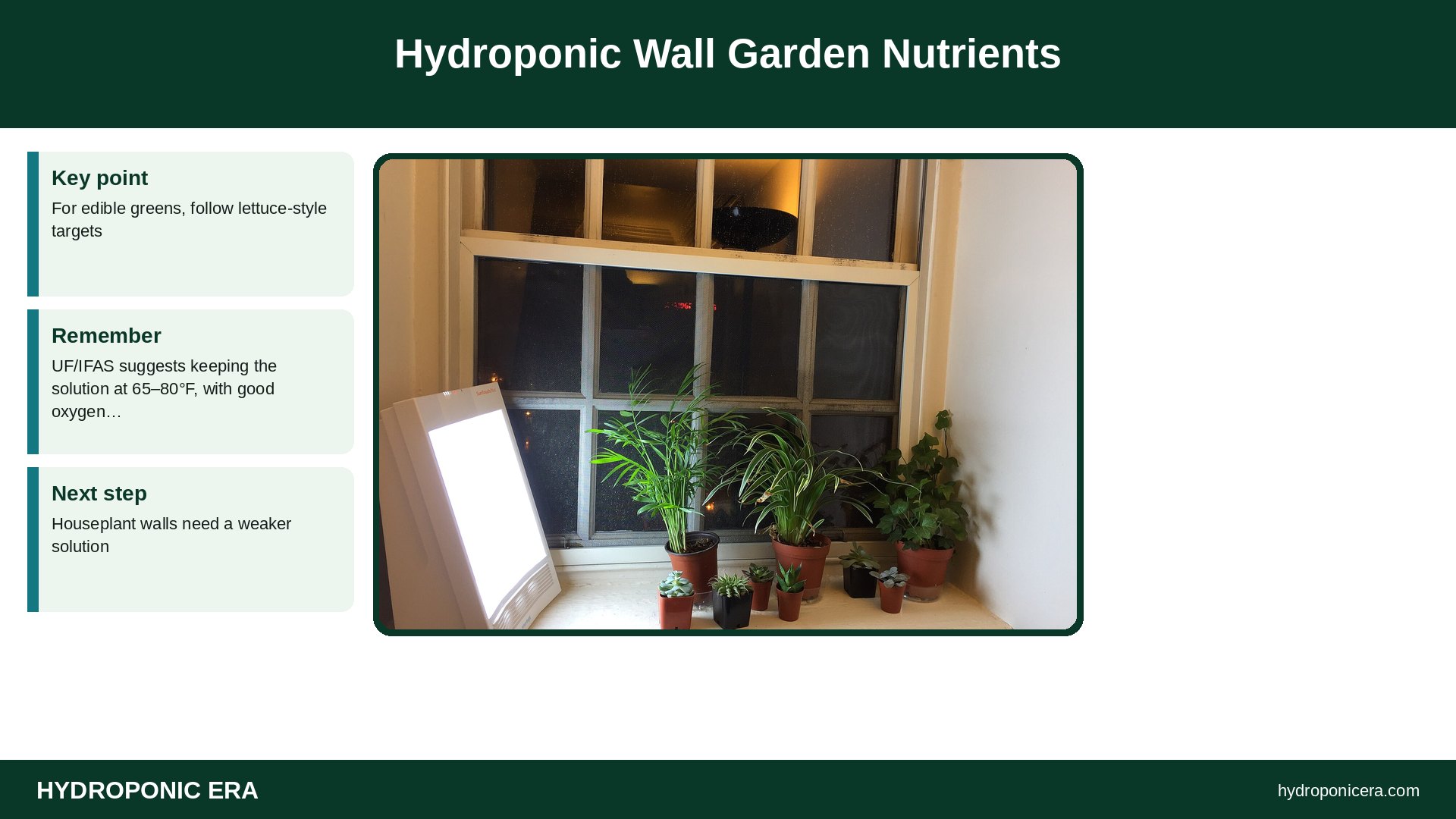
For edible greens, follow lettuce-style targets. UF/IFAS suggests keeping the solution at 65–80°F, with good oxygen (about 5 mg/liter) and EC 1.2–1.8 mS/cm. Houseplant walls need a weaker solution. Check pH and EC weekly. See EC and TDS.
Humidity and Mold
A wall garden releases moisture into the room. In small rooms, this can raise humidity and encourage mold on walls behind the system. Keep a gap behind the backing panel, run a fan, and check for damp spots. Colorado State’s PlantTalk notes good aeration and a root zone around 68–72°F help prevent root disease.
DIY vs Kit Hydroponic Wall Garden
DIY wall gardens can use PVC channels, gutters, or felt pockets on a waterproof panel. Kits come with matched pumps, reservoirs, and frames, and are easier to install. Compare by number of planting sites, reservoir size, and whether lighting is included. See rain gutter hydroponics for a cheap DIY channel approach.
Hydroponic Wall Garden Maintenance
- Top up the reservoir with fresh water.
- Change the solution every 2–3 weeks for edibles.
- Prune plants so lower rows get light.
- Clean the drip line and pump intake.
- Check the drip tray for leaks.
More Hydroponic Wall Garden Tips
Weight and water are the main design issues for a hydroponic wall garden. A wet wall is heavy, so mount it to studs or a freestanding frame, and put a drip tray or gutter at the bottom to catch overflow. Indoors, use a waterproof backing so moisture doesn’t damage the wall behind it.
Light usually limits indoor walls. Most walls get light from one side only, so plants lean and the lower rows get shade. A strip of LED grow lights mounted above and in front of the wall helps even it out.
Weekly Routine for Hydroponic Wall Garden
- Check pH and EC, and record them.
- Top off the reservoir with plain, pH-adjusted water.
- Look at roots for color and smell.
- Check leaves, especially undersides, for pests.
- Clean filters, emitters, and pump intakes.
- Change the nutrient fully every two to three weeks, or sooner if EC drifts.
Beginner Mistakes With Hydroponic Wall Garden
The most common mistakes are skipping pH testing, using nutrient that’s too strong, letting light reach the water, and ignoring water temperature. Each one is easy to fix once you know to check for it. Start with fewer plants than you think you need, learn the routine, and expand once the system runs smoothly.
Best Plants for a Hydroponic Wall Garden
Compact, shallow-rooted plants suit a hydroponic wall garden: lettuce, herbs like basil, mint, and parsley, strawberries, and trailing ornamentals such as pothos and philodendron. Avoid heavy fruiting crops. Group plants with similar light and water needs in the same row, and put thirstier plants near the bottom where water collects.
Watering a Hydroponic Wall Garden
Most wall systems use drip lines or a top channel that trickles down through pockets or cups. Run the pump on a timer, and check that every outlet drips, because one clogged emitter can dry out a whole column. Clean emitters monthly and use a filter on the pump intake.
FAQs: Hydroponic Wall Garden
Can I grow food on a hydroponic wall?
Yes, especially herbs, lettuce, and strawberries, with enough light.
Will it damage my wall?
Not with a waterproof backing, air gap, and drip tray.
Do I need grow lights?
For edibles indoors, almost always.
How heavy is a wall garden?
Water alone is about 8.3 pounds per gallon, plus plants and frame.
How often should I change the solution?
Every 2–3 weeks for edible crops.
Can a wall garden go in a bathroom?
Yes, if there’s enough light; humidity suits many tropical houseplants.
Sources
- UF/IFAS Extension — Growing Lettuce in Small Hydroponic Systems
- Colorado State University PlantTalk — Root Disease Problems and Management in Hydroponic Systems
- Photo credits (Wikimedia Commons, edited with titles): St Edmund Hall Living Wall by Harry Princethorpe (CC BY-SA 4.0); Philodendron hederaceum, Singapore Botanic Gardens (141542) by Moheen Reeyad (CC BY-SA 4.0); Click & Grow Smart Garden 27 by Janar Raidla (CC BY-SA 4.0); Potted plants succulents under grow light Nov 2016 by Asdfjrjjj (CC BY-SA 4.0); Blad van klimop (Hedera helix) 02 by Dominicus Johannes Bergsma (CC BY-SA 3.0)