
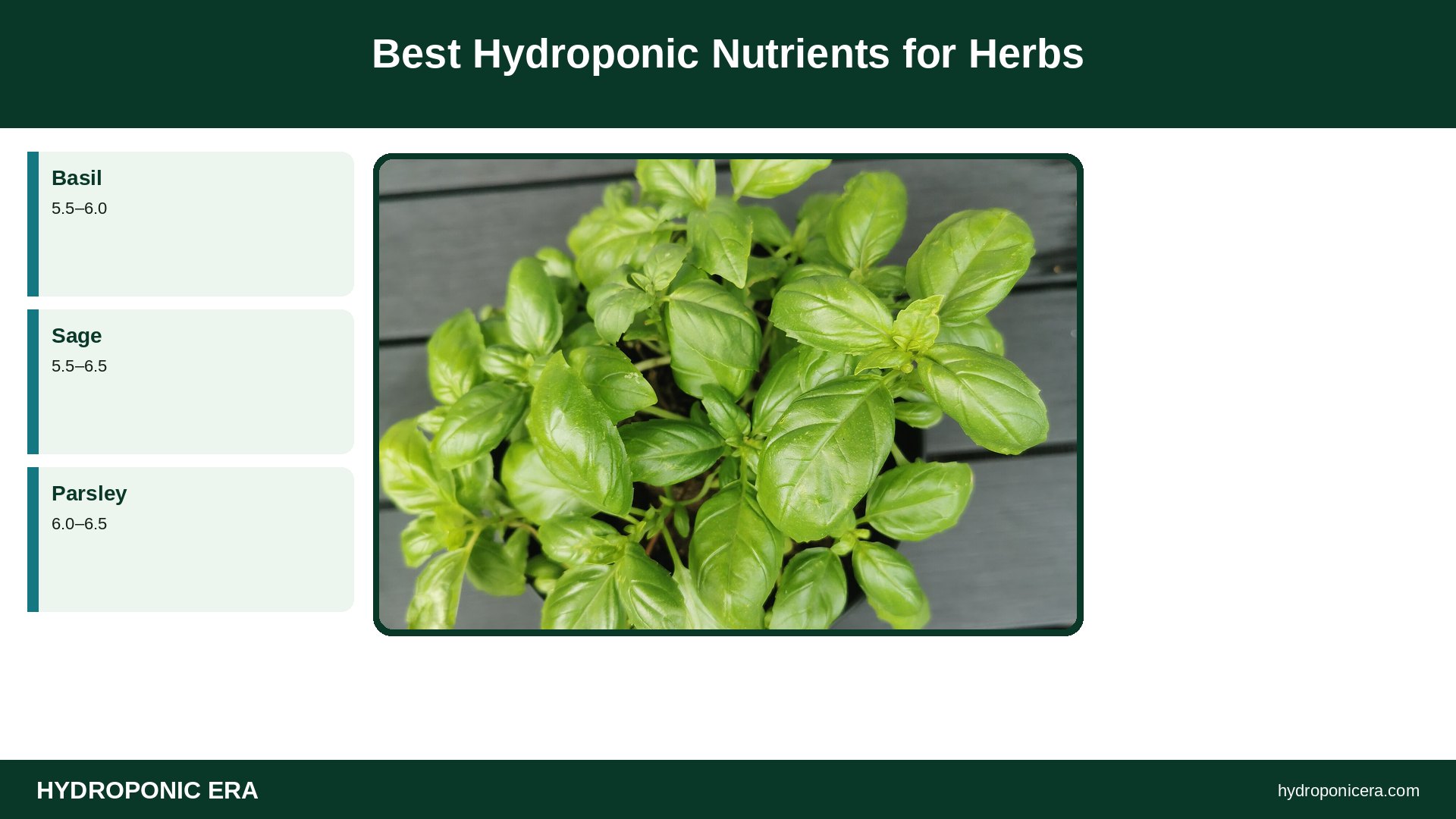
Hydroponic nutrients for herbs should be a complete, mild mix, since most herbs grow best at a lower EC than fruiting crops. Oklahoma State University lists basil at EC 1.0–1.6 mS/cm and pH 5.5–6.0, sage at 1.0–1.6 and pH 5.5–6.5, and parsley at 1.8–2.2 and pH 6.0–6.5. A general-purpose hydroponic base or a leafy-greens formula, mixed at reduced strength, works for most kitchen herbs. Too strong a mix burns leaf tips and can weaken flavor.
Key takeaway: Feed herbs a complete nutrient at moderate EC (about 1.0–1.6 for basil and most soft herbs), keep pH 5.5–6.5, and harvest often.
| Herb | EC (mS/cm) | pH |
|---|---|---|
| Basil | 1.0–1.6 | 5.5–6.0 |
| Sage | 1.0–1.6 | 5.5–6.5 |
| Parsley | 1.8–2.2 | 6.0–6.5 |
Source: Oklahoma State University Extension. Herbs not in the table, like mint and cilantro, are usually grown near the basil range.
What Hydroponic Nutrients for Herbs Need

Herbs need the same essential elements as any crop, but most are grown for leaves, so a nitrogen-forward “grow” formula suits them. Calcium and magnesium matter too, especially in soft RO or rain water. A leafy-greens nutrient or the grow stage of a general base works well. See best hydroponic nutrients.
EC for Hydroponic Nutrients for Herbs
Oklahoma State’s figures put soft herbs like basil and sage at 1.0–1.6, with parsley higher at 1.8–2.2. Start seedlings lower and raise EC as plants fill out. Because herbs are often grown together, pick a middle value that suits the group, or keep heavy feeders like parsley in their own container. See pH and EC meters.
pH for Hydroponic Nutrients for Herbs

Oklahoma State lists basil at 5.5–6.0, sage at 5.5–6.5, and parsley at 6.0–6.5. A shared target around 5.8–6.2 suits most mixed herb systems. Check pH every few days, since it drifts as plants feed. See how to control pH.
Hydroponic Nutrients for Herbs: Mixed Herb Systems
Grouping herbs with similar needs keeps everyone happy. Basil, mint, and oregano share similar ranges; parsley and chives can sit slightly higher. Mint spreads quickly, so give it its own cup or system. See best herbs for hydroponics.
Hydroponic Nutrients for Herbs: Feeding and Flavor
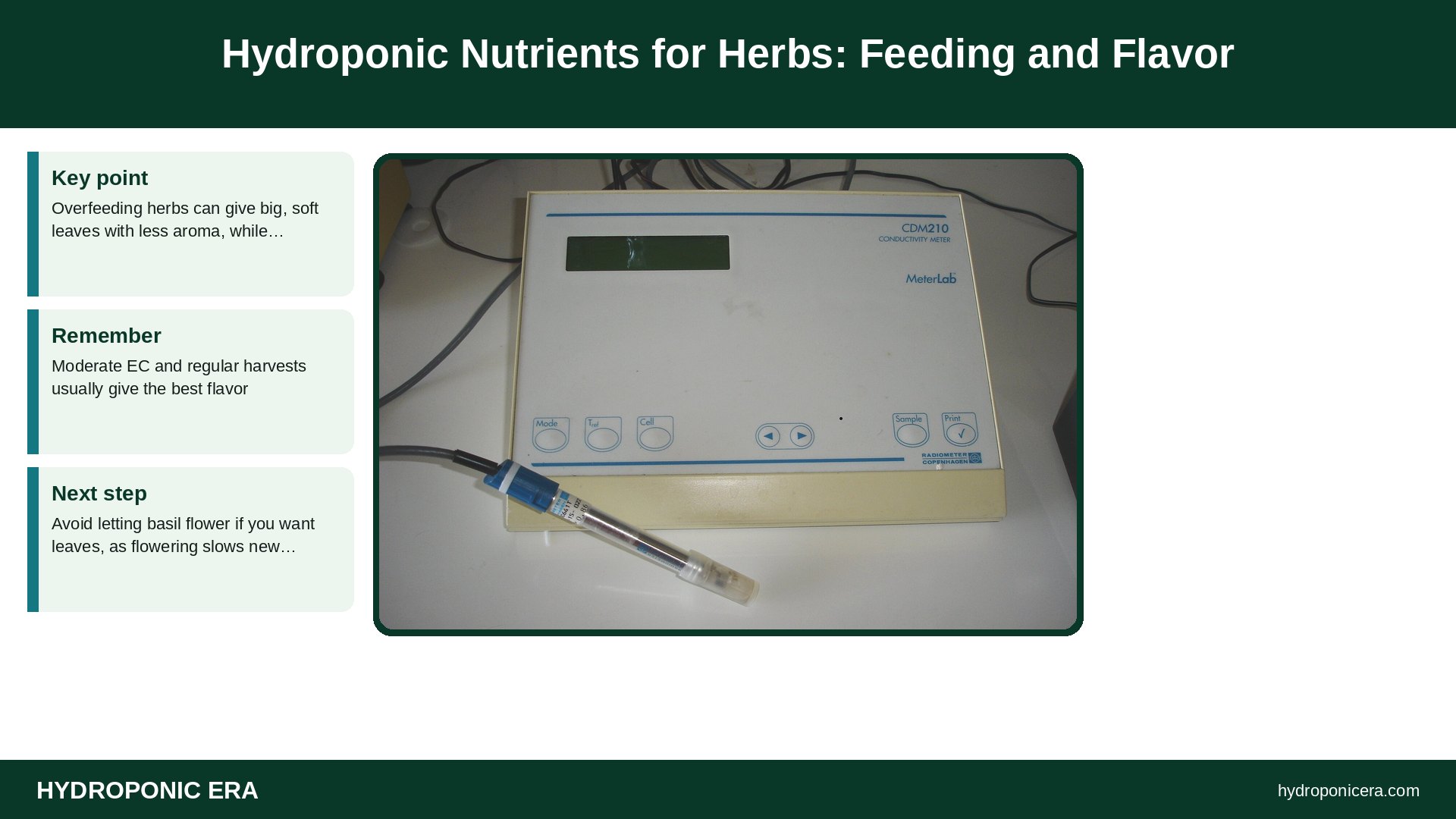
Overfeeding herbs can give big, soft leaves with less aroma, while underfeeding gives pale, slow plants. Moderate EC and regular harvests usually give the best flavor. Avoid letting basil flower if you want leaves, as flowering slows new leaf growth.
Hydroponic Nutrients for Herbs: Signs of Nutrient Problems in Herbs
- Pale or yellow older leaves: low nitrogen.
- Yellow new leaves: iron lockout from high pH.
- Brown, crispy tips: EC too high.
- Black spots on basil: often cold or disease, not nutrients.
See basil leaves turning black.
Systems for Herbs
Kratky jars, DWC totes, NFT, and towers all suit herbs. Kratky is easiest for a windowsill; DWC grows fastest. See Kratky method and how to grow basil hydroponically.
Weekly Routine
- Check pH and EC every few days.
- Top off with plain water if EC climbs.
- Harvest and pinch tips.
- Check leaf undersides for pests.
- Change nutrient every two to three weeks.
Hydroponic Nutrients for Herbs by Type
Soft, leafy herbs like basil, mint, and cilantro grow fast and use more nitrogen, so a grow formula suits them. Woody herbs like rosemary, thyme, and sage grow slowly and prefer lighter feeding and drier roots. Grouping herbs by type, and giving woody herbs their own system or media pots, makes feeding easier.
Water Quality and Herb Feeding
Test your tap water’s EC before mixing. Hard water adds calcium and magnesium; soft or RO water needs a nutrient that supplies them. Subtract your water’s EC from the target so you don’t overfeed delicate herbs.
Herb Feeding Log Example
Write down the date, EC, pH, water temperature, and what you harvested. Herbs that are cut often drink and feed steadily, and a log helps you spot when EC drifts or pH rises. Note flavor too; if basil tastes weak, check whether light or strong nutrient is to blame before changing both.
Herbs That Need Less Feeding
Woody herbs such as rosemary and thyme grow slowly and are easily overfed. Give them a weaker mix than basil.
Equipment Checklist for Hydroponic Nutrients for Herbs
- A calibrated EC meter.
- A pH meter or kit and pH up/down.
- A measuring syringe or cup in milliliters.
- A notebook or app to log readings.
- A clean reservoir with volume marks.
- Plain, low-salt water for top-offs.
Most of this gear is reusable from crop to crop, so the first setup costs the most. Buy reliable meters first; they prevent the majority of problems.
Beginner Mistakes With Hydroponic Nutrients for Herbs
The most common mistakes are feeding herbs too strongly, mixing herbs with very different needs in one reservoir, and letting basil flower.
Getting Started With Hydroponic Nutrients for Herbs
Start small, change one thing at a time, and keep a simple log of pH, EC, temperature, and what you changed. Most hydroponic problems show up as patterns in those numbers before they show on the plant. Compare your notes with the sources below, and adjust slowly rather than chasing every small swing. A steady routine matters more than any single product or setting.
FAQs: Hydroponic Nutrients for Herbs
What EC do hydroponic herbs need?
About 1.0–1.6 for basil and sage; parsley 1.8–2.2.
What pH do herbs like?
About 5.5–6.5, depending on the herb.
Can I use tomato nutrients for herbs?
Yes, at lower strength and with a grow ratio.
Do herbs need bloom nutrients?
Usually not; you’re harvesting leaves.
Why are my basil leaf tips brown?
EC is often too high.
Do herbs need calcium and magnesium?
Yes, especially with RO water.
Sources
- Oklahoma State University Extension — Electrical Conductivity and pH Guide for Hydroponics
- Photo credits (Wikimedia Commons, edited with titles): Basil plant in a pot 02 by Netha Hussain (CC BY-SA 4.0); Click & Grow Smart Garden 27 by Janar Raidla (CC BY-SA 4.0); -2020-07-10 Purple basil (Ocimum basilicum) seedlings, Trimingham by Kolforn (Kolforn) I’d appreciate if you could mail me (Kolforn@gmail.com) if you (CC BY-SA 4.0); Electrical conductivity meter by Nuno Nogueira (Nmnogueira) (CC BY-SA 2.5); Coriander Green Seeds (Coriandrum sativum) in Shimla by Sapna Sony (CC BY-SA 4.0)