
What is a cold frame? A cold frame is a bottomless box with a clear lid that traps solar heat to protect plants. Iowa State University Extension says it extends the growing season by two to four weeks in spring and fall. Face it south, vent it when it gets above 85°F (29°C), and grow cool-season crops.
Key takeaway: A cold frame is a sun-heated, south-facing box that adds two to four weeks of growing time each spring and fall.
| Cold frame detail | Guideline | Source |
|---|---|---|
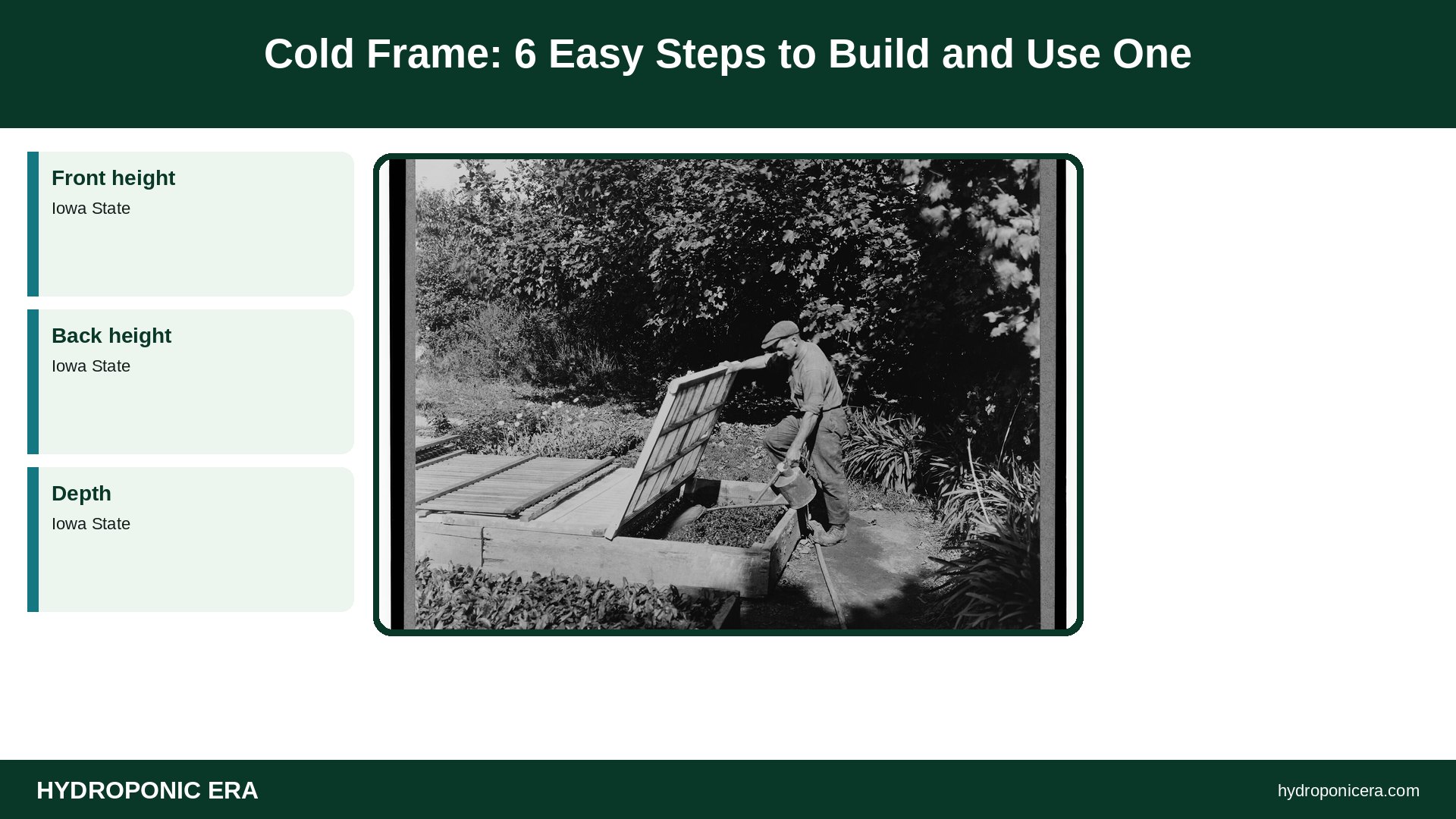
| Front height | About 12 inches (30 cm) | Iowa State |
| Back height | About 18 inches (46 cm) | Iowa State |
| Depth | No more than 3 feet (0.9 m) | Iowa State |
| Open lid | Above 85°F (29°C) inside | Iowa State |
| Spring target | About 70°F (21°C) | NYBG |
| Fall target | About 65°F (18°C) | NYBG |
How Does a Cold Frame Work?
It uses only the sun. Iowa State Extension says the ground and frame are heated by the sun during the day and radiate that heat at night, keeping the inside warmer. Purdue Extension explains that a hotbed has the same structure plus another heat source, such as electric cables, so growth without heat is slower.
How Do You Build a Cold Frame?
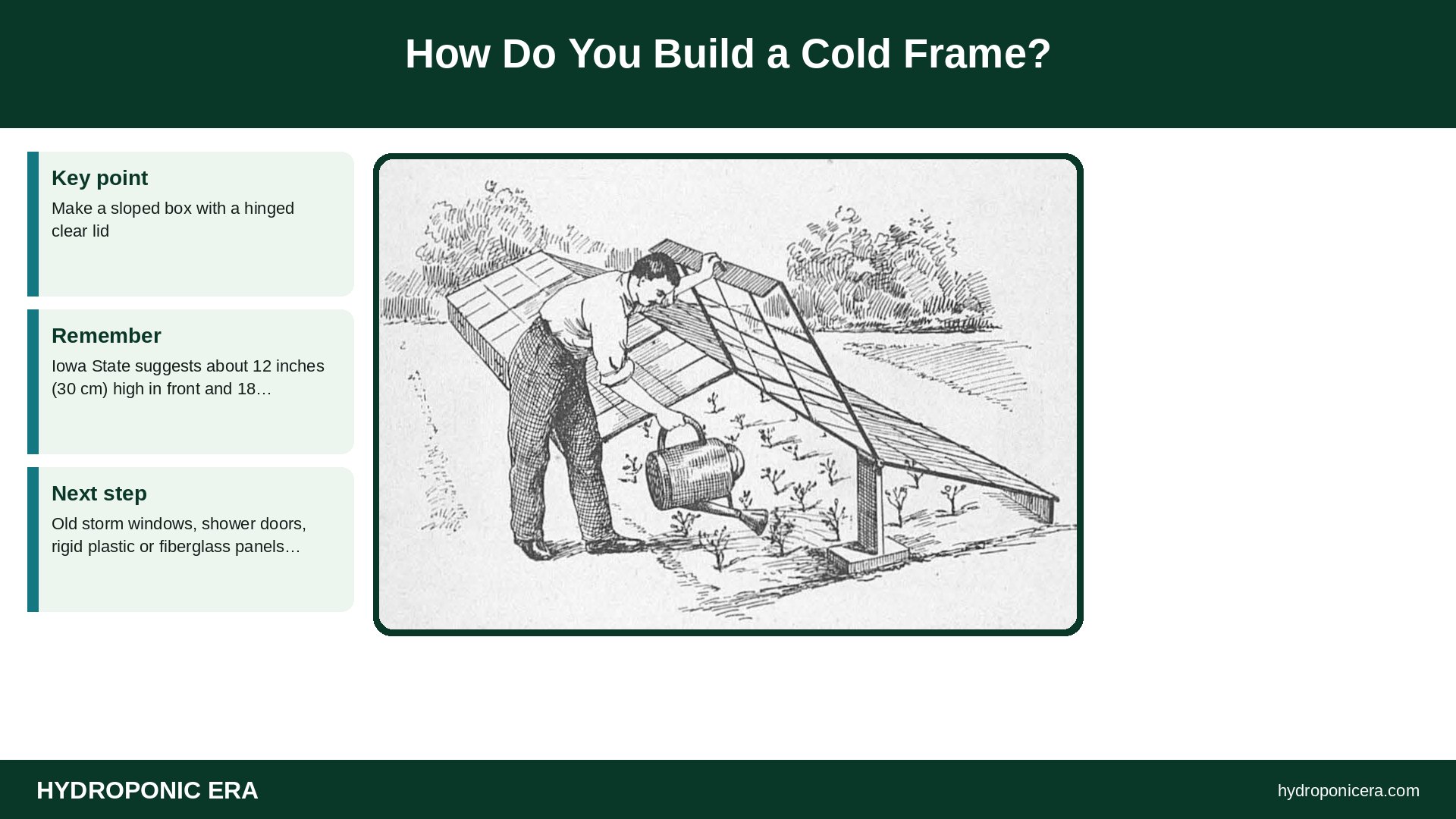
Make a sloped box with a hinged clear lid. Iowa State suggests about 12 inches (30 cm) high in front and 18 inches (46 cm) in back, no more than 3 feet (0.9 m) deep. Old storm windows, shower doors, rigid plastic or fiberglass panels work as covers, mounted on hinges for easy opening.
- Cut the two side boards on an angle, low in front and high in back.
- Screw the front, back and sides together, pre-drilling holes.
- Hinge an old window or clear panel to the high back wall.
- Set the frame over well-drained soil, facing south.
- Bank soil or straw bales around the outside to hold heat.
What Wood Is Safe for a Cold Frame?
Sources differ. The New York Botanical Garden says to use untreated lumber if you will grow food. Iowa State says treated lumber lasts longer but advises avoiding wood treated with creosote or similar chemicals, and suggests painting untreated wood. Purdue’s older guide lists redwood, cedar or pressure-treated lumber, so cedar or untreated wood is the cautious food-garden choice.
Where Should You Put a Cold Frame?
Face it south on dry ground. Iowa State says to choose well-drained soil that does not flood, orient the frame south for maximum sun and place the north side near a house, garage or fence to cut heat loss. Purdue adds that it should be sheltered from wind and close to a good water supply.
Learn more about structures in our hydroponic greenhouse for beginners guide.
When Should You Vent a Cold Frame?
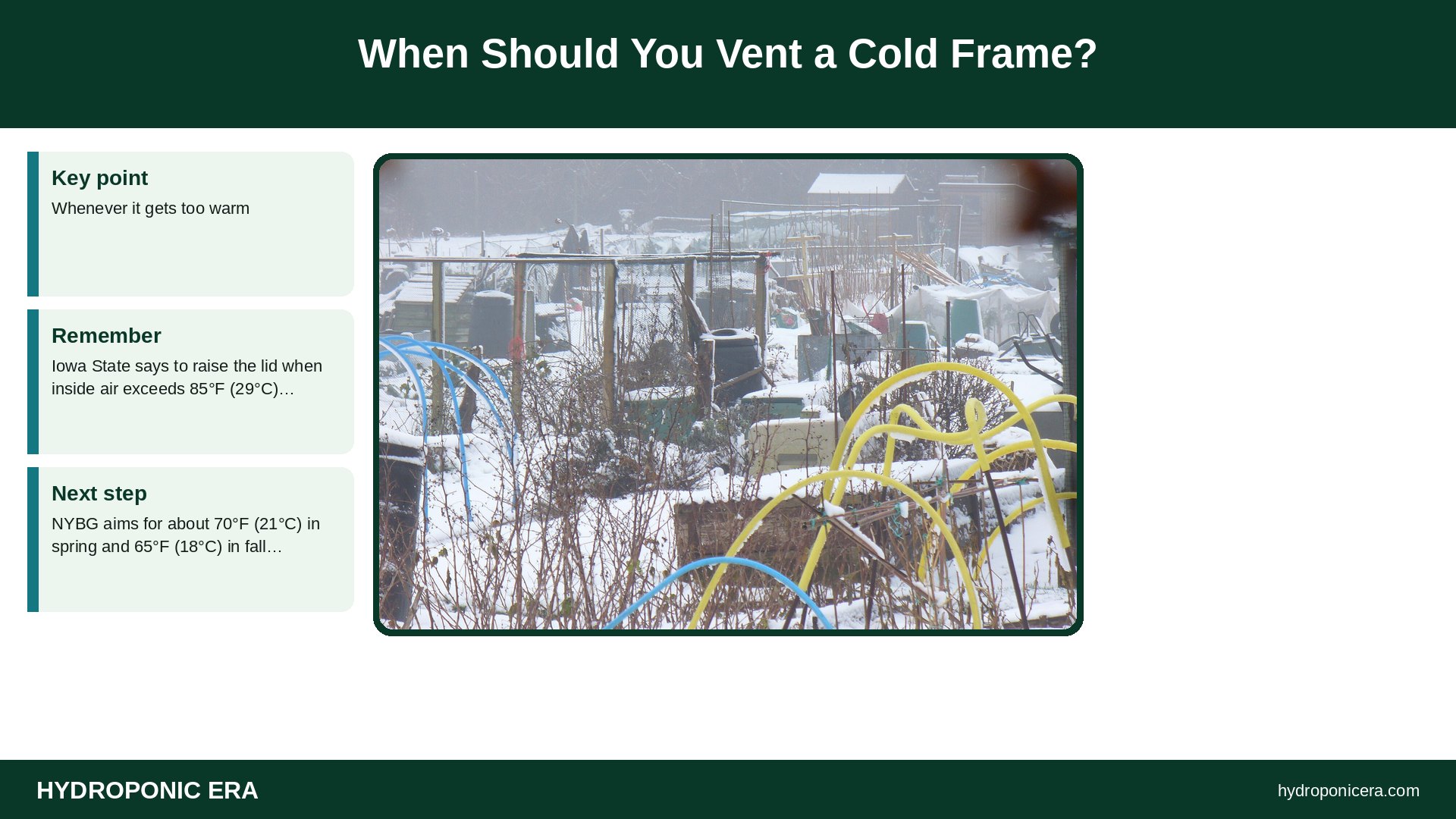
Whenever it gets too warm. Iowa State says to raise the lid when inside air exceeds 85°F (29°C) and close it before sunset, checking often, even on cloudy days, because temperatures change fast. NYBG aims for about 70°F (21°C) in spring and 65°F (18°C) in fall, measured with a shaded thermometer at the soil surface.
Purdue notes good ventilation also helps prevent damping-off disease. A board or dowel can prop the lid, and Iowa State says wax- or gas-filled automatic openers push the cover open as it warms and close it as it cools.
What Can You Grow in a Cold Frame?
Cool-season crops do best. NYBG recommends arugula, lettuce, parsley, radish, scallion, spinach and Swiss chard, harvested as baby greens, since tall crops will not fit with the lid closed. Purdue says the unheated frame suits cabbage, cauliflower, lettuce and spinach, while peppers, tomatoes and eggplants do better in a heated hotbed.
Grow greens year-round with our how to grow spinach hydroponically guide.
Can You Use a Cold Frame in Fall and Winter?
Yes. Iowa State says fall crops started in late August or early September can be harvested well into November when the frame is closed on frosty nights. NYBG says spinach planted in August can be picked from mid-October to late November, and Purdue says salad greens can produce until about Thanksgiving.
Plan indoor backups with our vegetables to grow indoors in winter guide.
How Do You Harden Off Seedlings in a Cold Frame?
Open it more each day. Iowa State says the frame makes hardening off easy: just close it on frosty nights. Purdue advises leaving the sash off most of the day as the season advances, then all day, then all day and night, before transplanting. NYBG notes seeds started in the frame need no hardening off.
FAQ About a Cold Frame
How much longer can I grow?
Iowa State says two to four weeks extra in both spring and fall.
Do I need to vent on rainy days?
NYBG says usually not, unless it is extremely warm.
Can snow sit on the lid?
NYBG says snow insulates, but too much can break glass.
How do I protect plants on freezing nights?
Purdue suggests covering with a straw mat, roofing paper or tarp.
Sources
- Iowa State University Extension and Outreach — All About Cold Frames
- Purdue Extension — HO-53: Hotbeds and Cold Frames
- The New York Botanical Garden, Bronx Green-Up — Build a Cold Frame
- Photo credits (Wikimedia Commons, edited with titles): Gardener watering cold frame plants, posed to illustrate Rudyard Kipling’s poem The Glory of the Garden LCCN00651263 by Johnston, Frances Benjamin, 1864-1952, photographer (Public domain); Baltet – La pépinière – fig46 by Charles Baltet (Public domain); Cold Frames – geograph.org.uk – 2793378 by Colin Smith (CC BY-SA 2.0); Salinas Lettuce Field by ChrisPChapman (CC BY 4.0)