
Can you grow komatsuna hydroponically? Yes. Komatsuna hydroponics is one of the easiest ways to grow this Japanese mustard spinach. It is a fast Brassica rapa green: farmer Pam Dawling notes baby leaves in about 21 days and full size in about 35 days, and Korin’s growing sheet gives a 60–80°F (16–27°C) growing range. Feed it like lettuce and harvest leaf by leaf or as whole heads.
Key takeaway: Komatsuna is quick, heat tolerant for a brassica, and happy in deep water culture, NFT or a Kratky jar. Start seeds warm, grow cooler, keep a leafy-green nutrient strength, and harvest from three weeks onward.
| Factor | Target | Source |
|---|---|---|
| Germination temperature | 70–85°F (21–29°C) | Korin growing sheet |
| Growing temperature | 60–80°F (16–27°C) | Korin growing sheet |
| Baby leaf | About 21 days | Pam Dawling, PASA |
| Full size | About 35 days (35–50 by variety) | Dawling; Cornell |
| Harvest height | 10–12 in (25–30 cm) for full heads | Korin growing sheet |
| Solution EC (leafy-green start) | 1.2–1.8 mS/cm | UF/IFAS lettuce guidance |
What Is Komatsuna?
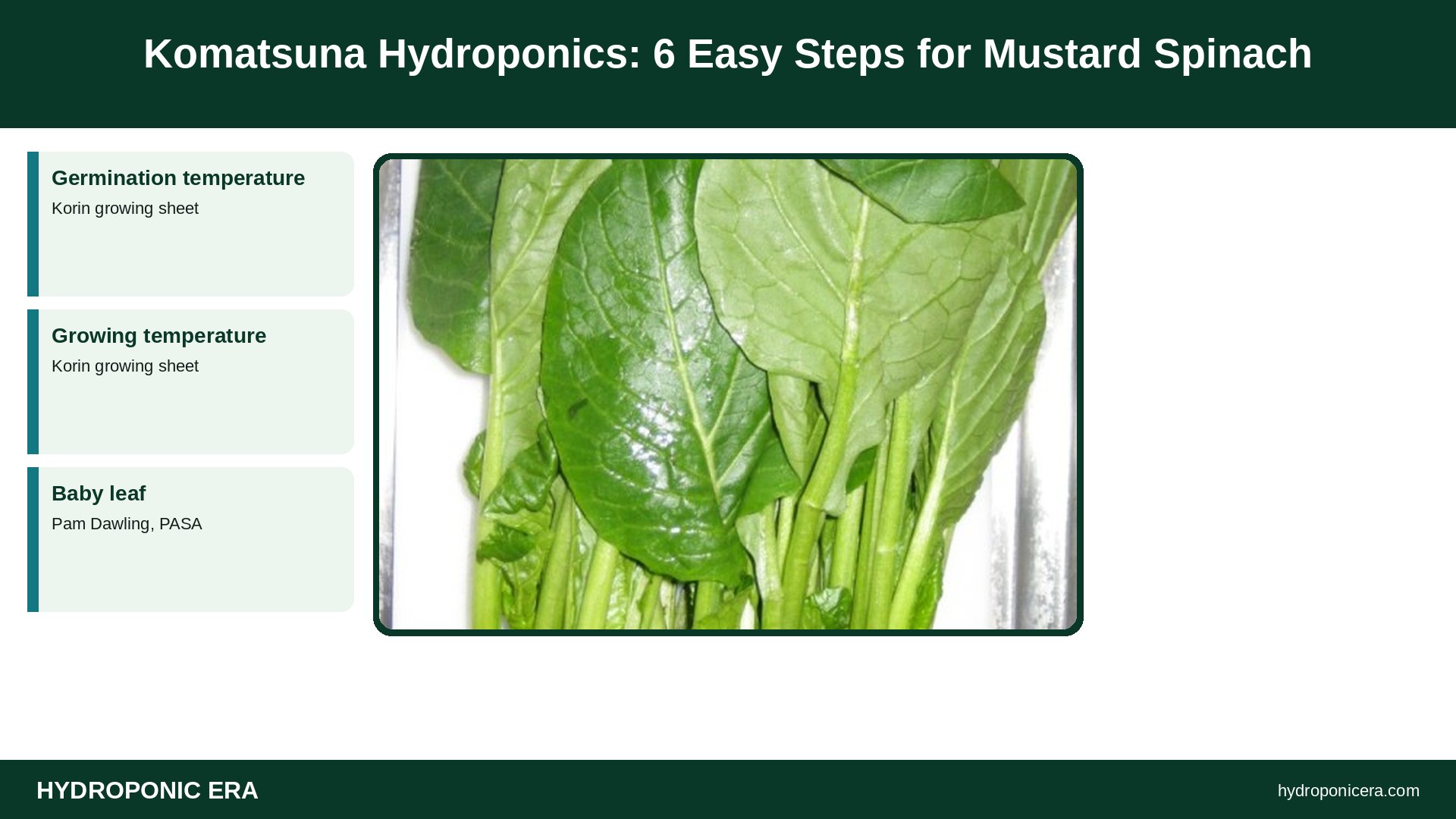
Komatsuna is a Japanese leafy green, Brassica rapa var. perviridis, often sold as mustard spinach. It has smooth, dark green, spoon-shaped leaves on thin stems and a mild flavor between spinach and cabbage. Market grower Pam Dawling lists it among the quickest Asian greens, ready for baby leaf in about three weeks.
Despite the nickname, komatsuna is not true spinach. In komatsuna hydroponics it behaves like a fast brassica, and it is not as hot as most mustards. Young leaves go into salads, while larger leaves are stir-fried, pickled or added to soups. Because it grows so fast, komatsuna fits small indoor systems where every week of bench space counts.
Why Is Komatsuna Hydroponics a Good Choice?
Komatsuna hydroponics suits beginners because the crop is fast, compact and more tolerant of heat than many brassicas. Cornell’s variety trials describe komatsuna types maturing in 35–50 days with good heat and disease resistance. In a hydroponic system, steady water and nutrients keep the leaves tender instead of tough.
- Speed: baby leaf in about 21 days, according to Pam Dawling’s PASA handout.
- Flexible harvest: pick outer leaves or cut whole heads.
- Warmer tolerance: grows from 60–80°F (16–27°C) per Korin’s grow sheet, wider than spinach.
- Small footprint: fits NFT channels, rafts and single jars.
If you enjoy komatsuna hydroponics, try its relatives too. Our mizuna and tatsoi guide covers two more fast Japanese greens.
What Nutrients and pH Does Komatsuna Need?
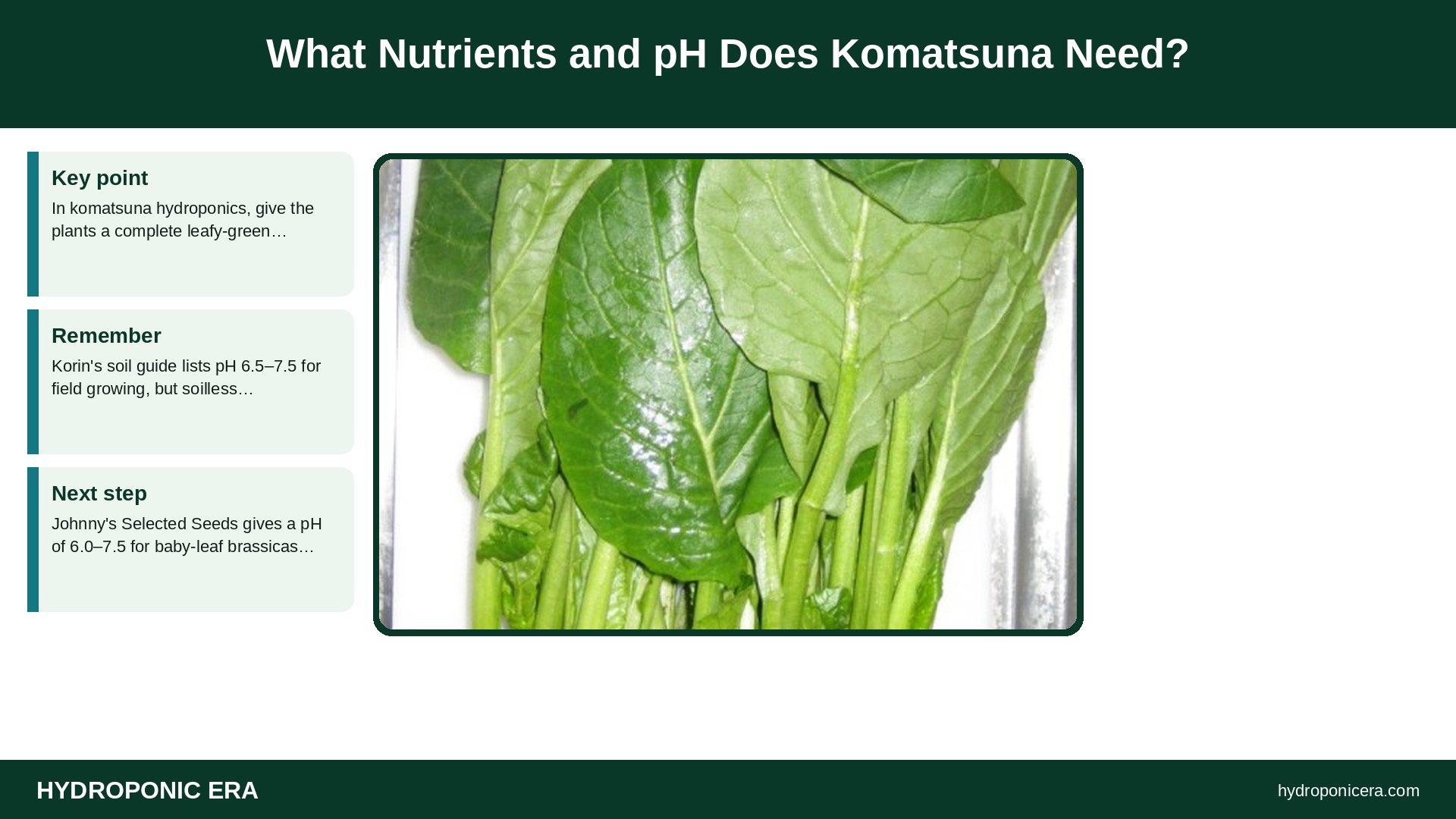
In komatsuna hydroponics, give the plants a complete leafy-green nutrient at an EC of about 1.2–1.8 mS/cm, the range UF/IFAS Extension gives for hydroponic lettuce, and hold pH around 5.8–6.5. Korin’s soil guide lists pH 6.5–7.5 for field growing, but soilless systems run a little lower so iron and manganese stay available.
Johnny’s Selected Seeds gives a pH of 6.0–7.5 for baby-leaf brassicas in soil and recommends sowing every two weeks for a steady supply. In hydroponics, check EC and pH every few days and top up with plain water when EC climbs. Pale new leaves usually mean the solution is too weak.
- Start seedlings at about half strength, then raise to full leafy-green strength after transplant.
- Keep solution temperature in the 65–80°F (18–27°C) range UF/IFAS recommends.
- Change the reservoir every two to three weeks in recirculating systems.
For step-by-step EC adjustments, see our hydroponic lettuce EC guide.
How Do You Start Seeds for Komatsuna Hydroponics?
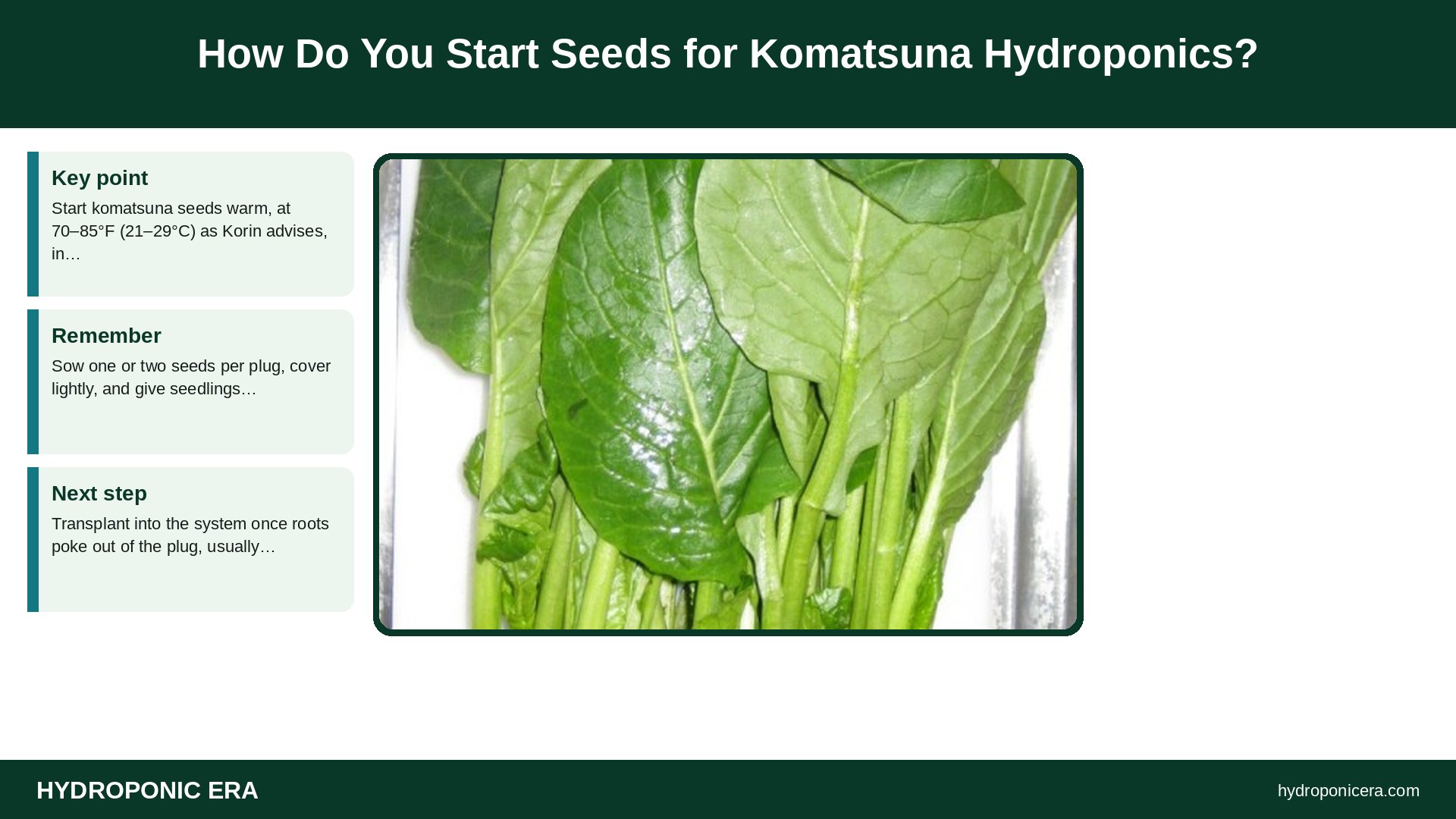
Start komatsuna seeds warm, at 70–85°F (21–29°C) as Korin advises, in moist rockwool or coco plugs. Sow one or two seeds per plug, cover lightly, and give seedlings bright light as soon as they emerge. Transplant into the system once roots poke out of the plug, usually within about two weeks.
- Pre-soak plugs in pH-adjusted water.
- Sow one or two seeds per cell and keep them moist.
- Remove the humidity dome once most seeds have germinated.
- Thin to one seedling per plug.
- Transplant into net cups when roots show.
Which System Works Best for Komatsuna Hydroponics?
Deep water culture and NFT both work well for komatsuna hydroponics, and a Kratky jar is fine for one plant. Deep water culture keeps temperature and nutrients stable, which helps a crop grown for tender leaves. NFT suits repeated baby-leaf harvests in tight rows. Choose by space and how often you want to harvest.
| System | Best use | Watch for |
|---|---|---|
| Deep water culture | Full heads, beginners | Air stone and water temperature |
| NFT | Baby leaf in rows | Pump failure dries roots fast |
| Kratky | Single plant, no power | Size reservoir for the whole crop |
| Ebb and flow | Mixed greens trays | Root zone drying between floods |
Our Kratky method guide explains how to keep the right air gap as the water drops.
When and How Do You Harvest Komatsuna?
Harvest komatsuna as baby leaves from about 21 days, or as full heads at about 35 days when plants reach 10–12 inches (25–30 cm), as Korin suggests. For repeat picking, take the outer leaves and leave the center growing. For a single harvest, cut the whole head just above the crown.
Indoor komatsuna hydroponics is more predictable than field growing. Korin notes spring crops can be ready in 30–40 days, while fall crops in the field take 50–80 days as light and temperatures fall. Indoors under steady LEDs, timing is more consistent. Harvest before plants send up a flower stalk, because leaves then turn tougher and stronger in flavor.
What Problems Affect Komatsuna Hydroponics?
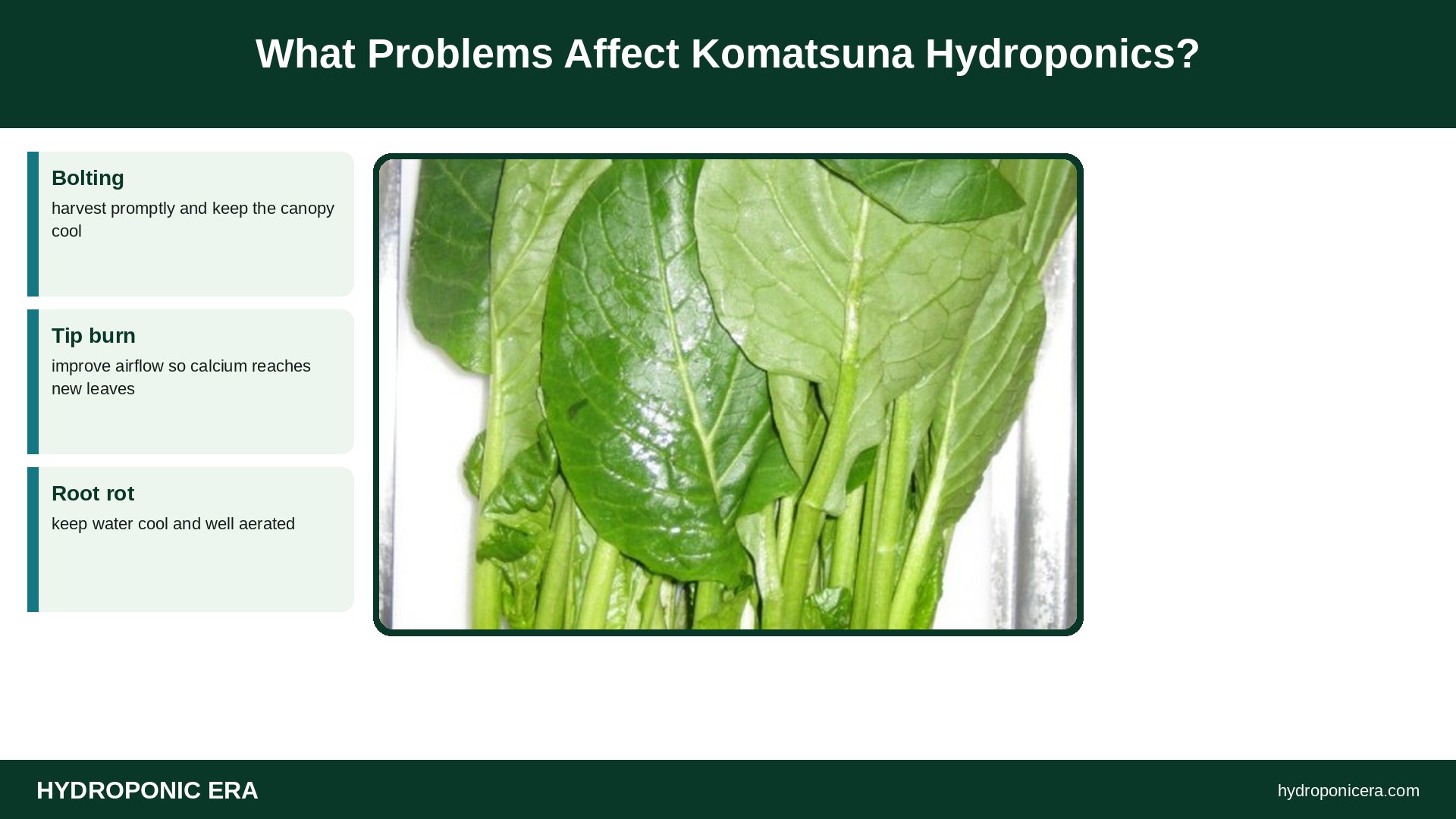
The common problems in komatsuna hydroponics are bolting in long, hot days, tip burn, root rot in warm water and brassica pests such as aphids and flea beetles. Most are prevented by cool roots, strong airflow and weekly leaf checks. Catch pests early, because fast crops leave little time to recover.
- Bolting: harvest promptly and keep the canopy cool.
- Tip burn: improve airflow so calcium reaches new leaves.
- Root rot: keep water cool and well aerated.
- Pests: inspect leaf undersides each week.
FAQ About Komatsuna Hydroponics
Is komatsuna the same as tatsoi?
No. Both are Brassica rapa greens, but tatsoi forms a flat rosette of small spoon leaves.
Can komatsuna be grown as microgreens?
Yes, like other brassicas it can be cut at the first true-leaf stage.
Does komatsuna taste like mustard?
It is milder than most mustards, closer to spinach with a light cabbage note.
How often should I sow for komatsuna hydroponics?
Johnny’s suggests sowing baby-leaf brassicas every two weeks for steady harvests.
Does komatsuna hydroponics work in summer?
Yes, it tolerates warmth better than spinach, but keep it below about 80°F (27°C).
Sources
- Korin — Growing Information: Komatsuna (FD-174)
- Pam Dawling, PASA Conference — Optimize Your Asian Greens Production
- Johnny’s Selected Seeds — Baby Leaf Brassicas Key Growing Information
- UF/IFAS Extension — Hydroponic Lettuce Production (HS1422)
- Cornell University — Vegetable Varieties for Gardeners: Komatsuna
- Photo credits (Wikimedia Commons, edited with titles): Komatsuna by 日陰猫Joga at Japanese Wikipedia (CC BY-SA 3.0)