
Can you grow choy sum hydroponically? Yes. Choy sum hydroponics works well because this cool-season Chinese green is fast and compact. UF/IFAS Extension says choy sum (Brassica rapa var. parachinensis) grows best at 59–77°F (15–25°C) and is harvested 30–50 days after sowing, when flower buds have formed but not opened. Keep the solution cool, oxygenated and fed like other leafy greens.
Key takeaway: Choy sum is grown for its tender flowering shoots, not just its leaves. Sow it, keep it cool, feed it at a leafy-green strength, and cut the shoots while the yellow buds are still closed. Expect two or three cuttings from one planting.
| Factor | Target | Source |
|---|---|---|
| Air temperature | 59–77°F (15–25°C) | UF/IFAS Extension |
| Days to harvest | 30–50 days from sowing | UF/IFAS Extension |
| Fast dwarf type | 21–28 days, cut at 3–4 in (8–10 cm) | Cornell vegetable varieties |
| Solution EC (leafy-green start) | 1.2–1.8 mS/cm | UF/IFAS lettuce guidance |
| Solution temperature | 65–80°F (18–27°C) | UF/IFAS Extension |
| Spacing | 8–12 in (20–30 cm) | UF/IFAS Extension |
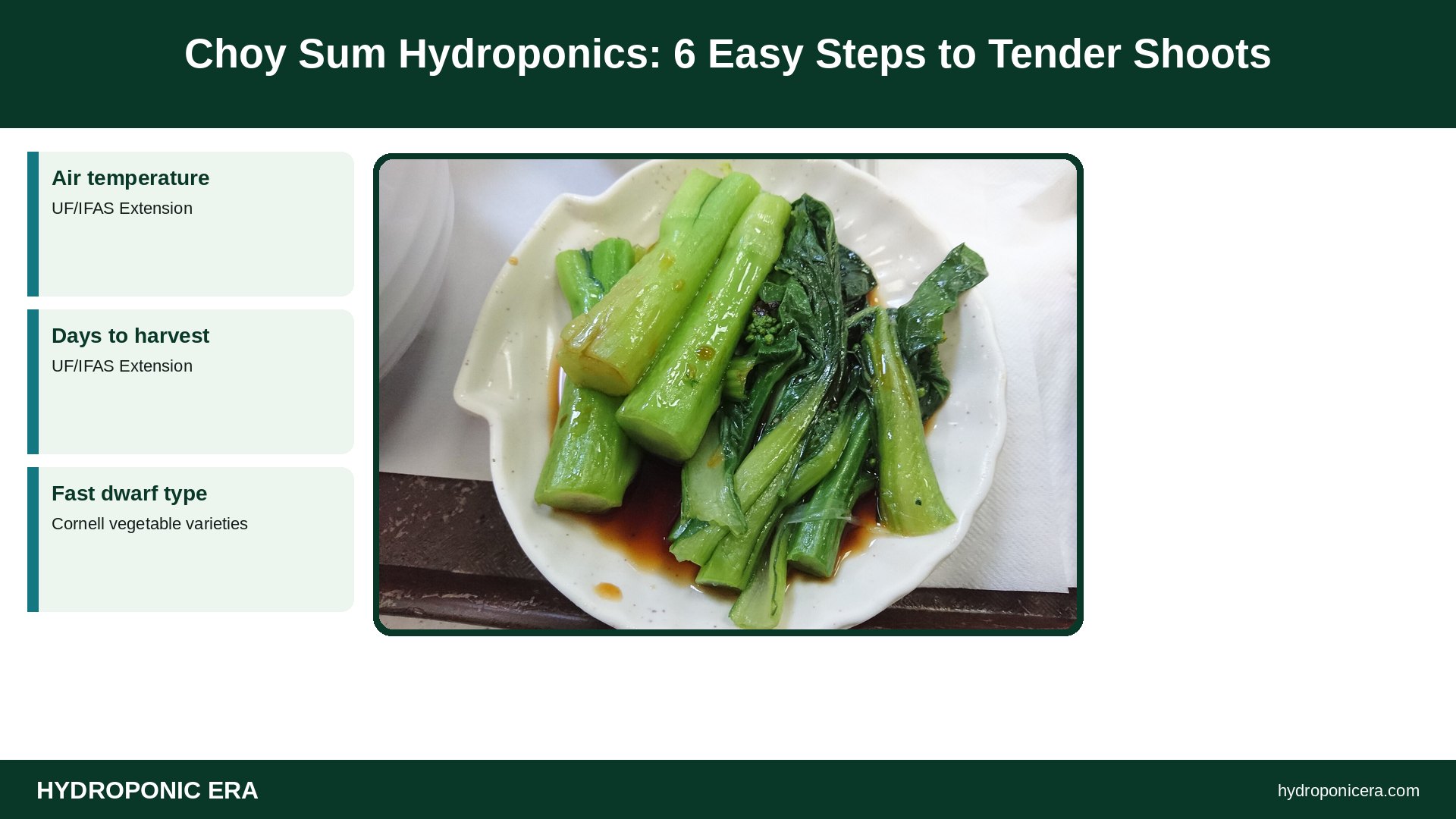
What Is Choy Sum and How Is It Different From Bok Choy?
Choy sum is a leafy Brassica rapa grown for its thin flowering stems, small yellow buds and tender leaves. Bok choy is grown for a thick rosette of white or green petioles. UF/IFAS Extension describes choy sum (also called cai xin or Chinese flowering cabbage) as a quick crop that is cut when the flower buds are developed but still closed.
That difference shapes how you grow it. Bok choy rewards a long, steady vegetative stage, while choy sum is supposed to push up a flowering shoot. You still want a cool environment, because heat makes the shoots run to open flowers before they thicken. If you already grow bok choy, see our bok choy hydroponics guide for the shared basics.
What Conditions Does Choy Sum Hydroponics Need?
Choy sum hydroponics needs cool air of 59–77°F (15–25°C), bright light, a well-oxygenated solution and steady leafy-green nutrition. UF/IFAS lists that temperature range for the crop and notes it is sensitive to waterlogging and to shortages of water and nitrogen. In hydroponics, that means strong aeration and no nutrient gaps.
- Temperature: cool is better. Only the purple-stemmed type, often sold as hon tsai tai, tolerates frost according to UF/IFAS.
- pH: UF/IFAS gives a soil pH of 6.0–7.0. In soilless systems most growers hold leafy greens slightly lower, around 5.5–6.5, to keep micronutrients available.
- Nutrients: begin at an EC of 1.2–1.8 mS/cm, the range UF/IFAS gives for hydroponic lettuce, and adjust by leaf color.
- Oxygen: use an air stone in deep water culture, or keep NFT channels flowing, because the roots dislike stagnant, waterlogged conditions.
Our hydroponic lettuce EC guide explains how to read EC and when to raise or lower strength.
Which Hydroponic System Is Best for Choy Sum?
Deep water culture, NFT and the Kratky method all suit choy sum hydroponics because it is a short leafy crop. Deep water culture is the most forgiving for beginners, since a large volume of water stays cool and stable. NFT suits compact dwarf types. Kratky works for a single quick crop if the reservoir is sized for its whole life.
In choy sum hydroponics, choose plant spacing to match the variety. UF/IFAS suggests 8–12 inches (20–30 cm) between plants for full-size choy sum. Dwarf varieties for baby harvest can be set closer. If you prefer a no-pump setup, our Kratky method guide covers reservoir sizing and the air gap.
How Do You Start Seeds for Choy Sum Hydroponics?
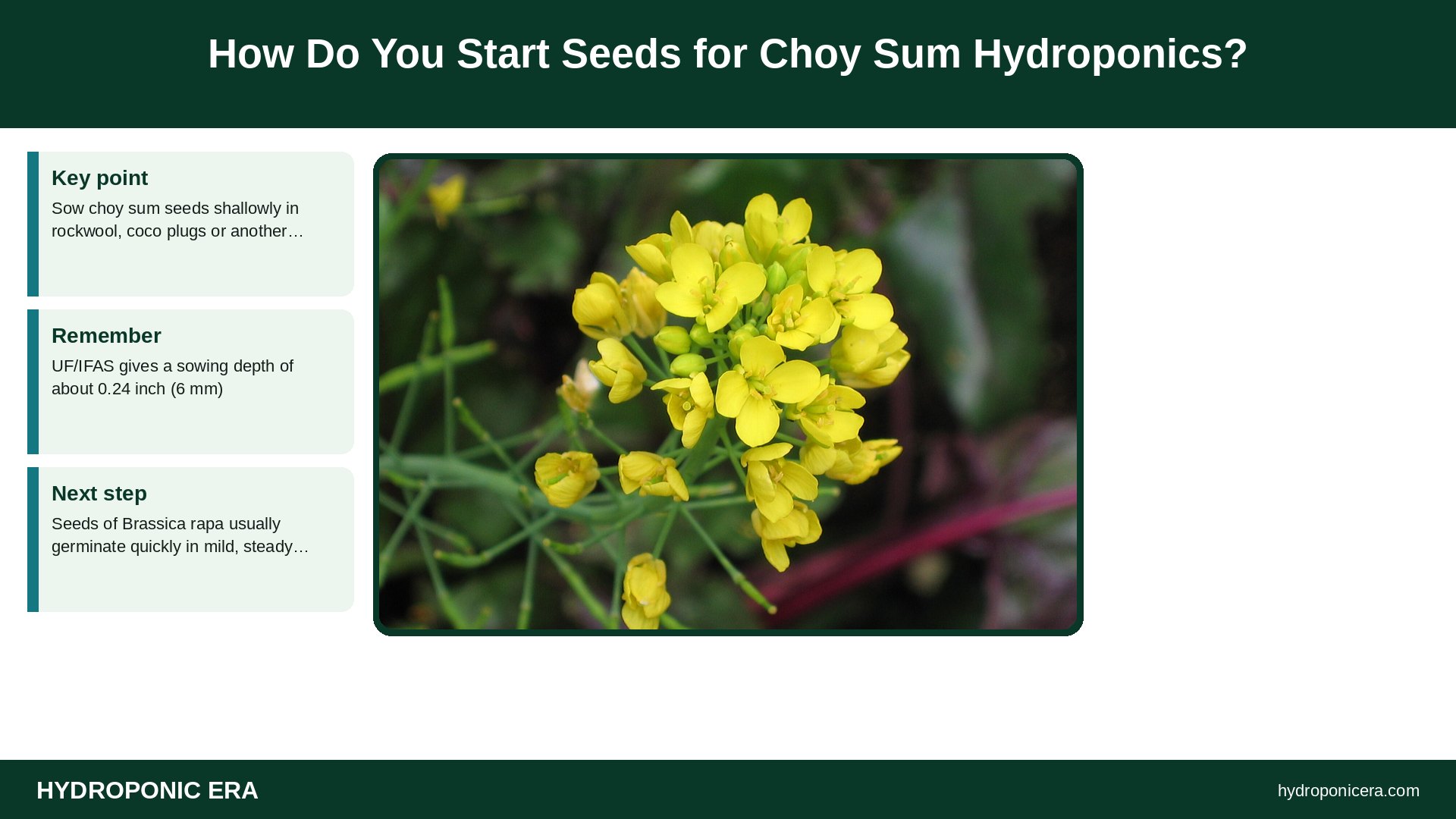
Sow choy sum seeds shallowly in rockwool, coco plugs or another sterile starter, keep them moist and warm, then move seedlings into the system once roots show through the plug. UF/IFAS gives a sowing depth of about 0.24 inch (6 mm). Seeds of Brassica rapa usually germinate quickly in mild, steady temperatures.
- Soak rockwool cubes in pH-adjusted water and press one or two seeds into each.
- Cover lightly so seeds sit about 0.24 inch (6 mm) deep, as UF/IFAS suggests.
- Keep the cubes moist under a humidity dome until seedlings emerge.
- Give seedlings bright light right away so stems do not stretch.
- Thin to the strongest seedling and transplant when roots poke out.
When Do You Harvest Choy Sum?
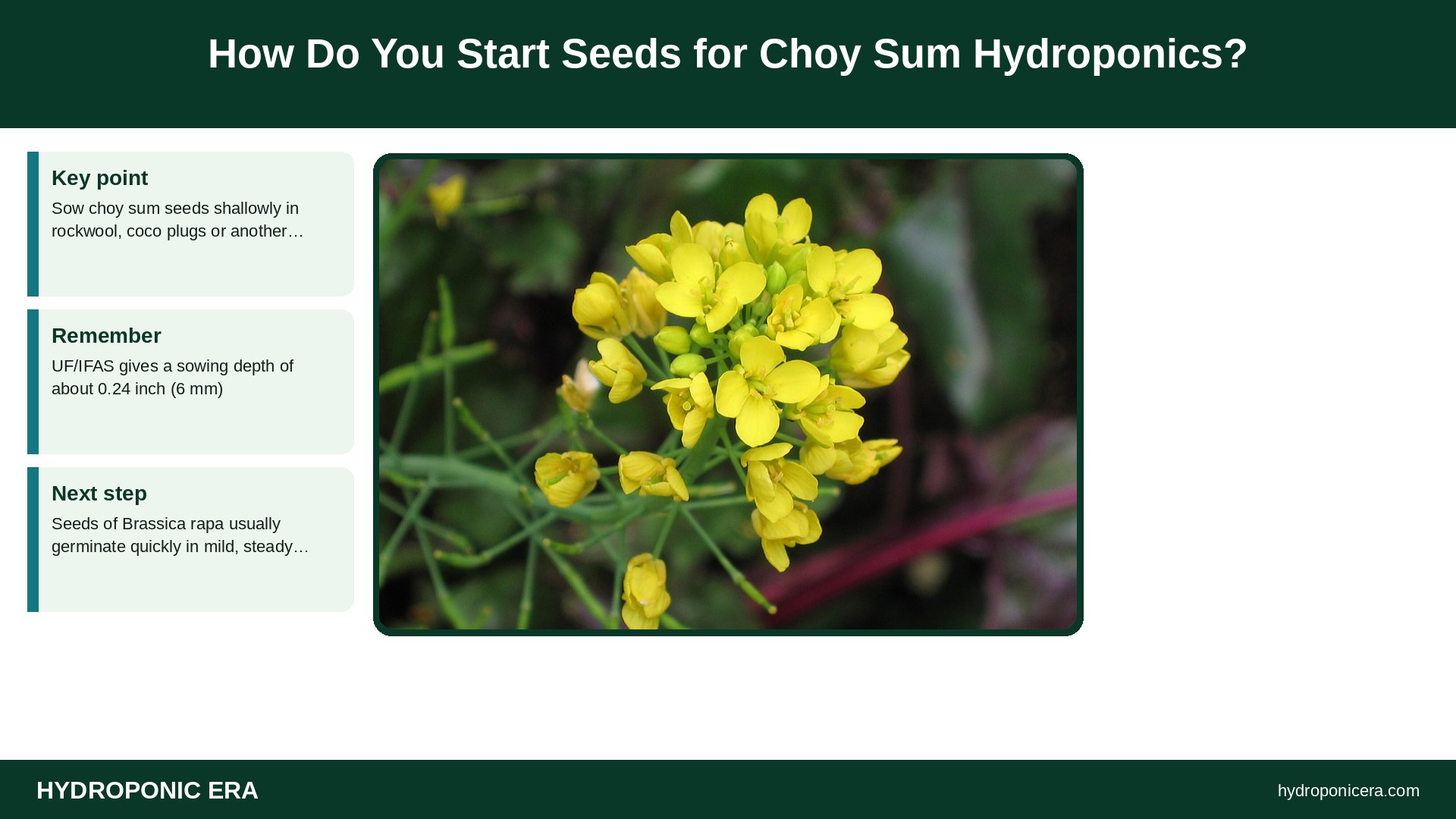
Harvest choy sum when the flowering shoots have formed buds that are still closed, usually 30–50 days after sowing according to UF/IFAS Extension. Cut the main stem a few inches above the base. Side shoots then develop, and UF/IFAS notes that you can usually take 2 to 3 harvests from one planting.
Variety matters for timing in choy sum hydroponics. Cornell’s vegetable variety trials list Extra Dwarf Choy Sum as ready in 21–28 days and harvested at 3–4 inches (8–10 cm) tall, while a full-size “50 day” choy sum takes 50–70 days and prefers 60–80°F (16–27°C). If yellow petals start to open, harvest at once, because stems toughen quickly after flowering.
| Variety type | Typical days | Harvest stage |
|---|---|---|
| Extra dwarf | 21–28 | 3–4 in (8–10 cm) tall |
| Standard green | 30–50 | Buds formed, still closed |
| “50 day” types | 50–70 | Buds formed, still closed |
| Purple (hon tsai tai) | Varies | Purple shoots, buds closed |
Why Is My Hydroponic Choy Sum Flowering Too Early?
Early flowering in choy sum hydroponics usually comes from heat, plant stress or simply waiting too long to cut. The crop naturally makes flower shoots, but warm air and a warm reservoir speed the jump from bud to open flower. Keep the room within 59–77°F (15–25°C) and harvest promptly to keep shoots tender.
- Cool the room: move lights higher or add airflow if the canopy feels hot.
- Cool the water: UF/IFAS gives 65–80°F (18–27°C) for lettuce solution; stay at the cooler end for brassicas.
- Avoid stress: keep the reservoir topped up so roots never dry or starve.
- Sow often: small sowings every two weeks give a steady supply instead of one crop that bolts at once.
The same rules that apply in choy sum hydroponics apply to other quick greens. Our spinach bolting guide explains how heat and light push leafy crops to flower.
What Pests and Problems Affect Choy Sum Hydroponics?
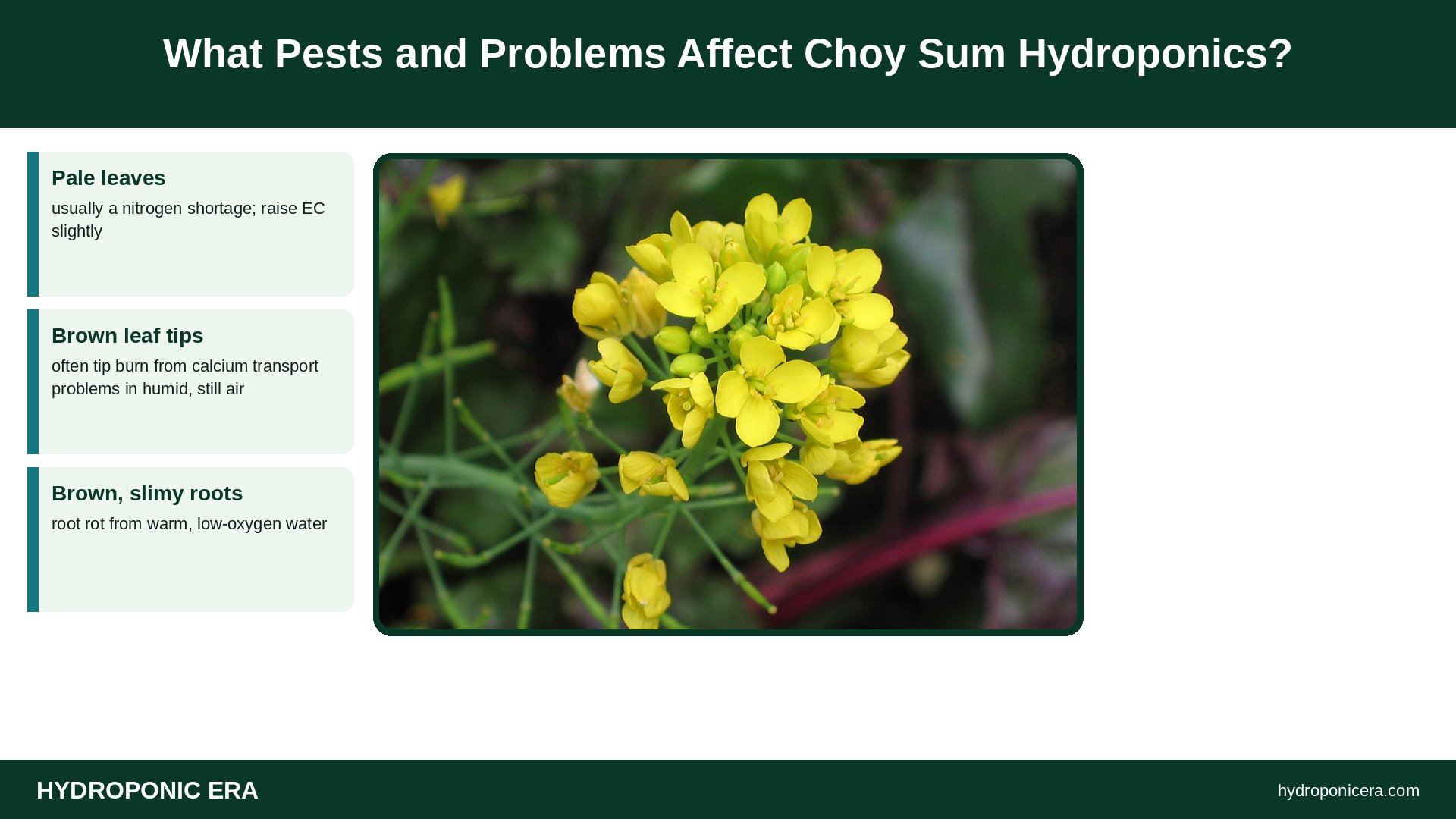
The main problems are the same as for other Asian greens: aphids, flea beetles, caterpillars, tip burn and root rot. UF/IFAS warns that choy sum is vulnerable when water or nitrogen run short. Indoors, check leaf undersides weekly, keep airflow strong and keep the reservoir oxygenated to prevent most issues before they start.
- Pale leaves: usually a nitrogen shortage; raise EC slightly.
- Brown leaf tips: often tip burn from calcium transport problems in humid, still air.
- Brown, slimy roots: root rot from warm, low-oxygen water.
- Holes in leaves: look for flea beetles or caterpillars.
FAQ About Choy Sum Hydroponics
Is choy sum the same as yu choy?
Yu choy is a common name for choy sum types grown for flowering shoots; names vary by region and seller.
Can you eat choy sum flowers?
Yes, but the shoots are best before the buds open. Open flowers mean tougher stems.
How many harvests does choy sum hydroponics give?
UF/IFAS says 2 to 3 harvests are usual as side shoots regrow.
Is choy sum hydroponics good for Kratky jars?
Yes, a dwarf type suits a single Kratky jar because it finishes in about a month.
Does choy sum hydroponics need full sun indoors?
It needs bright light. Under LEDs, give it the same strong light you would give lettuce.
Sources
- UF/IFAS Extension — Choy Sum: A Leafy Vegetable for Florida (HS1380)
- UF/IFAS Extension — Hydroponic Lettuce Production (HS1422)
- Cornell University — Vegetable Varieties for Gardeners: Extra Dwarf Choy Sum
- Cornell University — Vegetable Varieties for Gardeners: Choy Sum 50 Day
- Photo credits (Wikimedia Commons, edited with titles): Choy Sum with Soy Sauce by Ceeseven (CC BY-SA 4.0); 菜心 Brassica campestris v parachinensis -香港花展 Hong Kong Flower Show- (9213339539) by 阿橋 HQ (CC BY-SA 2.0)