
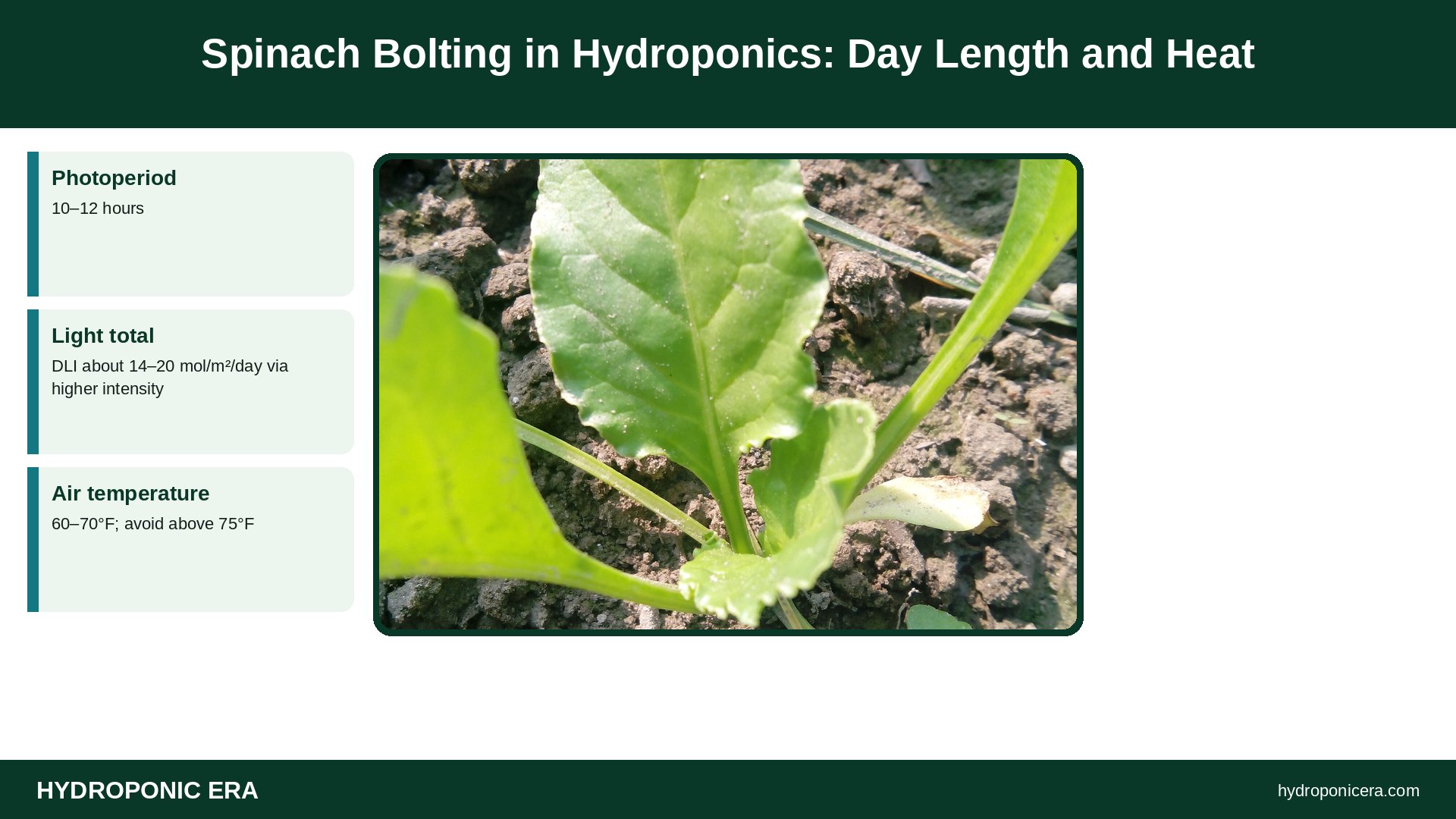
Spinach bolting in hydroponics happens when the plant switches from making leaves to sending up a flower stalk, and it is triggered mainly by long days and heat. Spinach is a long-day plant: once days stretch past roughly 12–14 hours, especially with air above about 75°F, it starts to bolt. To prevent it, give 10–12 hours of strong light instead of 16, keep air around 60–70°F and the solution below about 68°F, choose bolt-resistant varieties, and harvest as baby leaf at 3–5 weeks. Once a stalk forms, harvest right away; you can’t reverse it.
Key takeaway: Shorter, brighter days, cool air and water, slow-bolting varieties, and early harvest. Get the daily light total from intensity, not long photoperiods.
| Factor | To prevent spinach bolting |
|---|---|
| Photoperiod | 10–12 hours |
| Light total | DLI about 14–20 mol/m²/day via higher intensity |
| Air temperature | 60–70°F; avoid above 75°F |
| Solution temperature | 60–68°F |
| Varieties | Slow-bolting hybrids for baby leaf or summer |
| Harvest | Baby leaf at 3–4 weeks; full leaves by 5–6 weeks |
| EC / pH | 1.8–2.3 mS/cm; pH 6.0–6.5 |
Why Spinach Bolting Happens
Spinach evolved as a cool-season crop that flowers in late spring as days lengthen. It senses day length through its leaves. Long days are the main trigger, and heat speeds up the response. Stress from crowding, root problems, or drought can push it further. When bolting begins, the central stem elongates, leaves become narrow and pointed, and flavor turns bitter.
UF/IFAS notes spinach prefers cool temperatures, ideally 40–70°F, and shorter days, and that hydroponic growers are finding ways to manage its natural tendency to bolt in hot weather.
Light Without Long Days
Most indoor growers run lights 16–18 hours for lettuce. That schedule tells spinach it’s summer. Instead, run 10–12 hours and raise the light intensity to hit the same daily total. Virginia Cooperative Extension suggests a daily light integral of about 14–20 mol/m²/day for spinach. For example, a PPFD of about 350–450 µmol/m²/s for 12 hours gives roughly 15–19 mol/m²/day. See PPFD and DLI and light schedule and photoperiod.
Avoid even brief light during the dark period; light leaks can count as a long day. See light leaks and night interruption.
Keep Spinach Cool
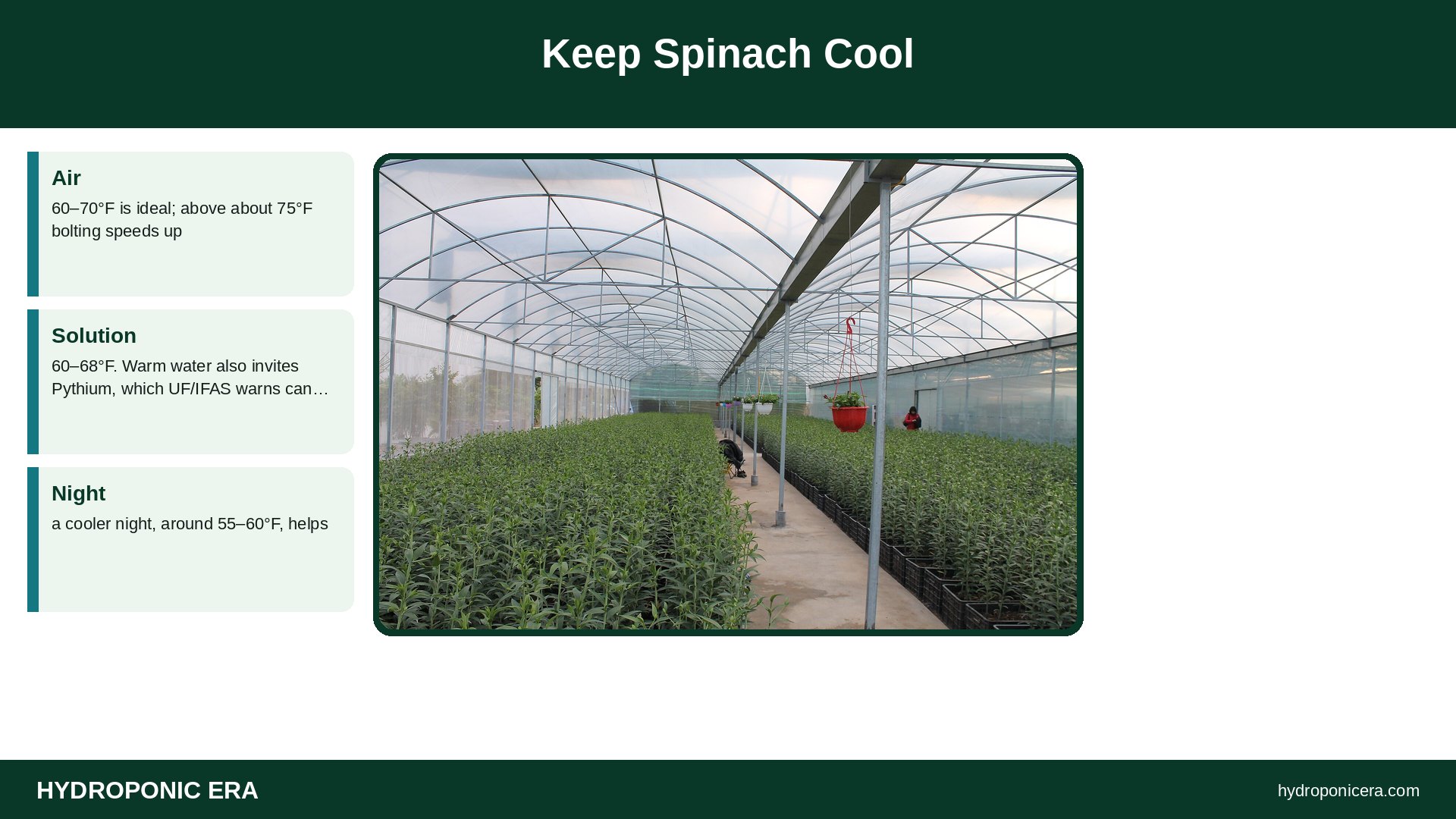
- Air: 60–70°F is ideal; above about 75°F bolting speeds up.
- Solution: 60–68°F. Warm water also invites Pythium, which UF/IFAS warns can wipe out spinach in hot, wet conditions.
- Night: a cooler night, around 55–60°F, helps.
Use a reservoir chiller in warm rooms, insulate tanks, and place the grow area away from heat sources. See reservoir chillers and reservoir temperature.
Bolt-Resistant Varieties
Modern hybrid spinach varieties are bred to bolt more slowly. Seed catalogs label them “slow bolting” or “long standing” and often recommend them for baby leaf or late-spring sowing. Savoy types are crinkled; semi-savoy and smooth types are easier to clean and often preferred in hydroponics. Old open-pollinated types like ‘Bloomsdale Long Standing’ are slower to bolt than many heirlooms but less uniform than hybrids.
Harvest Early to Beat Spinach Bolting
Baby leaf spinach can be harvested 3–4 weeks after planting, according to UF/IFAS. Harvesting young gives the plant less time to reach the bolting stage. You can cut outer leaves repeatedly or harvest the whole plant. If you see the center start to stretch upward, harvest everything that day.
Nutrition and Spinach Bolting
Spinach is a heavier feeder than lettuce. A common hydroponic range is EC 1.8–2.3 mS/cm and pH 6.0–6.5. Steady nutrition reduces stress, but nutrients won’t stop bolting if days are long and warm. Low nitrogen and root problems can increase stress and hasten flowering. See how to grow spinach hydroponically and the hydroponic ppm chart.
Spacing and Stress

Crowded plants compete for light and stretch, which can encourage bolting. Give each plant about 6 inches for baby leaf or 8 inches for full-size leaves. Keep roots healthy with good aeration. Transplant seedlings before they become root-bound in their cubes. See plant spacing.
Seasonal Planning
In a greenhouse, spinach grows best from fall through early spring. In summer, natural day length and heat make bolting nearly certain without blackout curtains and cooling. Switch to heat-tolerant greens in summer, such as Malabar spinach or water spinach, which are different plants that don’t bolt the same way. See Malabar spinach and water spinach.
Signs of Spinach Bolting
- The center of the plant stretches upward.
- New leaves become narrow and pointed.
- Small flower buds form at the top of the stalk.
- Leaves taste bitter or sharp.
Can You Eat Bolted Spinach?
Yes, the leaves are safe to eat, but they become bitter and tough as bolting progresses. Harvest immediately and cook them if the flavor is strong. Then sow a fresh crop and adjust light and temperature.
Spinach Bolting Prevention Checklist
- Choose slow-bolting hybrid seed.
- Set lights to 10–12 hours and increase intensity.
- Stop light leaks during the dark period.
- Keep air at 60–70°F and solution at 60–68°F.
- Space plants to reduce stress.
- Harvest baby leaf at 3–4 weeks.
- Sow new trays every 2 weeks.
Lettuce bolts for similar reasons; see lettuce bitterness and bolting.
Spinach Bolting in Different Hydroponic Systems
Deep water culture and raft systems hold a large volume of water, which buffers temperature swings and helps delay spinach bolting. NFT channels heat up quickly in warm rooms, so plants in NFT often bolt first in summer. Countertop kits put the light close to the leaves, which can warm the canopy; leave the light at the recommended height and avoid a 24-hour schedule. Towers in sunny spots can overheat at the top, so place the earliest-harvest plants there.
Using Shade and Cooling
In a greenhouse, shade cloth of about 30–50% in summer lowers leaf temperature. Evaporative pads, fans and venting all help. In a tent, an inline fan that pulls warm air out from the top of the space is often enough. For the reservoir, chilled water or a larger tank can keep roots cooler. Every few degrees you remove from the root zone pushes spinach bolting further back.
Switch Crops When It Gets Hot
If you cannot keep the grow area below about 75°F, consider heat-tolerant greens instead. Malabar spinach and water spinach are not true spinach, but they grow well in warm conditions and are not affected by spinach bolting in the same way. Lettuce, chard and kale are also more forgiving in heat.
FAQs
What causes spinach bolting in hydroponics?
Long days, usually over 12–14 hours, and heat.
How many hours of light should spinach get?
About 10–12 hours at higher intensity.
What temperature prevents spinach bolting?
Keep air around 60–70°F and below 75°F.
Can I stop spinach once it bolts?
No. Harvest right away.
Is bolted spinach safe to eat?
Yes, but it tastes bitter.
How fast can I harvest baby spinach?
In about 3–4 weeks.
Sources
- UF/IFAS Extension — Leafy Greens in Hydroponics and Protected Culture for Florida
- Virginia Cooperative Extension — Calculating and Using Daily Light Integral (DLI)
- Oklahoma State University Extension — Electrical Conductivity and pH Guide for Hydroponics
- Photo credits (Wikimedia Commons, edited with titles): Spinacia oleracea bd-1 by Kayser Ahmad (CC BY-SA 4.0); Ipomoea aquatica kz01 by Krzysztof Ziarnek, Kenraiz (CC BY-SA 4.0); Net house by vi:User:Goodmorninghpvn (CC BY-SA 3.0); 2008-09-20 Thermometer reading by Ildar Sagdejev (Specious) (CC BY-SA 4.0); Deep water culture by ArcadiYay (CC BY-SA 4.0)