
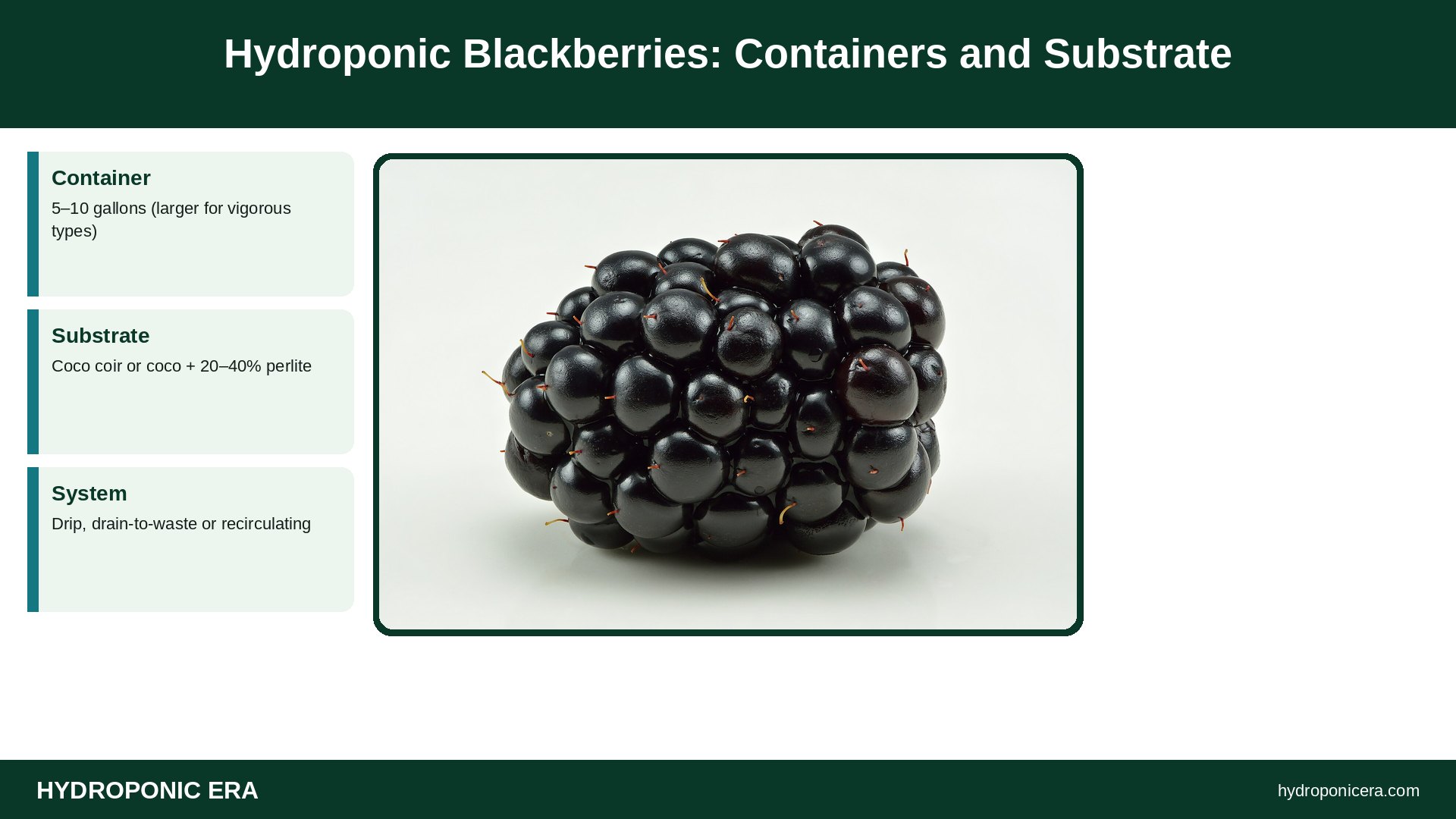
Hydroponic blackberries are best grown in large containers of soilless substrate, not in water-only systems. Use 5- to 10-gallon pots or grow bags filled with coco coir or a coco-perlite mix, feed through drip irrigation at EC 1.0–1.6 mS/cm and pH 5.5–6.2, and pick thornless cultivars. Primocane-fruiting varieties can fruit in the first year on new canes, while floricane types fruit on second-year canes. Blackberries need full sun or very strong light, a trellis, and yearly cane pruning, so they suit greenhouses, patios, and high tunnels better than small indoor tents.
Key takeaway: Big containers, coco-based substrate, drip feeding, thornless cultivars, a trellis, and correct cane pruning.
| Factor | Target |
|---|---|
| Container | 5–10 gallons (larger for vigorous types) |
| Substrate | Coco coir or coco + 20–40% perlite |
| System | Drip, drain-to-waste or recirculating |
| EC | 1.0–1.6 mS/cm |
| pH | 5.5–6.2 |
| Light | Full sun or high-intensity LEDs |
| Support | Trellis or T-post with wires |
Why Substrate Instead of Water Culture
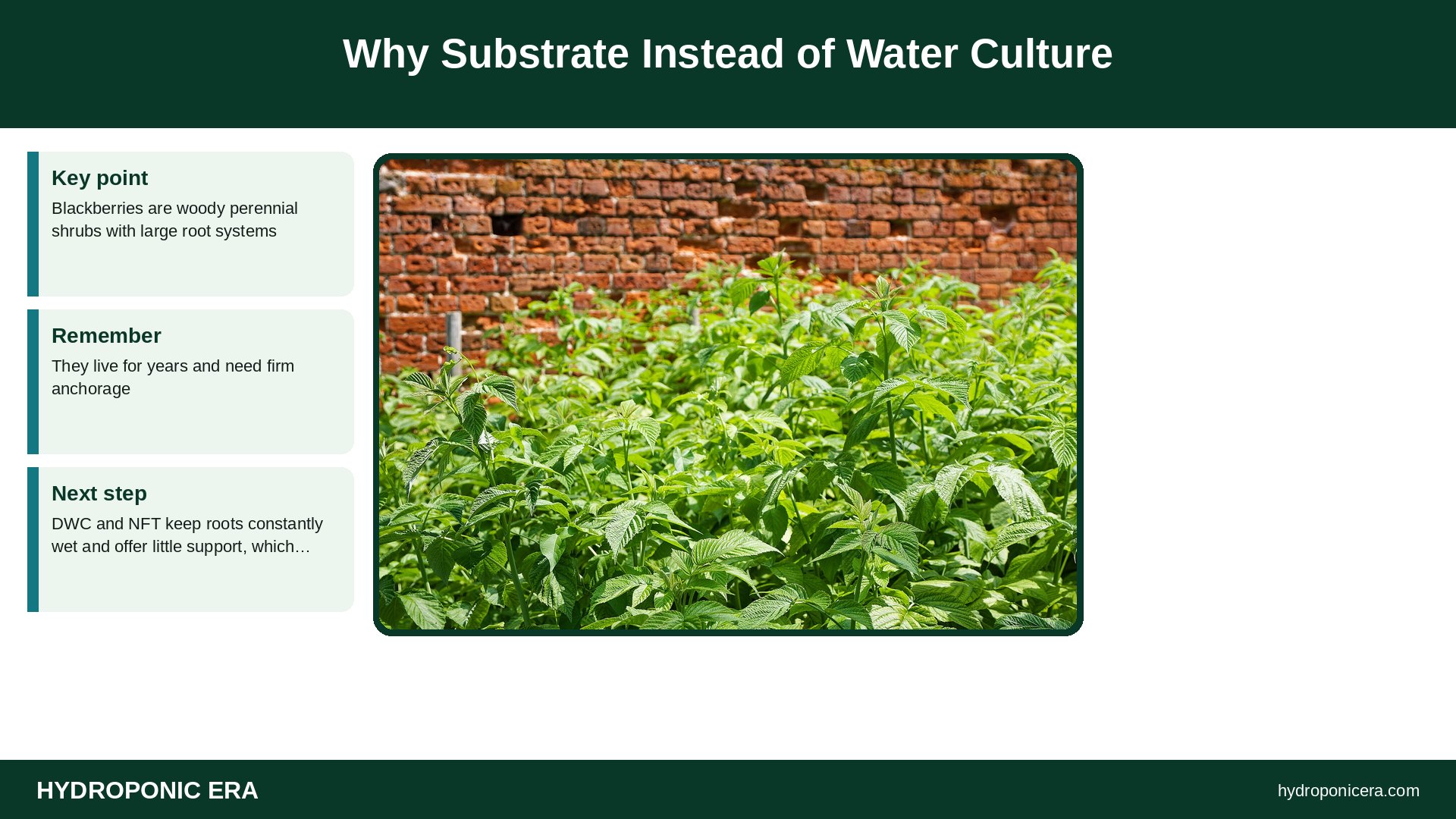
Blackberries are woody perennial shrubs with large root systems. They live for years and need firm anchorage. DWC and NFT keep roots constantly wet and offer little support, which suits lettuce but not a cane fruit. Container substrate culture, the same approach used for greenhouse raspberries and blueberries, gives roots air, moisture, and room. The Ohio State University indoor berry program uses substrate and fertigation for controlled-environment berries.
Floricane vs Primocane Blackberries
UF/IFAS explains that blackberry canes live two years. First-year canes, called primocanes, grow leaves. In the second year, those same canes, now floricanes, flower and fruit, then die. Primocane-fruiting cultivars can also fruit at the tips of first-year canes in late summer and again on floricanes the next year.
- Floricane types: one main crop in early summer; easier fruit quality in hot areas.
- Primocane types: fruit sooner after planting; can give two crops, though UF/IFAS notes fall primocane fruit quality can be poor in hot climates like Florida.
Choosing Hydroponic Blackberries Cultivars
Thornless cultivars from the University of Arkansas program, such as ‘Ouachita’, ‘Natchez’, and ‘Osage’, are widely grown, and the Prime-Ark primocane series includes thornless ‘Prime-Ark Freedom’. Compact patio varieties like ‘Baby Cakes’ suit containers. Chill hours matter for floricane types: UF/IFAS notes low chill accumulation causes poor fruit quality in subtropical climates, so choose cultivars matched to your winter. See UF/IFAS’s guide to choosing blackberry cultivars in the sources.
Setting Up the System
- Fill pots or grow bags with rinsed coco coir mixed with perlite.
- Run a drip line with one or two emitters per pot.
- Water several short cycles a day so 10–20% runs off the bottom, then check runoff EC.
- Install a two-wire trellis or a stake per pot.
- Plant dormant bare-root canes or plugs in spring.
See drip systems for beginners, coco coir, and runoff and leaching.
Feeding Hydroponic Blackberries
Use a balanced hydroponic nutrient at EC 1.0–1.6 mS/cm during growth, with slightly more potassium as fruit develops. Blackberries prefer slightly acidic conditions; keep pH around 5.5–6.2. Watch for iron chlorosis on new leaves if pH climbs. See iron deficiency and the hydroponic ppm chart.
Light and Temperature
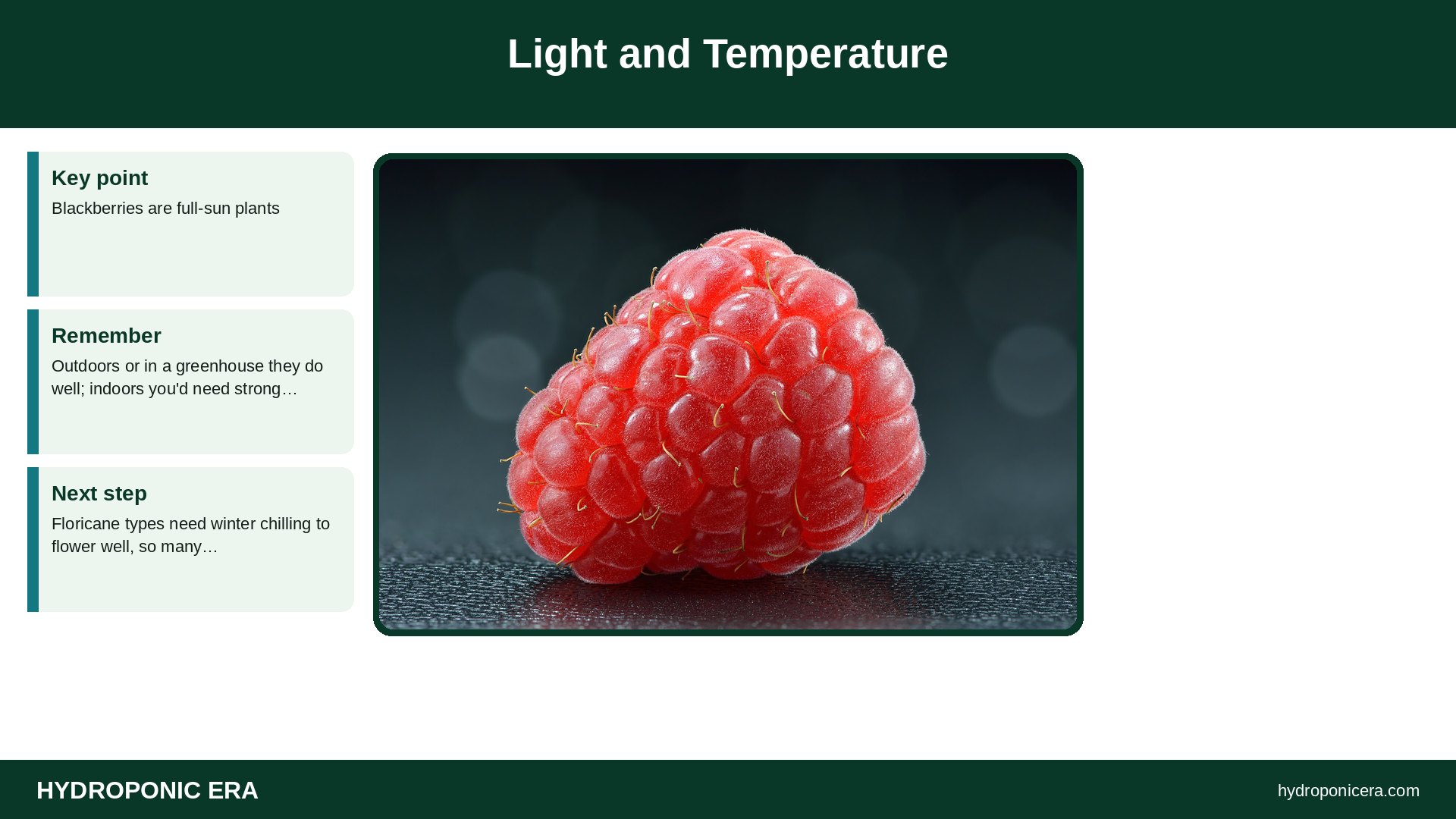
Blackberries are full-sun plants. Outdoors or in a greenhouse they do well; indoors you’d need strong fixtures over a large area. Floricane types need winter chilling to flower well, so many container growers keep pots outside or in an unheated greenhouse through winter. Primocane types are more flexible.
Pruning Canes
UF/IFAS’s floricane pruning guide notes that primocanes and floricanes grow at the same time and need different pruning:
- After harvest: cut fruited floricanes to the base; they won’t fruit again.
- Summer: tip new primocanes to encourage branching, which increases next year’s fruit.
- Winter: shorten lateral branches and keep 4–6 strong canes per plant.
- Primocane types: can be mowed or cut to the ground after fall harvest for one fall crop a year.
Pollination
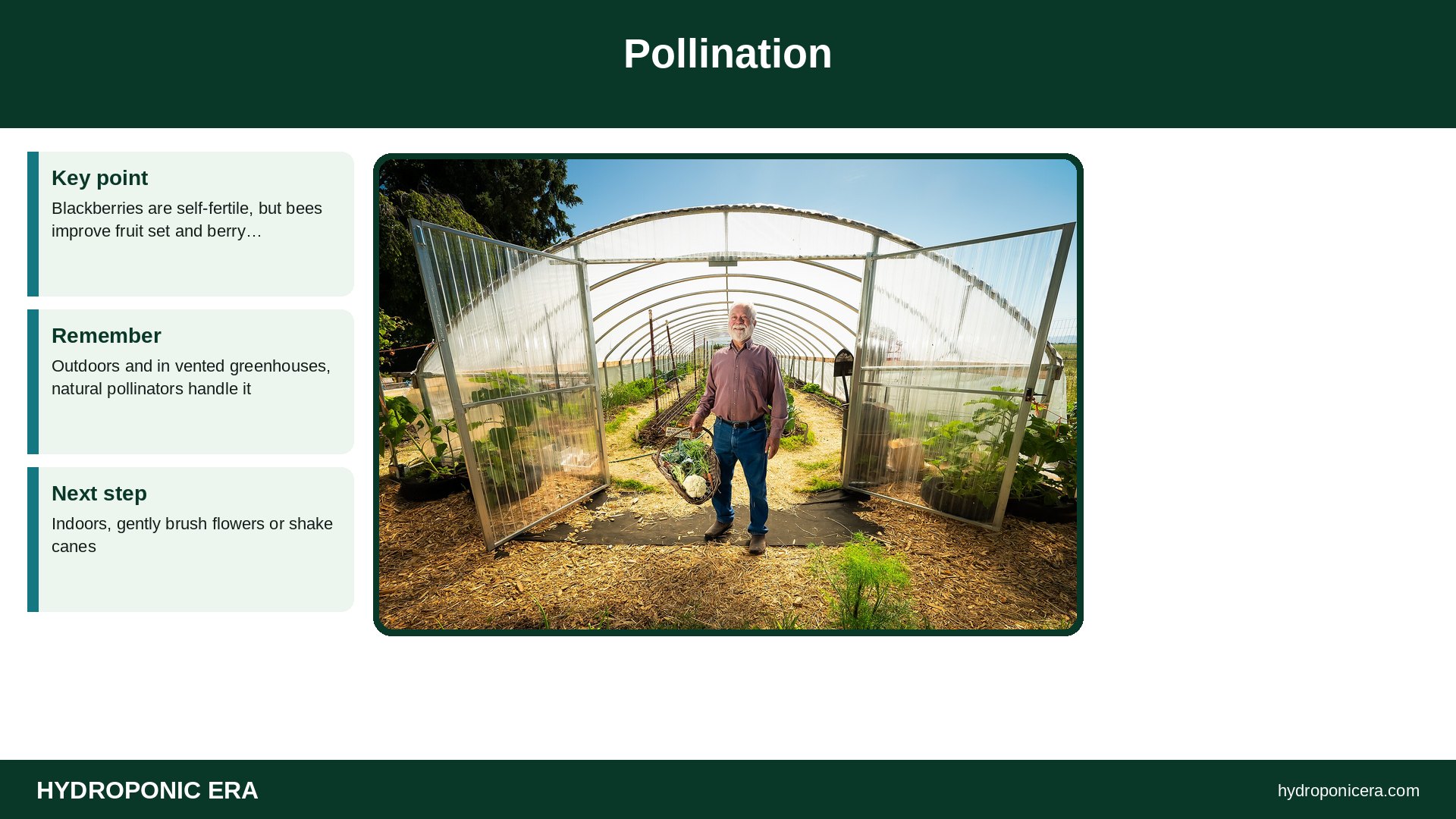
Blackberries are self-fertile, but bees improve fruit set and berry size. Outdoors and in vented greenhouses, natural pollinators handle it. Indoors, gently brush flowers or shake canes. Poor pollination produces crumbly berries with missing drupelets. See indoor pollination.
Pests and Diseases
- Spider mites in warm, dry conditions. See spider mites.
- Spotted wing drosophila on ripe fruit outdoors; harvest often.
- Gray mold on fruit in humid weather. See botrytis gray mold.
- Root rot in soggy media; keep drainage good.
Harvest and Yield
Blackberries are ripe when fully black and dull, and they come off with a gentle pull. Pick every 2–3 days in season, early in the morning. A healthy container plant can produce several pounds per year once established. Refrigerate right away; blackberries are perishable.
Related Berries
Raspberries grow the same way and are often easier in containers. Blueberries need more acidic conditions. See raspberries hydroponically and blueberries hydroponically.
Is It Worth Growing Hydroponic Blackberries?
For a hobbyist with a greenhouse or sunny patio, yes: thornless container blackberries are productive and attractive. For an indoor tent, they’re usually too large and light-hungry. Commercial growers use substrate systems under high tunnels mainly to control disease, extend the season, and get clean fruit.
Starting Hydroponic Blackberries From Plants
Blackberries are not usually grown from seed, because seedlings don’t come true to the variety and take years to fruit. Start hydroponic blackberries from certified disease-free plants from a nursery: bare-root canes, tissue-culture plugs, or rooted tip cuttings. Rinse the old soil from bare-root plants gently, trim broken roots, and set them in moist coco coir or a coco and perlite mix. Water with a mild solution of about EC 0.8–1.0 for the first two weeks, then raise feeding as new leaves expand.
Container Size for Hydroponic Blackberries
Blackberries form large root systems. Use containers or grow bags of at least 5–7 gallons per plant, or larger troughs for long-term plantings. Dutch buckets work well for compact thornless types. Make sure containers drain freely; blackberry roots rot quickly in waterlogged media. A drip emitter or two per plant, run several times a day, keeps the media moist without flooding it.
Overwintering
Floricane types need a cold period to flower. In mild climates, keep hydroponic blackberries outdoors or in an unheated tunnel through winter, with irrigation reduced to prevent freezing. In very cold regions, move containers to a sheltered spot or insulate them. Primocane types can be cut down and restarted each year if winter care is difficult.
FAQs
Can blackberries grow hydroponically?
Yes, best in containers of coco coir with drip feeding.
What EC for hydroponic blackberries?
About 1.0–1.6 mS/cm.
Which blackberries are best for containers?
Thornless and compact types; primocane types fruit sooner.
Do blackberries need winter chill?
Floricane types do; check your cultivar’s chill hours.
How big a pot do blackberries need?
At least 5 gallons, ideally 7–10.
Can I grow blackberries in DWC?
It’s not recommended; they need substrate and support.
Sources
- UF/IFAS Extension — Choosing the Right Blackberry Cultivar in Subtropical Florida
- UF/IFAS Extension — Floricane Blackberry Pruning Guide for Florida
- The Ohio State University — Indoor Berry Fertigation
- Photo credits (Wikimedia Commons, edited with titles): Blackberry (Rubus fruticosus) by Ivar Leidus (CC BY-SA 4.0); Raspberry canes Easton Lodge Gardens walled garden 01 by Acabashi (CC BY-SA 4.0); Indiana High Tunnel (EQIP) (20220627-NRCS-BJOC-031) by USDAgov (Public domain); Raspberry – whole (Rubus idaeus) by Ivar Leidus (CC BY-SA 4.0); Oregon High Tunnel, NRCS EQIP (20260611-NRCS-KLS-0001) by USDAgov (Public domain)