
Hydroponic goji berries are possible, but expect a slow, long-term project rather than a quick crop. Goji (Lycium barbarum) is a woody, spiny shrub that grows best in a large container of free-draining substrate such as coco coir with perlite, fed by drip at a moderate EC around 1.0–1.8 mS/cm and pH near 6.5–7.0, under full sun or very strong light. Plants typically start fruiting in their second year and reach full production in years 3–5, according to extension guides. Water-only systems like DWC are a poor fit.
Key takeaway: Use a 5- to 10-gallon container with coco-perlite, drip feeding, slightly higher pH than most crops, lots of light, and patience: fruit in year 2, full yields by years 3–5.
| Factor | Target |
|---|---|
| Container | At least 5 gallons (UF/IFAS); 10+ gallons for mature plants |
| Substrate | Coco coir + 30–40% perlite |
| EC | 1.0–1.8 mS/cm |
| pH | About 6.5–7.0 (goji prefers neutral to alkaline soils) |
| Light | Full sun or strong LEDs |
| First fruit | Year 2 |
| Full production | Years 3–5 |

What to Expect From Hydroponic Goji Berries
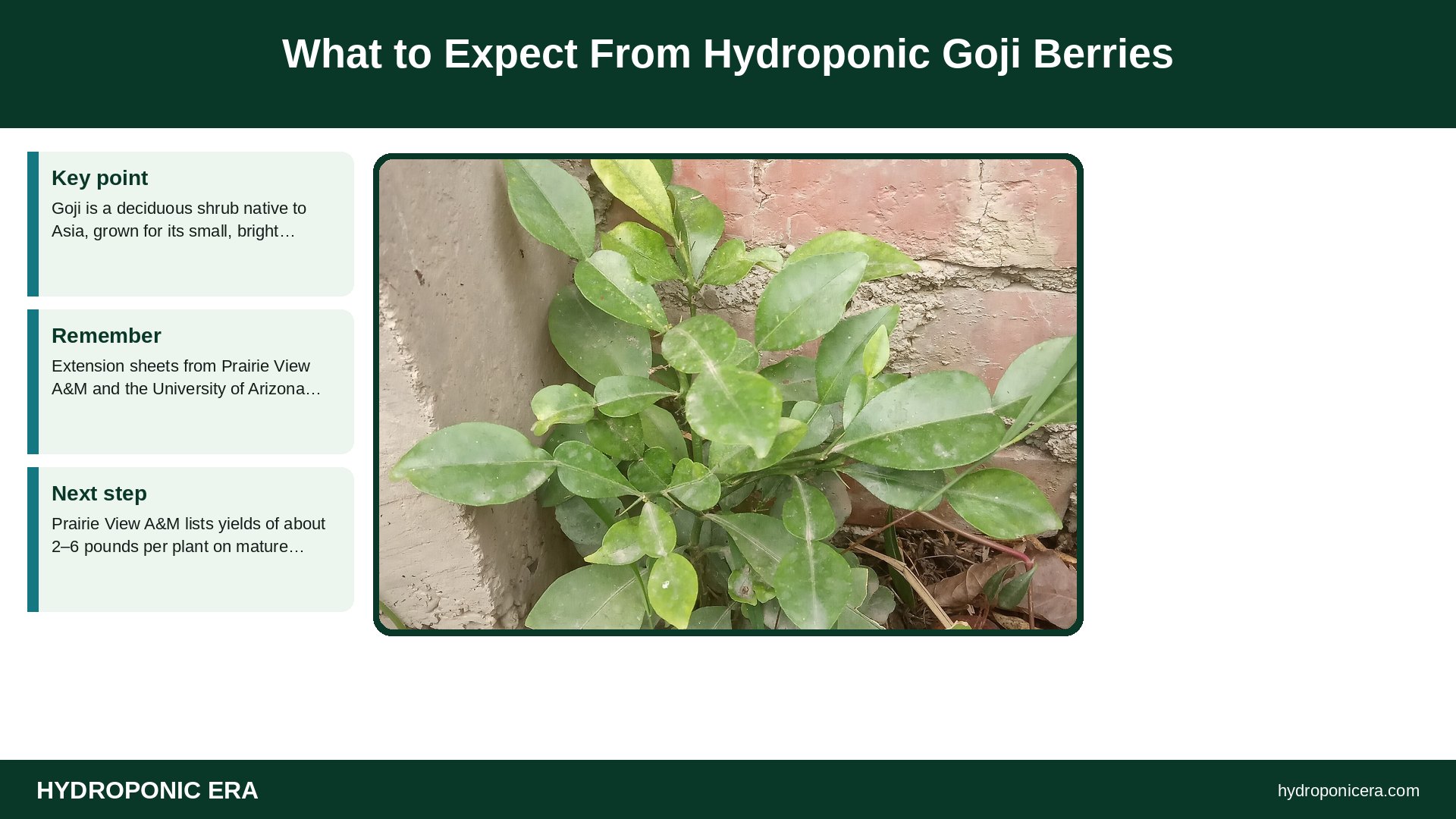
Goji is a deciduous shrub native to Asia, grown for its small, bright red-orange berries. Extension sheets from Prairie View A&M and the University of Arizona describe it as hardy, drought-tolerant once established, and self-fruitful, so one plant can set fruit. Prairie View A&M lists yields of about 2–6 pounds per plant on mature in-ground plants.
In containers, plants stay smaller and yield less, but you gain control over water and nutrients. Hydroponic goji is mainly for enthusiasts who enjoy unusual plants; it won’t compete with strawberries or tomatoes for fast returns.
Why Use Substrate, Not Water Culture
Goji develops a deep taproot, which is why UF/IFAS recommends containers of at least 5 gallons. Like other woody fruit, it needs firm anchorage and air around the roots. Container substrate with drip irrigation gives both. DWC and NFT keep roots constantly wet and offer little support for a shrub that can reach 3–6 feet when pruned. See hydroponic dwarf fruit trees.
Setting Up Hydroponic Goji Berries
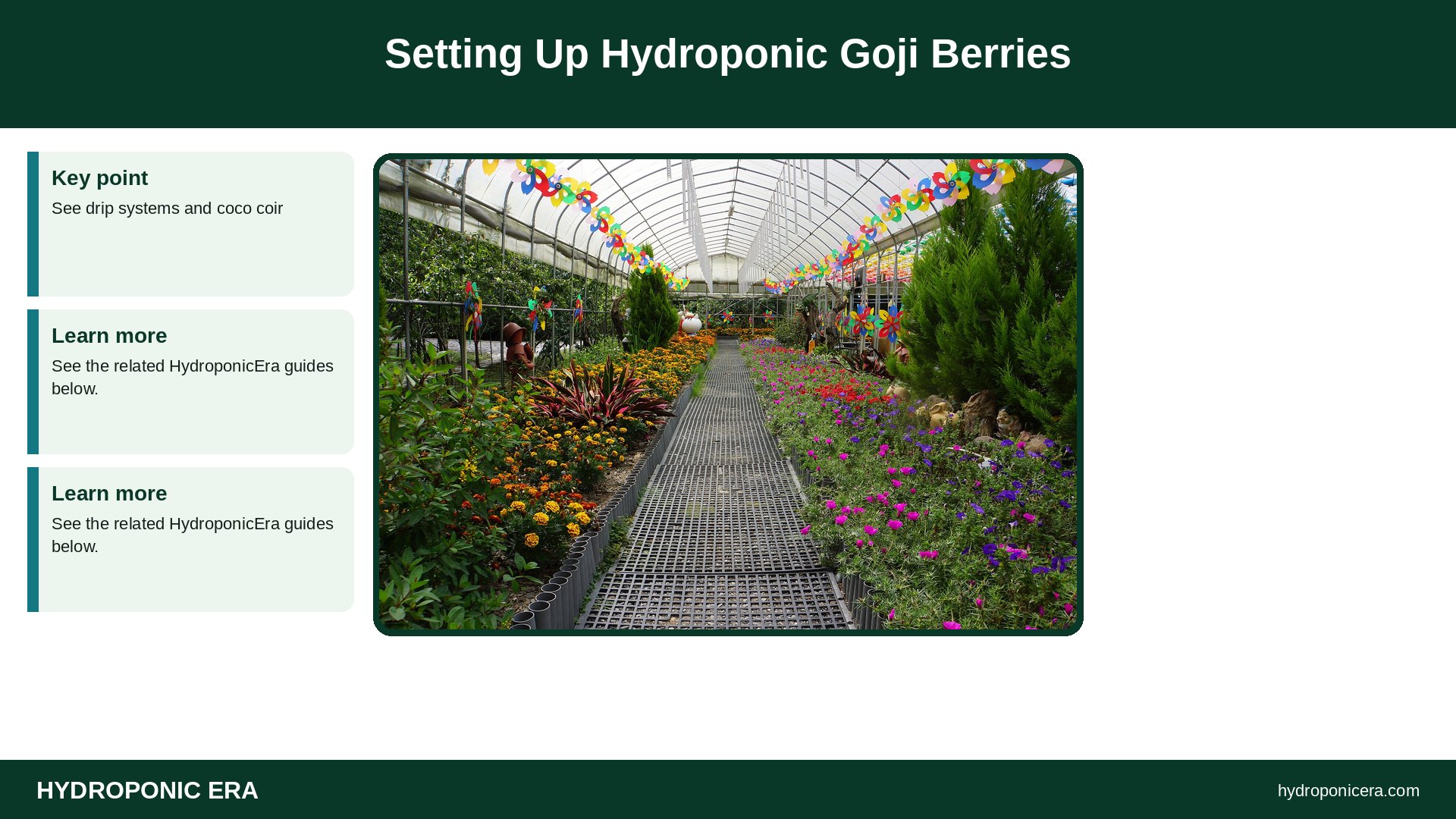
- Choose a 5-gallon pot for a young plant; move to 10–15 gallons as it grows.
- Fill with rinsed coco coir mixed with 30–40% perlite for drainage.
- Install one or two drip emitters per pot on a timer.
- Water so 10–20% drains from the bottom; check runoff EC weekly.
- Add a stake; young canes arch and flop.
See drip systems and coco coir.
pH and Nutrients
Most hydroponic crops grow at pH 5.5–6.5, but goji prefers neutral to slightly alkaline soils; Prairie View A&M and Arizona cite a soil pH of 7 to 8. In soilless culture, iron becomes less available above about 6.5–7.0, so a practical compromise is pH around 6.5–7.0 with chelated iron (DTPA or EDDHA types hold up better at higher pH). Use a balanced nutrient at moderate strength and avoid pushing nitrogen, which makes long, leafy canes with few flowers. See chelated micronutrients.
Light and Climate
Goji wants full sun. Arizona notes it tolerates harsh, hot, dry conditions, and Prairie View says hot, dry weather gives the best fruit quality. Outdoors on a patio or in a greenhouse is ideal. Indoors you’d need strong light over a large area. Goji is deciduous and hardy in roughly USDA zones 4–9, so potted plants can stay outdoors in mild winters but should be protected from deep freezes, since container roots are more exposed than in-ground roots.
Pruning Goji
UF/IFAS says goji doesn’t need pruning in the first year. In year two, a common approach is to choose one strong main trunk, remove other stems near the base, and tip the trunk at about 16–18 inches to encourage side branches. After that, keep 3–5 strong side shoots, remove spindly and dead wood, and prune in early spring. Arizona notes fruit forms on the current year’s wood, so pruning that encourages new growth increases yields.
Flowering and Fruit

Small purple flowers appear in late spring, and berries follow about 4–6 weeks later, according to Arizona. Plants are self-fruitful, but bees or gentle shaking help fruit set indoors. Pick berries when fully colored and soft; unripe fruit is bitter. Handle gently, as berries bruise and darken easily. Prairie View says fresh fruit keeps about 2 weeks refrigerated.
Common Problems With Hydroponic Goji Berries
- No flowers: plant too young, too little light, or too much nitrogen.
- Yellow new leaves: iron lockout at high pH; use a stronger chelate. See iron deficiency.
- Root rot: soggy media; increase perlite and reduce watering.
- Powdery mildew: humid, still air. See powdery mildew.
- Aphids and mites: check undersides of leaves. See aphids and mites.
- Suckers: Arizona notes plants sucker after 3–4 years; remove them or pot them up.
Most problems with hydroponic goji berries trace back to wet media, weak light or a pot that is too small.
Starting Goji
Goji can be grown from seed, cuttings, or bare-root plants. Seed is slow and variable. Buying a named, potted plant such as ‘Crimson Star’ gets you to fruit sooner. Softwood cuttings root readily in a cloner or moist media. See hydroponic cuttings and cloning.
Is It Worth It?
If you have a sunny patio or greenhouse and want an unusual, long-lived fruiting plant, hydroponic goji berries are a fun project. If you want fast, heavy yields indoors, strawberries or cherry tomatoes are better choices. See best strawberry varieties for hydroponics and hydroponic blackberries.
Container and Media for Hydroponic Goji Berries
Goji (Lycium barbarum) is a woody shrub, so it needs a deep, well-drained root zone. Grow hydroponic goji berries in 5–10 gallon fabric pots, Dutch buckets, or large troughs filled with coco coir, perlite, or a coco and perlite blend. Avoid fine, soggy mixes. Drip irrigation on a timer, with 10–20% runoff per watering, keeps salts from building up in the media. A pot that is too small will dry out quickly in summer and limit fruit.
Harvest and Use of Hydroponic Goji Berries
Pick berries when they are fully red and slightly soft. Unripe fruit is bitter. The berries bruise easily, so many growers shake branches over a sheet or pick into shallow trays. Fresh hydroponic goji berries keep only a few days in the refrigerator, so dry or freeze any extras. Extension guides note that goji is in the nightshade family, like tomatoes and peppers, so people allergic to nightshades should take care.
Fresh or dried, hydroponic goji berries taste best when they ripen slowly in warm days and cool nights.
Plant Lifespan
Goji plants can live and produce for many years. In containers, refresh the top layer of media yearly, and repot or root-prune every two to three years so hydroponic goji berries keep cropping.
FAQs
Can goji berries grow hydroponically?
Yes, in containers of coco substrate with drip feeding.
How long until goji fruits?
Usually year 2, with full production in years 3–5.
What pH do hydroponic goji berries need?
About 6.5–7.0, with chelated iron.
Does goji need a pollinator?
No, it’s self-fruitful.
How big a container?
At least 5 gallons, moving to 10+ as it grows.
Can I grow goji indoors?
Only with very strong light; outdoors or in a greenhouse is easier.
Sources
- UF/IFAS Extension — Goji Berry: A Novel Nutraceutical “Superfruit” for Florida Master Gardeners
- University of Arizona Cooperative Extension — Goji Berries
- Prairie View A&M University — Goji Berry Fact Sheet
- Photo credits (Wikimedia Commons, edited with titles): Lycium – Ripe goji berries by daveeza from okanagan, canada (CC BY-SA 2.0); A citrus plant by Haoreima (CC BY-SA 4.0); Greenhouse in Qingjing Small Swiss Garden 清境小瑞士花園溫室 – panoramio by lienyuan lee (CC BY 3.0); White plastic bucket by Santeri Viinamäki (CC BY-SA 4.0); Drip irrigation (2552390830) by Dwight Sipler from Stow, MA, USA (CC BY 2.0)