
A frame hydroponics is a space-saving form of NFT (nutrient film technique) where sloped channels are mounted on two leaning sides of a triangle-shaped frame, like a tent. A pump lifts nutrient solution to the top of each channel, a thin film runs down past the roots, and the solution drains back to a reservoir below. A frame hydroponics roughly doubles the plants you can grow per square foot of floor compared with a flat NFT table, and it works best for lettuce, leafy greens, herbs and strawberries in a greenhouse or outdoors with good sun on both faces.
Key takeaway: Build the frame so both sides get equal light, give each channel a slope of about 1:30 to 1:40, run roughly 0.5–1 liter per minute (8–16 gallons per hour) per channel, and keep channels shorter than about 30–40 feet.
| Design factor | Typical target | Why it matters |
|---|---|---|
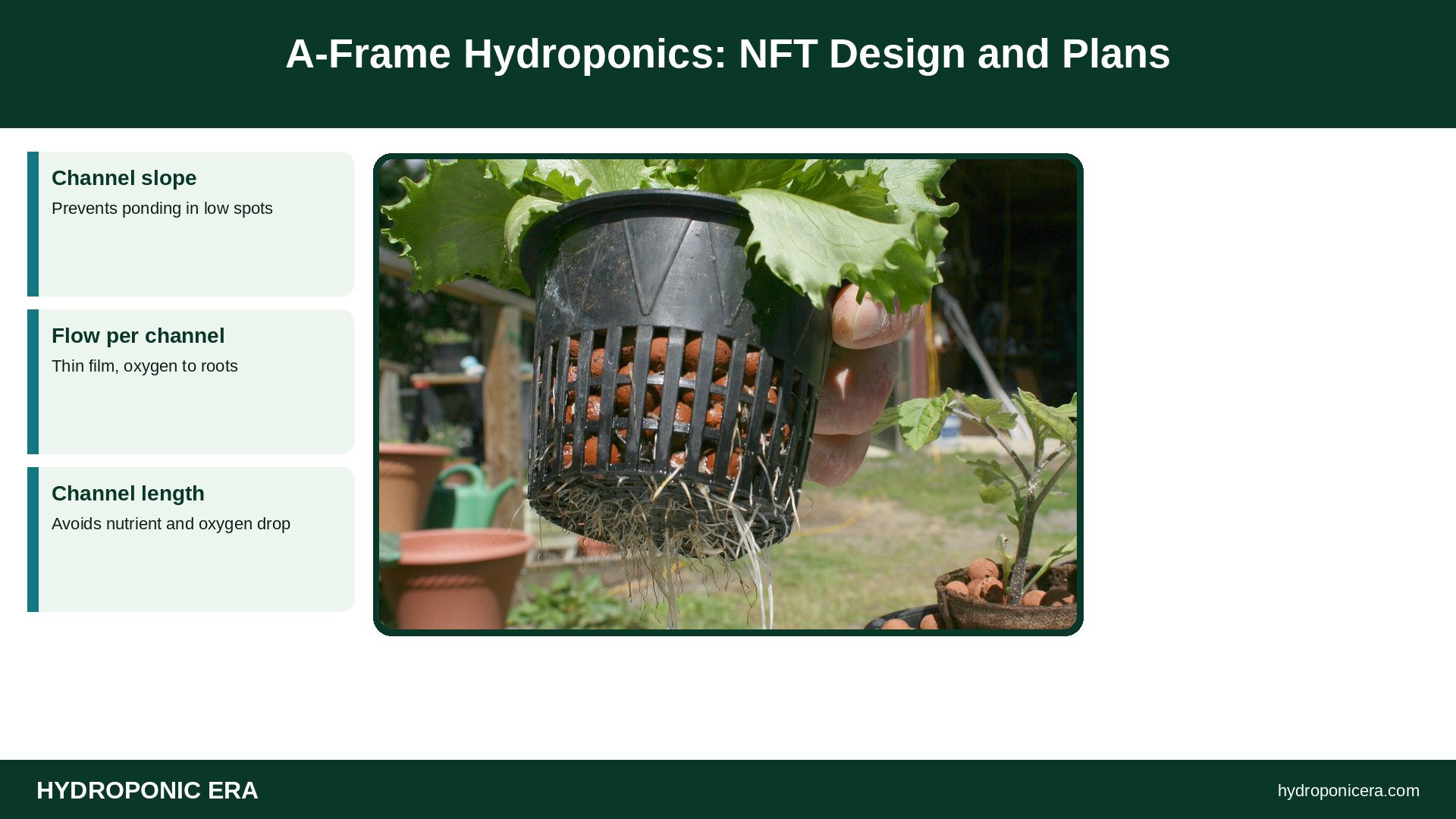
| Channel slope | 1:30 to 1:40 (about 2.5–3.3%) | Prevents ponding in low spots |
| Flow per channel | 0.5–1 L/min (8–16 GPH) | Thin film, oxygen to roots |
| Channel length | Under about 40 ft | Avoids nutrient and oxygen drop |
| Frame angle | About 60–70° from the ground | Balances footprint and light |
| Plant spacing | 6–8 in for lettuce, 4–6 in for herbs | Room for heads to fill out |
| Best crops | Lettuce, herbs, greens, strawberries | Light, shallow-rooted, short |
How A Frame Hydroponics Works
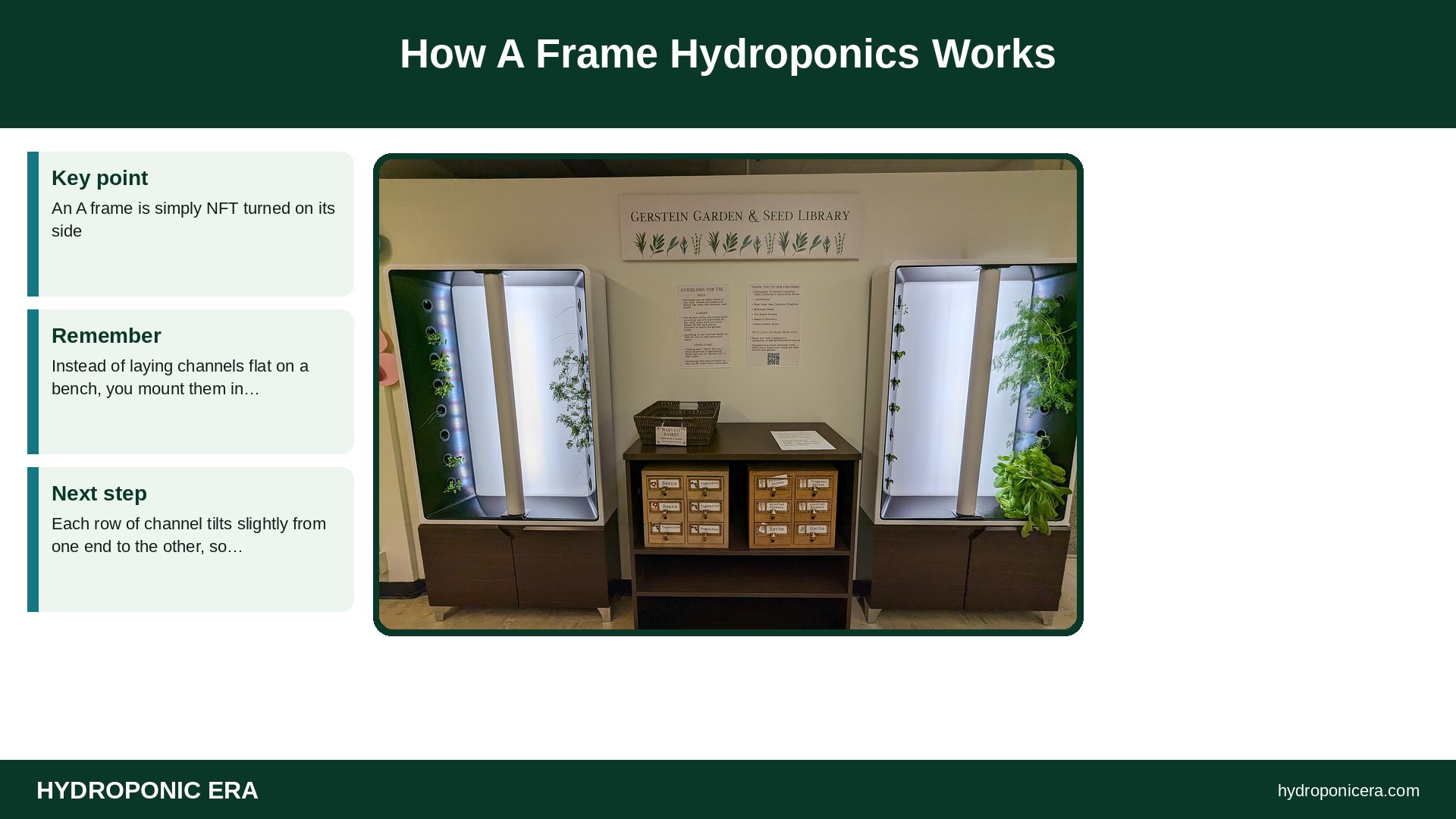
An A frame is simply NFT turned on its side. Instead of laying channels flat on a bench, you mount them in horizontal rows on two sloping faces that meet at the top. Each row of channel tilts slightly from one end to the other, so solution enters at the high end, flows the length of the channel and drops into a return pipe that leads back to the tank. The roots sit in a shallow stream with their upper surface in moist air, which is what makes NFT so productive.
The NFT basics don’t change. Virginia Cooperative Extension describes NFT as a recirculating system with roots in a thin film inside channels, fed from a manifold by a continuous-duty pump. For the full background, see NFT hydroponics for beginners.
A Frame Hydroponics vs Flat NFT and Towers
- Flat NFT tables are easier to build and tend, but use the most floor space.
- A frame hydroponics roughly doubles growing area on the same footprint, and both sides can be reached from the aisle.
- Vertical towers pack in more plants but shade each other more, and the top plants get the best light.
The trade-off with an A frame is light. The lower channels sit closer to the ground and can be shaded by the rows above, and the side facing away from the sun gets less light. Run the ridge north to south outdoors or in a greenhouse so both faces get sun during the day.
Planning Your A Frame Hydroponics Build
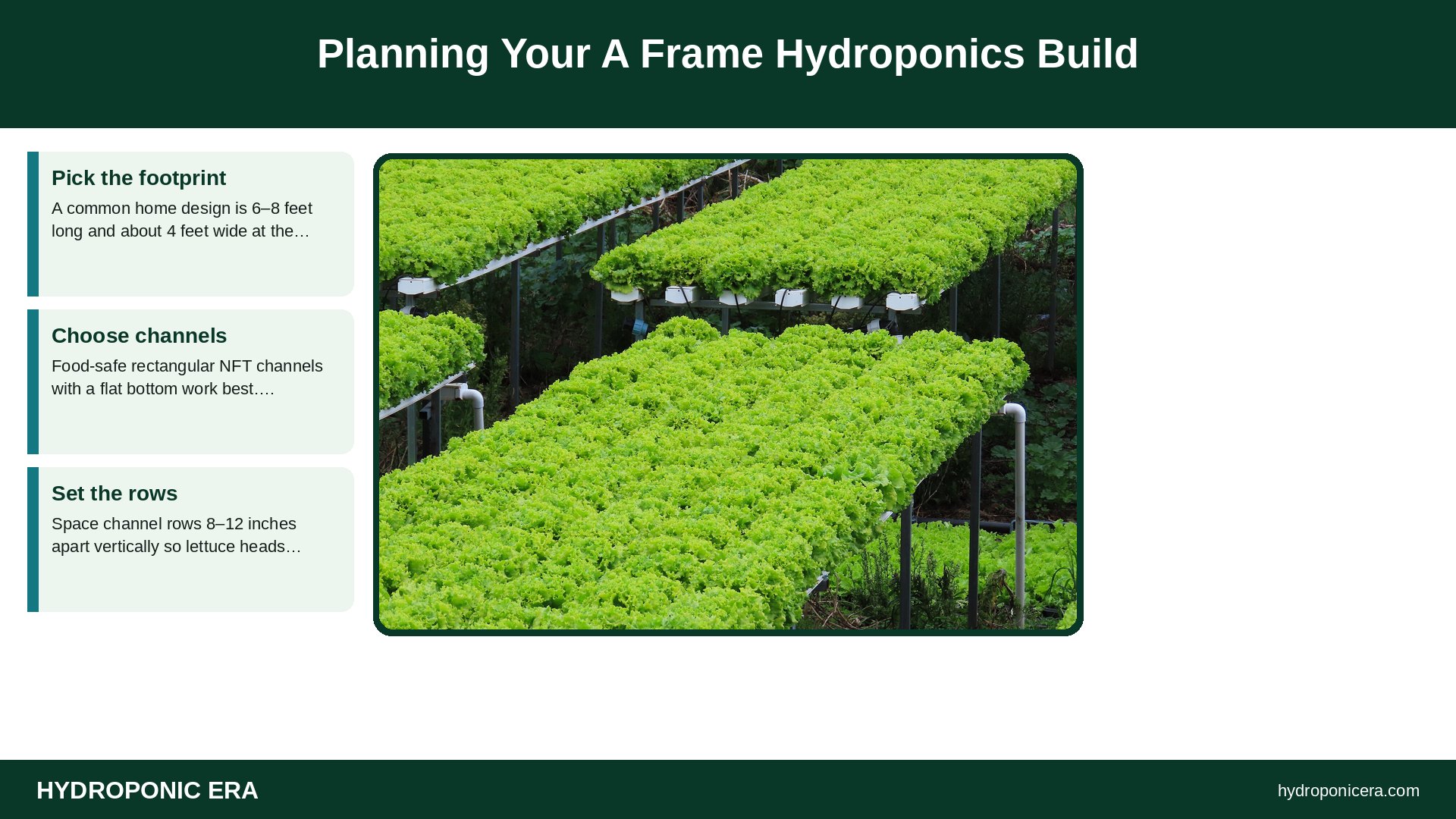
- Pick the footprint. A common home design is 6–8 feet long and about 4 feet wide at the base.
- Choose channels. Food-safe rectangular NFT channels with a flat bottom work best. Round PVC pipe can be used, but the curved bottom makes the film deeper in the middle. See DIY PVC NFT system and safe plastics.
- Set the rows. Space channel rows 8–12 inches apart vertically so lettuce heads don’t touch the row above.
- Add the slope. Mount one end of each channel lower than the other so the slope is about 1:30 to 1:40.
- Plumb the supply. Run a manifold up the high end with a small line and valve to each channel.
- Plumb the return. A larger return pipe at the low end collects all channels and drains to the tank.
- Size the pump. Add up the flow for every channel and the vertical lift to the top row. See water pump sizing.
Frame Materials
Treated lumber is common but should not touch the nutrient solution. Galvanized steel, aluminum, or powder-coated conduit last longer outdoors. The frame must be braced well, because a long channel full of water and mature lettuce is heavier than it looks, and wind can push on the large flat faces.
Flow Rate and Slope for A Frame Hydroponics
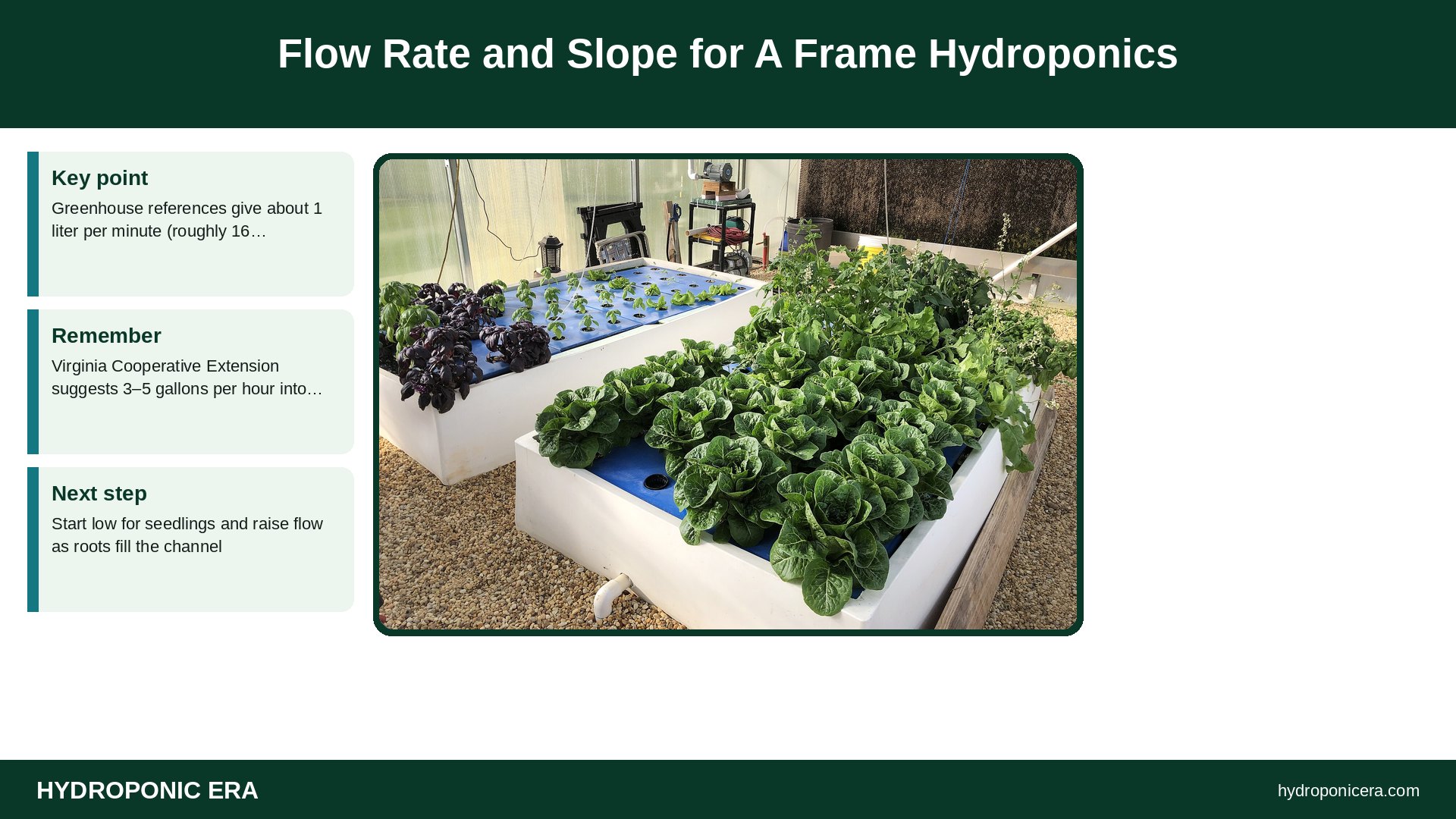
Greenhouse references give about 1 liter per minute (roughly 16 gallons per hour) per channel as a general NFT guide, with lower rates for lettuce and young plants and higher rates for fruiting crops. Virginia Cooperative Extension suggests 3–5 gallons per hour into each channel for small NFT systems. Start low for seedlings and raise flow as roots fill the channel. For more detail, see NFT clogs and dry-outs.
Slopes of about 1:100 work in theory, but home-built frames are rarely that true, so 1:30 to 1:40 is safer and helps prevent ponding.
Best Crops for A Frame Hydroponics
- Lettuce: butterhead, leaf and mini romaine types. See best lettuce varieties and lettuce EC targets.
- Herbs: basil, parsley, cilantro, chives and mint. See best herbs for hydroponics.
- Greens: kale, chard, arugula and Asian greens.
- Strawberries: day-neutral varieties trailing over the channel edge.
Avoid tall or heavy crops such as tomatoes, cucumbers and peppers; they need trellis space and deep roots.
Feeding and Water Management
NFT channels hold very little water, so the reservoir does most of the buffering. Keep a reservoir large enough to cover several hours of pump flow, check EC and pH daily, and top off often. Warm solution holds less oxygen, so shade the tank and return pipes outdoors. See reservoir temperature.
Pump Failure Risk
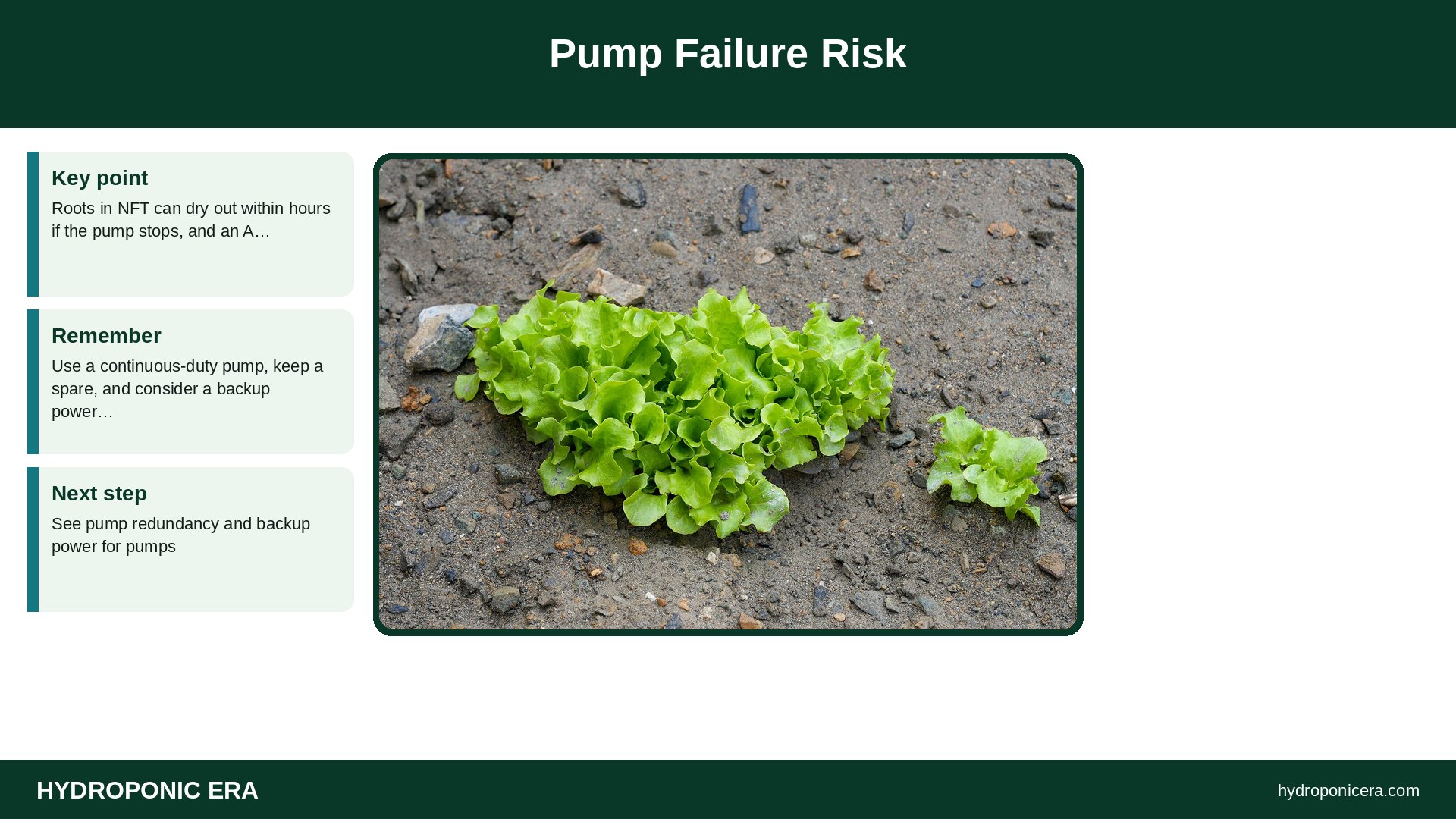
Roots in NFT can dry out within hours if the pump stops, and an A frame exposes them to more air movement than a flat table. Use a continuous-duty pump, keep a spare, and consider a backup power source or alarm. See pump redundancy and backup power for pumps.
Light and Spacing on Both Faces
Indoors, an A frame needs lights on both sides, which makes it less efficient than a flat table under one fixture. Outdoors or in a greenhouse it shines, because sunlight from the east reaches one face in the morning and the other in the afternoon. Keep at least 2–3 feet of aisle on each side so you can harvest and so light reaches the lower rows.
Common A Frame Hydroponics Problems
- Uneven flow: top channels get more water; add a valve on each line.
- Shaded lower rows: plant smaller or shade-tolerant crops low.
- Algae: keep channel lids closed and cover unused holes.
- Leaks at the return: use rubber grommets and check joints after filling.
- Heat: channels in full sun warm fast; use white channels.
Cleaning Between Crops
Pull old roots, rinse channels with a hose, scrub with mild soap, then sanitize and rinse well before replanting. See cleaning and sterilizing.
FAQs
What is A frame hydroponics?
An NFT system where channels run on two sloping faces of a triangle-shaped frame.
What can I grow in an A frame?
Lettuce, herbs, leafy greens and strawberries grow best.
What slope should NFT channels have?
About 1:30 to 1:40 is a safe target for home builds.
How much flow does each channel need?
Roughly 0.5–1 liter per minute, lower for seedlings.
Is an A frame good indoors?
It works but needs lighting on both faces.
How long can channels be?
Keep them under about 40 feet to avoid nutrient and oxygen drop.
Sources
- Virginia Cooperative Extension — Hydroponic Production of Edible Crops: Nutrient Film Technique (NFT) Systems
- Greenhouse Management — Nutrient Film Technique
- University of Florida IFAS — Evaluation of Lettuce Cultivars Grown in a Greenhouse Using NFT
- Photo credits (Wikimedia Commons, edited with titles): 2009-03-30 Lettuce roots by Ildar Sagdejev (Specious) (CC BY-SA 4.0); Gerstein Science Information Centre aeroponics towers by Jason Zhang (CC BY-SA 3.0); Hydroponic lettuce @ Plaine des Cafres 03 by Rémih (CC BY-SA 4.0); Deepwater Aquaponics Floating Rafts Growing Lettuce, Basil and Arugula by Alabama Extension (CC0); Lettuce Closeup Greenhouse Phuktal Zanskar Jun24 A7CR 00442 by This Photo was taken by Timothy A. Gonsalves. Feel free to use my photos, but pl (CC BY-SA 4.0)