
A good NFT flow rate for most home and greenhouse channels is about 0.5–1 liter per minute (roughly 8–16 gallons per hour) per channel, with the lower end for seedlings and lettuce and up to about 2 liters per minute (32 GPH) as a practical maximum for large fruiting crops. Pair that NFT flow rate with a channel slope of about 1:30 to 1:40 (2.5–3.3%) so the solution forms a thin film that never ponds, and keep channels under roughly 40 feet long.
Key takeaway: Start around 0.5 L/min (8 GPH) per channel at planting, raise toward 1 L/min as roots fill the channel, and use enough slope that water never sits in low spots.
| Setting | Typical value | Notes |
|---|---|---|
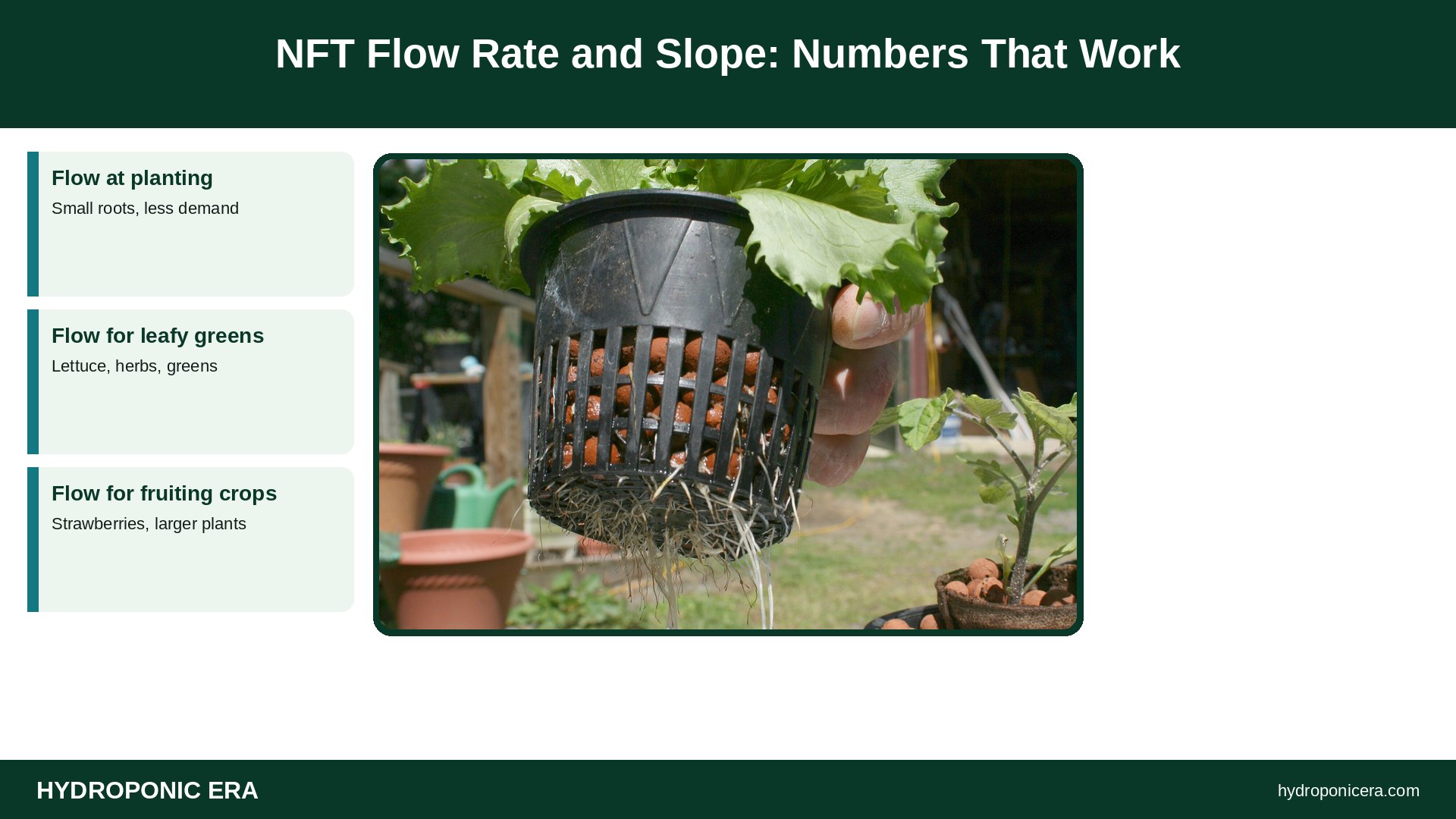
| Flow at planting | 0.5 L/min (about 8 GPH) | Small roots, less demand |
| Flow for leafy greens | 0.5–1 L/min (8–16 GPH) | Lettuce, herbs, greens |
| Flow for fruiting crops | 1–2 L/min (16–32 GPH) | Strawberries, larger plants |
| Small DIY channels | 3–5 GPH | Short channels with few plants |
| Slope | 1:30 to 1:40 (2.5–3.3%) | Some sources accept 1–3% |
| Channel length | Under about 40 ft (12 m) | Growth drops in longer runs |
Why NFT Flow Rate Matters
NFT depends on a very shallow stream. Roots sit in the channel with the bottom of the root mat wet and the top in moist air, which gives them both water and oxygen. If the NFT flow rate is too low, the far end of the channel can run short of water, oxygen and nutrients, and plants there grow more slowly. If it’s too high, the film gets deep, roots lose access to air, and a thick root mat can dam the channel and cause overflow.
Greenhouse references give about 1 liter per minute per channel as a general guide, lower for lettuce and higher for fruiting vegetables. For NFT basics, see NFT hydroponics for beginners.
NFT Flow Rate by Crop and Stage
- Seedlings and new transplants: about 0.5 L/min (8 GPH). Make sure the film reaches the base of every plug.
- Lettuce and leafy greens: 0.5–1 L/min. Research on lettuce in short channels found very low flows worked well, so start low.
- Herbs: 0.5–1 L/min; basil with big roots may need the higher end.
- Strawberries and fruiting crops: 1–2 L/min, because larger root masses use more water.
Virginia Cooperative Extension suggests 3–5 gallons per hour into each channel for small NFT systems, which fits short home channels with a few plants each.
Channel Slope Basics
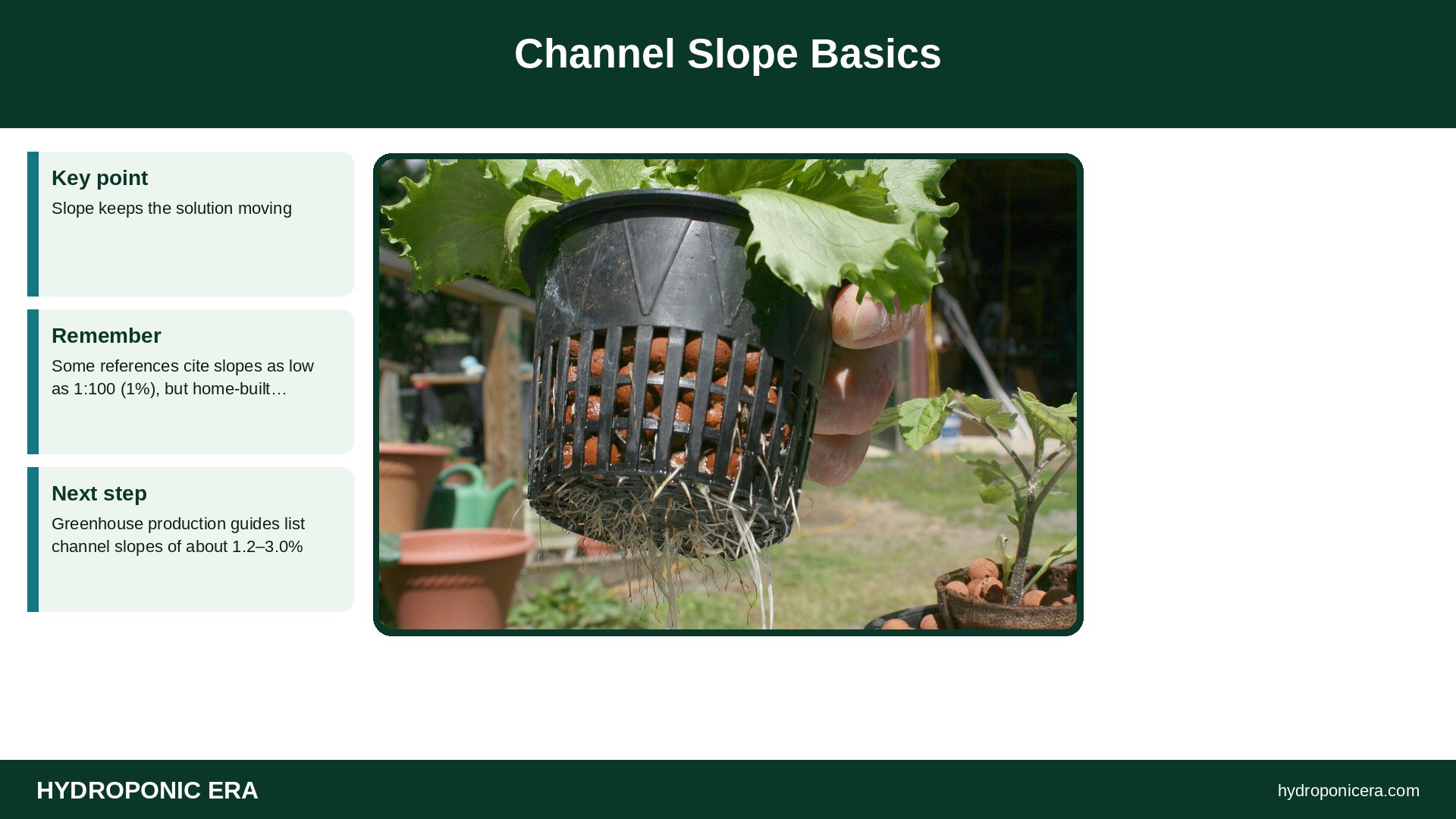
Slope keeps the solution moving. Some references cite slopes as low as 1:100 (1%), but home-built benches are rarely flat enough for that to work without ponding, so a slope of about 1:30 to 1:40 is safer. Greenhouse production guides list channel slopes of about 1.2–3.0%.
To convert, divide the drop by the length. A 10-foot channel at 1:40 drops 3 inches from inlet to outlet. A 6-foot channel at 1:30 drops about 2.4 inches. Use a level or a laser and shim the low end until every channel matches.
How to Measure NFT Flow Rate
- Hold a measuring cup or jug under the outlet of one channel.
- Time how long it takes to collect 1 liter or 1 quart.
- Divide to get liters per minute or gallons per hour. One liter in 60 seconds is 1 L/min; one quart in 60 seconds is about 15 GPH.
- Repeat for every channel. They should be within about 10–20% of each other.
- Adjust the valve or emitter on each line until flow is even.
Sizing the Pump for Your NFT Flow Rate
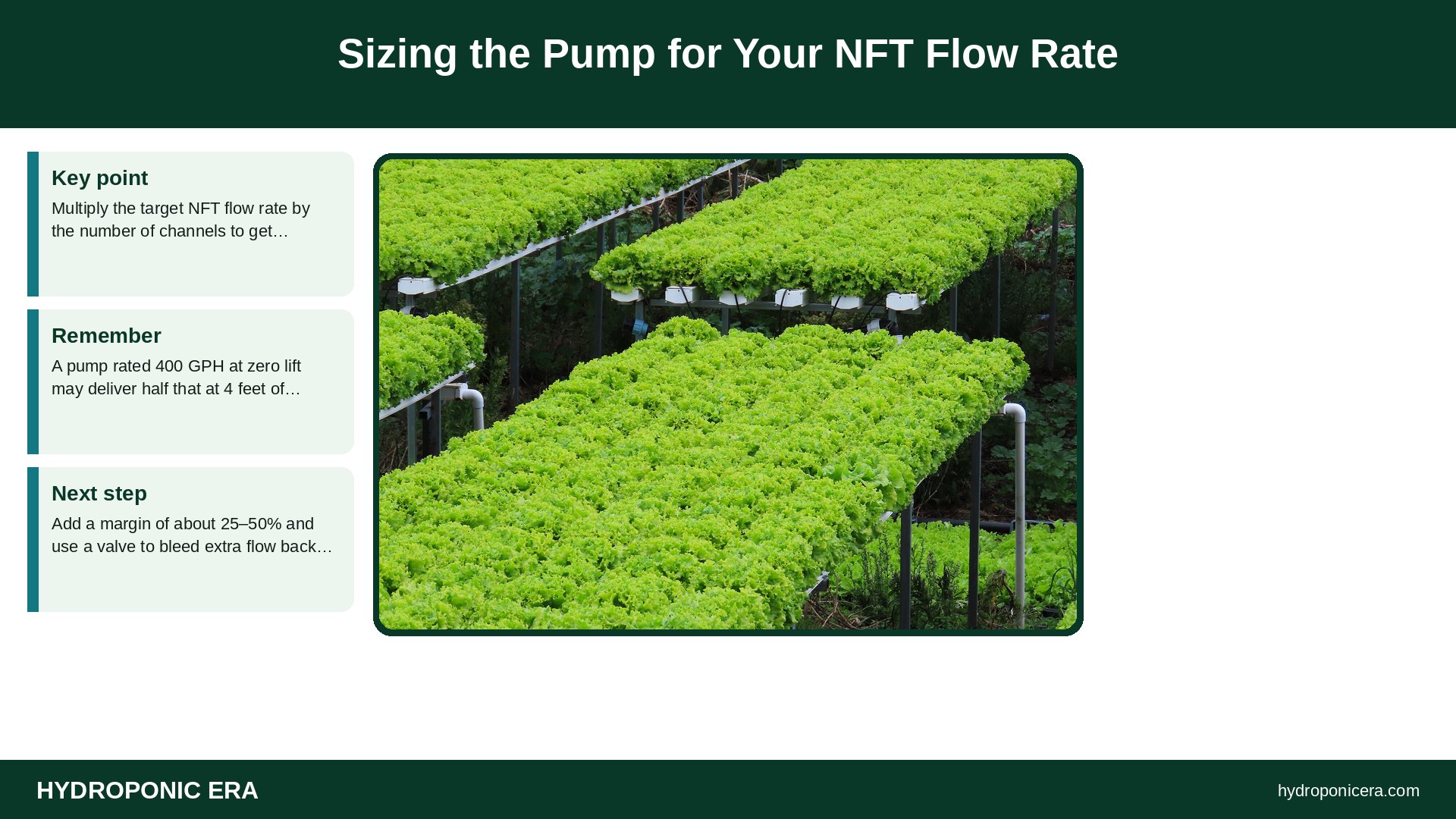
Multiply the target NFT flow rate by the number of channels to get the total flow, then check the pump’s flow chart at your head height. A pump rated 400 GPH at zero lift may deliver half that at 4 feet of head. Add a margin of about 25–50% and use a valve to bleed extra flow back to the tank. See water pump sizing and manifolds.
Channel Length and Width
Longer channels mean the plants at the end get solution that has already passed many roots. Growth slowdowns have been reported in channels longer than about 12 meters (40 feet). Home systems are usually 4–12 feet, which avoids the problem. Wider channels help larger crops by preventing the root mat from damming the flow. Flat-bottom channels keep the film shallow; round pipes give a deeper stream in the middle.
Signs Your NFT Flow Rate Is Wrong
- Wilting at the far end: flow too low or a clog upstream.
- Brown, slimy roots: film too deep or water too warm. See Pythium root rot.
- Water spilling from plant holes: flow too high or roots damming the channel.
- Dry plugs: the film isn’t reaching the base of seedlings; add a strip of capillary mat.
- Uneven growth between channels: balance the valves.
Continuous vs Intermittent Flow
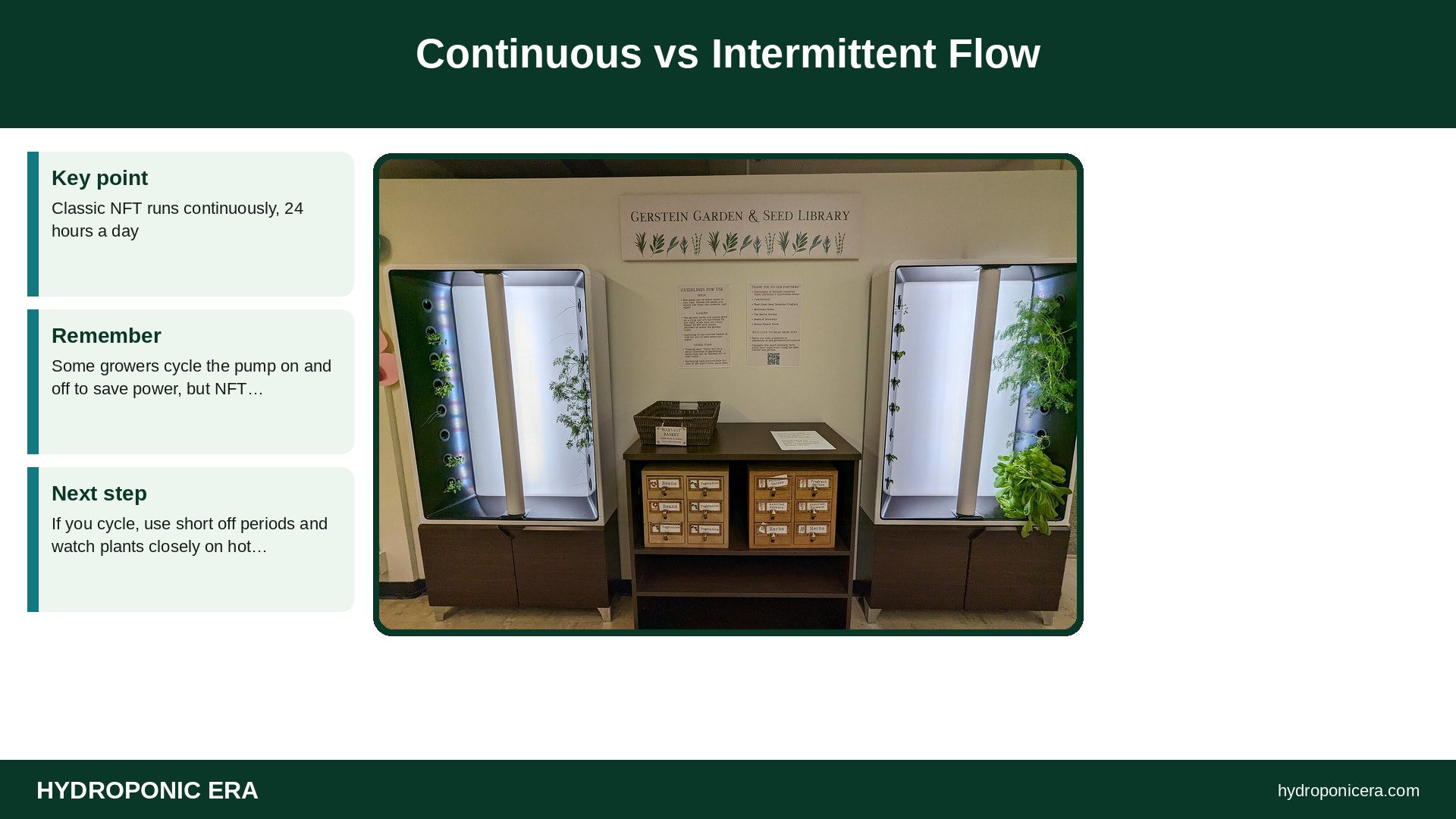
Classic NFT runs continuously, 24 hours a day. Some growers cycle the pump on and off to save power, but NFT channels hold almost no water, so roots can dry quickly. If you cycle, use short off periods and watch plants closely on hot days. Continuous flow is the safer choice. See timers and automation and NFT dry-out failures.
Temperature and Oxygen
Warm solution holds less oxygen, and a thin film in a sunny channel warms quickly. Aim for a solution temperature of about 65–72°F. Use white or light-colored channels, shade the reservoir, and insulate supply lines if needed. See reservoir temperature and A frame hydroponics.
A Simple NFT Flow Rate Checklist
- Slope set and checked with a level.
- Each channel measured and balanced.
- Flow started low and raised as roots grow.
- Pump on a protected outlet with a spare ready.
- Channels flushed and cleaned between crops.
NFT Flow Rate in Stacked and A Frame Systems
When channels are stacked or mounted on an A frame, the top rows sit closest to the pump outlet and often get more flow than the bottom rows. Put a small ball valve or adjustable emitter on every supply line, measure each channel’s NFT flow rate after any change, and recheck weekly as roots grow. Higher rows also need a pump that can push water to the full height, so check the head rating, not just the gallons per hour on the box.
Adjusting Flow as the Crop Grows
A channel of young lettuce plugs uses little water, but by harvest the root mat can fill most of the channel. Plan to raise flow two or three times during a crop. If roots begin to dam the channel, a slightly steeper slope helps more than a big jump in flow. At the end of each crop, clear old roots so the next planting starts with an open channel.
FAQs
What is a good NFT flow rate?
About 0.5–1 L/min (8–16 GPH) per channel for most crops.
What slope should NFT channels have?
About 1:30 to 1:40 for home builds; 1–3% in some guides.
Can NFT flow be too high?
Yes. A deep stream starves roots of air and can overflow.
How do I measure flow?
Time how long one channel takes to fill a measured container.
Should NFT run all day?
Continuous flow is safest because channels hold little water.
How long can an NFT channel be?
Keep it under about 40 feet.
Sources
- Virginia Cooperative Extension — Hydroponic Production of Edible Crops: NFT Systems
- Greenhouse Management — Nutrient Film Technique
- CropKing — NFT Production of Lettuce
- University of Florida IFAS — Evaluation of Lettuce Cultivars Grown in a Greenhouse Using NFT
- Photo credits (Wikimedia Commons, edited with titles): 2009-03-30 Lettuce roots by Ildar Sagdejev (Specious) (CC BY-SA 4.0); Romaine lettuce by Rainer Zenz (CC BY-SA 3.0); 2009-03-30 Lettuce roots by Ildar Sagdejev (Specious) (CC BY-SA 4.0); Hydroponic lettuce @ Plaine des Cafres 03 by Rémih (CC BY-SA 4.0); Gerstein Science Information Centre aeroponics towers by Jason Zhang (CC BY-SA 3.0)