
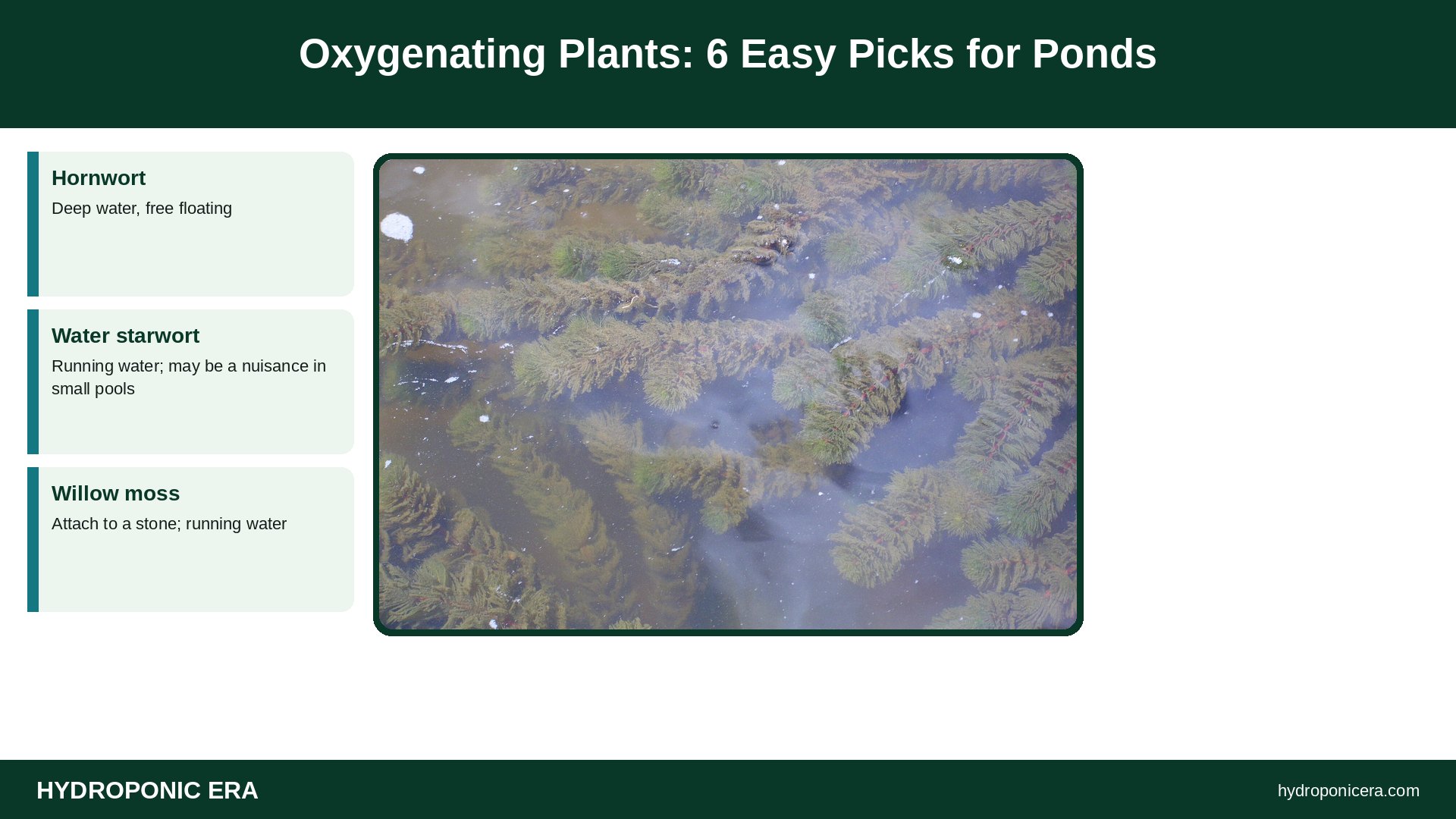
What are the best oxygenating pond plants? Good oxygenating pond plants include hornwort, water starwort, willow moss, water crowfoot, water violet and mare’s-tail, all listed by the RHS. Plant about 4–5 bunches per 11 sq ft (1 m²) of surface. K-State Extension adds that these submerged aquatics compete with algae for nutrients and give fish a spawning bed.
Key takeaway: Oxygenating pond plants are submerged aquatics that grow underwater, release oxygen by day and shelter pond life. They also compete with algae for carbon dioxide and dissolved nutrients. Choose non-invasive species, anchor them in baskets, and avoid overplanting, because the RHS warns they respire at night and too many can starve fish of oxygen in summer.
| Plant | Botanical name | Notes from the RHS |
|---|---|---|
| Hornwort | Ceratophyllum demersum | Deep water, free floating |
| Water starwort | Callitriche hermaphroditica | Running water; may be a nuisance in small pools |
| Willow moss | Fontinalis antipyretica | Attach to a stone; running water |
| Water crowfoot | Ranunculus aquatilis | White flowers in May |
| Water violet | Hottonia palustris | Lilac summer flowers; do not move in summer |
| Mare’s-tail | Hippuris vulgaris | Listed oxygenator |
What Do Oxygenating Pond Plants Do?
They add oxygen by day and fight algae. The RHS says submerged plants produce oxygen during the day and provide cover for aquatic life. K-State Research and Extension says submerged aquatics compete with algae for carbon dioxide and dissolved nutrients and serve as a spawning bed for fish and frogs while protecting smaller species.
K-State notes that water lilies and floating plants help in a different way, by shading the surface and limiting sunlight. Combining both types gives a better balance. For more on clear water, see our aquaponics algae control guide.
Which Oxygenating Pond Plants Should You Choose?
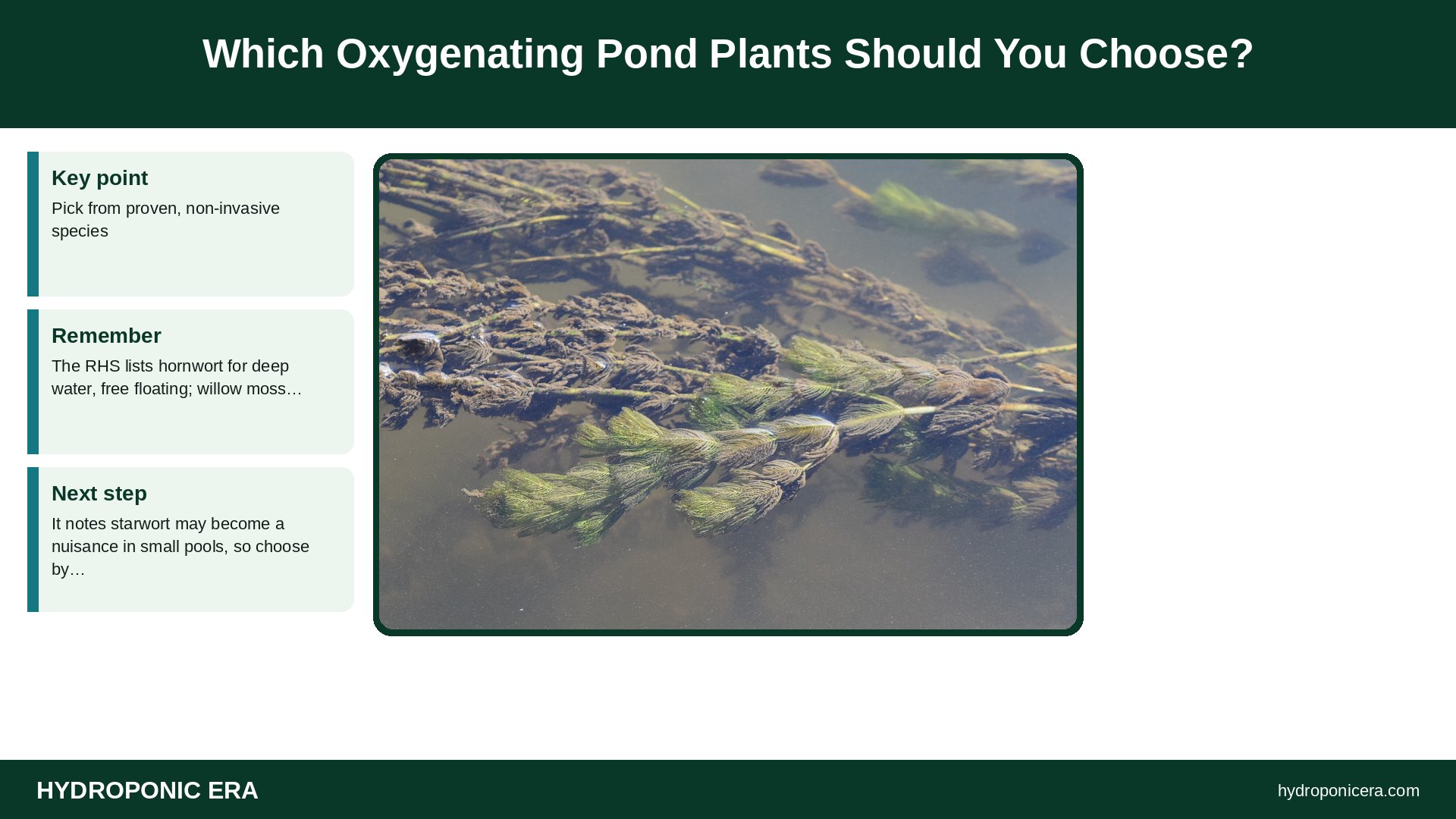
Pick from proven, non-invasive species. The RHS lists hornwort for deep water, free floating; willow moss, best attached to a stone; water crowfoot with white May flowers; water violet with lilac summer flowers; water starwort; and mare’s-tail. It notes starwort may become a nuisance in small pools, so choose by pond size.
- Read our full hornwort guide for a free-floating option.
- Compare another submerged favorite in our anacharis guide.
- See more choices in our koi pond plants guide.
How Many Oxygenating Pond Plants Do You Need?
Start with a modest number. The RHS says roughly four to five bunches, each of three to four stems, per 11 sq ft (1 m²) of water surface should be sufficient. K-State’s water gardening guide suggests one bunch of submerged aquatics for every 1 to 2 feet (0.3–0.6 m) of pond surface, so begin low and adjust.
- Measure your pond’s surface area.
- Plan four to five bunches per 11 sq ft (1 m²).
- Group bunches in baskets or gravel beds.
- Watch growth and thin if plants crowd the water.
When Should You Plant Oxygenators?
Plant in mid-spring to early summer. The RHS says this is the best time to buy and plant new aquatics, because the water is warming and plants should establish well. In smaller ponds, the RHS adds, growing aquatic plants in containers helps keep them from becoming too large and makes thinning and lifting much easier later.
- Anchor each bunch firmly, as the RHS advises.
- Choose fine-mesh or lined baskets so soil stays put.
- Check depth needs before lowering baskets.
Can Oxygenating Pond Plants Harm Fish?
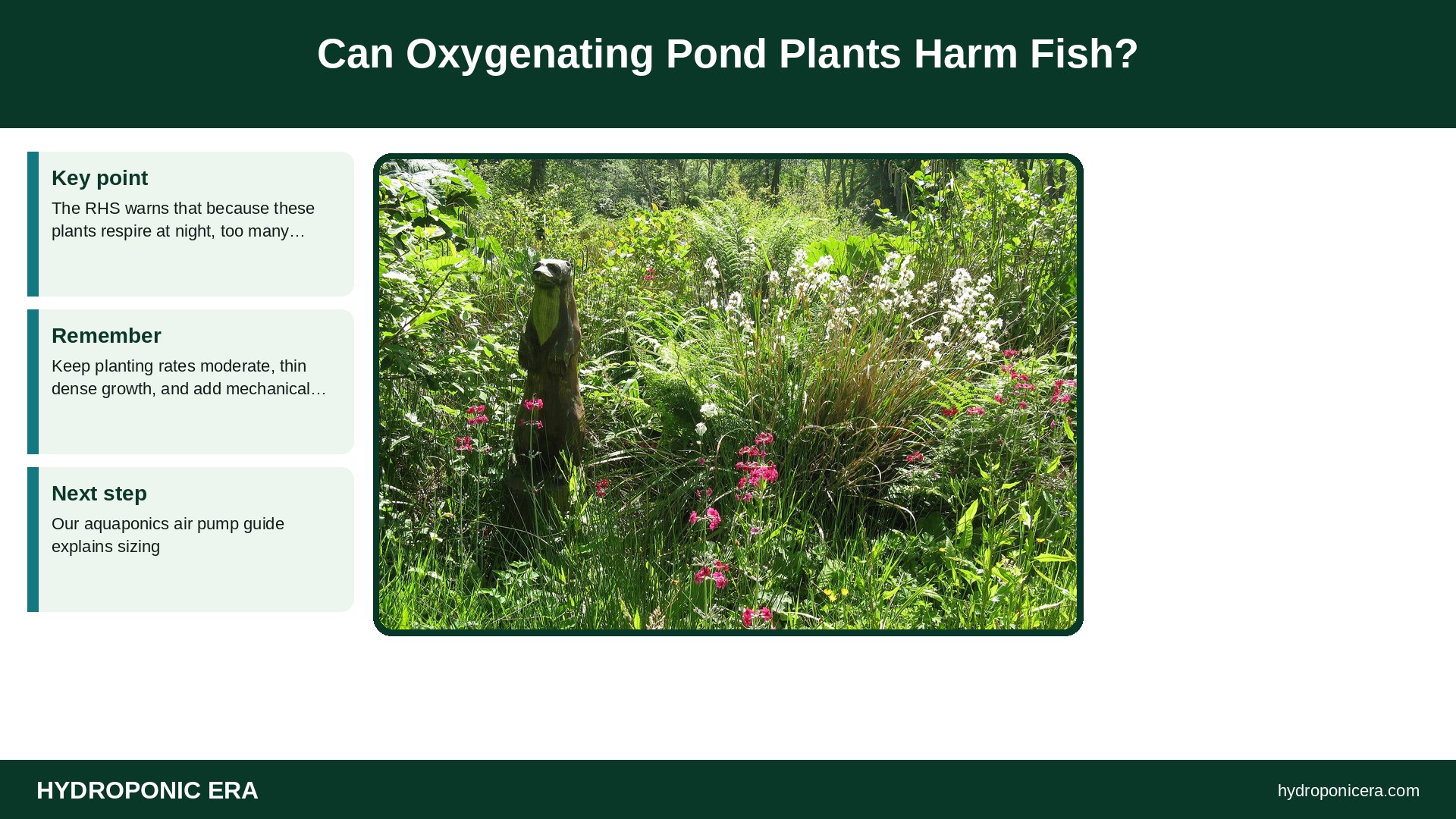
Yes, if you overplant. The RHS warns that because these plants respire at night, too many can cause a lack of oxygen at night during summer, causing fish to die. Keep planting rates moderate, thin dense growth, and add mechanical aeration in heavily stocked ponds. Our aquaponics air pump guide explains sizing.
How Do You Plant Oxygenating Pond Plants?
Anchor bunches in baskets. The RHS says oxygenating plants are sold in bunches, planted into baskets and need anchoring firmly in place. K-State says bunches can be grouped in pots or planted directly in gravel beds to create underwater groves, and they do best near moving water, such as under waterfalls, where they efficiently filter water.
- Line lattice baskets with hessian or fabric to hold soil.
- Push bunches into the basket and weigh them down.
- Lower baskets into the pond at the right depth.
- Add fish after plants so they have hiding places, as K-State advises.
Which Oxygenating Pond Plants Are Invasive?
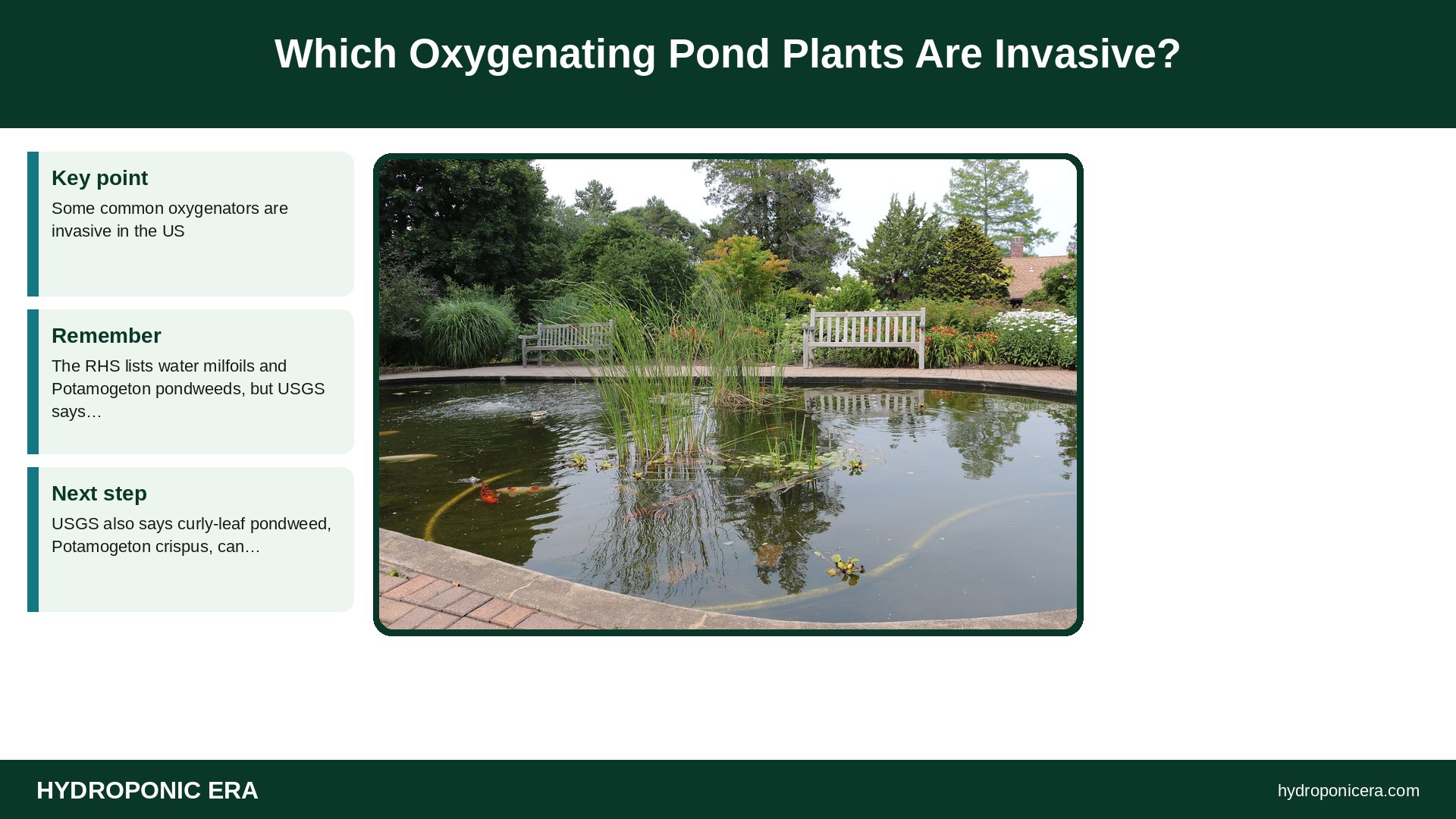
Some common oxygenators are invasive in the US. The RHS lists water milfoils and Potamogeton pondweeds, but USGS says Eurasian water-milfoil, Myriophyllum spicatum, is a major nuisance in the Northeast, northern Midwest and Pacific Northwest and displaces native plants. USGS also says curly-leaf pondweed, Potamogeton crispus, can outcompete natives for light and space early in the season.
The RHS also tells pond owners to avoid invasive parrot’s feather, Myriophyllum aquaticum. Check your state’s invasive list before buying oxygenating pond plants, and never release pond plants into the wild.
How Do You Care for Oxygenating Pond Plants in Winter?
Trim and leave them in place. K-State’s maintenance guide says to trim hardy submerged plants to below ice level for winter and to dredge debris from the pond bottom in spring. Thin overgrown oxygenating pond plants in summer to prevent night oxygen dips. For fish-and-plant pond systems, see our pond aquaponics guide.
Do oxygenating pond plants really add oxygen?
Yes, by day. The RHS says submerged plants produce oxygen during daylight.
How many oxygenating pond plants do I need?
The RHS suggests four to five bunches per 11 sq ft (1 m²) of surface.
Can too many oxygenators kill fish?
Yes. The RHS warns night respiration can cause low oxygen in summer.
Is hornwort a good oxygenator?
Yes. The RHS lists it for deep water, free floating.
Which oxygenators should I avoid in the US?
Eurasian water-milfoil and curly-leaf pondweed, per USGS.
Sources
- Royal Horticultural Society. Choosing pond plants.
- Royal Horticultural Society. Aquatic plants: planting.
- Kansas State University Research and Extension. MF2911: Water Gardening, Biological Balance.
- Kansas State University Research and Extension. MF2913: Water Gardening, Maintenance.
- U.S. Geological Survey. Myriophyllum spicatum fact sheet.
- U.S. Geological Survey. Potamogeton crispus fact sheet.
- Photo credits (Wikimedia Commons, edited with titles): Ceratophyllum demersum 2010-8-14 RioMontoro SierraMadrona by Javier martin (Public domain); Myriophyllum spicatum kz01 by Krzysztof Ziarnek, Kenraiz (CC BY-SA 4.0); Pond-edge plants at Achamore Garden – geograph.org.uk – 5446824 by M J Richardson (CC BY-SA 2.0); Deep Cut Gardens Koi Pond by FossilDS (CC0)
1 thought on “Oxygenating Plants: 6 Easy Picks for Ponds”