
Can you grow gotu kola hydroponically? Yes. Gotu kola hydroponics works well because Centella asiatica naturally grows in moist to wet places along swamps, ponds and rivers, according to NC State Extension. It is a low, creeping perennial with fan-shaped leaves that spreads by runners. Root a runner section in a net cup, keep it warm and bright, and harvest the leaves regularly.
Key takeaway: Gotu kola (Centella asiatica) is a creeping, rhizomatous perennial in the carrot family. It likes moisture but NC State notes root rot can occur in poorly drained soil, so hydroponic roots need oxygen. It is frost-tender and tropical, which makes an indoor hydroponic setup a good way to grow it year-round.
| Factor | What sources report | Source |
|---|---|---|
| Botanical name | Centella asiatica (Apiaceae) | NC State Extension |
| Native range | Asia, India, Africa and Australia | NC State Extension |
| Natural habitat | Moist to wet areas along swamps, ponds, rivers | NC State Extension |
| Light | Partial shade to full sun | NC State Extension |
| Growth habit | Low, creeping ground cover | NC State Extension |
| Weak point | Root rot in poorly drained conditions | NC State Extension |
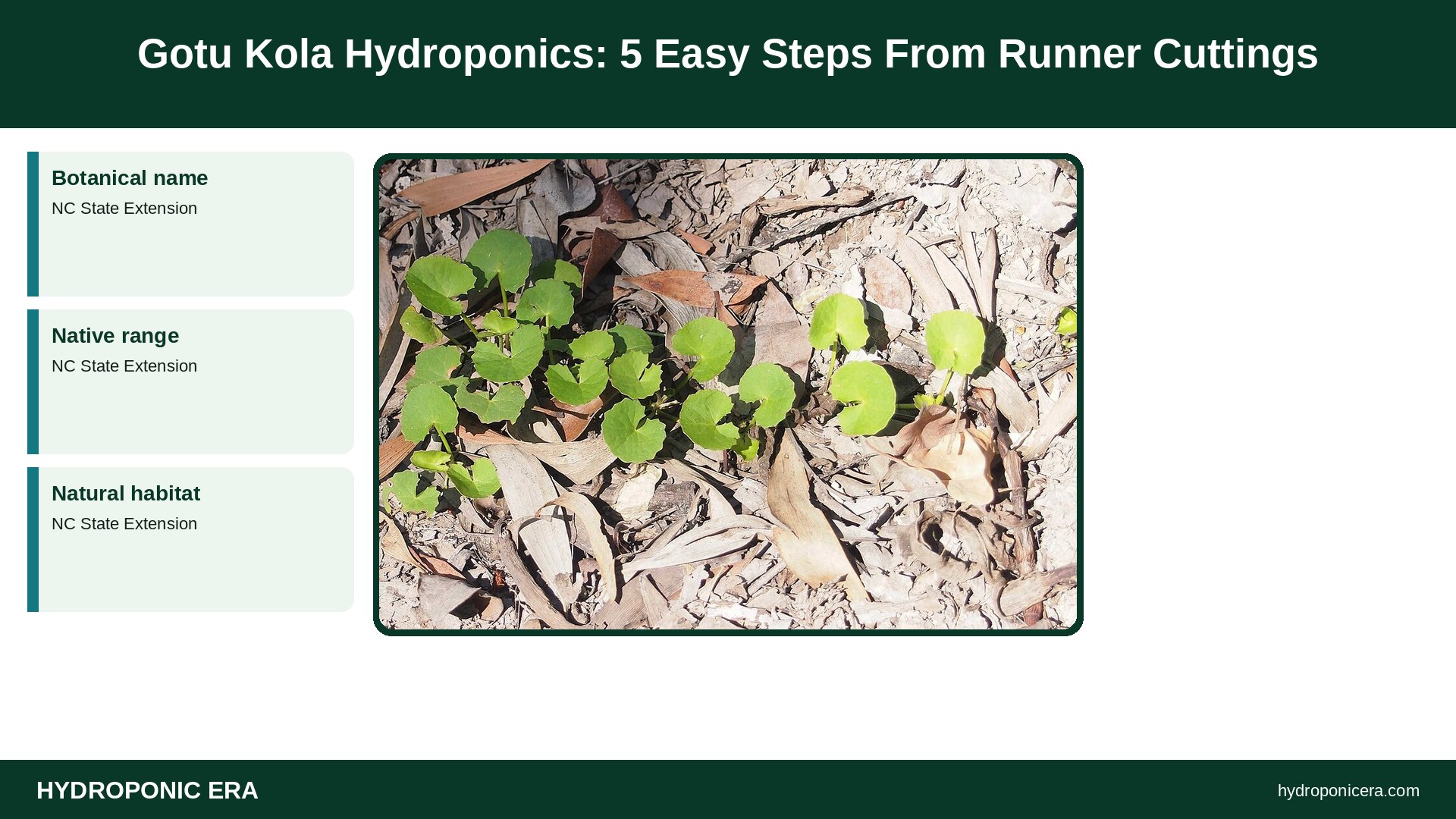
What Is Gotu Kola?
Gotu kola is Centella asiatica, also called Asiatic pennywort or false pennywort. NC State Extension describes it as a rhizomatous perennial in the carrot family (Apiaceae), native to Asia, India, Africa and Australia. It grows low to the ground with small, fan-shaped green leaves and tiny white or pinkish flowers, and it can spread quickly into a dense mat.
The leaves are edible and are widely used as an herb. Memorial Sloan Kettering Cancer Center notes that gotu kola has been used in traditional medicine but that there is insufficient evidence to support its use for specific conditions. This guide covers growing it as a leafy plant, not medical use.
Why Grow Gotu Kola Hydroponically?
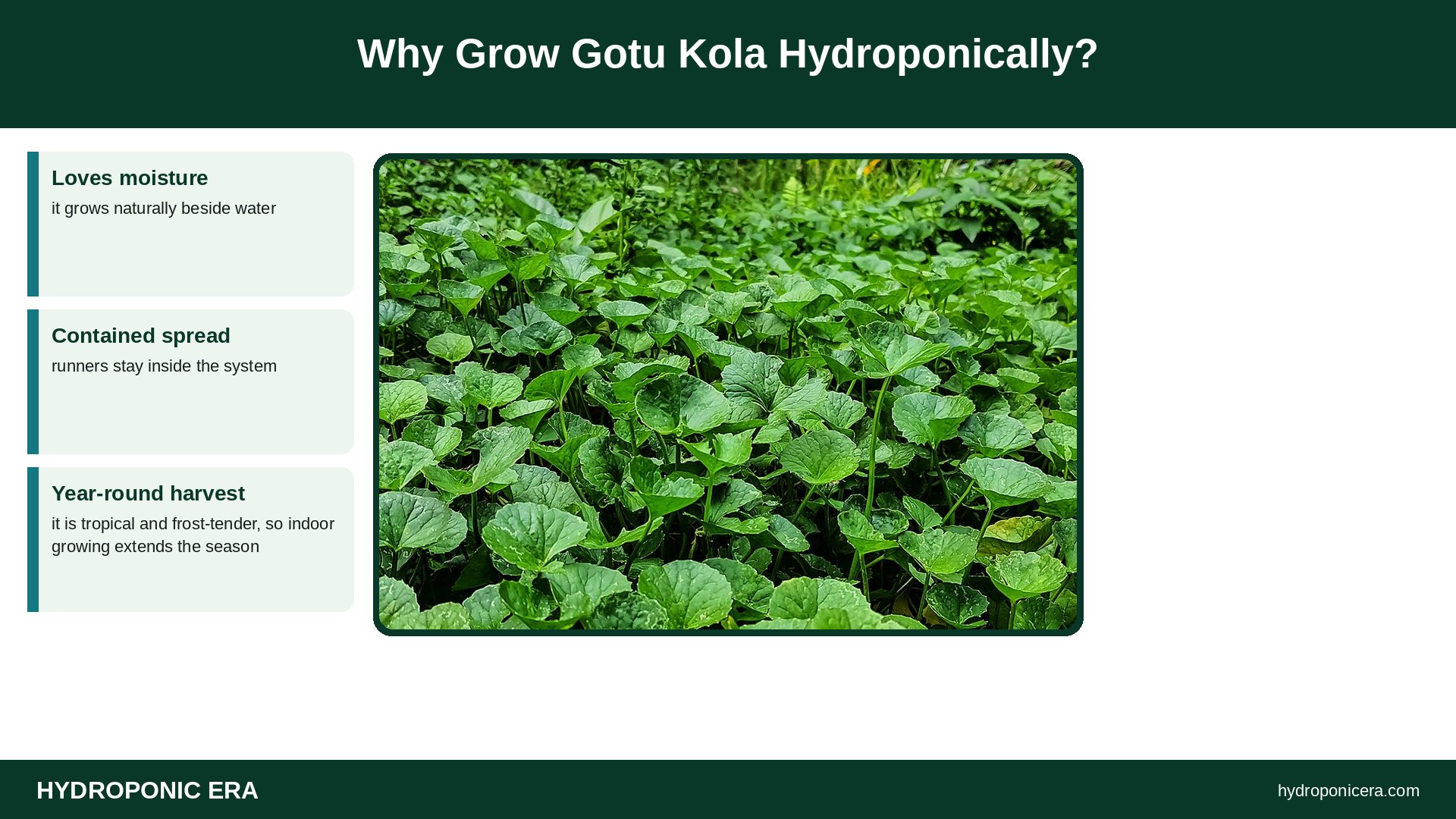
Gotu kola hydroponics matches the plant’s natural preference for constant moisture while keeping it contained. NC State notes it is considered highly invasive on several Pacific islands, so an indoor system is a responsible way to grow it. Hydroponics also gives clean leaves without soil splash on the low-growing foliage.
- Loves moisture: it grows naturally beside water.
- Contained spread: runners stay inside the system.
- Year-round harvest: it is tropical and frost-tender, so indoor growing extends the season.
- Easy propagation: each rooted runner node can become a new plant.
How Do You Start Gotu Kola Hydroponics?
Start gotu kola hydroponics from a rooted runner rather than seed. The plant spreads by creeping stems that root at the nodes, so a section with a few leaves and visible root bumps establishes quickly. Wash any soil away, then set it in a net cup with clay pebbles or a coco plug.
- Cut a runner section with 2–3 leaves and at least one rooted node.
- Rinse the roots clean of soil.
- Place the section in a net cup so the roots touch the solution.
- Keep the crown above the waterline to avoid rot.
- Keep humidity high for the first week, then harden off.
A simple raft or deep water culture setup suits gotu kola because the plant sits low and spreads sideways.
What Conditions Does Gotu Kola Need Indoors?
Gotu kola grows in partial shade to full sun, according to NC State, so indoors it does well under moderate LED light. The University of Maryland recommends 14–16 hours of grow light for indoor herbs in winter. Keep the plant warm, since it is a tropical, frost-tender perennial, and keep the root zone oxygenated.
| Setting | Starting point | Basis |
|---|---|---|
| Light | Moderate to bright LED | NC State (part shade to full sun) |
| Photoperiod | 14–16 hours | University of Maryland |
| Temperature | Warm, frost-free | NC State (tropical) |
| Root zone | Constantly moist, well aerated | NC State root-rot note |
For humidity and airflow, see our guide to humidity and VPD in indoor hydroponics. For feeding, start with a mild solution from hydroponic nutrients for herbs.
What Is the Best System for Gotu Kola Hydroponics?
The best system for gotu kola hydroponics is a wide, shallow raft or DWC tub, because the plant creeps sideways rather than growing tall. NFT channels also work for single plants, but runners can block channels. Kratky works for a single plant if the crown stays above the falling waterline.
| System | Fit for gotu kola | Note |
|---|---|---|
| DWC raft | Excellent | Room for runners to spread |
| NFT channel | Good | Trim runners often |
| Kratky jar | Fair | Watch for rot near the crown |
| Ebb and flow tray | Good | Mimics wet-dry marsh conditions |
How Do You Harvest Gotu Kola?
Harvest gotu kola by cutting individual leaves with their stalks once the plant is established and spreading. Take the larger outer leaves and leave the growing points so the plant keeps producing. Regular cutting also keeps runners in check. Leaves are used fresh in salads and drinks in many Asian cuisines.
What Problems Affect Gotu Kola Hydroponics?
The main problem in gotu kola hydroponics is root rot when roots sit in stagnant, low-oxygen water. NC State notes root rot in poorly drained soil and lists the plant as weedy. Pale leaves usually mean weak light or a weak nutrient solution, and leggy runners usually mean the light is too dim.
- Brown, slimy roots: add aeration and keep the crown dry.
- Pale leaves: raise light or nutrient strength slightly.
- Runners everywhere: trim and pot up the extras.
- Long, thin stalks: increase light.
Gotu kola hydroponics plants can also be shared. Each new runner that roots in the system can be cut free and potted up, so one starter plant quickly becomes several.
Can You Grow Gotu Kola Hydroponics From Seed?
Gotu kola hydroponics from seed is possible but slow and uncommon, because the plant propagates so easily from runners. Seeds are tiny and germination can be uneven. Most home growers buy a potted plant from an Asian grocery, herb nursery or friend and root runners from it instead.
FAQ About Gotu Kola Hydroponics
Is gotu kola an aquatic plant?
NC State tags it as aquatic and notes it grows in moist to wet areas, so it handles constant moisture well.
Can gotu kola grow in water only?
A runner can root in plain water, but it needs nutrients for long-term growth.
How much light does gotu kola hydroponics need?
Moderate to bright LED light for about 14–16 hours a day works well indoors.
Is gotu kola the same as kola nut?
No. Memorial Sloan Kettering notes gotu kola contains no caffeine and is different from kolanut.
Is gotu kola hydroponics hard?
No. Keep roots oxygenated and the crown above water.
Sources
- NC State Extension — Centella asiatica
- Memorial Sloan Kettering Cancer Center — Gotu kola
- USDA PLANTS Database — Centella asiatica profile
- University of Maryland Extension — Growing herbs in containers and indoors
- Photo credits (Wikimedia Commons, edited with titles): Centella asiatica habit by Mark Marathon (CC BY-SA 4.0); A patch of Centella Asiatica or pegaga in Malay. by Azreey (CC BY-SA 4.0)