
Does the aphid midge control aphids in hydroponics? Yes. The aphid midge (Aphidoletes aphidimyza) is a tiny fly whose orange larvae paralyze and drain aphids, and Cornell says it attacks over 60 aphid species. It suits long-term hydroponic crops, but larvae drop to soil or media to pupate, and adults stop reproducing when days are shorter than about 16 hours, so plan for both.
Key takeaway: Aphid midges are sold as pupae in sand or vermiculite and released near aphid colonies. UC IPM says each larva eats about 3 to 50 aphids a day for about a week, and Cornell notes larvae kill more aphids than they eat. Unlike the parasitic wasp Aphidius colemani, the midge also takes larger aphids such as foxglove and potato aphids.
| Fact | What sources report | Source |
|---|---|---|
| Adult size | 1/12–1/8 in (2–3 mm) | UC IPM; Cornell |
| Prey range | Over 60 aphid species | Cornell |
| Larval feeding | About 3–50 aphids per day | UC IPM |
| Eggs per female | About 70 | Cornell; UC IPM |
| Egg to adult | About 3 weeks at 72°F (22°C) | UC IPM |
| Day length | Stops reproducing below ~16 hours | UC IPM |
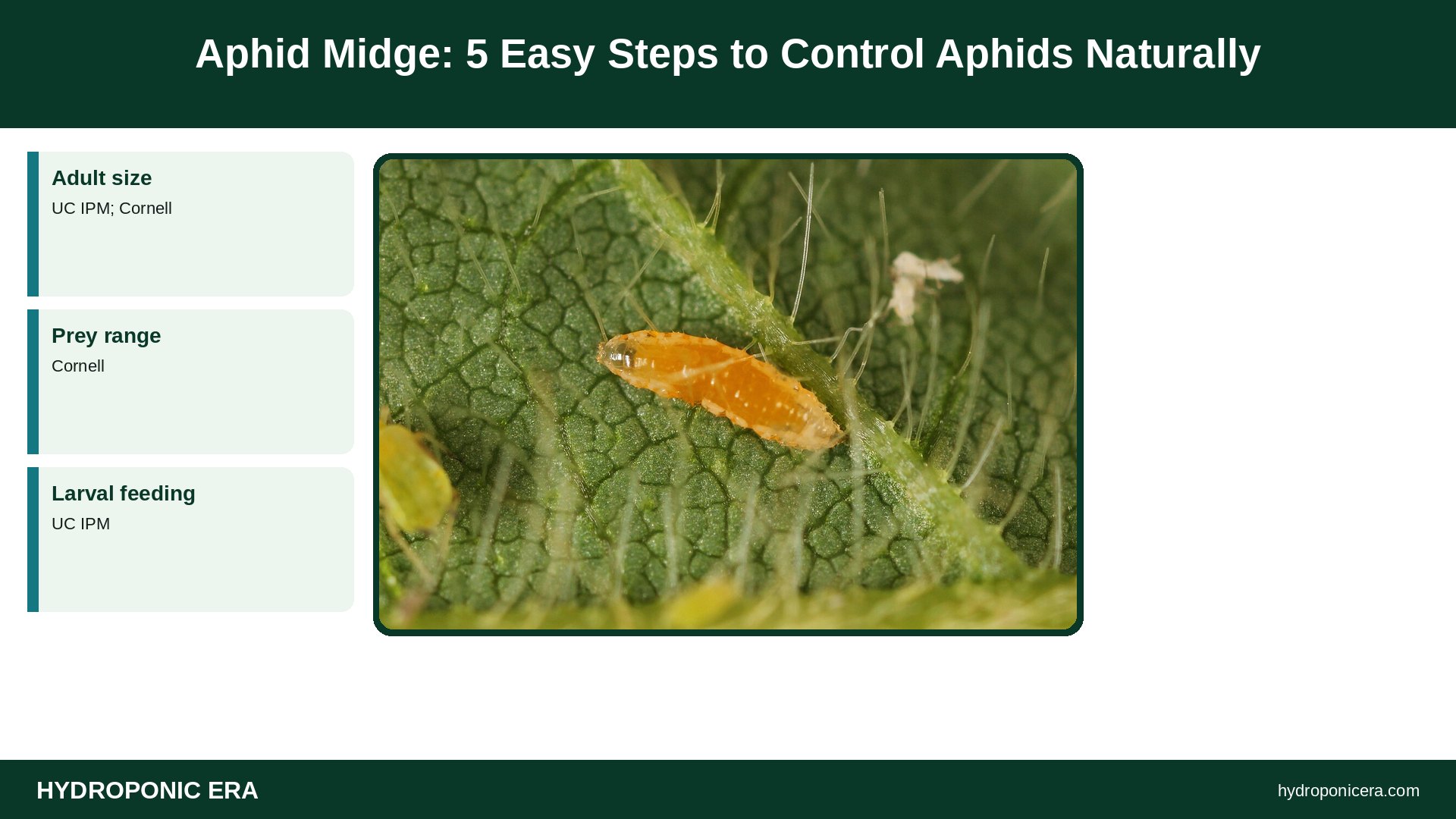
What Is the Aphid Midge?
The aphid midge is a small, delicate, mosquito-like fly whose larvae prey on aphids. Cornell describes adults as 2–3 mm (about 1/12–1/8 inch (2–3 mm)) long, with long dangling legs and antennae. Eggs are tiny and orange, and larvae look like orange to red maggots that grow to 2–3 mm. Adults fly at night, feed on honeydew and are rarely seen.
UC IPM notes adults look similar to fungus gnats but can be told apart by wing veins. Both can show up together in container and greenhouse crops, so check carefully before treating “gnats.”
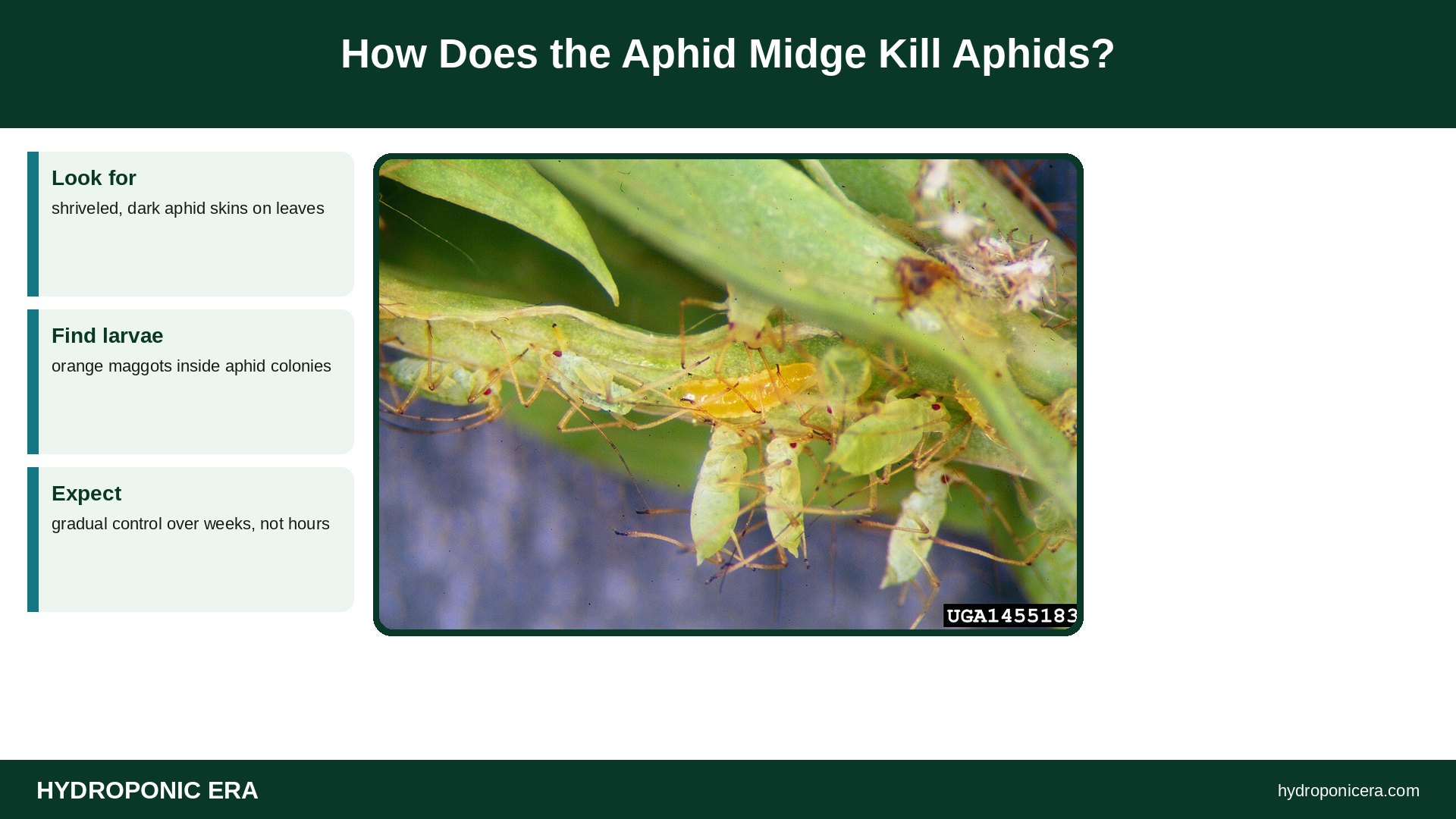
How Does the Aphid Midge Kill Aphids?
The larva attacks an aphid at a leg joint, paralyzes it and sucks it dry. Cornell says this leaves a blackened, collapsed aphid stuck to the leaf. One larva needs at least seven aphids to finish developing but may eat as many as 80, and larvae kill more than they consume when aphids are plentiful.
- Look for: shriveled, dark aphid skins on leaves.
- Find larvae: orange maggots inside aphid colonies.
- Expect: gradual control over weeks, not hours.
Identify your aphids first with our guide to hydroponic pests like aphids and mites.
What Is the Aphid Midge Life Cycle?
Cornell says each female lives one to two weeks and lays about 70 orange eggs among aphids, mostly in the first few days after emerging. Eggs hatch in two to four days. In greenhouses, larvae feed for under a week, drop to pupate, and adults emerge one to two weeks later. UC IPM gives about three weeks from egg to adult at 72°F (22°C).
Which Aphids Does the Aphid Midge Control?
Many. Cornell says Aphidoletes attacks over 60 aphid species. UConn Extension recommends using banker plants to support the aphid midge when larger foxglove or potato aphids are present, because the parasitic wasp Aphidius colemani does not control those species. Adults are also very good at finding aphid colonies; in one study, they located the single infested plant among 75.
| Aphid | Aphid midge | Aphidius colemani |
|---|---|---|
| Green peach aphid | Yes | Yes |
| Melon/cotton aphid | Yes | Yes |
| Foxglove aphid | Yes | Not effective |
| Potato aphid | Yes | Not effective |
| Source | Cornell; UConn | UConn |
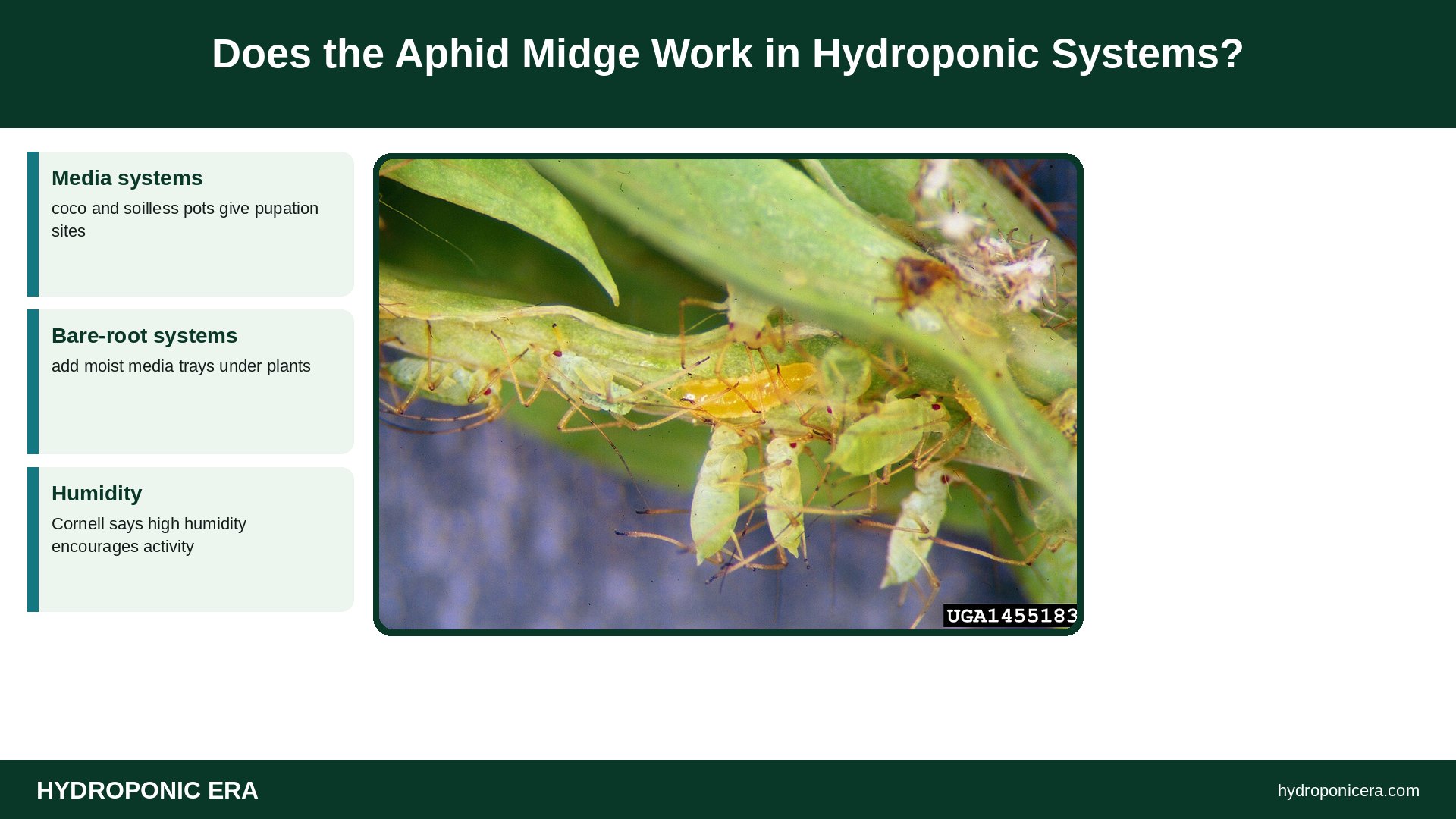
Does the Aphid Midge Work in Hydroponic Systems?
It can, with one caveat. In greenhouses, Cornell says larvae drop to the soil less than a week after hatching and burrow in to pupate, and UC IPM says they pupate on the ground or in potting soil. Bare-root systems such as NFT and deep water culture lack that layer, so place trays of moist media or keep a damp, media-covered floor under the crop.
- Media systems: coco and soilless pots give pupation sites.
- Bare-root systems: add moist media trays under plants.
- Humidity: Cornell says high humidity encourages activity.
- Temperature: Cornell lists 68–79°F (20–26°C) for adults.
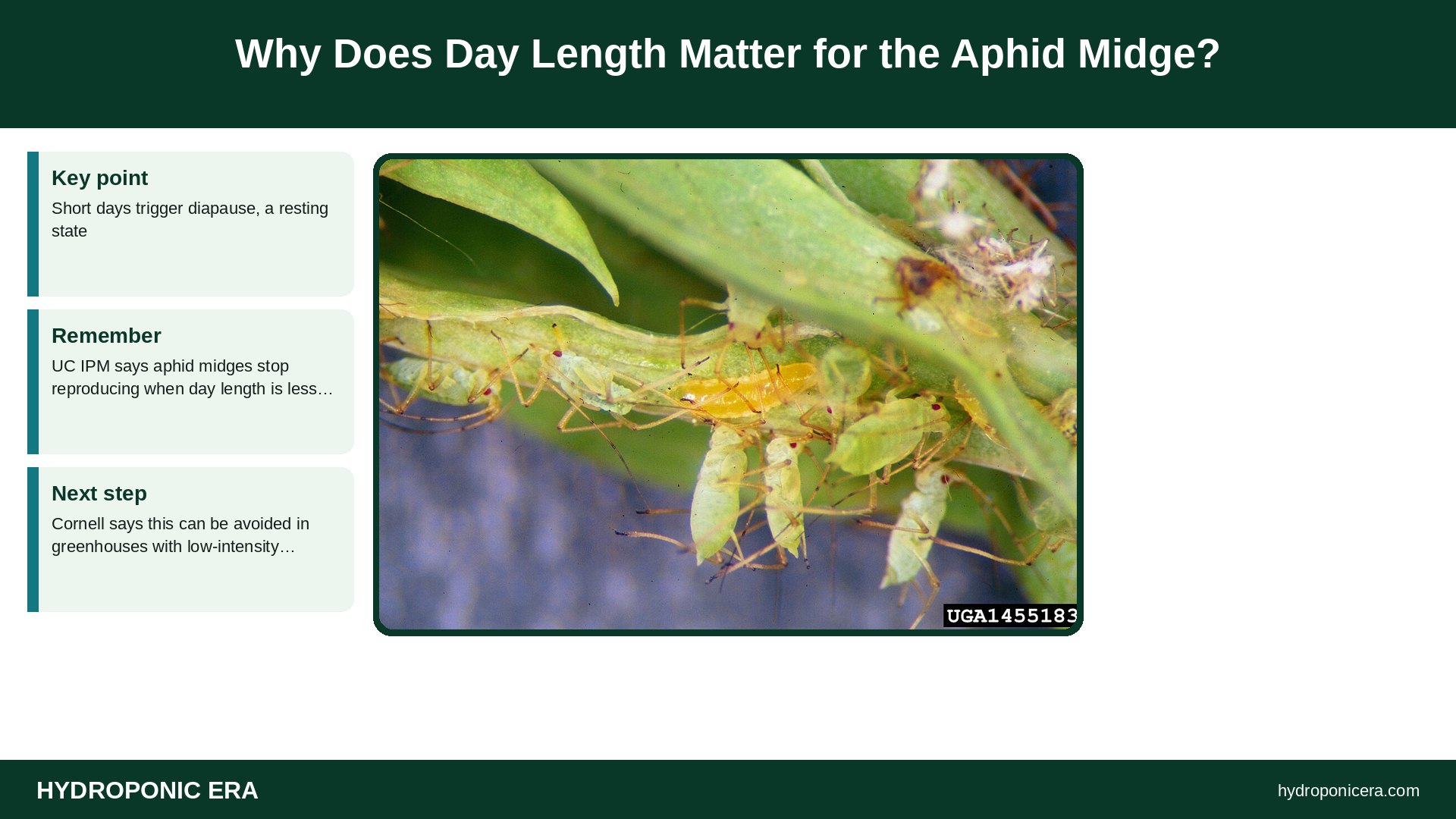
Why Does Day Length Matter for the Aphid Midge?
Short days trigger diapause, a resting state. UC IPM says aphid midges stop reproducing when day length is less than about 16 hours. Cornell says this can be avoided in greenhouses with low-intensity night lighting from 100 W incandescent bulbs spaced about 72 feet (22 m) apart, closer in dense canopies. Indoor grow rooms with long light cycles avoid the problem for vegetative crops.
Short-day flowering crops under 12-hour lighting are a poor fit for midge releases. See our guide to grow lights for hydroponic lettuce for typical photoperiods.
How Do You Release Aphid Midges?
Place the pupae near aphid colonies so emerging adults find prey quickly. UC IPM says midges are delivered as pupae in sand or vermiculite and that females lay few eggs without honeydew, so releases work best when aphids are already present. Avoid broad-spectrum insecticides; Cornell says most sprays are toxic to midges.
- Open the container near aphid-infested plants.
- Leave the carrier undisturbed until adults emerge.
- Release before or at the first aphid colonies.
- Check leaves after 1–2 weeks for orange larvae.
- Pair with ladybugs for aphids only if needed.
What Conditions Help Aphid Midges Establish?
Humidity, shelter and food for adults. Cornell says high humidity and shelter from high temperatures and strong winds encourage midge activity, and that adults need honeydew. UC IPM recommends avoiding broad-spectrum and persistent insecticides, controlling ants and dust, and growing flowering plants that provide nectar and pollen for natural enemies.
- Humidity: keep grow rooms from running very dry.
- Airflow: gentle, not strong drafts over colonies.
- Food: honeydew from aphids or nearby flowering plants.
- Sprays: Cornell says most sprays are toxic to midges.
FAQ About the Aphid Midge
Are aphid midges harmful to people or plants?
No; adults drink honeydew and larvae eat aphids.
Why can’t I see adult aphid midges?
Cornell says they fly at night and are rarely seen.
How long do aphid midges live?
Females live about one to two weeks, per Cornell and UC IPM.
Do aphid midges need honeydew?
Yes; UC IPM says females lay few eggs without it.
How soon do aphid midge eggs hatch?
Cornell says in two to four days.
Are aphid midges fungus gnats?
No; UC IPM says wing veins separate the two.
Sources
- Cornell University — Aphidoletes aphidimyza
- UC IPM — Aphid midge
- UConn Extension — Aphid banker plants
- Photo credits (Wikimedia Commons, edited with titles): Cécidomyie du puceron by Rsbernard (CC BY-SA 4.0); Predatory midge by Whitney Cranshaw, Colorado State University. (CC BY 3.0 us)