
The best grow lights for hydroponic lettuce are full-spectrum white LED fixtures that deliver about 200–300 µmol/m²/s of PPFD at the canopy for 14–16 hours a day, which adds up to a daily light integral (DLI) of roughly 12–17 mol/m²/day. Cornell’s CEA lettuce program uses a target of about 17 mol/m²/day for fast greenhouse lettuce. For a 2 by 4 foot shelf, a quality LED drawing about 100–150 watts is usually enough; seedlings need only about 100–200 µmol/m²/s.
Key takeaway: Buy lights by measured PPFD and efficacy (µmol/J), not by watts or “equivalent” claims, and aim for an even 200–300 PPFD across the whole tray.
| Stage | PPFD (µmol/m²/s) | Hours per day | DLI (mol/m²/day) |
|---|---|---|---|
| Germination | 0–100 | 16–18 | Under 6 |
| Seedlings | 100–200 | 16–18 | 6–12 |
| Growing to harvest | 200–300 | 14–16 | 12–17 |
| Upper practical limit | About 300–400 | 12–16 | Around 17–20 |

How Much Light Hydroponic Lettuce Needs
Lettuce is a low to moderate light crop compared with tomatoes or peppers. The Cornell CEA Lettuce Handbook targets a DLI of 17 mol/m²/day, and notes that higher light speeds growth but raises the risk of tip burn unless airflow and calcium supply keep up. Many home growers see good heads at 12–15 mol/m²/day with slightly longer crop times. Virginia Cooperative Extension explains how to calculate DLI from PPFD and hours of light. See PPFD and DLI.
Choosing Grow Lights for Hydroponic Lettuce
- Full-spectrum white LEDs give good growth and let you see true leaf color for spotting problems.
- Bar-style fixtures spread light evenly over long shelves and trays.
- Board-style fixtures work well over square tents and totes.
- T5 fluorescents still grow lettuce but use more power for the same light. See T5 vs LED.
Research by Kusuma, Pattison and Bugbee shows that modern white LEDs can exceed 2.5–3 µmol of light per joule of electricity. The higher the efficacy, the lower the power bill for the same lettuce.
Sizing Grow Lights for Hydroponic Lettuce

A target of 250 µmol/m²/s over a 2 by 4 foot area (about 0.74 m²) needs about 185 µmol/s of light reaching the canopy. Fixtures lose some light at the edges, so plan on a fixture rated for about 200–250 µmol/s total output. With an efficacy of 2.5 µmol/J, that’s roughly 80–100 watts. Lower-efficacy fixtures need more watts. See LED watts per square foot.
Light Height and Evenness
Hang LEDs about 12–24 inches above the canopy, using the maker’s PPFD map as a guide. Measure at the center and corners of the tray; aim for corners at least 70–80% of the center reading. Reflective walls help. Raise the light if leaves near the center bleach or curl. See light hanging height by stage and measuring PPFD.
Light Schedule for Lettuce

Run lights 14–16 hours a day for most lettuce. Longer days increase DLI at lower PPFD, which can be cheaper with fewer fixtures, but very long days can push some varieties toward bolting. Keep the dark period regular and avoid light leaks. See light schedule and photoperiod.
Spectrum: Do You Need Red, Blue or Far-Red?
Lettuce grows well under broad white light. More blue light tends to make plants compact and can deepen red coloring in red varieties. Some far-red light can increase leaf expansion. For home growers, a quality white LED with a color temperature around 3000–5000 K covers lettuce needs without special tuning.
Heat and Grow Lights for Hydroponic Lettuce
LEDs make less radiant heat at the leaf than older lamps, but drivers and fixtures still warm a small tent. Lettuce prefers air at about 60–75°F and solution at about 65–72°F. Use a fan, mount drivers outside the tent if possible, and watch the reservoir temperature. See reservoir temperature.
Tip Burn Under Strong Light
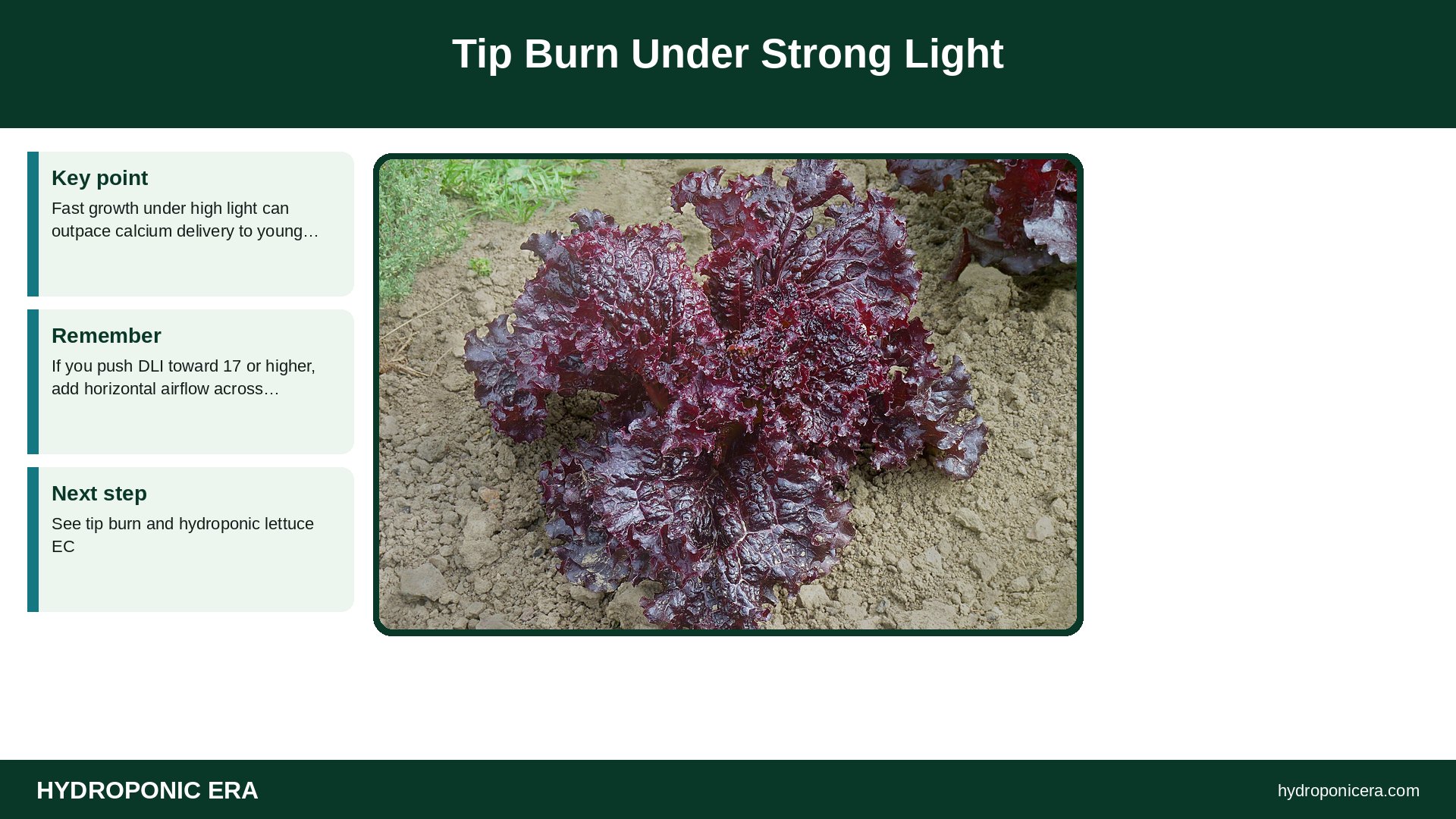
Fast growth under high light can outpace calcium delivery to young inner leaves, which causes tip burn. If you push DLI toward 17 or higher, add horizontal airflow across the canopy and keep humidity moderate. See tip burn and hydroponic lettuce EC.
Lights for Seedlings vs Mature Heads
Seedlings in a propagation tray need less light than full heads, so many growers run a separate, lower-power shelf for starts at about 100–200 µmol/m²/s and move plants under brighter grow lights once they have three or four true leaves. This saves power and keeps young plants from stretching or bleaching.
Running Costs
A 100-watt LED on for 16 hours uses 1.6 kWh a day, or about 48 kWh a month. At 16 cents per kWh, that’s under $8 a month. See electricity cost.
Common Lighting Mistakes With Lettuce
- Buying by “equivalent watts” instead of PPFD.
- Hanging lights too high so the edges get too little light.
- Running 24 hours a day with no dark period.
- Using herb-kit lights for full-size heads.
- Ignoring heat from drivers in small tents.
Grow Lights for Hydroponic Lettuce by Setup
Countertop kits: built-in lights are fine for a few heads of loose-leaf lettuce, but they are often too weak for full butterhead or romaine. Keep the light at its lowest safe height and harvest outer leaves early.
Shelf systems: a 2 by 4 foot shelf with one or two LED bars is the most common home setup. Grow lights for hydroponic lettuce on shelves should cover the whole tray so plants at the ends grow as fast as those in the middle. See seed-starting shelf with grow lights.
Grow tents: a 2 by 4 or 4 by 4 foot tent with reflective walls uses light efficiently. Choose a board or bar fixture sized for the tent footprint.
Greenhouses: in northern winters, sunlight alone may give only a few mol/m²/day. Supplemental grow lights for hydroponic lettuce bring DLI up to the target and keep harvest timing steady. Cornell’s program uses light and shade control together to hold DLI near 17.
How to Check Your Grow Lights for Hydroponic Lettuce
- Measure PPFD at canopy height with a quantum sensor or a calibrated phone app.
- Take readings at the center, corners and edges of the tray.
- Multiply average PPFD by hours of light and by 0.0036 to get DLI.
- Compare with the 12–17 mol/m²/day target and adjust height or hours.
- Recheck every few months; LED output slowly falls over time.
When to Upgrade
If heads are loose, stretched or pale even with good EC and pH, the light is likely too weak. Upgrading grow lights for hydroponic lettuce is often the single biggest improvement a home grower can make, because it shortens the crop and produces denser heads.
FAQs
What PPFD does hydroponic lettuce need?
About 200–300 µmol/m²/s for growing plants.
What DLI is best for lettuce?
About 12–17 mol/m²/day; Cornell targets 17.
How many hours of light does lettuce need?
Usually 14–16 hours a day.
Are cheap LEDs good for lettuce?
Some are; check the measured PPFD map and efficacy.
How high should lights hang?
About 12–24 inches, depending on the fixture.
Can too much light hurt lettuce?
Yes; it can cause bleaching and tip burn.
Sources
- Cornell CEA — Cornell CEA Lettuce Handbook
- Virginia Cooperative Extension — Calculating and Using Daily Light Integral (DLI)
- Kusuma, Pattison and Bugbee (2020), Horticulture Research — From physics to fixtures to food: current and potential LED efficacy
- University of Kentucky — Hydroponic Lettuce Production in Controlled Environments
- Photo credits (Wikimedia Commons, edited with titles): Potted plants succulents under grow light Nov 2016 by Asdfjrjjj (CC BY-SA 4.0); Led digital visuals-leds in grow box PNr°0082 by D-Kuru (CC BY-SA 3.0 at); Romaine lettuce by Rainer Zenz (CC BY-SA 3.0); Dahlias started indoors by F. D. Richards from Clinton, MI (CC BY-SA 2.0); Red leaf lettuce J1 by Jamain (CC BY-SA 3.0)