
The Advanced Nutrients feeding chart for pH Perfect Grow, Micro, Bloom is simple: mix all three parts 1:1:1, start at 1 mL per liter of each in week 1 of the grow phase, step up to 2, 3, then 4 mL/L by week 4, and hold 4 mL/L of each through the bloom phase. In US units that’s about 3.8 mL per gallon of each part rising to about 15 mL per gallon. Advanced Nutrients says to add Micro first, then Grow, then Bloom, and to shake bottles first. For a custom schedule by reservoir size and stage, use the company’s official nutrient calculator.
Key takeaway: Ramp from 1 to 4 mL/L of each part over four weeks, hold 4 mL/L in bloom, mix in order Micro, Grow, Bloom, and still check EC.
| Week | Grow (each part) | Per gallon (approx.) |
|---|---|---|
| Grow week 1 | 1 mL/L | 3.8 mL/gal |
| Grow week 2 | 2 mL/L | 7.6 mL/gal |
| Grow week 3 | 3 mL/L | 11.4 mL/gal |
| Grow week 4 | 4 mL/L | 15.1 mL/gal |
| Bloom weeks 1–7 | 4 mL/L | 15.1 mL/gal |
How to Read the Advanced Nutrients Feeding Chart
The official chart for pH Perfect Grow, Micro, Bloom has two phases. In the grow (vegetative) phase, each of the three parts rises by 1 mL/L per week from 1 to 4 mL/L. In the bloom phase, each part stays at 4 mL/L for seven weeks. Advanced Nutrients describes the 1:1:1 ratio as what its tissue testing supports. The company’s product page notes the base suits DWC, NFT, drip, flood and drain, aeroponics, and coco.
Converting the Advanced Nutrients Feeding Chart to Gallons
US growers usually measure reservoirs in gallons. One gallon is about 3.785 liters, so multiply mL/L by 3.785 to get mL per gallon. For a 5-gallon reservoir at 4 mL/L, add about 76 mL of each part. Use a graduated syringe or measuring cup marked in milliliters for accuracy. See hydroponic nutrient calculator.
Advanced Nutrients Feeding Chart: Mixing Order
- Fill the reservoir with water first.
- Shake each bottle.
- Add Micro and stir.
- Add Grow and stir.
- Add Bloom and stir.
- Measure EC and pH.
Advanced Nutrients says not to mix the parts together as a concentrate, because concentrated nutrients can react. See nutrient mixing order.
Advanced Nutrients Feeding Chart: pH Perfect and pH Testing
Advanced Nutrients says its pH Perfect technology holds pH in range for about a week and that you can skip pH meters. Many growers still test, because source water, media, and plant uptake vary. A cheap check confirms the product is working in your setup and catches problems early. See pH and EC meters.
Adjusting the Advanced Nutrients Feeding Chart for Vegetables
The chart is a general schedule. Leafy greens and herbs usually need less than full strength, while tomatoes and peppers take more. Start lower for seedlings and sensitive crops, raise strength slowly, and watch leaf tips: burned tips mean too strong. Compare your EC with crop targets; for example, Oklahoma State lists lettuce at EC 1.2–1.8 and tomatoes at 2.0–4.0. See how to lower EC.
Advanced Nutrients Feeding Chart: Supplements
Advanced Nutrients sells many add-ons. The base nutrient alone supplies the essential elements, so start with the base only and add supplements one at a time if you have a clear reason. Each addition raises cost and EC.
Reservoir Changes
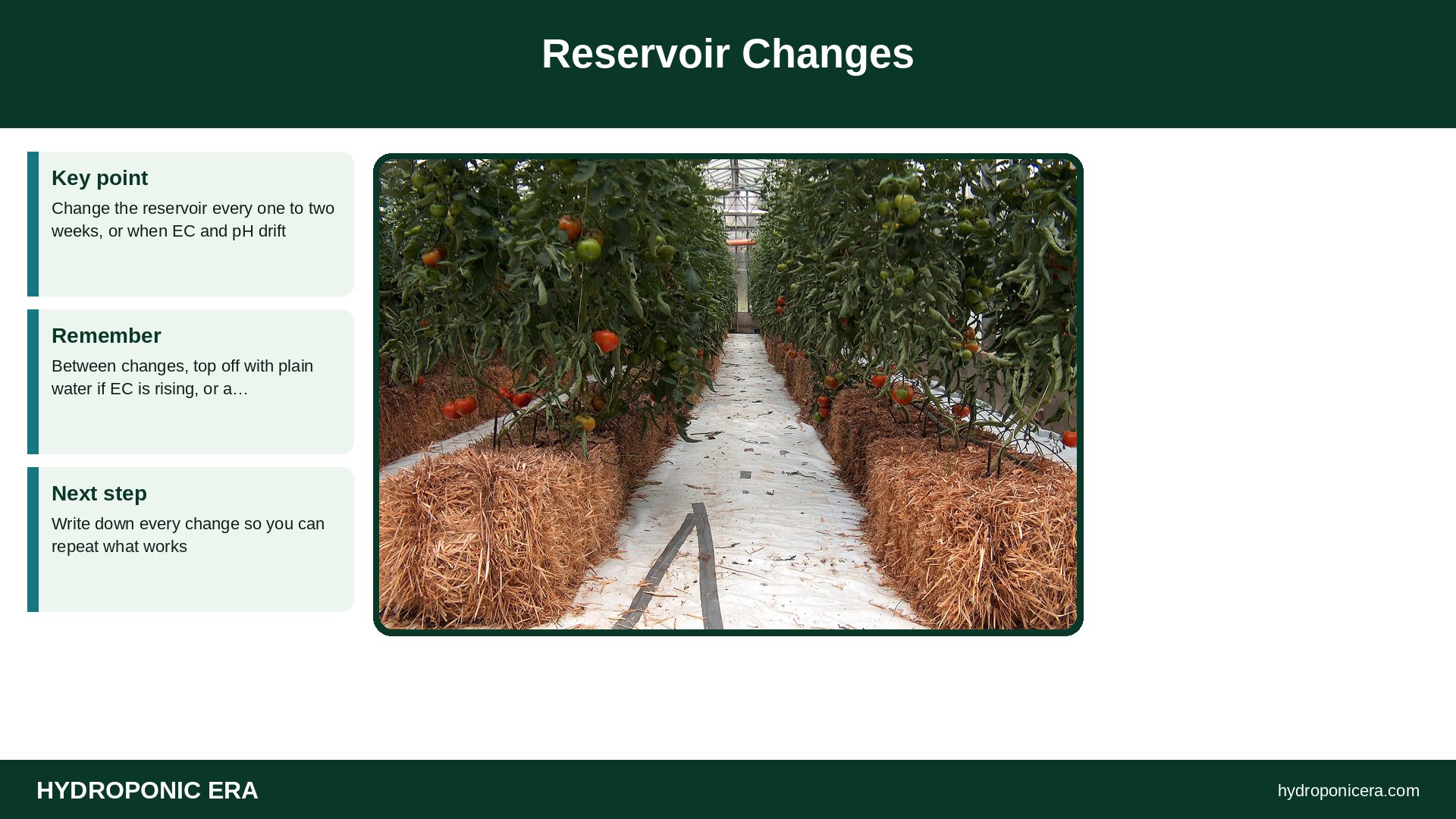
Change the reservoir every one to two weeks, or when EC and pH drift. Between changes, top off with plain water if EC is rising, or a weaker mix if EC is falling. Write down every change so you can repeat what works.
Common Mistakes With the Advanced Nutrients Feeding Chart
- Mixing parts together before adding them to water.
- Jumping to 4 mL/L for seedlings.
- Using liters as gallons by mistake.
- Skipping EC checks.
- Adding many supplements at once.
Advanced Nutrients vs Other Three-Part Nutrients
Advanced Nutrients claims its base is stronger than some competitors, so dose rates aren’t interchangeable between brands. If you switch brands, use the new brand’s chart and check EC rather than copying milliliter amounts. See best hydroponic nutrients.
Equipment Checklist for Advanced Nutrients Feeding Chart
- A calibrated EC meter.
- A pH meter or kit and pH up/down.
- A measuring syringe or cup in milliliters.
- A notebook or app to log readings.
- A clean reservoir with volume marks.
- Plain, low-salt water for top-offs.
Most of this gear is reusable from crop to crop, so the first setup costs the most. Buy reliable meters first; they prevent the majority of problems.
Beginner Mistakes With Advanced Nutrients Feeding Chart
Most problems with the chart come from unit mix-ups between liters and gallons, skipping the gradual ramp-up, or adding several supplements at once. Measure carefully and change one thing at a time.
Getting Started With Advanced Nutrients Feeding Chart
Start small, change one thing at a time, and keep a simple log of pH, EC, temperature, and what you changed. Most hydroponic problems show up as patterns in those numbers before they show on the plant. Compare your notes with the sources below, and adjust slowly rather than chasing every small swing. A steady routine matters more than any single product or setting.
Advanced Nutrients Feeding Chart for Different Reservoir Sizes
| Reservoir | 1 mL/L each part | 4 mL/L each part |
|---|---|---|
| 1 gallon | 3.8 mL | 15.1 mL |
| 5 gallons | 18.9 mL | 75.7 mL |
| 10 gallons | 37.9 mL | 151.4 mL |
| 20 gallons | 75.7 mL | 302.8 mL |
These figures convert Advanced Nutrients’ mL/L rates using 3.785 liters per gallon. Measure the actual water volume rather than the container’s rated size.
FAQs: Advanced Nutrients Feeding Chart
How much Advanced Nutrients do I use per gallon?
About 3.8 mL/gal of each part in week 1, rising to about 15 mL/gal.
What order do I mix them in?
Micro, then Grow, then Bloom.
Do I need to check pH?
The company says pH Perfect makes it optional; testing is still wise.
Can I use it for vegetables?
Yes; adjust strength to crop needs.
Where’s the official calculator?
On the Advanced Nutrients website.
Can I use the chart for lettuce?
Yes, but at lower strength.
Sources
- Advanced Nutrients — pH Perfect Grow Micro Bloom
- Advanced Nutrients — Nutrient Calculator
- Oklahoma State University Extension — Electrical Conductivity and pH Guide for Hydroponics
- Photo credits (Wikimedia Commons, edited with titles): Electrical conductivity meter by Nuno Nogueira (Nmnogueira) (CC BY-SA 2.5); Medals weighed in digital scale by Kpubkalanami (CC BY-SA 4.0); Laboratory peristaltic pump Gilson-01 by Lilly_M (CC BY-SA 3.0); White plastic bucket by Santeri Viinamäki (CC BY-SA 4.0); Hydroponic g12 by Giancarlo Dessì (CC BY-SA 3.0)