
A hydroponic nutrient calculator turns a target concentration (ppm) into grams of fertilizer per gallon, or the reverse. The core formula is short: grams per US gallon = target ppm × 3.785 ÷ (nutrient % × 10). For example, 150 ppm nitrogen from calcium nitrate at 15.5% N needs about 3.7 g per gallon. Free tools like HydroBuddy do the same math for whole recipes, but an EC meter still has the final word.
| What you want | Formula (US gallons) |
|---|---|
| Grams per gallon for a target ppm | g/gal = ppm × 3.785 ÷ (% × 10) |
| ppm from grams per gallon | ppm = g/gal × % × 10 ÷ 3.785 |
| Grams per liter for a target ppm | g/L = ppm ÷ (% × 10) |
| Phosphorus from a label’s P2O5 % | % P = % P2O5 × 0.436 |
| Potassium from a label’s K2O % | % K = % K2O × 0.830 |
| Ounces per gallon of injector stock | oz/gal = ppm × injector ratio ÷ (% × 75) |

How a Hydroponic Nutrient Calculator Works

Every hydroponic nutrient calculator rests on one fact Penn State Extension spells out: 1 ppm equals 1 milligram per liter. If a recipe calls for 150 ppm nitrogen, you need 150 mg of nitrogen in every liter of water. Since a US gallon is about 3.785 liters, that’s about 568 mg of nitrogen per gallon.
The fertilizer label tells you what fraction of the product is nitrogen. Divide the nitrogen you need by that fraction, and you have grams of fertilizer. That’s all the “× 10” in the formula does: it converts a percentage into milligrams per gram.
Worked Example: Calcium Nitrate for 150 ppm N
- Target: 150 ppm N = 150 mg N per liter.
- Per gallon: 150 × 3.785 = 568 mg N per gallon.
- Label: calcium nitrate at 15.5% N contains 155 mg N per gram.
- Divide: 568 ÷ 155 = 3.66 g per gallon.
- Scale up: a 10-gallon reservoir needs about 36.6 g.
Run the same check on a published recipe and you’ll see it holds. Jack’s 321 uses 3.6 g of 5-12-26 and 2.4 g of 15.5-0-0 per gallon; the math gives about 146 ppm N total. Our Jacks 321 feed chart shows the full breakdown.
Converting P2O5 and K2O on Labels

US fertilizer labels list phosphorus as P2O5 (phosphate) and potassium as K2O (potash), while hydroponic recipes list elemental P and K. Penn State notes that phosphate and potash “include oxygen and we need to account for that in hydroponic calculations.” Multiply P2O5 by 0.436 to get P, and K2O by 0.830 to get K.
Example: a 5-12-26 product has 12% P2O5, or 5.24% P, and 26% K2O, or 21.6% K. At 3.6 g per gallon, that supplies about 50 ppm P and 205 ppm K. Any hydroponic nutrient calculator that skips this step will overstate your P and K.
Injector Math for Bigger Systems
If you run a fertilizer injector, you mix a concentrated stock instead of a ready-to-use solution. UMass Extension gives a one-line formula: amount = (ppm × injector ratio) ÷ (% nutrient × C), where C is 75 for ounces per US gallon and 1,200 for pounds per gallon.
- UMass example: 250 ppm N, a 1:200 injector and a 15-16-17 fertilizer need about 44.5 oz to make 1 gallon of concentrate.
- Penn State example: 150 ppm N from 20-20-20 with a 100:1 injector and a 5-gallon stock tank needs 1,417.5 g, about 3.12 lb.
Most hobby growers don’t need injectors, but the same principle applies when you make A and B stock bottles.
Free Hydroponic Nutrient Calculator Tools
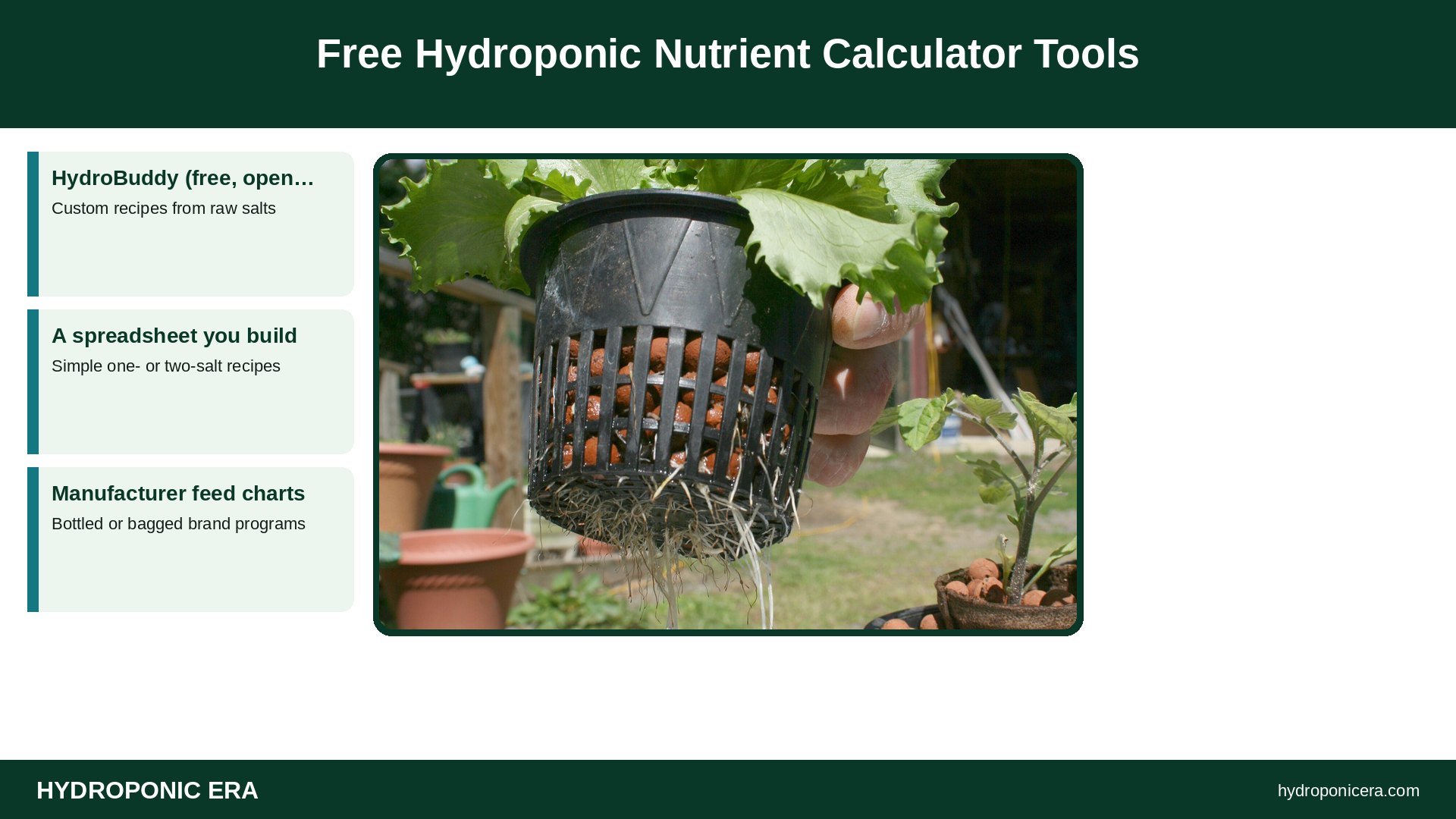
| Tool | What it does | Good for |
|---|---|---|
| HydroBuddy (free, open source) | Calculates salt weights for target ppm, reverse calculations, A+B stocks and an EC estimate | Custom recipes from raw salts |
| A spreadsheet you build | Uses the formulas above | Simple one- or two-salt recipes |
| Manufacturer feed charts | Pre-calculated doses per gallon | Bottled or bagged brand programs |
HydroBuddy was built by chemist Daniel Fernandez, who describes it as “a completely free and open source program for the calculation of nutrient solutions for hydroponics and general agriculture.” The developer offers downloads (Windows is the best-supported platform, with a macOS build) and publishes the source code on GitHub.
Build Your Own Calculator in a Spreadsheet: 6 Steps
- In column A, list each fertilizer you own.
- In column B, enter the guaranteed % for the nutrient you’re targeting (convert P2O5 and K2O first).
- In column C, enter your target ppm.
- In column D, enter =C2*3.785/(B2*10) for grams per gallon.
- In column E, multiply by your reservoir size in gallons.
- Add a reverse column, =grams*B2*10/3.785, to see what a dose actually delivers.
That’s a working hydroponic nutrient calculator in under ten minutes.
Typical Salts to Enter in a Hydroponic Nutrient Calculator
| Salt | Typical label grade | Main elements supplied |
|---|---|---|
| Calcium nitrate | 15.5-0-0 | N and Ca |
| Potassium nitrate | 13-0-44 | N and K |
| Monopotassium phosphate (MKP) | 0-52-34 | P and K |
| Magnesium sulfate (Epsom salt) | About 10% Mg | Mg and S |
Grades vary by brand, so always type in the numbers printed on your own bag.
Limits of Any Hydroponic Nutrient Calculator
- Your water isn’t zero. Tap and well water add calcium, magnesium, sodium and more. Test your starting EC first.
- Labels are minimums. Guaranteed analysis is a floor, not an exact value.
- Hydrates matter. Epsom salt is magnesium sulfate heptahydrate, so it’s only about 10% Mg by weight.
- EC predictions are estimates. Always confirm with a meter; see our EC and TDS guide.
- Plants change the solution. Uptake shifts ratios between changes.
Common Mistakes

- Using liters in one step and gallons in the next.
- Forgetting to convert P2O5 and K2O.
- Weighing tiny amounts on a scale that only reads whole grams.
- Treating ppm meter readings as if they were nutrient ppm. TDS meters estimate salts, not nitrogen.
- Mixing calcium and sulfate concentrates together. Follow our mixing order guide.
FAQs: Hydroponic Nutrient Calculator
Is there a free hydroponic nutrient calculator?
Yes. HydroBuddy is free and open source, and a simple spreadsheet using the formulas above works for basic recipes.
How do I convert grams per gallon to ppm?
ppm = grams per gallon × nutrient % × 10 ÷ 3.785.
Can a hydroponic nutrient calculator predict EC?
Some, like HydroBuddy, estimate EC with a model, but you should still measure with a calibrated meter.
What ppm should I target?
It depends on the crop and stage. Our leafy vs fruiting recipes give starting points.
Related HydroponicEra Guides
- Mixing hydroponic nutrient solution
- Single-element nutrient corrections
- Masterblend 4-18-38 recipe
- Stock concentrate storage
Sources
- Penn State Extension — Hydroponics Systems: Calculating Nutrient Solution Concentrations Using the Two Basic Equations
- UMass Amherst Extension — Fertilizer Calculations for Greenhouse Crops
- Science in Hydroponics (Daniel Fernandez) — HydroBuddy: Free Open Source Hydroponic Nutrient Calculator
- GitHub — danielfppps/hydrobuddy
- Jack’s Nutrients — Technical Bulletin: Jack’s 321 (PDF)
- Photo credits (Wikimedia Commons, edited with titles): Medals weighed in digital scale by Kpubkalanami (CC BY-SA 4.0); PH- und Leitfähigkeitsmessgeräte by Rotkaeppchen68 (CC0); Hydroponic lettuce @ Plaine des Cafres 03 by Rémih (CC BY-SA 4.0); 2009-03-30 Lettuce roots by Ildar Sagdejev (Specious) (CC BY-SA 4.0)