
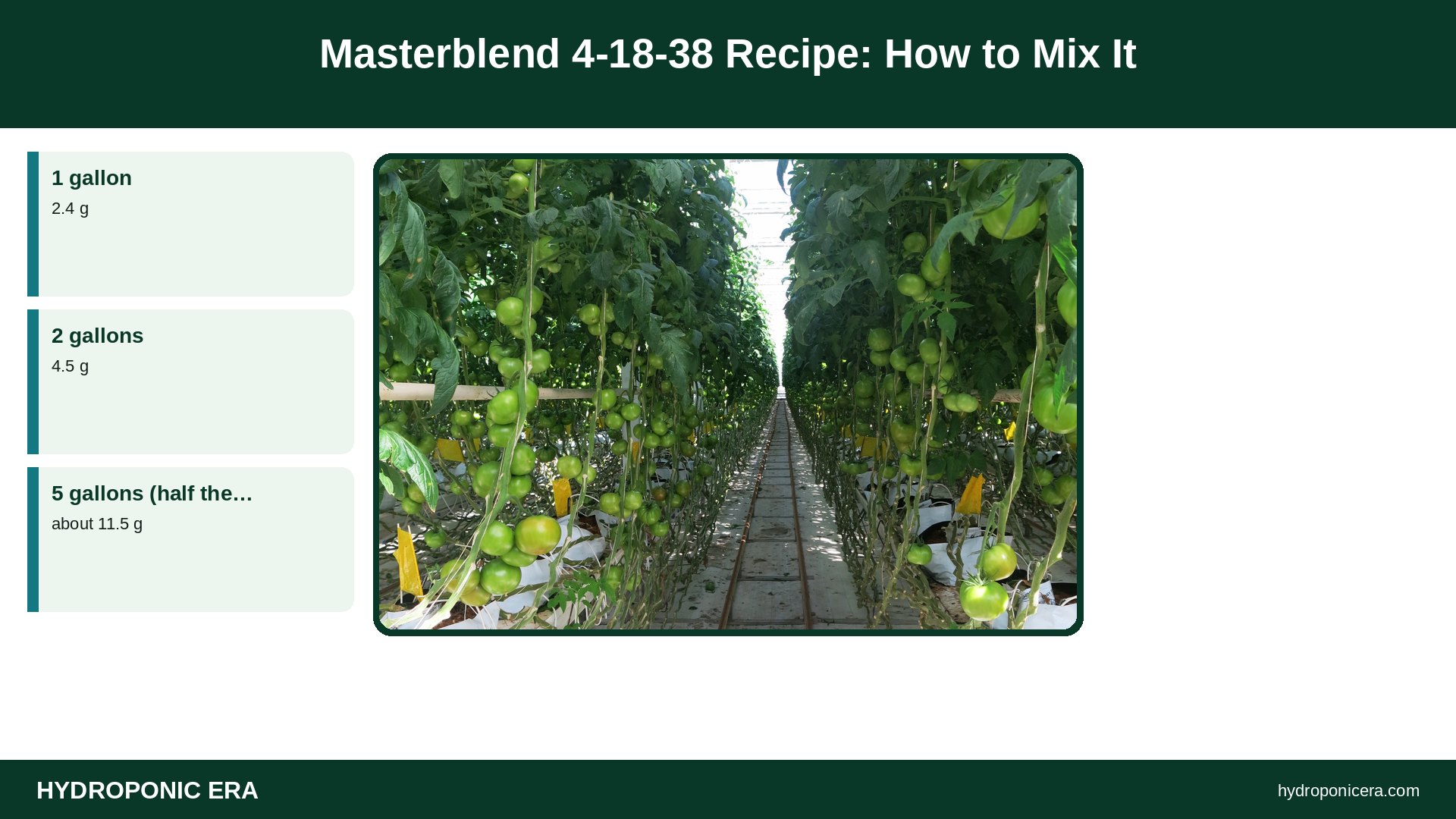
The Masterblend 4-18-38 hydroponic recipe is 2.4 grams of Masterblend, 1.5 grams of magnesium sulfate (Epsom salt) and 2.4 grams of calcium nitrate per gallon of water. Dissolve the 4-18-38 first, then the Epsom salt, then the calcium nitrate last. Masterblend says to use half rates for seedlings until they are well established.
| Reservoir size | Masterblend 4-18-38 | Magnesium sulfate | Calcium nitrate |
|---|---|---|---|
| 1 gallon | 2.4 g | 1.5 g | 2.4 g |
| 2 gallons | 4.5 g | 2.8 g | 4.5 g |
| 5 gallons (half the 10-gal row) | about 11.5 g | about 7 g | about 11.5 g |
| 10 gallons | 23 g | 14 g | 23 g |
| 25 gallons | 57 g | 35 g | 57 g |
| 100 gallons | 227 g | 142 g | 227 g |
All rows except 5 gallons come straight from Masterblend’s official mixing instructions. The 5-gallon row is our math.
What Is in Masterblend 4-18-38?

Masterblend’s guaranteed analysis for the 4-18-38 Tomato Formula lists 4% nitrogen (all nitrate), 18% available phosphate and 38% soluble potash, plus 0.2% magnesium, 0.2% boron, 0.4% chelated iron, 0.2% chelated manganese, and small amounts of chelated copper, chelated zinc and molybdenum. It’s made from potassium nitrate, potassium phosphate, potassium chloride, magnesium sulfate and chelated micronutrients.
What it doesn’t have is enough nitrogen, calcium or magnesium for a full hydroponic diet. That’s why the recipe has three parts:
- Masterblend 4-18-38: phosphorus, potassium and micronutrients.
- Calcium nitrate: calcium plus most of the nitrogen. It’s commonly sold as 15.5-0-0.
- Magnesium sulfate (Epsom salt): magnesium and sulfur. Plain, unscented Epsom salt works. See Epsom salt in hydroponics.
Penn State Extension describes this same style of program, a 4-18-38 base supplemented with calcium nitrate and magnesium sulfate, as a standard hydroponic fertilizer program for tomatoes.
How Do You Mix Masterblend 4-18-38 Step by Step?
- Fill your reservoir with the final volume of water. Note the starting EC.
- Weigh each part on a gram scale. A scale that reads to 0.1 g is ideal for small batches.
- Dissolve the Masterblend 4-18-38 first. Stir until the water is clear.
- Add the magnesium sulfate. Stir until fully dissolved.
- Add the calcium nitrate last. Stir until fully dissolved.
- Check EC and pH. Adjust pH into the 5.5 to 6.5 range most crops prefer. See fixing high or low pH.
- Label the reservoir with the date and strength.
Why Must Calcium Nitrate Go In Last?
Calcium reacts with phosphate and sulfate when they’re concentrated, forming solids that settle out of the solution. Masterblend says you can make a concentrate of the 4-18-38 and magnesium sulfate together, but not to add calcium nitrate to that concentrate because it causes nutrient fall-out. Add calcium nitrate only after the concentrate is diluted into the full volume of water. Penn State Extension gives the same rule for stock tanks: keep calcium in a different tank from phosphates and sulfates. See nutrient mixing order.
How Do You Adjust Masterblend 4-18-38 for Different Crops?
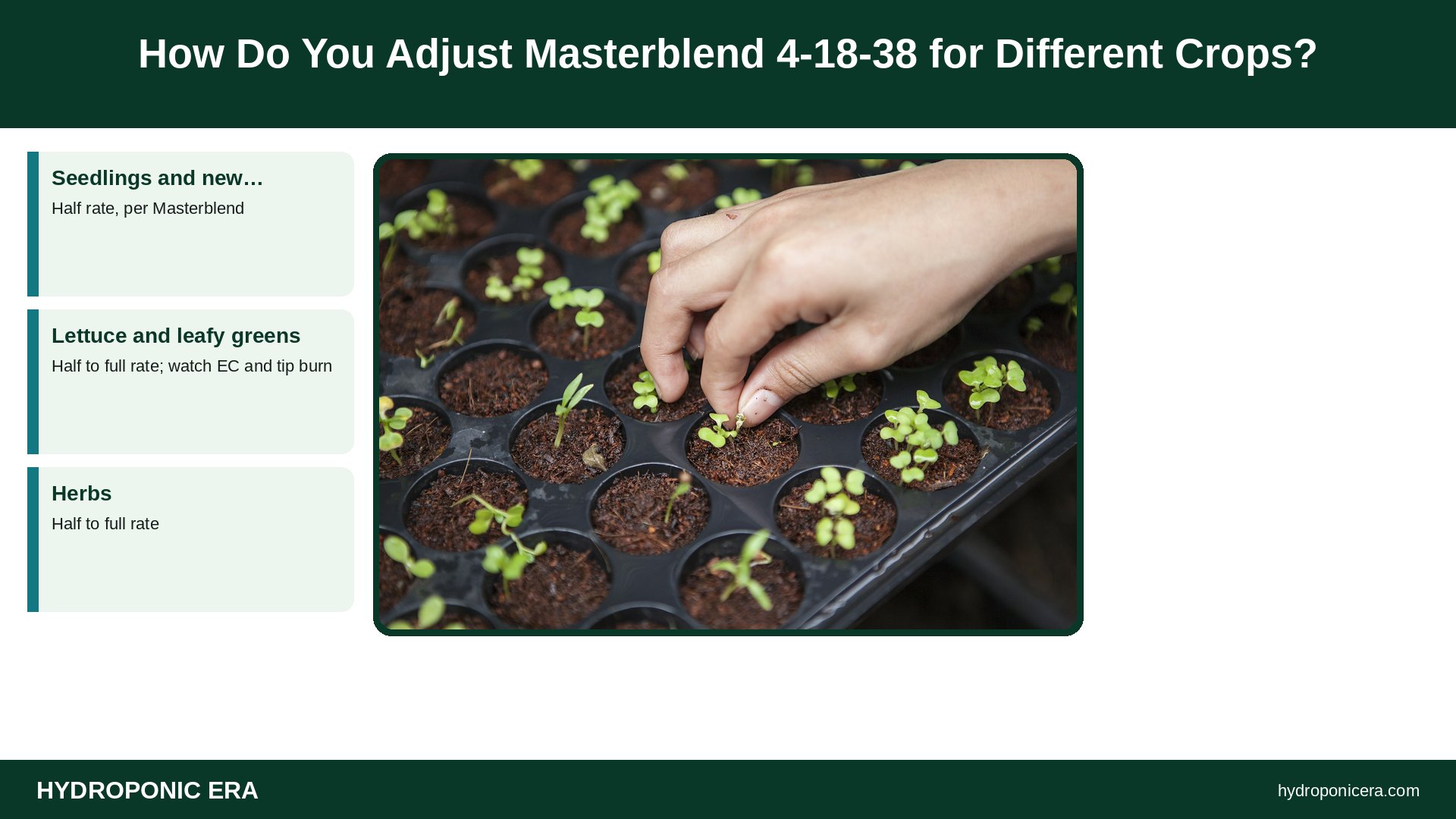
| Crop or stage | Suggested approach |
|---|---|
| Seedlings and new transplants | Half rate, per Masterblend |
| Lettuce and leafy greens | Half to full rate; watch EC and tip burn |
| Herbs | Half to full rate |
| Tomatoes, peppers, cucumbers | Full rate once established |
Masterblend also sells an 8-15-36 Lettuce Formula, a 5-11-26 Hydroponic Formula and a 9-12-34 Strawberry Formula for growers who want a crop-specific base. For leafy versus fruiting differences, see nutrient recipes for leafy vs fruiting crops.
Can You Make a Masterblend Stock Concentrate?
Yes, as a two-tank system. Following Masterblend’s and Penn State’s guidance:
- Tank A: Masterblend 4-18-38 plus magnesium sulfate.
- Tank B: calcium nitrate on its own.
- Dose both into the reservoir water separately, never into each other.
Store concentrates in labeled, opaque containers. See stock concentrate shelf life and stock tanks vs mixing per reservoir.
Does Your Water Change the Masterblend Recipe?
It can. Hard tap water already carries calcium, magnesium and bicarbonate, so a full-rate mix may read a higher EC than the same mix in soft water, and pH may drift upward. RO or rainwater starts near zero, so the recipe supplies everything. Measure the EC of your water before adding anything, then subtract it when you compare readings. If your water is very hard, test before adding the full amount of Epsom salt and calcium nitrate. See hard water and RO and alkalinity management.
How Often Should You Change a Masterblend Reservoir?
Treat a Masterblend 4-18-38 solution like any other hydroponic mix. Top off with plain water as plants drink, check EC and pH every day or two, and replace the full reservoir every one to three weeks, more often in small or warm systems. Masterblend’s dry salts store well when kept sealed and dry. See how often to change hydroponic water.
What Mistakes Happen With Masterblend 4-18-38?

| Mistake | Result | Fix |
|---|---|---|
| Dry-mixing all three salts together | Clumping and precipitate | Dissolve each part separately in order |
| Skipping calcium nitrate | Too little nitrogen and calcium; tip burn, blossom end rot | Always use all three parts |
| Using the soil “tablespoon” directions in a reservoir | Much stronger, unbalanced solution | Use the gram chart for hydroponics |
| Measuring by volume instead of weight | Inconsistent strength | Weigh in grams |
| Full strength on seedlings | Burned roots and leaf tips | Half rate until established |
Note: the retail Masterblend bag also carries soil-style directions (1 tablespoon of 4-18-38 per gallon once weekly, with 1/2 teaspoon Epsom salt and 1 teaspoon calcium nitrate). Those are for watering plants, not for a recirculating reservoir.
FAQs About Masterblend 4-18-38
What is the Masterblend ratio per gallon?
2.4 g Masterblend 4-18-38, 1.5 g magnesium sulfate and 2.4 g calcium nitrate per gallon, which is roughly a 1.6 : 1 : 1.6 ratio by weight.
How much Masterblend for 5 gallons?
About 11.5 g of 4-18-38, 7 g of magnesium sulfate and 11.5 g of calcium nitrate, which is half of Masterblend’s 10-gallon row. Many growers round to 12 g, 7 g and 12 g.
Is Masterblend 4-18-38 good for lettuce?
Yes, at half to full rate. It’s one of the most popular budget nutrients for home lettuce growers.
Can I use Masterblend without calcium nitrate?
Not for hydroponics. The 4-18-38 supplies only 4% nitrogen and no calcium.
Is Masterblend organic?
No. It’s a water-soluble mineral fertilizer made from technical-grade salts.
Related HydroponicEra Guides
- Best hydroponic nutrients
- Mixing hydroponic nutrient solution
- Calcium and magnesium deficiency
Sources
- Masterblend — 4-18-38 Tomato Formula Mixing Instructions (PDF)
- Masterblend — Vegetable and Tomato Formula (guaranteed analysis)
- Masterblend — Can I Make a Concentrate of the Tomato Formula?
- Masterblend — Hydroponics formulas
- Penn State Extension — Nutrient Solution Programs and Recipes