
Ammonium vs nitrate: which nitrogen is better for hydroponics? In the ammonium vs nitrate choice, nitrate should supply most hydroponic nitrogen, with ammonium as a small share. Ammonium uptake pushes pH down, while nitrate uptake pushes it up. Experts say problems are rare when ammoniacal nitrogen stays at 40 percent or less, and lower in cool, wet conditions.
Key takeaway: Nitrate is the safe base; a little ammonium steadies pH; too much ammonium in cold, wet conditions causes toxicity.
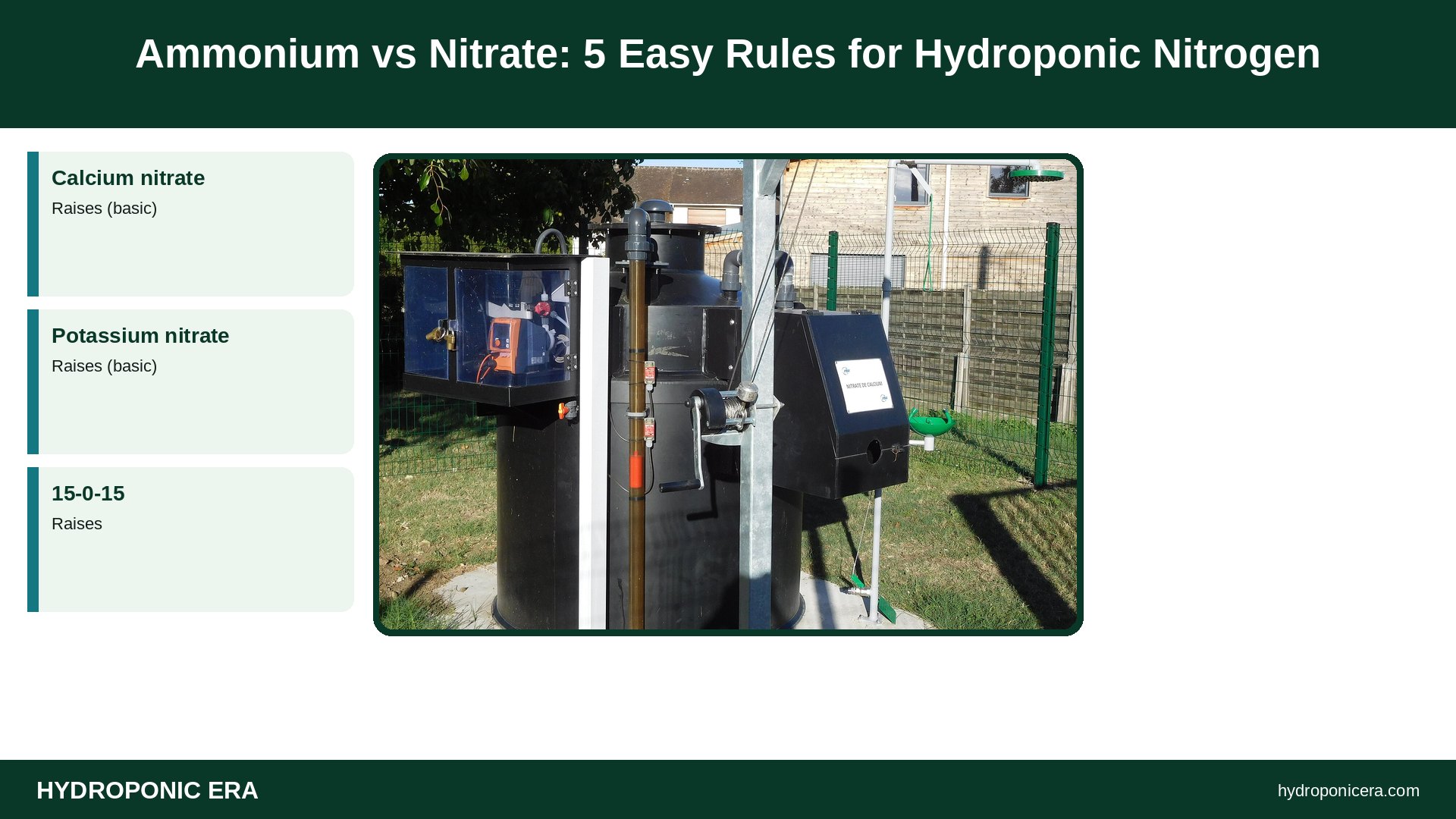
| Fertilizer | Nitrate share | Ammonium + urea share | Effect on pH |
|---|---|---|---|
| Calcium nitrate | 100% | 0% | Raises (basic) |
| Potassium nitrate | 100% | 0% | Raises (basic) |
| 15-0-15 | About 81–87% | About 13–19% | Raises |
| 20-10-20 | About 60% | About 40% | Lowers |
| 20-20-20 | 27.5% | 72.5% | Lowers more |
| Ammonium sulfate | 0% | 100% | Lowers strongly |
What Is the Difference Between Ammonium and Nitrate?
The core ammonium vs nitrate difference is electrical charge. Ammonium (NH4+) is positive, nitrate (NO3-) is negative, and urea has no charge. Cornell’s Neil Mattson explains that bacteria turn urea into ammonium within about two days, so ammonium plus urea is grouped as “ammoniacal” nitrogen. Plants can store extra nitrate safely, but storing too much ammonium damages cells.
For signs that plants are short of either form, see our nitrogen deficiency guide.
How Does Ammonium vs Nitrate Change pH?
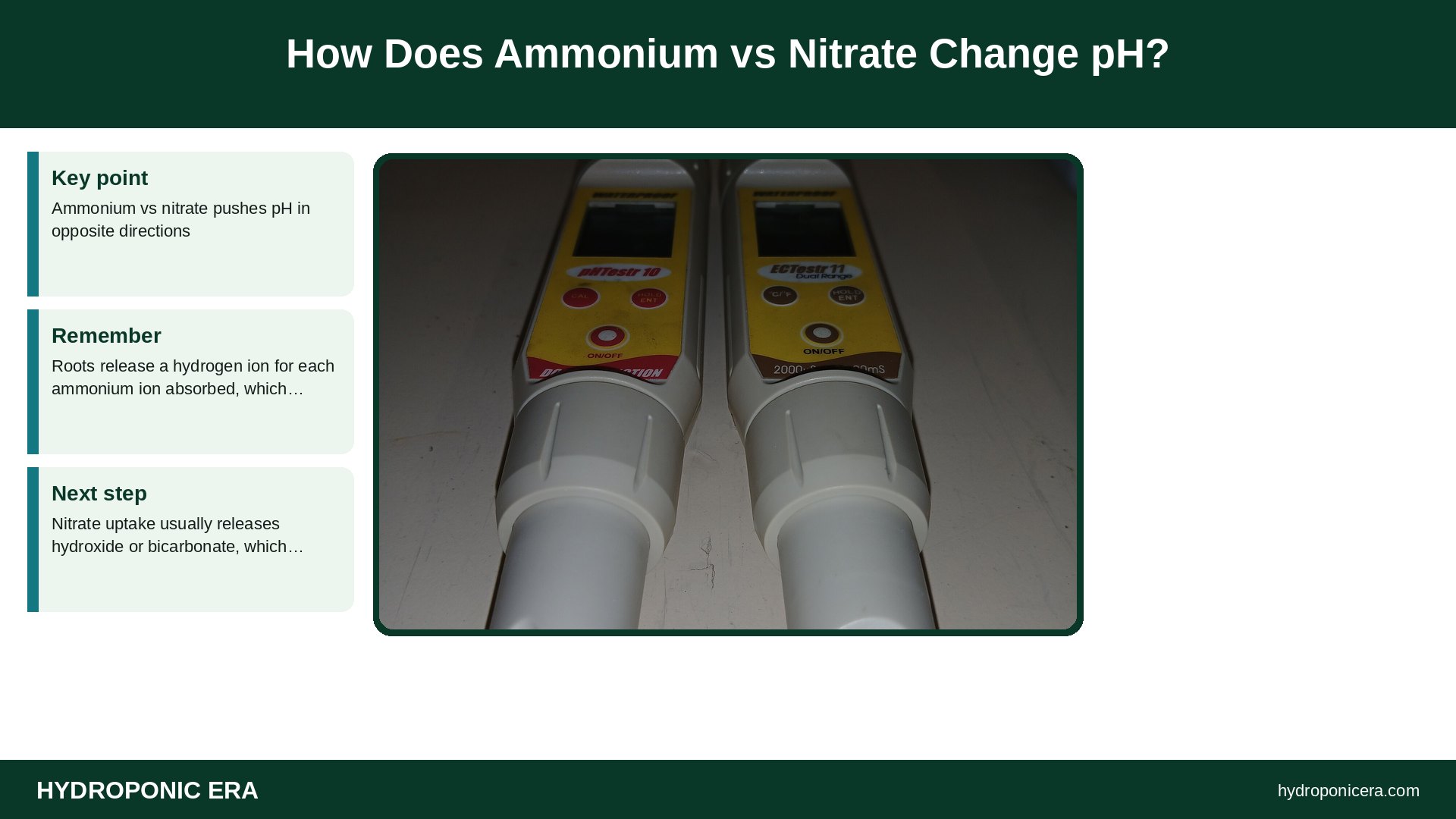
Ammonium vs nitrate pushes pH in opposite directions. Roots release a hydrogen ion for each ammonium ion absorbed, which lowers pH. Nitrate uptake usually releases hydroxide or bicarbonate, which raises it. Greenhouse Grower notes nitrogen is the only required nutrient supplied as both a cation and an anion, and it makes up over half the ions plants take up.
What Did Hydroponic Tests Show About the Ratio?
The ammonium vs nitrate ratio steadies pH in water culture. Cornell describes roses grown hydroponically with 8, 16 and 31 percent ammonium. In the 8 and 16 percent solutions, pH dropped first, then climbed as only nitrate was left. At 31 percent ammonium, pH stayed fairly steady for five days. Unbuffered nutrient solution shows these swings more than potting mix.
Our guide to mixing hydroponic nutrient solution shows where pH checks fit.
When Does Ammonium Become Toxic?
When it is cold, wet and low in oxygen. Nitrifying bacteria convert ammonium to nitrate, but they slow below an average 60°F (15.5°C), in saturated or low-oxygen root zones, and at low pH. UMass Extension says symptoms start as interveinal chlorosis easily confused with iron deficiency, and roots develop brown, necrotic tips.

Which Crops Are Sensitive to Ammonium?
Fruiting transplants and lettuce. UMass Extension lists tomato, eggplant and pepper transplants as particularly sensitive to high ammonium, along with coleus, pansy, salvia, zinnia and lettuce. Keep the ammoniacal share low for these crops, especially in winter, low light or a cool grow room where nitrification and growth both slow.
How Do You Choose an Ammonium vs Nitrate Blend?
Use the fertilizer’s potential acidity or basicity. Cornell’s table shows calcium nitrate and 15-0-15 are basic and raise pH, while 20-10-20 and 21-5-20 are acidic. If pH keeps rising, a slightly more ammoniacal blend can help; if it keeps falling, shift toward nitrate. Make small ammonium vs nitrate changes and keep monitoring.
- Check the label for percent nitrate versus ammoniacal nitrogen.
- Keep ammonium plus urea at 40 percent or less of total nitrogen.
- Go lower in cool, cloudy or poorly aerated conditions.
- Track pH every day or two for a week after any change.
Learn how the main nitrate salt behaves in our calcium nitrate guide.
Can Changing the Ratio Fix Water Alkalinity?
Not completely. In Weihenstephan research reported by Greenhouse Grower, very alkaline tap water raised pH under every ammonium-to-nitrate ratio from 90:10 to 10:90, and deionized water let pH fall under all of them. Alkalinity dominated. Test your source water and correct it with acid or RO, then fine-tune with nitrogen form.
Does Ammonium vs Nitrate Change How Plants Grow?
Yes, it shifts plant tone. Cornell notes ammonium and urea fertilizers tend to produce lush, soft growth with larger, darker green leaves. Nitrate fertilizers are used by plug growers to tone or harden plants. The trade-off is that nitrate-heavy plug feeds can raise pH over time and trigger micronutrient deficiencies, so Cornell suggests plug formulas with under 5 percent ammoniacal nitrogen.
If rising pH has already locked out iron or zinc, compare symptoms in our zinc deficiency guide.
How Do You Fix Ammonium Toxicity Fast?
Stop the ammoniacal feed and warm the roots. UMass Extension advises raising root-zone temperature, switching to a fertilizer with no ammoniacal nitrogen, and leaching with clear water. In hydroponics, that means replacing the reservoir with a nitrate-based solution, boosting aeration and keeping solution above 60°F (15.5°C) so nitrifying bacteria recover.
FAQ About Ammonium vs Nitrate
Ammonium vs nitrate: which is better?
For hydroponics, nitrate is the safer main source.
What ratio should I use?
Keep ammoniacal N at 40 percent or less, lower when cool.
Does ammonium lower pH?
Yes. Roots release hydrogen ions when they take it up.
Is urea the same as ammonium?
For pH effects, yes; it converts to ammonium quickly.
What is a dark weather formula?
A low-ammonium fertilizer such as 15-0-15 for cold, gray spells.
Sources
- Cornell University, Mattson, Leatherwood and Peters — Nitrogen: All Forms Are Not Equal
- Greenhouse Grower, Matt Taylor — Addressing pH Problems
- UMass Extension, Geoffrey Njue — Cold, Cloudy Weather Can Lead to Ammonium Toxicity
- Photo credits (Wikimedia Commons, edited with titles): Calcium nitrate, waste water treatment by Cjp24 (CC BY-SA 4.0); PH- und Leitfähigkeitsmessgeräte by Rotkaeppchen68 (CC0); Male whale shark at Georgia Aquarium by Zac Wolf (CC BY-SA 2.5); Potassium nitrate crystals by Adam Rędzikowski (CC BY-SA 4.0)