
How close should grow lights be to seedlings? For LEDs, about 8–12 inches (20–30 cm) above the seedlings; for fluorescent tubes, about 2–6 inches (5–15 cm). Iowa State and University of Maryland Extension give these ranges and recommend running grow lights for seedlings 14–16 hours a day on a timer. Raise the light as plants grow, and lower it if stems stretch.
Key takeaway: Grow lights for seedlings are the simplest fix for weak, leaning transplants. University of Maryland Extension says natural light from a window is seldom enough for strong seedling growth, because stems stretch and lean toward the light. Extension guides from Iowa State, Minnesota and Wisconsin agree on the basics: close light, long days and a timer.
| Factor | Guideline | Source |
|---|---|---|
| LED distance for grow lights for seedlings | About 8–12 in (20–30 cm) | Iowa State University Extension |
| Fluorescent distance | 2–6 in (5–15 cm) | UMD; Iowa State |
| Hours per day | 14–16 h; up to 16–18 h | UMD; Iowa State; UMN |
| Spinach exception | No more than 10–11 h | Wisconsin Extension |
| Spectrum | Broad-spectrum white LED or 6500K fluorescent | UMD Extension |
| Temperature after germination | Days 65–70°F (18–21°C); nights 55–60°F (13–16°C) | UMD Extension |
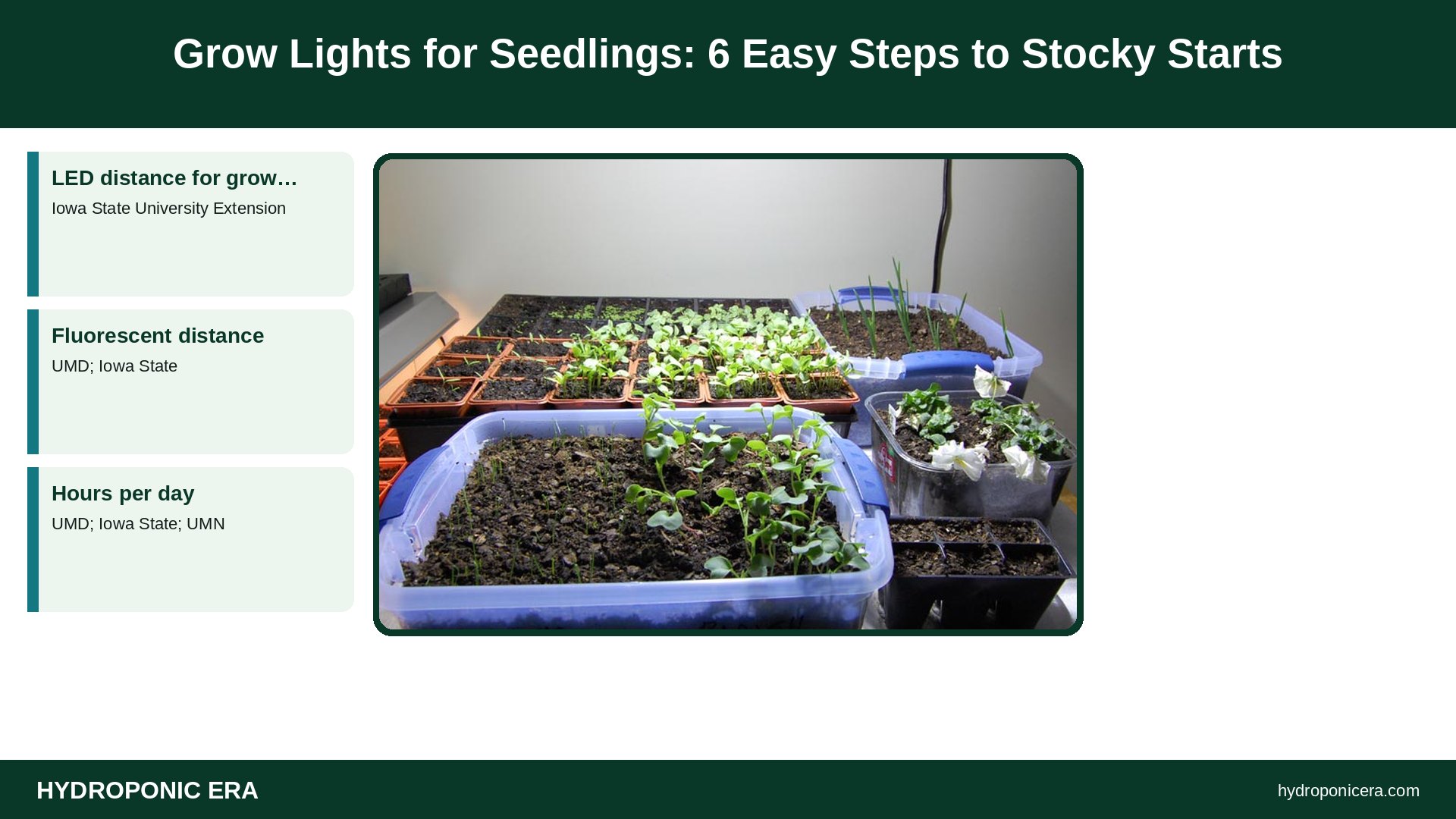
Do You Really Need Grow Lights for Seedlings?
Usually, yes. University of Maryland Extension says window light is seldom enough for strong seedlings and that acceptable growth usually only happens in south-facing bay windows or sunrooms with ample direct sun. University of Minnesota Extension says you would need artificial lighting to start seeds in a medium-light spot, such as an east-facing window.
Stretched, pale stems are the classic sign; see our leggy seedlings guide for fixes.
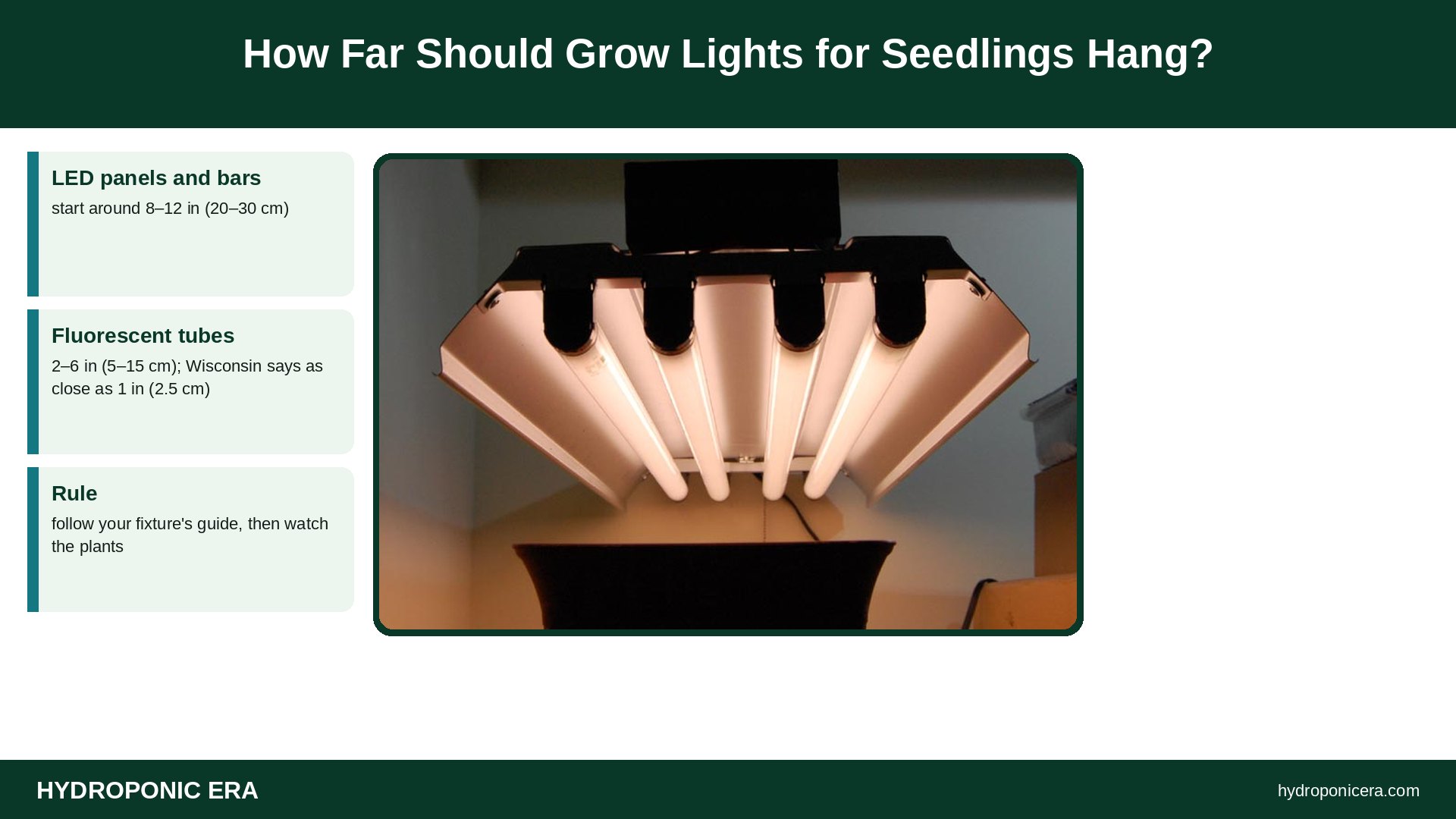
How Far Should Grow Lights for Seedlings Hang?
Close, and adjustable. Iowa State University Extension says seedlings should be 4 to 6 inches (10–15 cm) from most fluorescent fixtures, while LED fixtures can often sit a little farther away, at about 8 to 12 inches (20–30 cm). UMD suggests 2 to 6 inches (5–15 cm) for fluorescent and LED fixtures, and Minnesota lists 4 to 6 inches (15 cm) for seedlings.
- LED panels and bars: start around 8–12 in (20–30 cm).
- Fluorescent tubes: 2–6 in (5–15 cm); Wisconsin says as close as 1 in (2.5 cm).
- Rule: follow your fixture’s guide, then watch the plants.
How Many Hours Should Grow Lights for Seedlings Run?
About 14 to 16 hours a day. Iowa State and UMD both recommend 14 to 16 hours on a timer, Wisconsin Extension says about 16 hours suits most crops, and Minnesota Extension lists 16 to 18 hours for seedlings. Spinach is the exception: Wisconsin warns that more than 10 or 11 hours can make it bolt, turning tough and bitter.
Automate the schedule with a plug-in timer; our hydroponic timers guide shows options.
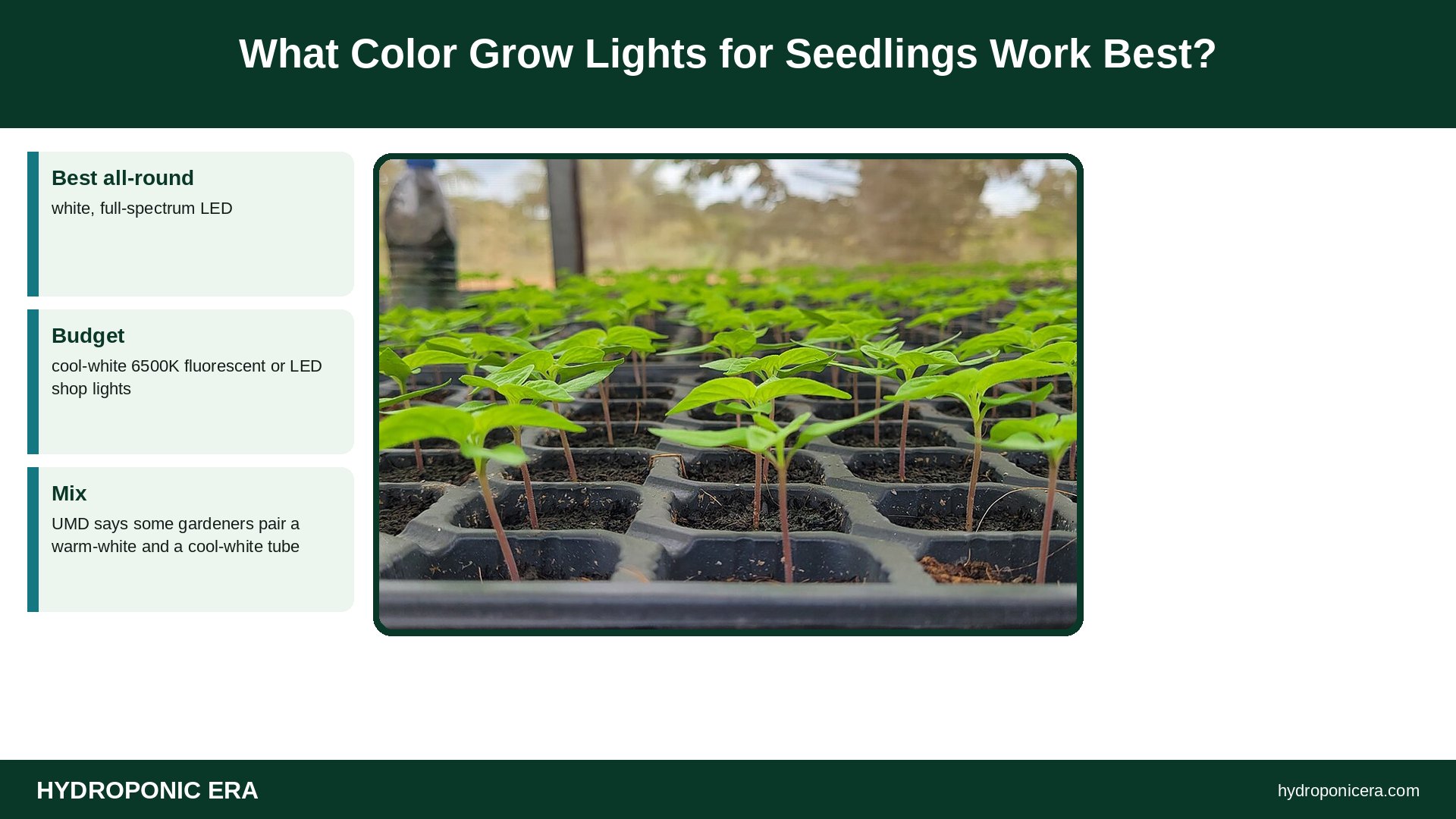
What Color Grow Lights for Seedlings Work Best?
White, broad-spectrum light. UMD says broad-spectrum LED grow lights that mimic daylight and cool-white 6500K fluorescent tubes are good options for transplants. Minnesota Extension says blue or mixed lights suit seed starting and leafy greens, while white or balanced lights suit most plants at any stage. Red-heavy lights are better for flowering.
- Best all-round: white, full-spectrum LED.
- Budget: cool-white 6500K fluorescent or LED shop lights.
- Mix: UMD says some gardeners pair a warm-white and a cool-white tube.
How Do You Set Up Grow Lights for Seedlings Step by Step?
Hang the light so it can move. UMD suggests attaching a thin chain or wire to each end of the fixture so you can raise it as plants grow, and Iowa State suggests chains, cables or removable blocks under trays. Iowa State also advises good air circulation to carry away heat from the fixture.
- Hang the light on chains or an adjustable stand.
- Set a timer for 14–16 hours.
- Start LEDs about 8–12 in (20–30 cm) above the trays.
- Keep days at 65–70°F (18–21°C) after germination.
- Raise the light as seedlings grow.
- Lower it if stems stretch; raise it if leaves bleach.
For a full shelf build, see our seed starting shelf with grow lights guide.
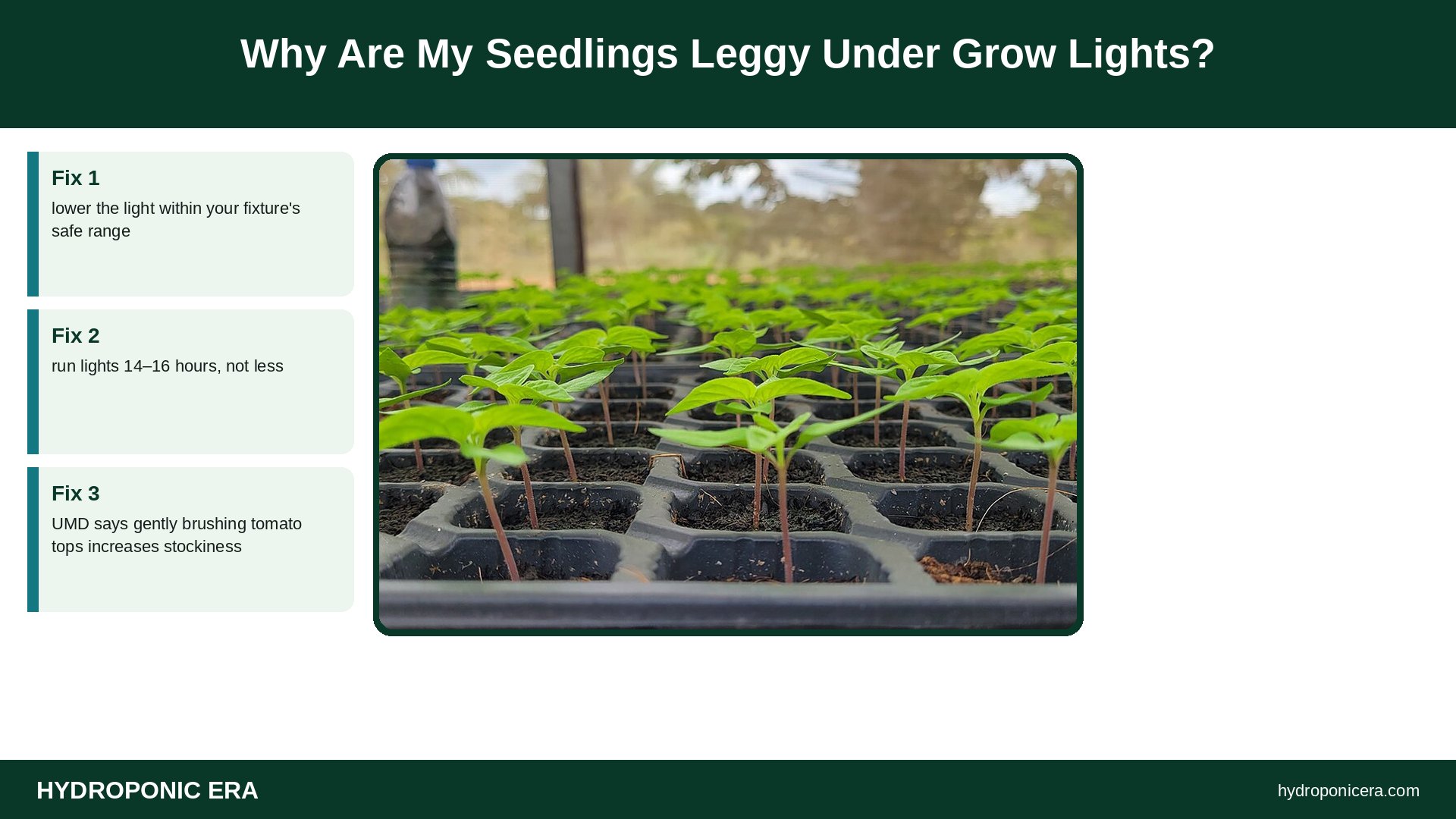
Why Are My Seedlings Leggy Under Grow Lights?
The light is usually too far away or too weak. UMD says to adjust fixtures as needed to keep plants stocky rather than stretched and leggy, and notes tomato and cabbage family plants are especially prone to stretching. After germination, UMD recommends cooler conditions of 55–60°F (13–16°C) at night and 65–70°F (18–21°C) by day, which also helps keep growth compact.
- Fix 1: lower the light within your fixture’s safe range.
- Fix 2: run lights 14–16 hours, not less.
- Fix 3: UMD says gently brushing tomato tops increases stockiness.
Can Grow Lights for Seedlings Burn Leaves?
They can if leaves touch them. Wisconsin Extension warns not to let seedlings grow into fluorescent lights, because the leaves may burn, and says LED-grown seedlings do not need to be as close. UMD recommends keeping transplant tops 1 to 2 inches (2.5–5 cm) from the grow lights after potting up. Bleached or crisp leaf tops mean the light needs to go higher.
What Comes After Grow Lights for Seedlings?
Hardening off. Wisconsin Extension says to start acclimating plants near your last frost date by setting them outside each day, beginning in semi-shade and moving gradually into more sun over one to two weeks. Our hardening off seedlings guide walks through the schedule.
FAQ About Grow Lights for Seedlings
How far should an LED grow light be from seedlings?
About 8–12 inches (20–30 cm), per Iowa State.
How many hours of light do seedlings need?
About 14–16 hours a day.
Should grow lights stay on 24 hours for seedlings?
No; extension guides suggest 14–18 hours.
What color light is best for seedlings?
White, broad-spectrum light.
Why are my seedlings leggy under lights?
The light is too far away or too weak.
Can I use a regular LED shop light?
Yes; UMD lists broad-spectrum LEDs and cool-white tubes.
Sources
- University of Maryland Extension — Starting Vegetable Seeds Indoors
- Iowa State University Extension — How Do I Set Up Supplemental Lights for My Seedlings?
- University of Minnesota Extension — Lighting for Indoor Plants and Starting Seeds
- University of Wisconsin–Madison Extension — Timely Tips for Seedling Care
- Photo credits (Wikimedia Commons, edited with titles): Indoor garden by Dennis Brown (CC BY-SA 3.0); Fluorescent-grow-lights by Dennis Brown (CC BY-SA 3.0); Plants in seed tray by Pascal Kings (CC BY 4.0)