
When basil yellow leaves show up in hydroponics, the most common causes are nitrogen deficiency (older, lower leaves yellow first), iron or magnesium deficiency (yellowing between veins), pH outside 5.8–6.2 locking out nutrients, root rot from warm or poorly oxygenated water, too little light, and cold damage. Start by checking pH and EC, then look at the roots: healthy basil roots are white and smell fresh. Where the yellow appears on the plant tells you which cause is most likely.
Key takeaway: Old leaves yellow = nitrogen or magnesium. New leaves yellow = iron or pH. Whole plant yellow and wilting = roots.
Basil Yellow Leaves: Quick Diagnosis Chart
| Where and how | Likely cause | Fix |
|---|---|---|
| Lower leaves turn evenly pale yellow | Nitrogen deficiency or low EC | Raise EC to 1.0–1.6; change solution |
| Lower leaves yellow between veins | Magnesium deficiency | Add Epsom salt or Cal-Mag; check pH |
| New leaves yellow with green veins | Iron deficiency or high pH | Lower pH to 5.8–6.2; add chelated iron |
| Whole plant yellow, wilting, brown roots | Root rot | Cool water, more air, clean system |
| Pale, stretched plant | Low light | More light; DLI 15–25 |
| Yellow with dark blotches after cold | Chill injury | Keep above 55°F |
| Yellow tops with gray fuzz underneath | Downy mildew | Remove leaves, lower humidity |
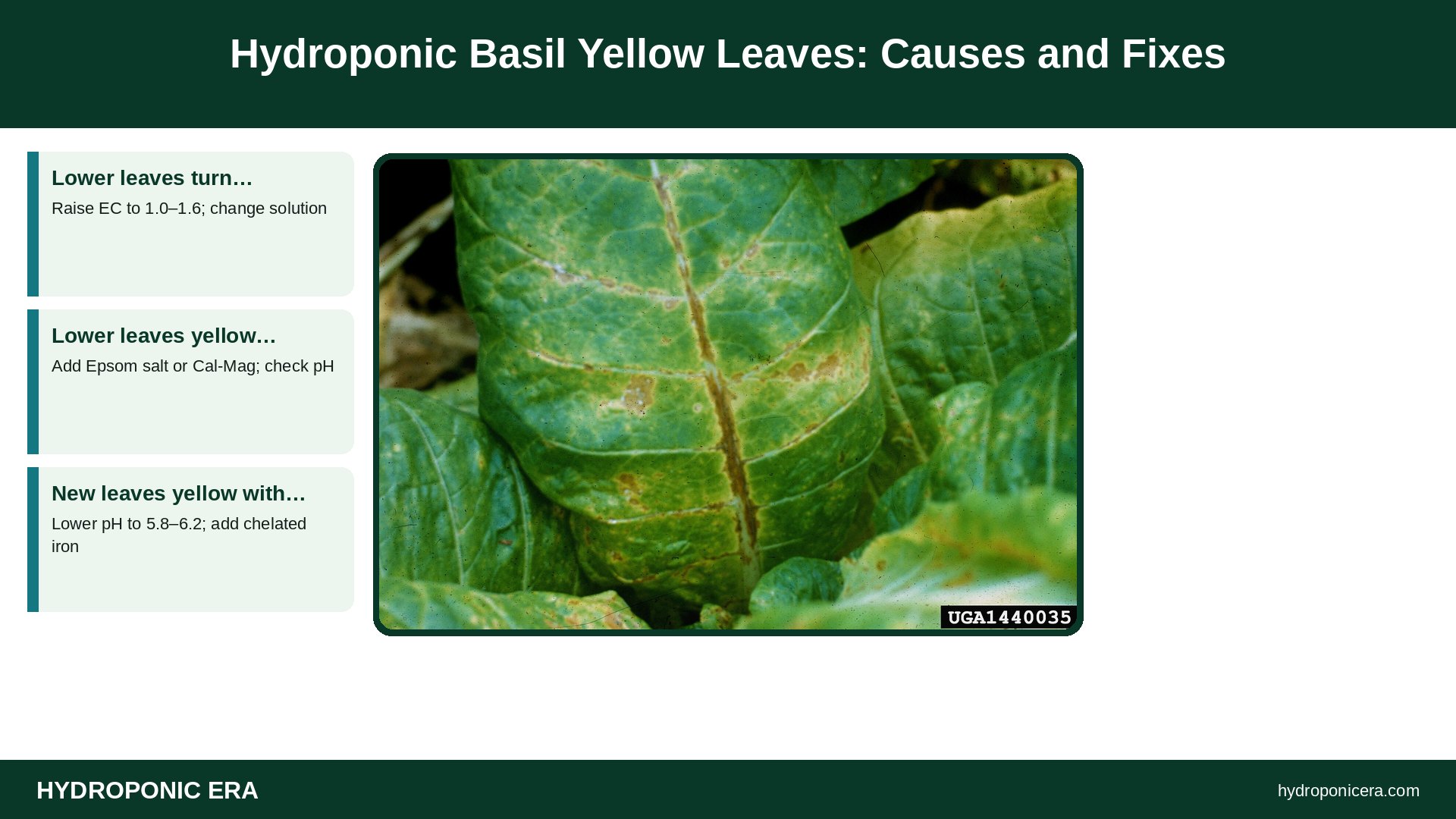
Nitrogen Deficiency and Basil Yellow Leaves

Nitrogen is mobile in the plant. When it runs short, basil moves nitrogen from old leaves to new growth, so the oldest leaves turn pale and then yellow first. This is common when EC is too low, when the solution is old, or when plants are large and hungry.
Fix: measure EC. For basil, aim for about 1.0–1.6 mS/cm. If EC is fine but the solution is more than 2–3 weeks old, change it; the nutrient balance shifts as plants feed. See nitrogen deficiency and the hydroponic ppm chart.
Magnesium and Iron Deficiency
Magnesium deficiency causes yellowing between the veins of older leaves while the veins stay green. It’s common with soft or RO water and nutrients low in magnesium. Add Epsom salt (magnesium sulfate) at about 1/4 teaspoon per gallon or use a Cal-Mag supplement. See Epsom salt in hydroponics.
Iron deficiency shows on the newest leaves: they turn pale yellow while the veins stay green. In hydroponics it’s usually caused by high pH rather than a lack of iron. Bring pH back to 5.8–6.2 and, if needed, add chelated iron. See iron deficiency.
pH Problems Behind Basil Yellow Leaves
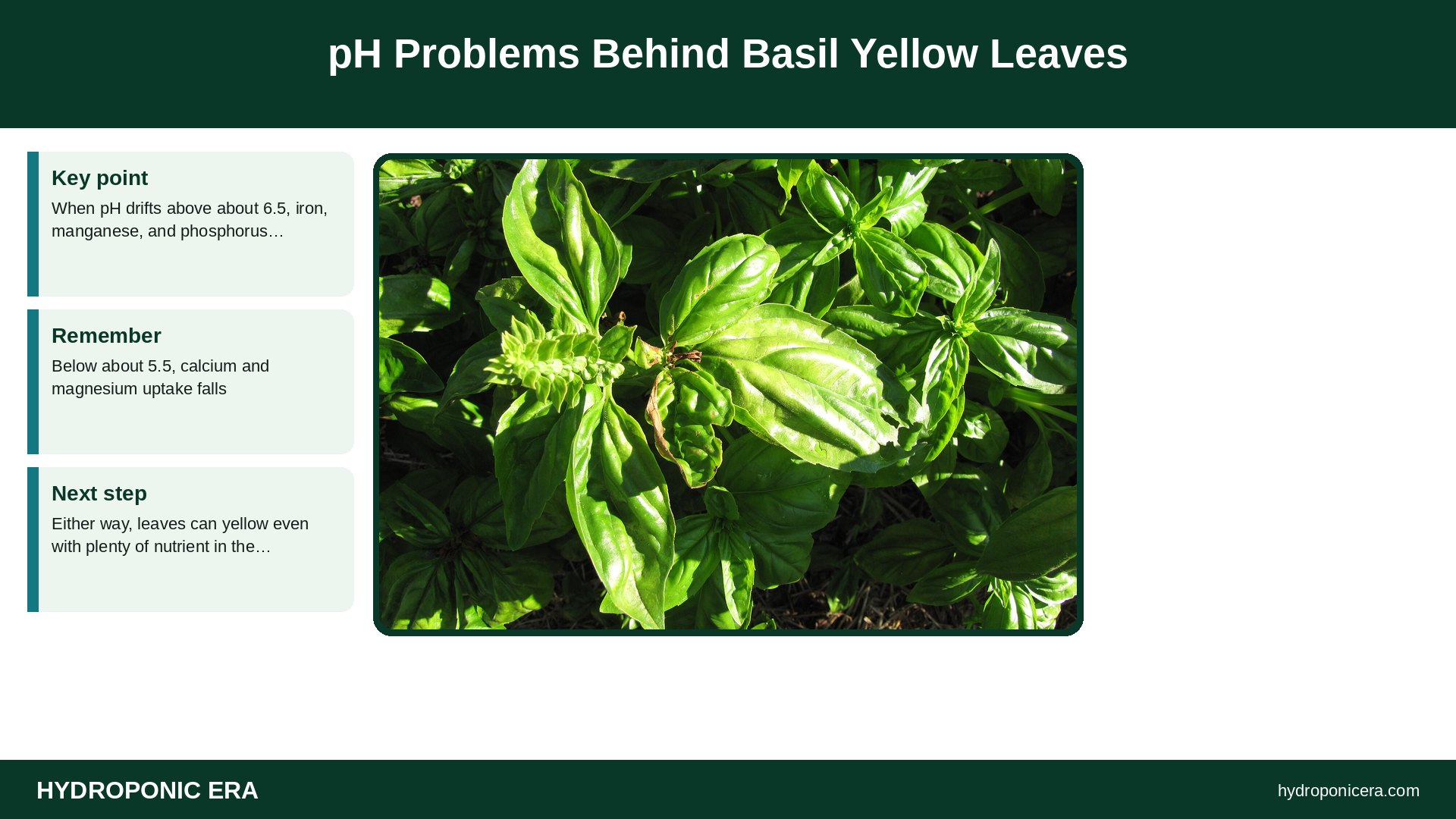
When pH drifts above about 6.5, iron, manganese, and phosphorus become less available. Below about 5.5, calcium and magnesium uptake falls. Either way, leaves can yellow even with plenty of nutrient in the water. Check pH daily for a week to see which way it drifts, and adjust. Oklahoma State University Extension’s guide explains how pH affects nutrient availability in hydroponics. See fixing high or low pH.
Root Rot
If the whole plant yellows and wilts, even with a full reservoir, pull a plant and look at the roots. Brown, slimy, smelly roots mean root rot, usually caused by Pythium in warm water with low oxygen. Colorado State University Extension notes root diseases are a leading problem in hydroponic systems, and warm solution temperatures make them worse.
- Keep water at 65–72°F.
- Run air stones 24/7 in DWC.
- Block light from the reservoir.
- Remove badly affected plants and clean the system.
See Pythium root rot and why roots turn brown.
Light, Temperature, and Age

Low light: basil under weak light grows pale, thin, and stretched, and lower leaves yellow and drop as the plant shades itself. Virginia Cooperative Extension suggests a DLI of about 15–25 mol/m²/day for basil.
Cold: basil is very sensitive to cold. Below about 50–55°F, leaves can yellow, darken, or develop black patches. Keep plants away from cold windows and AC vents.
Age: a few lower leaves yellowing on an older plant is normal, especially if they’re shaded. Remove them and move on.
Downy Mildew on Basil
Basil downy mildew causes yellowing that starts near the central vein and spreads, with gray-purple fuzzy growth on the underside of leaves. It thrives in humid, still air. Remove infected leaves or plants, increase airflow, lower humidity, and avoid wetting leaves. Some newer basil varieties are bred for resistance. See downy mildew on greens.
Step-by-Step Fix for Basil Yellow Leaves
- Note where the yellow is: old leaves, new leaves, or the whole plant.
- Check pH and correct it to 5.8–6.2.
- Check EC and adjust to 1.0–1.6.
- Look at roots for color and smell.
- Check water temperature and air supply.
- Check light hours and intensity.
- If the solution is old, change it.
- Watch new growth for a week. Yellow leaves won’t turn green again, but new leaves should come in healthy.
Preventing Basil Yellow Leaves
- Use a complete hydroponic nutrient with calcium, magnesium, and iron.
- Test pH and EC at least every other day.
- Change the solution every 2–3 weeks.
- Keep the reservoir cool, dark, and well aerated.
- Give strong light and good airflow.
- Prune regularly so plants don’t shade themselves. See pruning hydroponic basil.
When Yellow Leaves Mean It’s Time to Replace the Plant
An old basil plant that has flowered several times, has woody stems, and keeps dropping yellow leaves may simply be worn out. Take a few healthy tip cuttings, root them, and replace the plant. This is often faster than trying to revive it. See hydroponic cuttings and cloning.
Basil Yellow Leaves in Different Hydroponic Systems
The system you use changes which cause is most likely. In Kratky jars and other passive setups, basil yellow leaves often show up late in the crop as the solution runs low and nitrogen is used up, or when the air gap shrinks and roots sit too deep.
In deep water culture, warm water and low oxygen are common triggers, so check water temperature and the air pump first. In NFT channels, a pump timer failure or a clogged channel can dry roots quickly, which shows as wilting followed by basil yellow leaves along the whole channel. In countertop kits, an old pod, a dim light or a nutrient dose that was never topped up are the usual causes.
How Fast Basil Recovers
Leaves that have already turned fully yellow rarely turn green again, so judge recovery by the new growth. After you correct pH, EC or root health, fresh leaves at the tips should come in a normal green within 7–10 days. If new growth is still pale after two weeks, test the meter against calibration fluid and look at the roots again. Remove badly yellowed lower leaves so they don’t rot in humid air, but leave partly green leaves in place while the plant recovers.
Keep a Simple Log
Writing down EC, pH, water temperature and the date of each reservoir change makes basil yellow leaves much easier to diagnose next time, because you can see which reading changed first.
FAQs
Why does my hydroponic basil have yellow leaves?
Usually low nitrogen, pH problems, root rot, or low light.
Can yellow basil leaves turn green again?
Rarely. Fix the cause and watch new growth.
What pH prevents basil yellow leaves?
5.8–6.2.
Is yellowing between veins a deficiency?
Yes. Older leaves suggest magnesium; new leaves suggest iron.
Do basil yellow leaves mean overwatering?
In hydroponics, it usually means low oxygen and root rot.
Should I remove yellow leaves?
Yes, to improve airflow and appearance.
Sources
- Oklahoma State University Extension — Electrical Conductivity and pH Guide for Hydroponics
- Colorado State University Extension — Root Disease Problems and Management in Hydroponic Systems
- Virginia Cooperative Extension — Calculating and Using Daily Light Integral (DLI)
- Clemson Cooperative Extension — Basil
- Photo credits (Wikimedia Commons, edited with titles): Tobacco vein mottling virus TVMV by R.J. Reynolds Tobacco Company , R.J. Reynolds Tobacco Company, Bugwood.org (CC BY 3.0 us); Ocimum Basilicum leaf lighted by the left by BernaBotto (CC BY-SA 4.0); Starr-110822-8253-Ocimum basilicum-leaves with basil downy mildew Peronospora belbahrii-Hawea Pl Olinda-Maui (25010109901) by Forest and Kim Starr (CC BY 3.0 us); PH- und Leitfähigkeitsmessgeräte by Rotkaeppchen68 (CC0); Spathiphyllum wallisii hydroponically grown by Kephalian (CC BY-SA 4.0)