
When hydroponic plants dying is the problem, the cause is usually in the root zone: warm or oxygen-poor water leading to root rot, pH out of range, nutrient strength too high or too low, or a pump or air failure. Check the roots first. Healthy roots are white or cream and firm. Colorado State’s PlantTalk says root rot, most often caused by Pythium, first shows as wilting or tip burn, with brown roots that have sparse root hairs. Then check water temperature (68–72°F is the optimum root zone per Colorado State), pH, EC, and whether the pump and air stones are running.
Key takeaway: Inspect roots, measure water temperature, pH, and EC, and confirm water and air are moving before changing anything else.
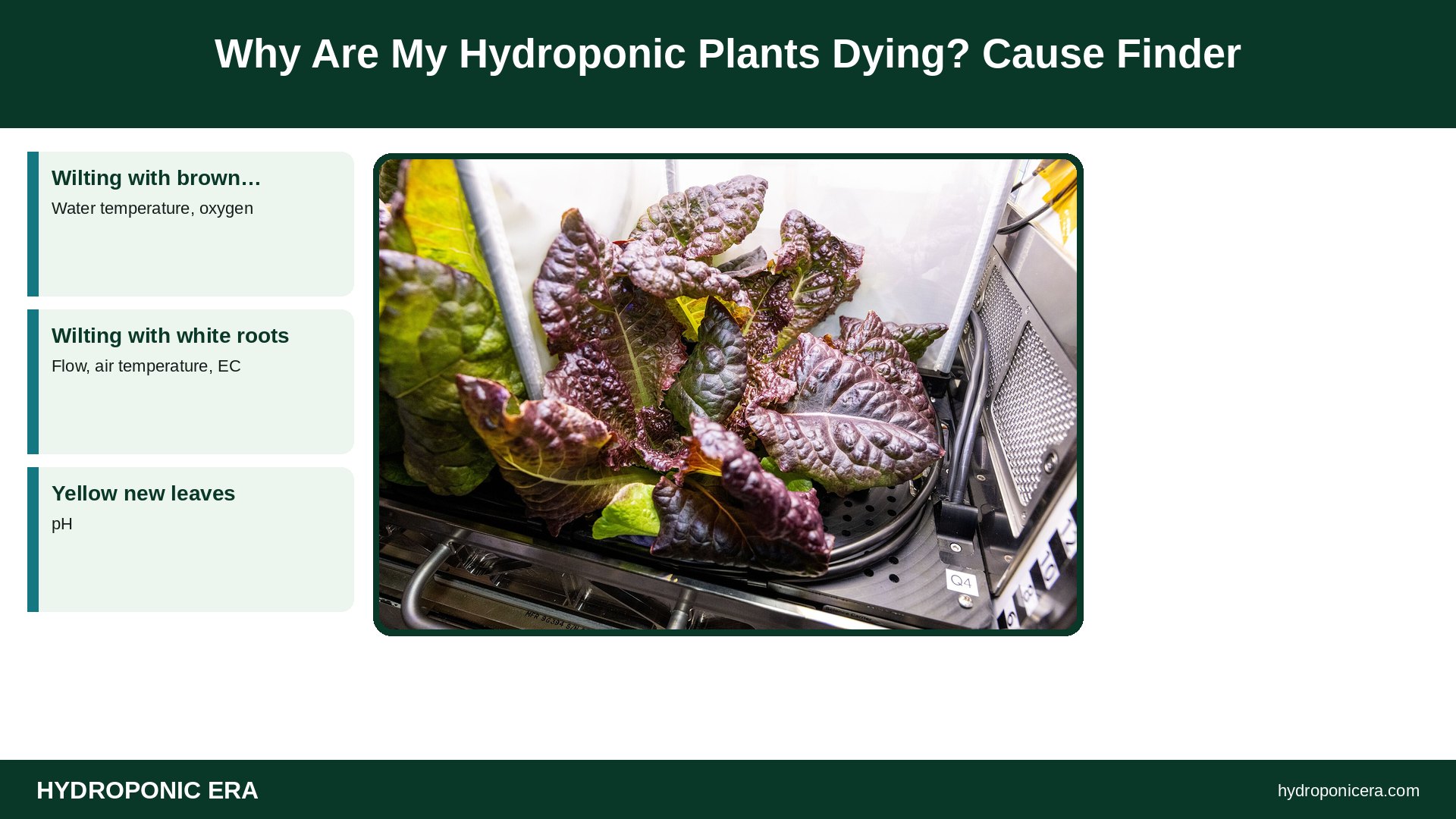
| Symptom | Likely cause | First check |
|---|---|---|
| Wilting with brown, slimy roots | Root rot | Water temperature, oxygen |
| Wilting with white roots | Pump failure, heat stress, or salt stress | Flow, air temperature, EC |
| Yellow new leaves | Iron or pH problem | pH |
| Yellow old leaves | Low nitrogen or weak solution | EC |
| Burnt leaf edges | EC too high | EC |
| Seedlings collapsing at base | Damping off | Humidity, overwatering |
| Stretched, pale plants | Too little light | Light distance and hours |
Step 1: Check the Roots of Hydroponic Plants Dying
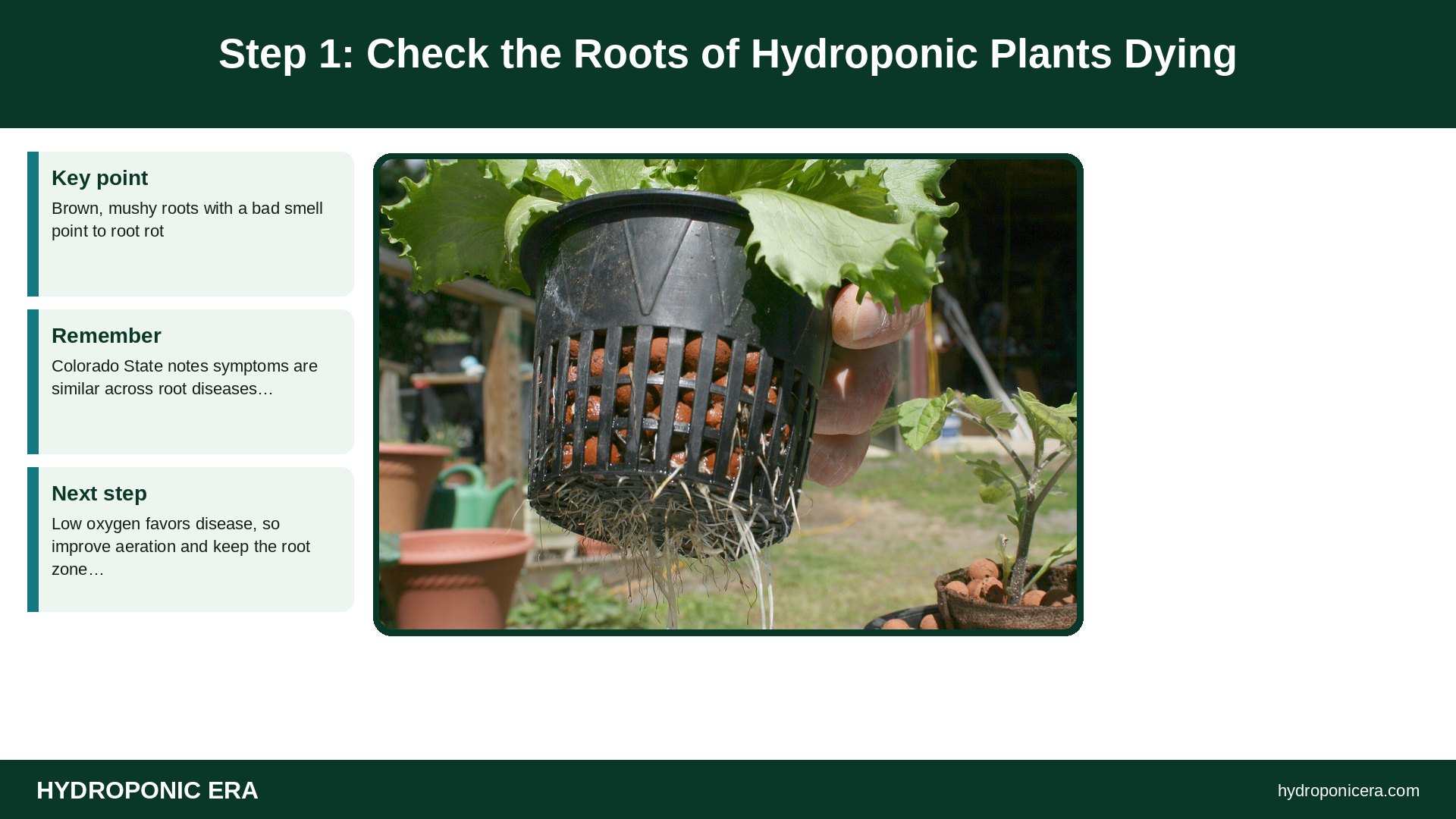
Lift a plant and look. Brown, mushy roots with a bad smell point to root rot. Colorado State notes symptoms are similar across root diseases, including Pythium, Fusarium, Phytophthora, and Rhizoctonia, and a diagnostician may be needed to identify which. Low oxygen favors disease, so improve aeration and keep the root zone near 68–72°F. See Pythium root rot.
Step 2: Check Water Temperature
Warm water is a top reason for hydroponic plants dying in summer. UF/IFAS Extension suggests 65–80°F for lettuce solutions, and Colorado State gives 68–72°F as optimum for roots. Above that, oxygen falls and disease rises. Shade and insulate the reservoir. See hydroponics in hot climates and reservoir temperature.
Step 3: Check pH and EC
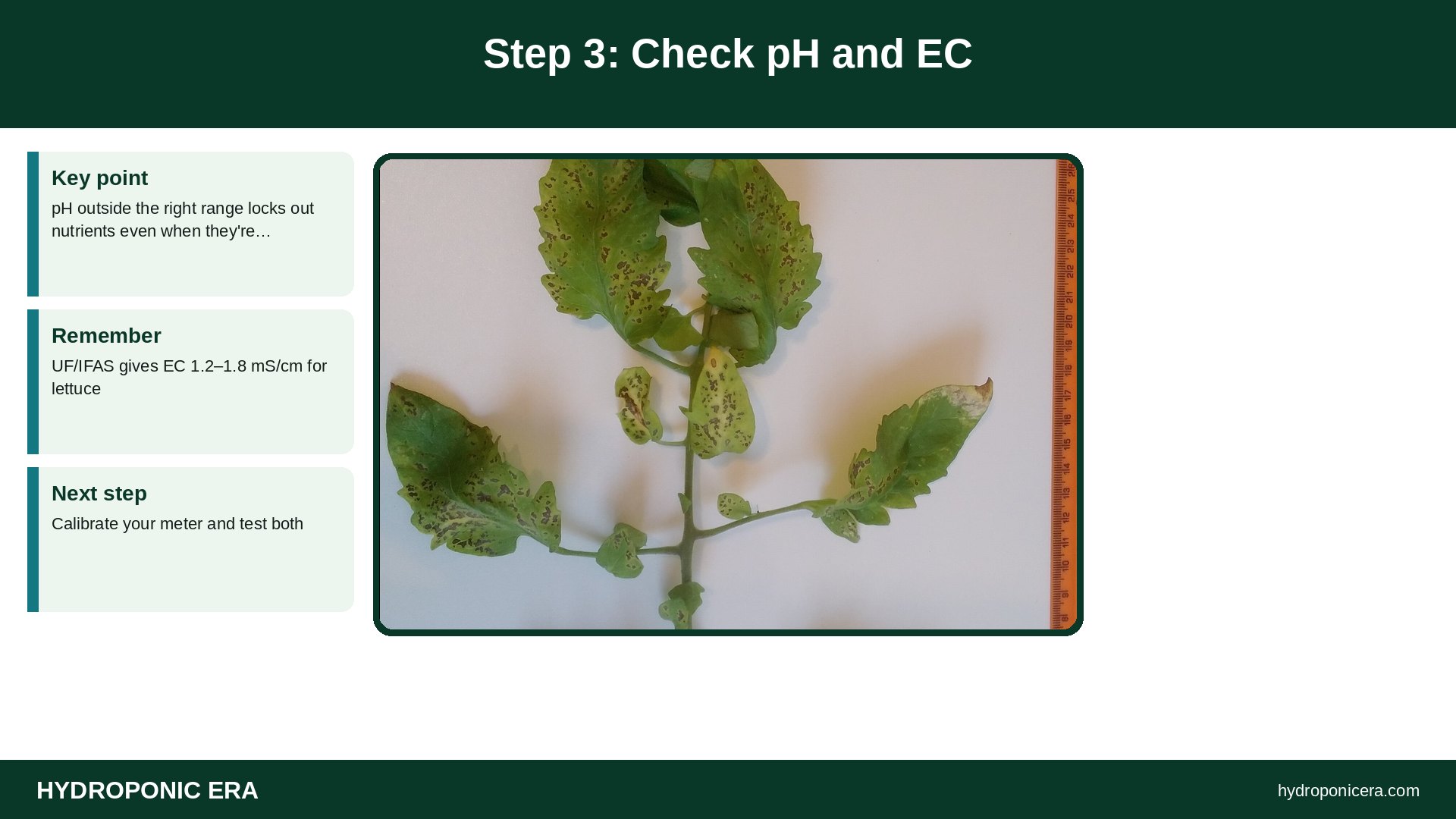
pH outside the right range locks out nutrients even when they’re present, and EC that’s too high causes salt stress and burnt edges. UF/IFAS gives EC 1.2–1.8 mS/cm for lettuce. Calibrate your meter and test both. See fix high or low pH and EC and TDS.
Step 4: Check Water and Air Flow
- Is the pump running and delivering water to every site?
- Are air stones bubbling evenly?
- Is the reservoir low, leaving roots dry?
- Are NFT channels or drip lines clogged with roots?
Dry roots wilt fast in NFT and towers, which hold little water. See dissolved oxygen.
Step 5: Check Light and Air Temperature
Too little light causes pale, stretched plants; too much can bleach leaves. Lettuce air temperatures shouldn’t exceed about 75°F by day, per the University of Kentucky, and heat can cause bolting and tip burn. See light burn.
Step 6: Look for Pests
Check leaf undersides for aphids, spider mites, whiteflies, and thrips. Yellow speckling, sticky residue, or webbing are clues. Treat early with methods safe for food crops.
Hydroponic Plants Dying as Seedlings
Seedlings that collapse at the soil line usually have damping off, caused by wet, humid conditions. The University of Kentucky advises removing humidity domes about two days after emergence. Don’t keep plugs soggy. See starter sponges.
Saving Hydroponic Plants Dying From Root Rot
- Remove badly affected plants.
- Change the nutrient solution.
- Clean and disinfect the reservoir. Colorado State lists 10% bleach solutions or hydrogen peroxide products made for hydroponics; follow labels and rinse.
- Cool the water and increase aeration.
- Trim dead roots from plants worth saving.
- Restart with healthy plants if the problem returns.
Prevent Hydroponic Plants Dying
- Start with a clean system.
- Keep water cool and well aerated.
- Check pH and EC regularly.
- Keep light out of the reservoir.
- Inspect roots weekly.
See wilting plants and beginner mistakes.
Diagnosing Hydroponic Plants Dying
When hydroponic plants are dying, work through the system in order: roots first, then water temperature, then pH and EC, then light, then pests. Healthy roots are white or cream and smell fresh; brown, slimy roots point to rot and low oxygen. Writing down readings each day for a week often shows the cause.
If a whole system crashes, clean everything, replace the nutrient, and restart with fresh plants rather than nursing badly damaged ones.
Weekly Routine to Stop Hydroponic Plants Dying
- Check pH and EC, and record them.
- Top off the reservoir with plain, pH-adjusted water.
- Look at roots for color and smell.
- Check leaves, especially undersides, for pests.
- Clean filters, emitters, and pump intakes.
- Change the nutrient fully every two to three weeks, or sooner if EC drifts.
Beginner Mistakes Behind Hydroponic Plants Dying
The most common mistakes are skipping pH testing, using nutrient that’s too strong, letting light reach the water, and ignoring water temperature. Each one is easy to fix once you know to check for it. Start with fewer plants than you think you need, learn the routine, and expand once the system runs smoothly.
Symptoms of Hydroponic Plants Dying and Likely Causes
| Symptom | Likely cause |
|---|---|
| Wilting with brown, slimy roots | Root rot, low oxygen, warm water |
| Yellow new leaves | pH too high, iron lockout |
| Brown, crispy leaf edges | Nutrient too strong |
| Pale, slow, stretched plants | Too little light |
| Speckled or webbed leaves | Spider mites or other pests |
Use this table as a starting point, then confirm with readings. Several causes often stack, such as warm water plus high EC.
Preventing Hydroponic Plants Dying
Most losses come from a few causes that are easy to watch for: warm or stagnant water, wrong pH, nutrient too strong or too weak, poor light, and pests. Keep water cool and aerated, test pH and EC regularly, match nutrient strength to plant size, and quarantine new plants before adding them to your system. Clean and sanitize equipment between crops so disease doesn’t carry over.
FAQs: Hydroponic Plants Dying
Why are my hydroponic plants dying suddenly?
Often pump failure, root rot, or heat.
What do healthy roots look like?
White or cream, firm, with plenty of fine root hairs.
Can plants recover from root rot?
Mild cases can, with cooler water, more oxygen, and a clean system.
What water temperature is best?
Colorado State says 68–72°F is optimum for roots.
Can high EC kill plants?
Yes. Excess salts cause burnt edges and wilting.
Should I change the water if hydroponic plants are dying?
Usually yes; fresh nutrient at the right pH removes one variable fast.
Sources
- Colorado State University PlantTalk — Root Disease Problems and Management
- UF/IFAS Extension — Growing Lettuce in Small Hydroponic Systems
- University of Kentucky — Hydroponic Lettuce Production
- Photo credits (Wikimedia Commons, edited with titles): Iss072e404275 (12-27-2024) — The Spaceflight Microbiome of a Food Crop Grown Using Different Substrate Moisture Levels (Plant Habitat-07) investigation grows ‘Outredgeous’ red romaine lettuce aboard the Internati by NASA Johnson Space Center (Public domain); 2009-03-30 Lettuce roots by Ildar Sagdejev (Specious) (CC BY-SA 4.0); Septoria leaf spot symptoms on tomato leaf (Septoria lycopersici on Solanum lycopersicum leaf) by MerielGJones (CC BY-SA 4.0); Leaf spot grey necrosis by Savina Jo (CC BY-SA 4.0); Electrical conductivity meter by Nuno Nogueira (Nmnogueira) (CC BY-SA 2.5)