
Can you use lava rock for hydroponics? Yes. Lava rock hydroponics works because crushed volcanic scoria drains fast and holds lots of air around roots. The trade-off is poor water holding and a tendency to raise pH, so use small particles, irrigate often, and blend with coco coir for steadier moisture.
Key takeaway: Lava rock hydroponics uses a coarse, reusable medium that suits flood-and-drain and drip systems better than passive ones. Studies on volcanic rock show high aeration but very little easily available water, so success depends on grain size, a coir blend and frequent watering.
| Property | What research shows | What it means for you |
|---|---|---|
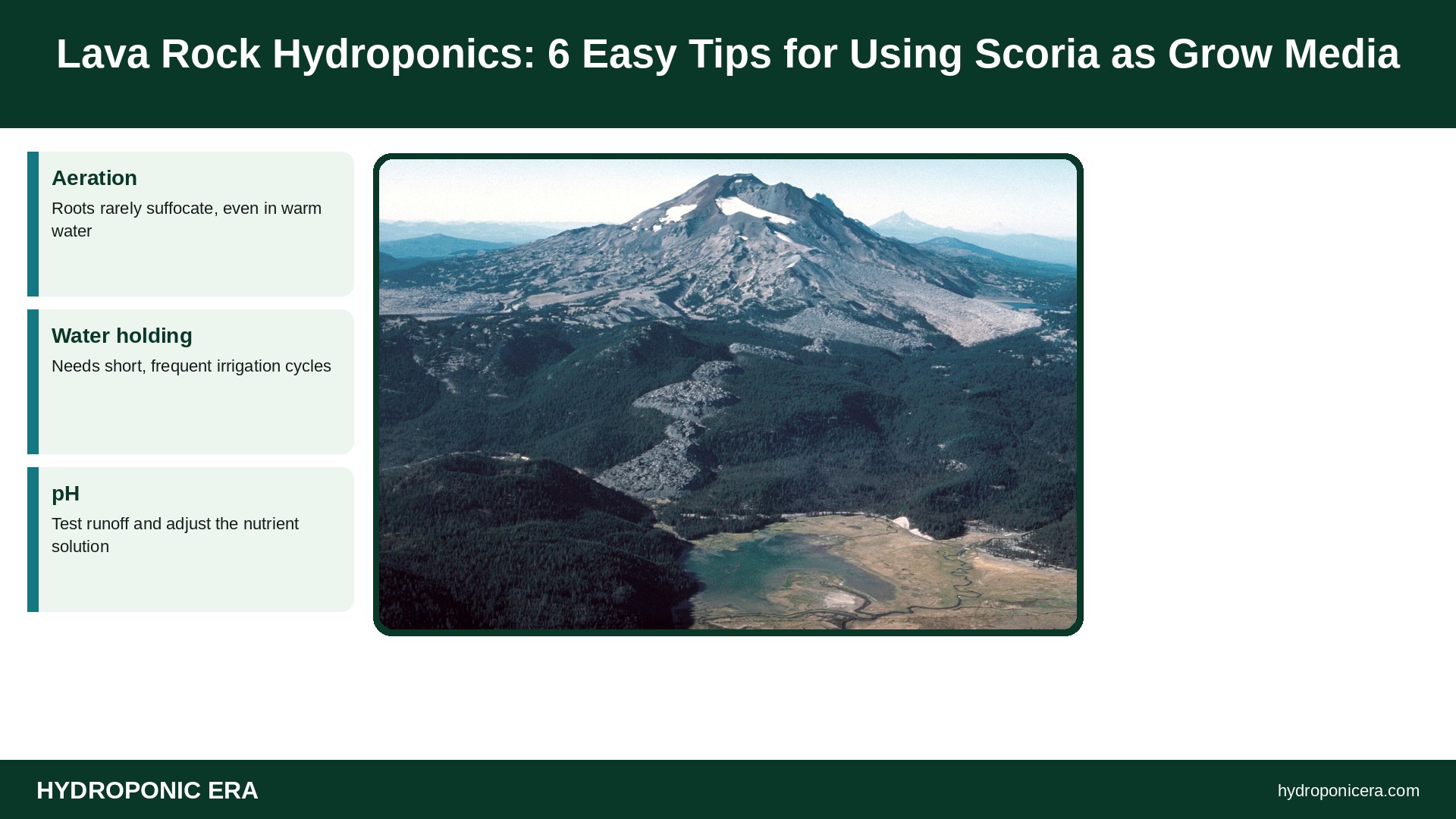
| Aeration | Coarse volcanic tuff tested above 35% air space | Roots rarely suffocate, even in warm water |
| Water holding | Coarse tuff held under 5% available water; 1/8–1/5 in (3–5 mm) rock held only 2.3–2.9% easily available water | Needs short, frequent irrigation cycles |
| pH | Drainage from volcanic rock ran higher than from coconut fiber | Test runoff and adjust the nutrient solution |
| Best blend tested | 3 parts volcanic rock to 1 part coconut fiber for tomatoes | A coir mix balances air and water |
What Is Lava Rock Hydroponics?
Lava rock hydroponics means growing plants with their roots in crushed volcanic rock, usually red or black scoria, while a nutrient solution is delivered by drip, flood-and-drain or hand watering. The rock is only a support. It supplies no meaningful nutrients, so the water has to carry everything the plant needs.
Lava rock hydroponics is not new: growers in Spain and Mexico have tested volcanic rock for commercial soilless crops such as tomatoes, and it is sold under names like scoria, tezontle and picón. It is also easy to find in garden centers, which is why home growers ask about it. If you are comparing options, our guide to growing media for hydroponics shows where it fits.
Is Lava Rock Hydroponics a Good Choice?
Lava rock hydroponics is a good choice when you want a durable, airy medium and can water frequently. It drains almost instantly and keeps roots oxygenated, but it stores very little water, so plants dry out quickly in warm rooms. It performs poorly in set-and-forget systems without a timer.
In research on coarse tuff, air space topped 35% while available water stayed under 5%. A Mexican study of 1/8–1/5 in (3–5 mm) volcanic rock found only 2.3–2.9% easily available water. Compare that with coco coir, which holds far more moisture, and you can see why a blend is popular.
- Pros: reusable, does not break down, cheap, heavy enough to anchor tall plants, and drains well.
- Cons: dries fast, can be dusty, may raise pH, and the sharp edges can scratch roots if pieces are large.
How Do You Prepare Media for Lava Rock Hydroponics?
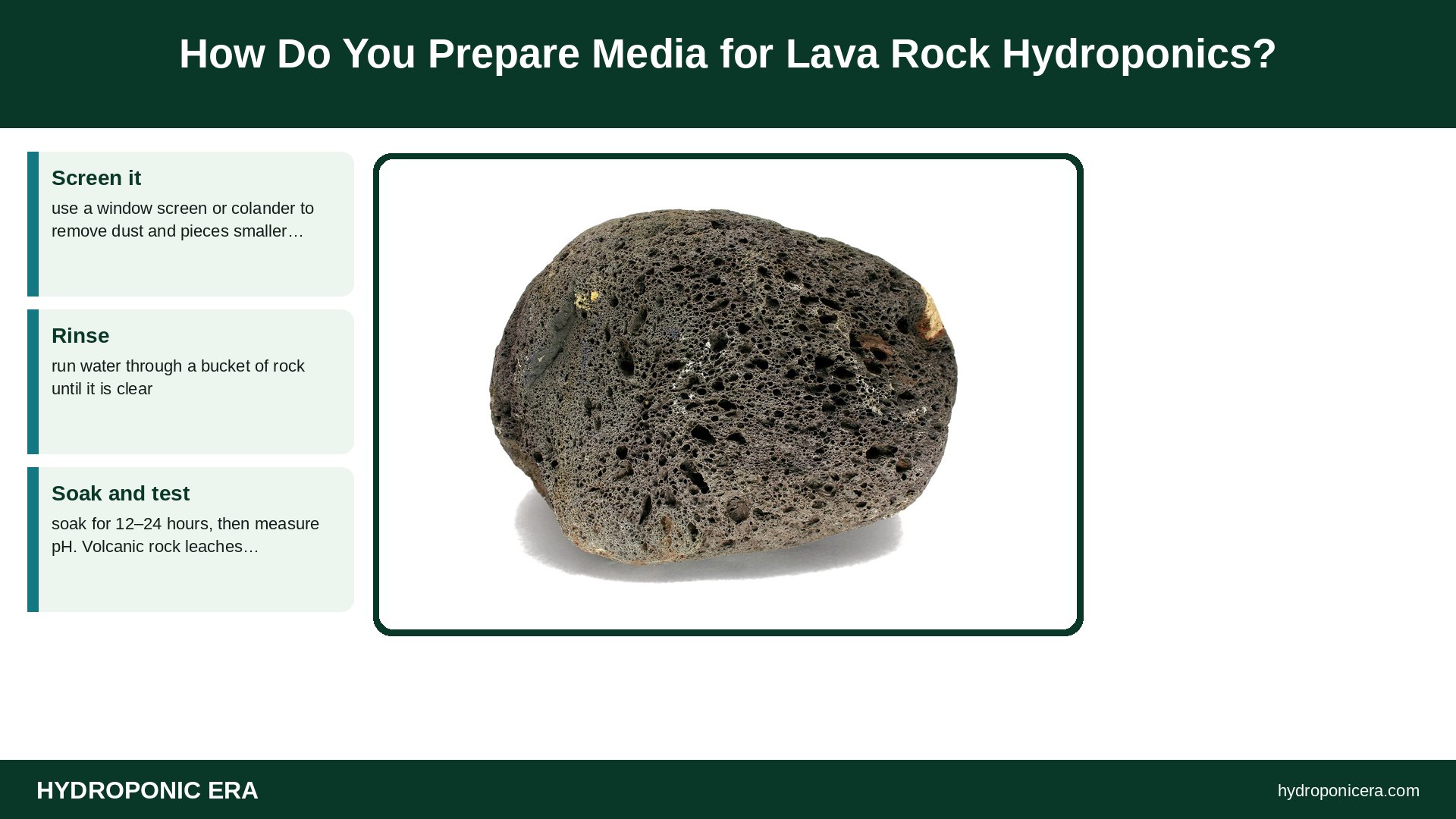
For lava rock hydroponics, rinse the rock until the water runs clear, then soak it in clean water for a day and test the runoff pH. Dust clogs drip emitters and fine particles can choke roots, so washing is not optional. Sort out pieces that are much larger than 1/2 in (about 12 mm).
- Screen it: use a window screen or colander to remove dust and pieces smaller than 1/8 in (3 mm).
- Rinse: run water through a bucket of rock until it is clear.
- Soak and test: soak for 12–24 hours, then measure pH. Volcanic rock leaches alkalinity.
- Sanitize if reusing: soak used rock in a diluted bleach or hydrogen peroxide solution, then rinse well.
- Blend: mix 3 parts rock with 1 part coco coir for crops that dislike drying out.
What Size Rock Works Best for Lava Rock Hydroponics?
Small, graded scoria around 1/8–3/8 in (3–10 mm) works best, because finer particles hold more water between pieces. Coarse rock above 1/2 in (12 mm) behaves like gravel with almost no water storage. A Canary Islands study confirmed that particle size controls how much water volcanic material retains.
For lava rock hydroponics with seedlings and herbs, choose the fine end. For tomatoes, peppers or cucumbers in buckets, a coir blend of about 3:1 gave the best tomato results in a published trial. Match the rock to your irrigation: finer rock suits drip lines every few hours, coarser rock only suits flood-and-drain systems that cycle several times a day.
| Grain size | Water holding | Good for |
|---|---|---|
| Under 1/8 in (3 mm) | Higher, but can pack and clog | Screened out as dust |
| 1/8–3/8 in (3–10 mm) | Moderate to low | Herbs, lettuce, seedlings, coir blends |
| Over 1/2 in (12 mm) | Very low | Drainage layer, ebb and flow beds |
How Do You Manage pH With Lava Rock Hydroponics?
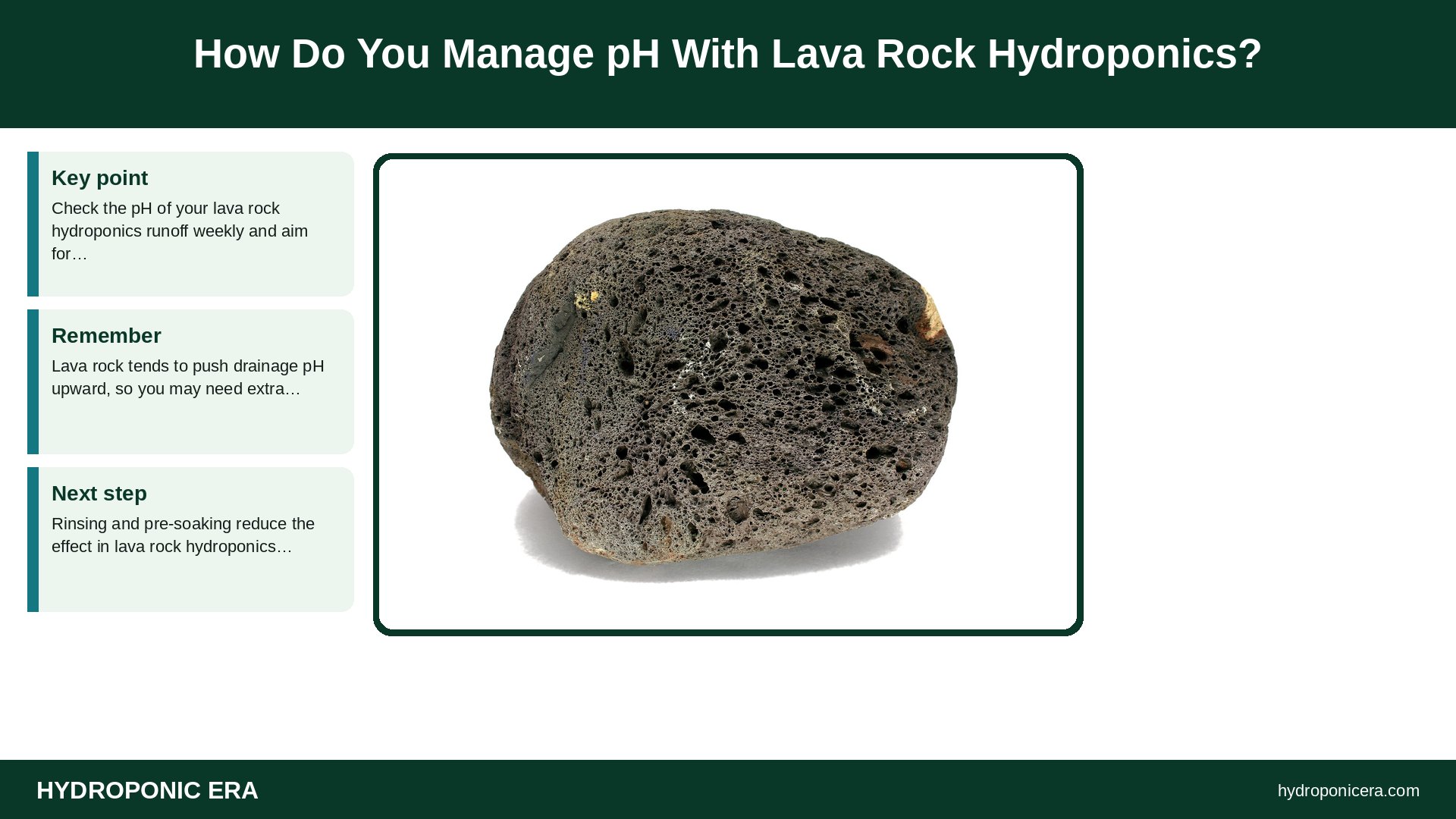
Check the pH of your lava rock hydroponics runoff weekly and aim for the usual hydroponic range of 5.5–6.5. Lava rock tends to push drainage pH upward, so you may need extra acid in your nutrient solution at first. Rinsing and pre-soaking reduce the effect in lava rock hydroponics over a few weeks.
Measure the solution going in and the runoff coming out. If runoff is far higher, flush with plain pH-adjusted water and shorten the time between irrigations so salts do not build up. Our guide to EC and TDS in hydroponics explains how to read the numbers.
How Often Should You Water Lava Rock Hydroponics?
Water lava rock hydroponics beds more often than other media, usually every 2–4 hours during the day in a drip or flood-and-drain system. Short cycles keep roots moist without leaving them sitting in water. A plug-in timer is essential for lava rock hydroponics, and the schedule should shrink or grow with plant size and room temperature.
- Seedlings: 4–6 short cycles a day with a coir blend.
- Leafy greens: 4–8 cycles of a few minutes each.
- Fruiting crops: frequent drip with runoff of roughly 10–20% to prevent salt buildup.
Watch the plants first. Wilting in the afternoon means the cycles are too far apart. Constant wet rock with yellowing leaves means too frequent. The media comparison and clay pebbles guide show alternatives that hold a bit more water.
Is Lava Rock Hydroponics Better Than Clay Pebbles or Perlite?
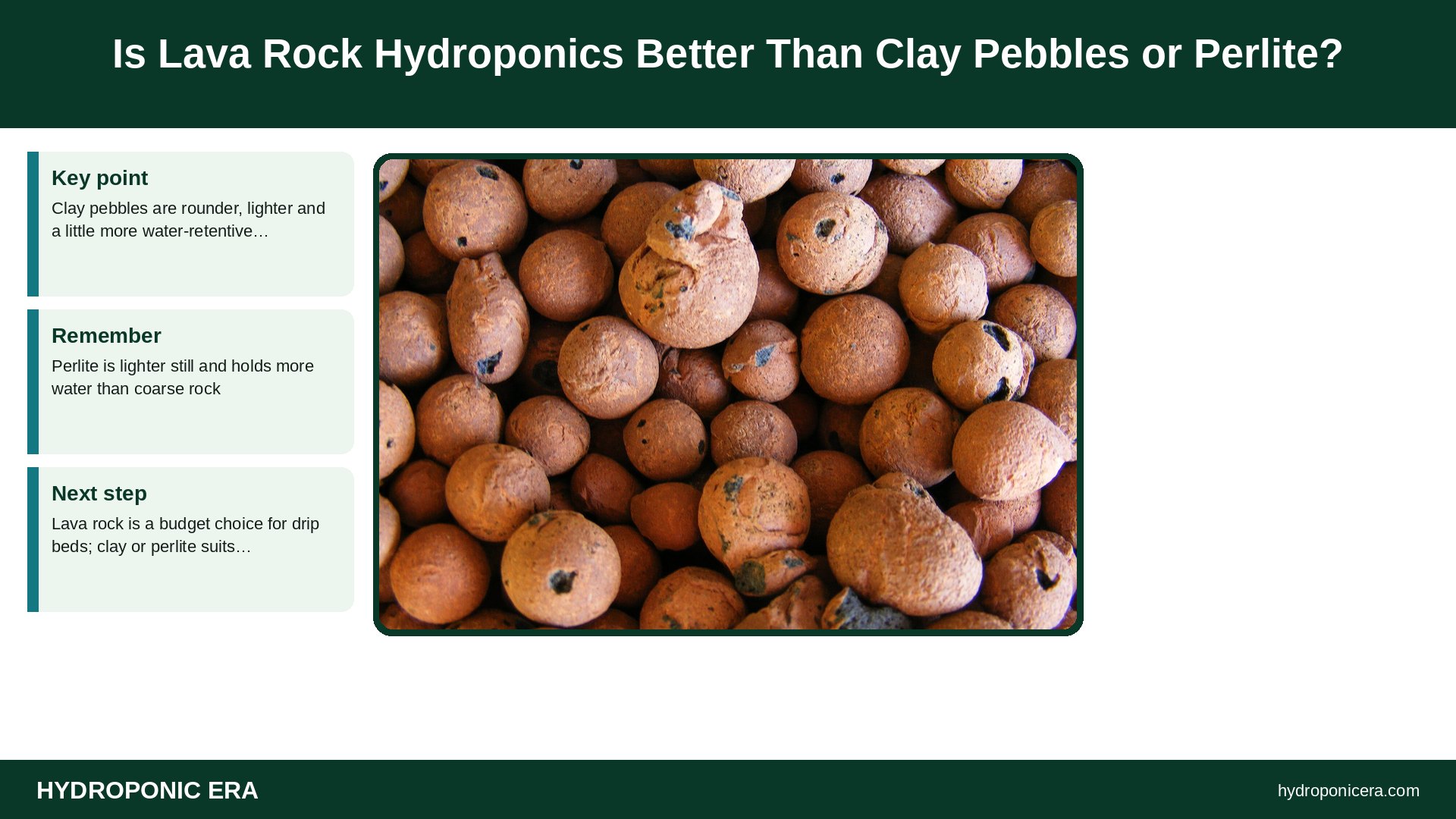
Clay pebbles are rounder, lighter and a little more water-retentive, while lava rock is cheaper and heavier but sharper and more alkaline. Perlite is lighter still and holds more water than coarse rock. Lava rock is a budget choice for drip beds; clay or perlite suits beginners better.
If you already run perlite or vermiculite, lava rock can replace the coarse fraction of a blend. Compare cost per cubic foot (0.03 m³), because rock is dense and shipping is heavy. Reuse is easy since it does not decompose, which keeps long-term lava rock hydroponics costs low.
FAQ About Lava Rock Hydroponics
Can I use lava rock from a garden store?
Yes, if it is plain scoria with no added dyes or coatings. Rinse it well and test runoff pH.
Does lava rock add nutrients?
Not in useful amounts. Treat it as inert and supply all nutrients in the solution.
Can I reuse lava rock?
Yes. Clear roots, rinse, soak in a sanitizer, then rinse again before the next crop.
Is lava rock safe for aquaponics?
Many aquaponic growers use it in media beds, but test pH because it can drift upward and stress fish.
Why are my plants wilting in lava rock?
The medium drains fast. Shorten the time between irrigation cycles or blend in coco coir.
Sources
- Horticulturae (MDPI) — Physical Properties of the Canary Islands’ Volcanic Pyroclastic Materials as Horticultural Substrates
- HortScience — A New Local Sustainable Inorganic Material for Soilless Culture in Spain: Granulated Volcanic Rock
- Revista Mexicana de Ciencias Agrícolas — Physical and chemical evaluation of volcanic rocks and its use for tulip production
- International Society for Horticultural Science — Tomato production in different sizes of “tezontle”
- Photo credits (Wikimedia Commons, edited with titles): South Sister lava flows, USGS by C. Dan Miller, USGS/Cascades Volcano Observatory (Public domain); Scoria Macro Digon3 by “Jonathan Zander (Digon3)” (CC BY-SA 3.0); Scoria Macro Digon3 by “Jonathan Zander (Digon3)” (CC BY-SA 3.0); Hydroton by Lucis (CC BY-SA 3.0)