
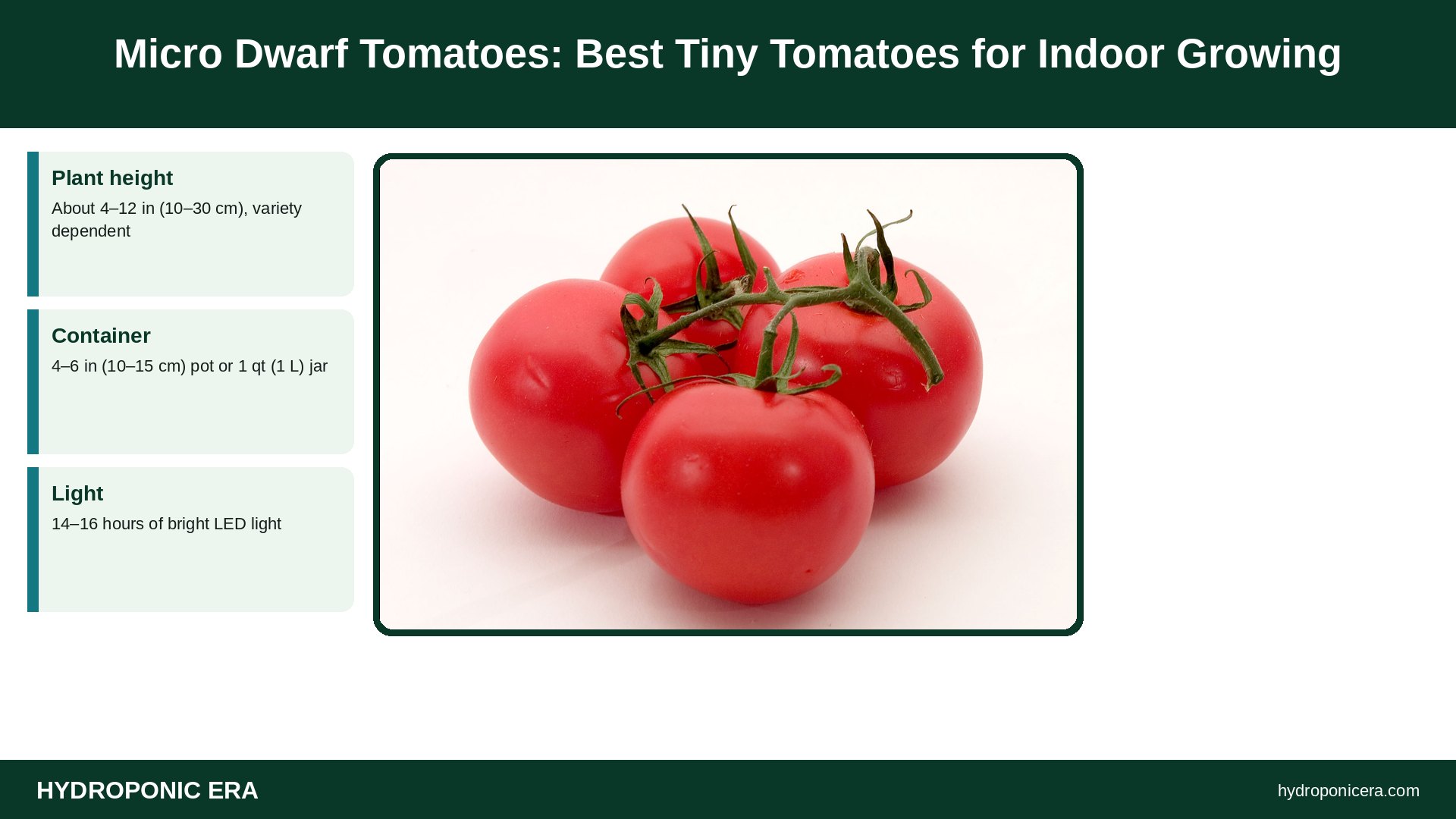
What are micro dwarf tomatoes? Micro dwarf tomatoes are tiny, compact plants that stay roughly 4–12 in (10–30 cm) tall and fit in a small pot or hydroponic site. The best known is Micro-Tom, released by the University of Florida in 1989. They suit windowsills, grow shelves and small Kratky jars indoors.
Key takeaway: Choose a true miniature dwarf variety, give it bright light for 14–16 hours a day, keep the root zone aerated, and hand-pollinate flowers indoors. Expect small cherry-size fruit, not big slicers, and plan on one plant per small container.
| Factor | Micro dwarf target |
|---|---|
| Plant height | About 4–12 in (10–30 cm), variety dependent |
| Container | 4–6 in (10–15 cm) pot or 1 qt (1 L) jar |
| Light | 14–16 hours of bright LED light |
| Temperature | About 65–80°F (18–27°C) |
| Fruit size | Small cherry type |
What Makes Micro Dwarf Tomatoes Different?
Micro dwarf tomatoes differ from regular dwarf and patio tomatoes because they are much smaller and more compact. University of Florida breeders J.W. Scott and B.K. Harbaugh released Micro-Tom in 1989 as a miniature pot tomato. In their trials it stayed roughly 4–8 in (10–20 cm) tall, depending on pot size and season.
Later UF releases such as Micro-Tina and Micro-Gemma, described in UF/IFAS EDIS publication HS224, were bred for the same small-pot use. Because the plants are so small, Micro-Tom also became a popular model plant for tomato research, as a 2025 review in Horticulture Advances explains.
- Determinate growth: plants stop growing at a set size.
- Short internodes: leaves and fruit sit close together.
- Fast cycle: small plants flower early.
- Small fruit: cherry-size or smaller.
Which Micro Dwarf Tomatoes Should You Grow?
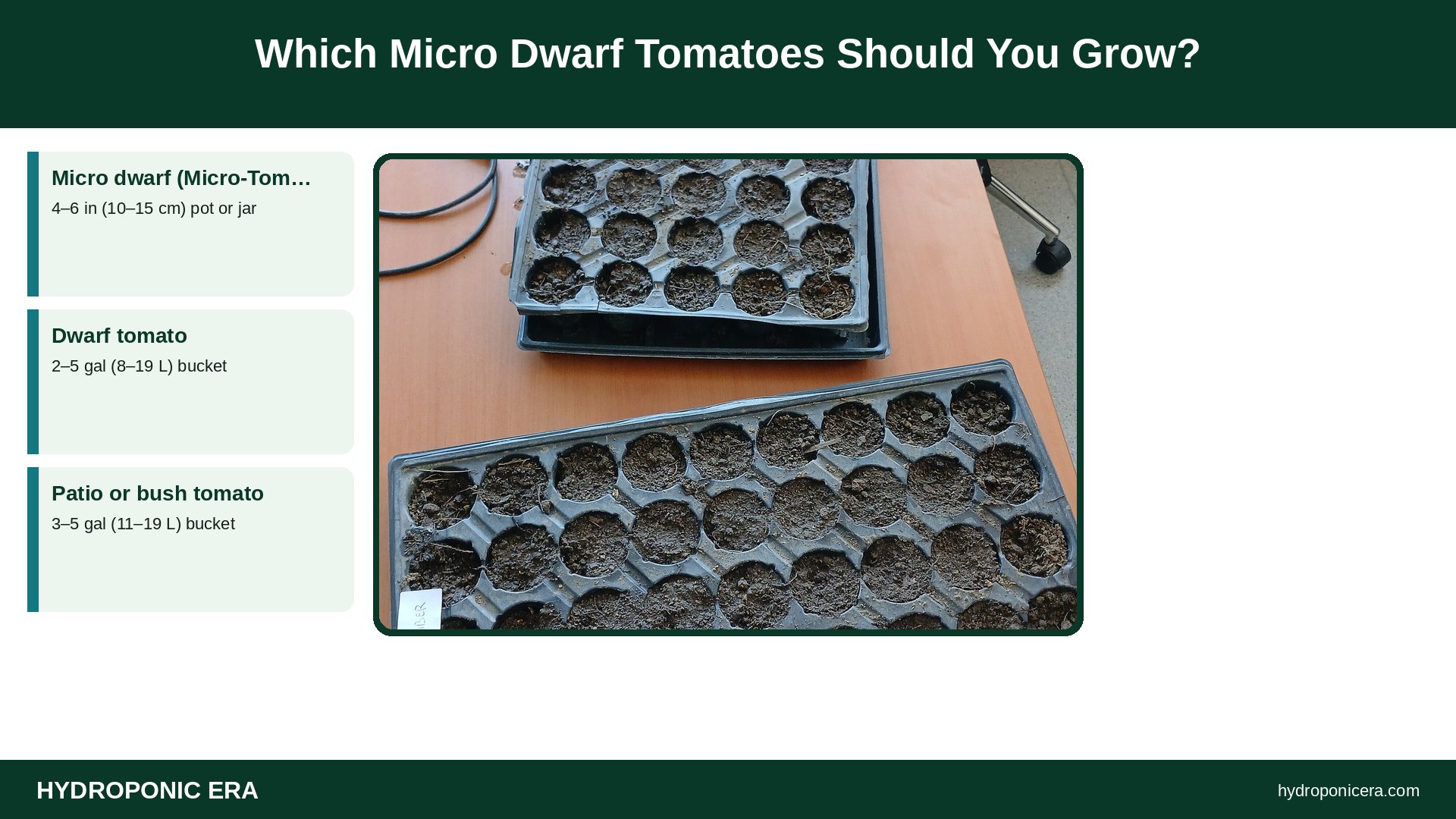
Good micro dwarf tomatoes for beginners include Micro-Tom and other true miniature varieties sold for pots and windowsills. Read the seed packet for mature height. If a seed company lists a plant at 2–3 ft (60–90 cm), it is a dwarf or patio type, not a micro dwarf, and it needs a bigger container.
| Type | Typical height | Best container |
|---|---|---|
| Micro dwarf (Micro-Tom style) | Under about 1 ft (30 cm) | 4–6 in (10–15 cm) pot or jar |
| Dwarf tomato | About 2–4 ft (60–120 cm) | 2–5 gal (8–19 L) bucket |
| Patio or bush tomato | About 2–3 ft (60–90 cm) | 3–5 gal (11–19 L) bucket |
For bigger cherry plants, see our guide to growing cherry tomatoes hydroponically.
How Do You Grow Micro Dwarf Tomatoes Hydroponically?
To grow micro dwarf tomatoes hydroponically, start seeds in rockwool or plugs, move seedlings into a net pot over a small reservoir, and feed a fruiting-crop nutrient once flowers appear. A 1 qt (1 L) Kratky jar or a single deep water culture cup is enough for one plant because the root system stays small.
- Germinate seeds at about 75–80°F (24–27°C).
- Grow seedlings under LEDs for 14–16 hours a day.
- Transplant into a net pot when roots poke out of the plug.
- Feed a mild solution, then a tomato formula at flowering.
- Keep pH around 5.5–6.5 and top off with fresh solution.
- Pollinate open flowers every day or two.
- Harvest fruit when fully colored.
Our Kratky method guide explains passive jars, and pH and EC meters help you hold steady targets.
How Much Light Do Micro Dwarf Tomatoes Need?
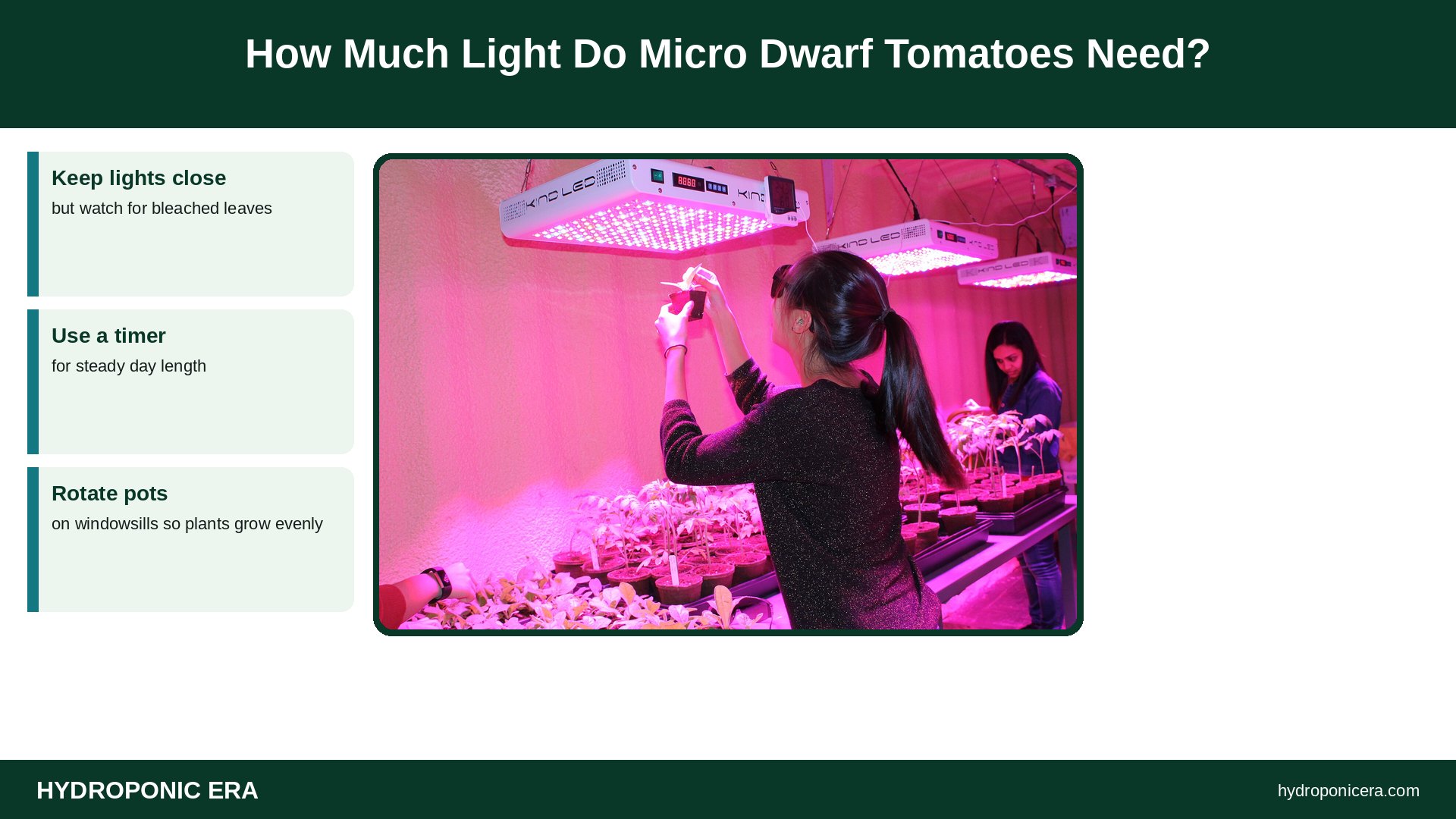
Micro dwarf tomatoes need bright light to flower and set fruit, even though the plants are small. Give them 14–16 hours of strong LED light a day and at least 6 hours of darkness. A sunny south window alone is often too weak in winter, so most indoor growers use a small full-spectrum LED panel.
- Keep lights close but watch for bleached leaves.
- Use a timer for steady day length.
- Rotate pots on windowsills so plants grow evenly.
See our chart on light distance by growth stage.
How Do You Pollinate Tomatoes Indoors?
Tomato flowers are self-fertile, but indoors there is no wind or bees to shake pollen loose. Tap the flower clusters, flick the stems, or touch each open flower with an electric toothbrush once a day or every other day around midday. Good pollination gives fuller trusses and fewer dropped flowers.
If flowers fall off without fruit, check heat, humidity and feeding. Our guide to blossom drop in tomatoes and peppers covers the common causes.
What Problems Affect Tiny Tomato Plants?
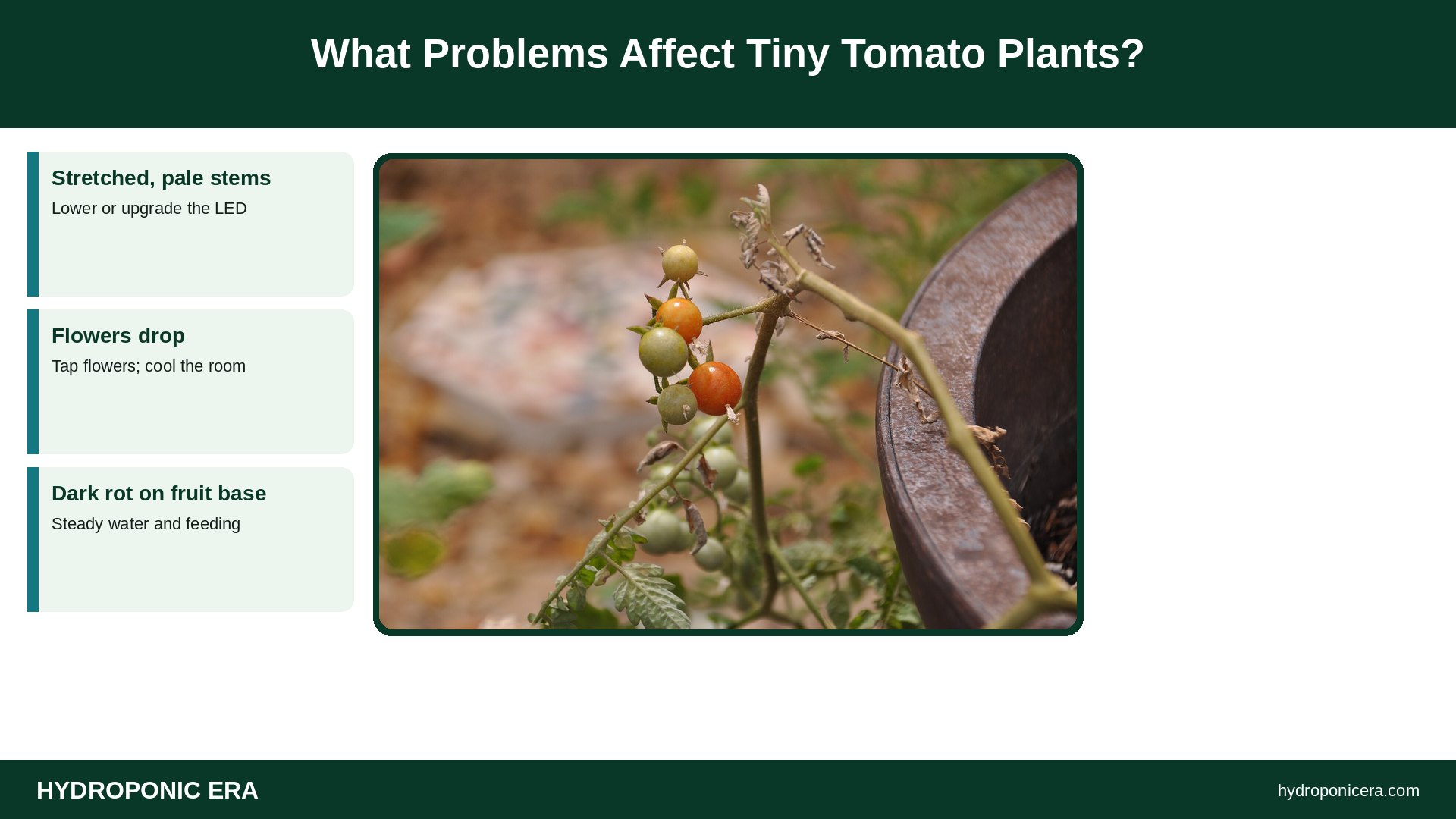
The most common problems with tiny tomato plants indoors are weak light, uneven watering, poor pollination and nutrient deficiency. Because the root zone is small, a pot can dry out or a jar can run low quickly. Check plants daily, keep the reservoir topped up, and watch the lower leaves for yellowing.
| Symptom | Likely cause | Fix |
|---|---|---|
| Stretched, pale stems | Too little light | Lower or upgrade the LED |
| Flowers drop | Poor pollination or heat | Tap flowers; cool the room |
| Dark rot on fruit base | Calcium supply problem | Steady water and feeding |
| Yellow lower leaves | Low nitrogen or old leaves | Check EC and nutrient strength |
| Sticky leaves, tiny insects | Aphids or whiteflies | Inspect and treat early |
How Long Until Micro Dwarf Tomatoes Produce Fruit?
Micro dwarf tomatoes usually flower and set fruit faster than full-size plants because they are compact and determinate. Exact timing depends on the variety, light and temperature, so use the days-to-maturity listed by your seed supplier as a guide. Because growth is determinate, most fruit ripens over a fairly short window.
To keep fresh tomatoes coming, start a new seed every few weeks. Staggered sowing gives you a steady supply from a single shelf, and it is the same idea we explain in our guide to continuous harvest planning.
Are Micro Dwarf Tomatoes Worth Growing?
Micro dwarf tomatoes are worth growing if you have little space and want a fun, quick indoor crop. They will not out-yield a full-size vine, but they let you grow ripe tomatoes on a desk, kitchen counter or classroom shelf. They are also a great way for kids and beginners to learn how tomatoes flower and fruit.
FAQ About Micro Dwarf Tomatoes
Can I grow these tomatoes in a Kratky jar?
Yes. One plant fits a 1 qt (1 L) jar with an air gap.
Do tiny tomatoes need staking?
Usually not, though heavy fruit may need a small stick.
Are they self-pollinating?
Yes, but tap flowers indoors to release pollen.
Can I save seeds?
Seeds from open-pollinated varieties can come true; hybrids may not.
Do they regrow after fruiting?
Determinate types decline after their main crop, so sow new seed.
Sources
- UF/IFAS EDIS — ‘Micro-Tina’ and ‘Micro-Gemma’ Miniature Dwarf Tomatoes (HS224)
- Springer Nature, Horticulture Advances (2025) — Micro-Tom tomato: from ornamental horticulture to fundamental research
- Martí et al. (2006), Journal of Experimental Botany — Genetic and physiological characterization of tomato cv. Micro-Tom
- Photo credits (Wikimedia Commons, edited with titles): Tomato je by Softeis (CC BY-SA 3.0); Pepper and tomato seedling trays at Boğaziçi University 2026 by Furkan Akkurt (CC BY-SA 4.0); Terramera scientists working in a climate-controlled growth chamber located in Vancouver, BC. The space uses LED lighting, which supports plant growth. (50188965171) by Simon Fraser University – Communications & Marketing (CC BY 2.0); Ripening Tomatoes by WarmPhoto (CC BY-SA 4.0)