
How does microgreens bottom watering work? Set a tray with drainage holes into a second tray of water for a few minutes, let the growing mix soak water up from below, then drain the extra. Microgreens bottom watering keeps leaves and stems dry, which Penn State and Mississippi State Extension recommend to limit mold and keep greens clean.
Key takeaway: Mist seeds until they sprout, then switch to bottom watering. Water only when the mix starts to feel dry, never leave trays standing in water, and add airflow. Use clean, drinking-quality water, since microgreens are eaten raw.
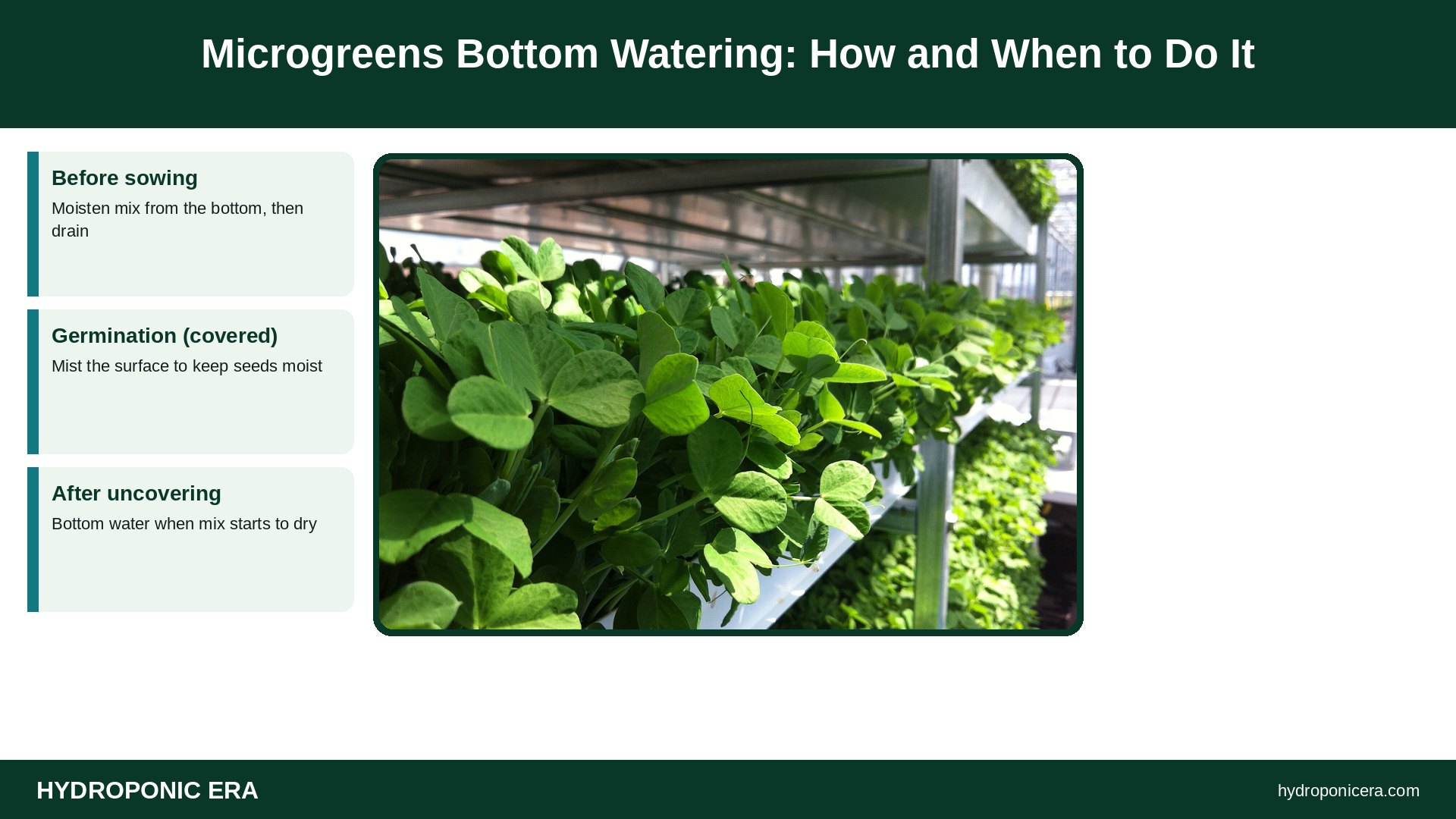
| Stage | How to water |
|---|---|
| Before sowing | Moisten mix from the bottom, then drain |
| Germination (covered) | Mist the surface to keep seeds moist |
| After uncovering | Bottom water when mix starts to dry |
| Before harvest | Water lightly a day ahead so leaves are dry |
Why Is Microgreens Bottom Watering Better?
Microgreens bottom watering is better because it wets the roots without wetting the dense canopy. Penn State Extension recommends watering trays from the bottom to limit contact between water and the greens. Dry leaves mean less mold, less damping off and cleaner shoots, and the delicate stems don’t get flattened by a stream of water.
- Less mold: wet, crowded leaves with poor airflow invite fungus.
- Cleaner greens: no mix splashed onto shoots.
- Even moisture: the whole tray soaks up water at once.
- Food safety: Penn State also stresses clean water and trays for microgreens.
How Do You Bottom Water Microgreens Step by Step?
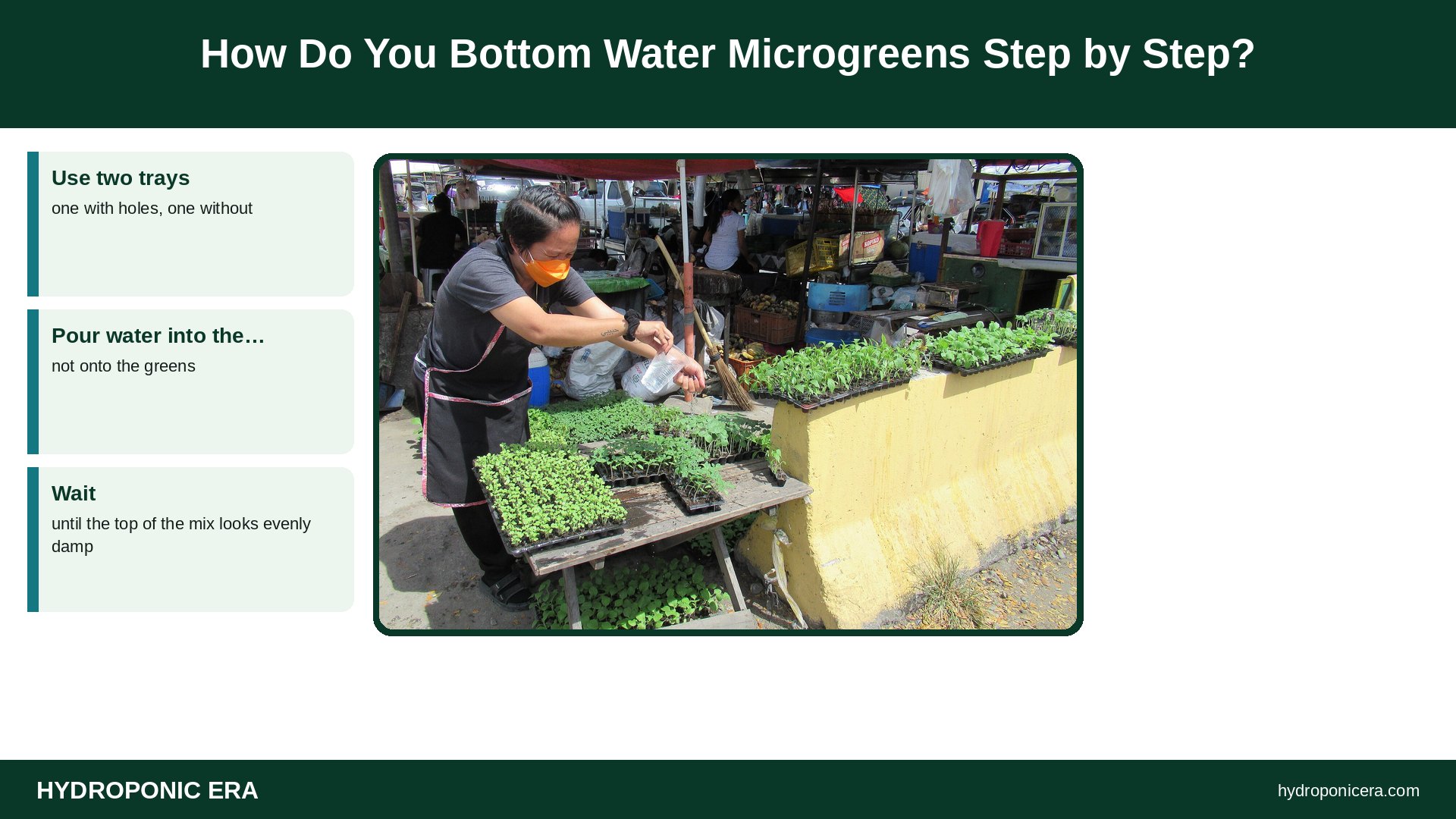
For microgreens bottom watering, nest your growing tray, which must have drainage holes, inside a solid tray. Pour about 1/4–1/2 in (6–13 mm) of clean water into the solid tray, wait 5–15 minutes for the mix to darken and soak through, then lift the growing tray, drain, and discard leftover water.
- Use two trays: one with holes, one without.
- Pour water into the bottom tray, not onto the greens.
- Wait until the top of the mix looks evenly damp.
- Lift and drain the growing tray for a minute.
- Dump leftover water; don’t let trays sit in it all day.
- Repeat when the mix feels lighter or the surface dries.
Our microgreens guide covers seeding and light.
How Often Should You Bottom Water Microgreens?
Bottom water microgreens only when the mix begins to dry, often once a day or every other day, depending on tray size, warmth and light. Penn State advises giving water only when needed and avoiding excess moisture. Lift the tray: a light tray needs water; a heavy one doesn’t.
| Condition | Watering need |
|---|---|
| Warm room, strong light | More often |
| Cool room, low light | Less often |
| Thin mat or hemp pad | Check daily; dries fast |
| Deep peat mix | Holds water longer |
Should You Bottom Water During Germination?
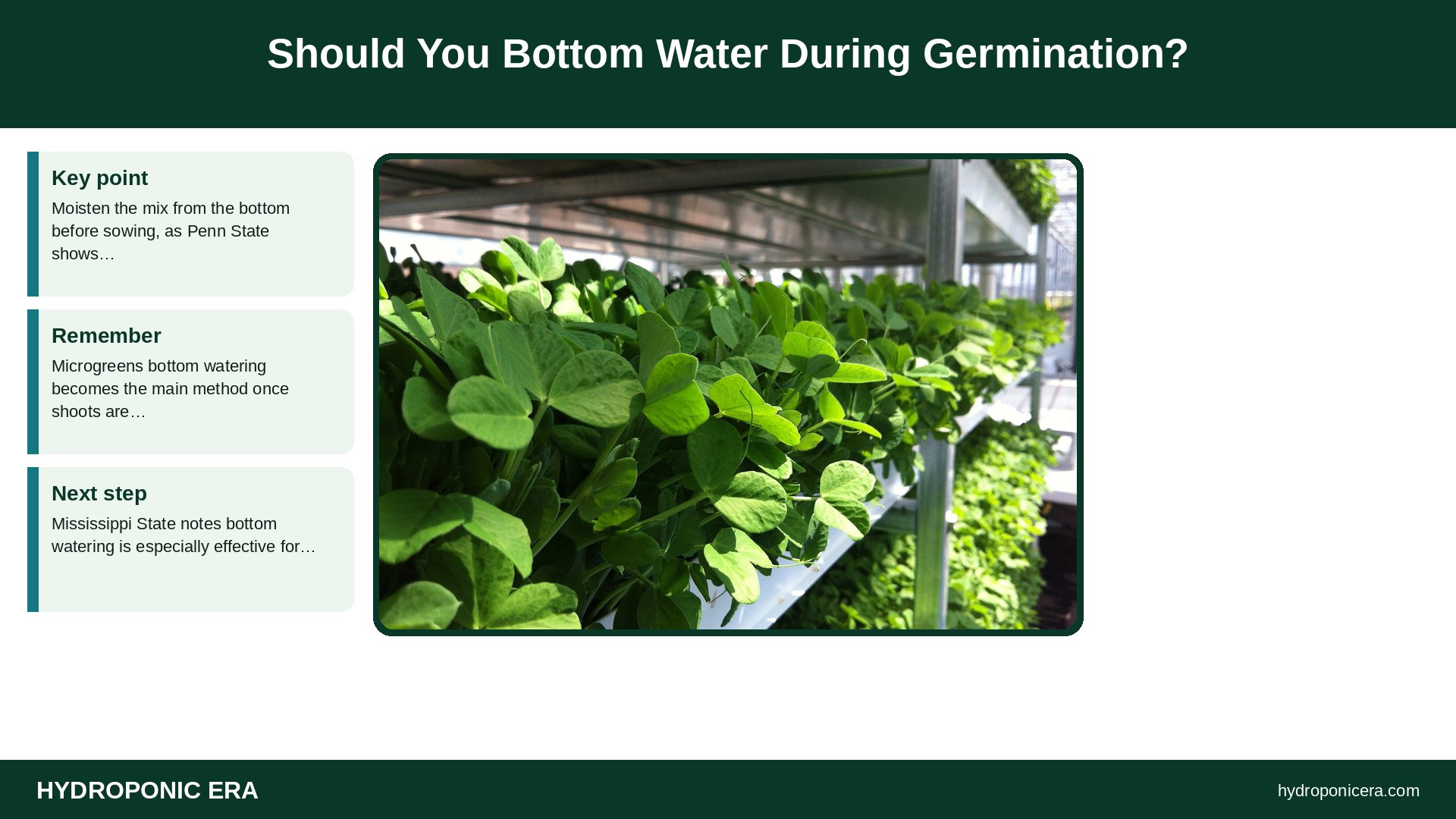
Partly. Moisten the mix from the bottom before sowing, as Penn State shows, then mist the seeds during germination while the tray is covered and dark. Microgreens bottom watering becomes the main method once shoots are up and the cover comes off. Mississippi State notes bottom watering is especially effective for windowsill growing.
Heavy seeds like peas and sunflowers are often weighted during germination. Keep them moist from below so the seeds stay in contact with the mix.
What Mistakes Happen With Microgreens Bottom Watering?
The biggest microgreens bottom watering mistakes are overwatering, leaving trays in standing water, and using trays without enough drainage holes. These keep the mix soggy and starve roots of air, which leads to mold, sour smells and damping off. Dirty trays and stale water also raise food safety risks.
- Soggy mix: water less often and drain fully.
- Mold patches: add a small fan and space trays apart.
- Dry top, wet bottom: soak a little longer so water reaches the surface.
- Algae on mats: reduce water and light on exposed areas.
See our guide to cloudy solution causes if you feed nutrients.
Can You Add Nutrients When Bottom Watering Microgreens?
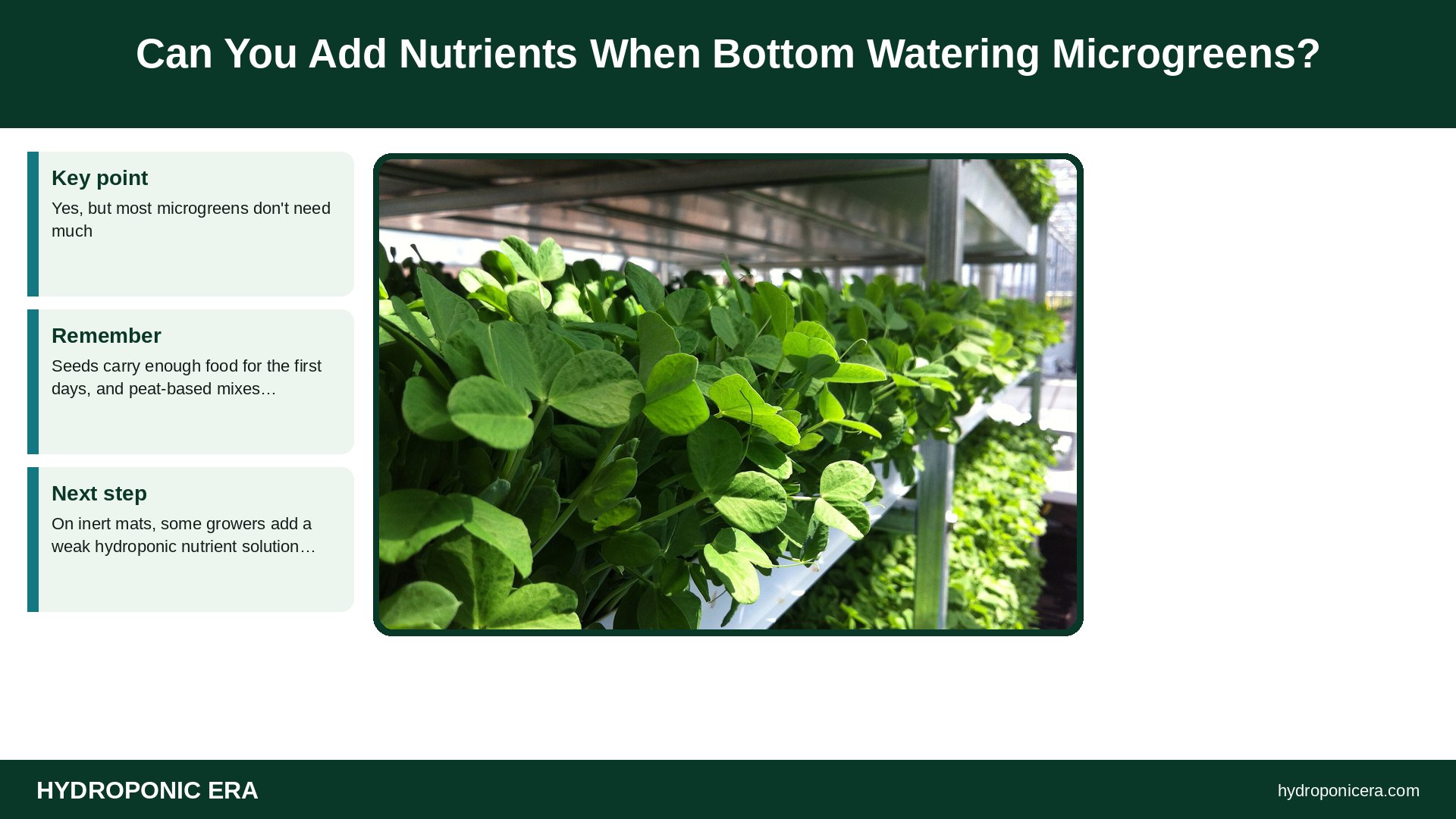
Yes, but most microgreens don’t need much. Seeds carry enough food for the first days, and peat-based mixes often contain some starter fertilizer. On inert mats, some growers add a weak hydroponic nutrient solution during bottom watering after germination. Keep it dilute, since microgreens are harvested young.
A 2021 Horticulturae study on spinach microgreens found that the nutrient feeding regime affected yield and mineral content, so feeding can matter for some crops. Start with plain water and test a weak feed on a single tray.
What Trays Work Best for Bottom Watering?
The best setup for microgreens bottom watering is a shallow tray with drainage holes nested inside a solid tray of the same size. Mississippi State notes the standard 10 by 20 in (25 by 51 cm) flat works well. Food-grade plastic that you can wash and sanitize between crops is ideal.
- Use trays rated for food contact.
- Wash with soap, rinse and sanitize between uses.
- Store dry to avoid mold between crops.
Does Microgreens Bottom Watering Work on Grow Mats?
Yes, with care. Microgreens bottom watering works on hemp, coconut and other mats, but thin mats hold less water and dry faster than soil mixes. Mississippi State Extension notes that with grow mats you should take care not to overwater or dislodge the germinating seeds. Add a shallow layer of water and check mats daily.
| Medium | Water holding | Bottom watering tip |
|---|---|---|
| Peat and perlite mix | High | Water less often; drain well |
| Coconut coir | High | Rinse coir before use |
| Hemp or jute mat | Moderate | Check daily; shallow water |
| Rockwool sheet | Moderate to high | Pre-soak; avoid soggy sheets |
Hydroponic growers often use mats with a weak feed; our guide to selling microgreens covers scaling up.
How Do You Keep Microgreens Bottom Watering Clean?
Keep microgreens bottom watering clean by using fresh drinking water each time, washing trays between crops, and never reusing standing water. Penn State Extension’s food safety guidance for microgreens stresses clean water, clean surfaces and good hygiene because microgreens are usually eaten raw. Wash hands before handling trays and harvesting.
FAQ About Microgreens Bottom Watering
How long should microgreens sit in water?
Usually 5–15 minutes, until the mix is evenly damp.
Can I bottom water without holes in the tray?
No. Water must pass up through drainage holes.
Is tap water OK?
Use drinking water, as Penn State suggests.
Should I mist after germination?
Rarely. Bottom water to keep leaves dry.
Does bottom watering prevent all mold?
No, but it helps a lot when paired with airflow.
Sources
- Penn State Extension — A Step-By-Step Guide for Growing Microgreens at Home
- Penn State Extension — Ensuring Food Safety in Microgreens Production
- Mississippi State University Extension — Growing Microgreens for the Mississippi Gardener
- Petropoulos et al. (2021), Horticulturae — Nutrient Solution Feeding Regime and Spinach Microgreens
- Photo credits (Wikimedia Commons, edited with titles): Lufa Farms Microgreens in Trays by Lufa Farms (CC BY-SA 2.0); Bulakeña vegetable market vendor watering vegetable seedling for sale 07 by FBenjr123 (CC BY-SA 4.0); Lufa Farms Microgreens in Trays by Lufa Farms (CC BY-SA 2.0); Lufa Farms Microgreens in Trays by Lufa Farms (CC BY-SA 2.0)