
CMH vs LED: which grow light is better? For most growers in 2026, LED wins. In CMH vs LED tests, the best ceramic metal halide fixtures measured about 1.46–1.58 µmol/J, while many LED fixtures on the DesignLights Consortium list exceed 2.5 µmol/J. CMH costs less up front, but uses more power and adds heat.
Key takeaway: Choose LED for efficiency, low heat and long life. Consider CMH only if you already own fixtures, want radiant heat in a cool room, or prefer its natural-looking light. Always compare fixtures by photon efficacy (µmol/J), not watts.
| Feature | CMH | LED |
|---|---|---|
| Measured efficacy | About 1.46–1.58 µmol/J in tests | About 1.8–3.7 µmol/J on the DLC list (2022) |
| Spectrum | Broad, sun-like | Fixed or tunable; white, red-heavy and more |
| Heat at the plant | More radiant heat | Less radiant heat; heat sinks |
| Up-front cost | Lower | Higher, but falling |
| Bulb changes | Yes | No bulbs |
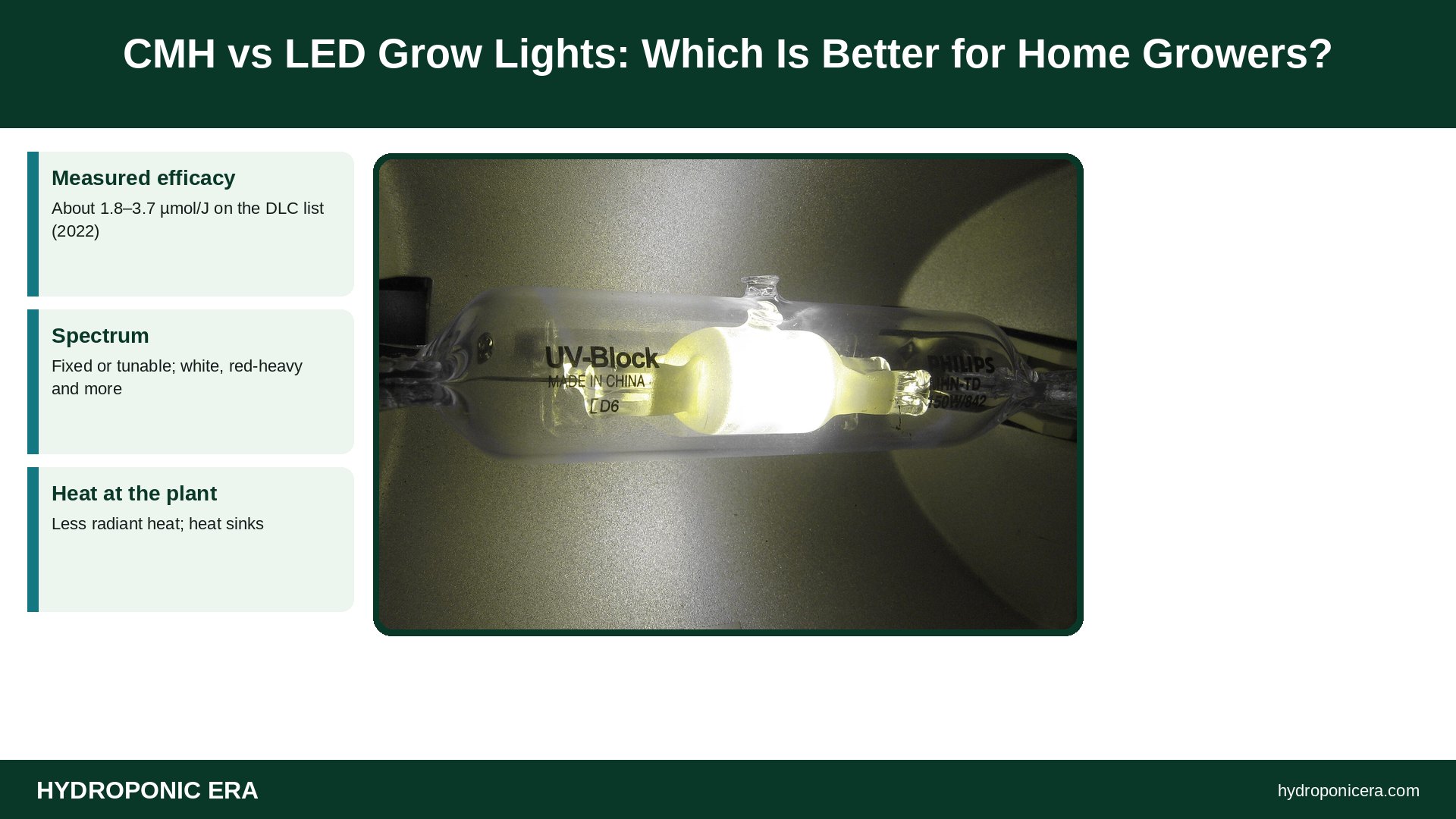
What Is the Difference in CMH vs LED Grow Lights?
The main CMH vs LED difference is how light is made. Ceramic metal halide is a high-intensity discharge lamp: an arc inside a ceramic tube excites metal salts to make broad-spectrum light, and it needs a ballast. LED fixtures use many small diodes on a circuit board with a driver, so spectrum and intensity can be tuned.
CMH lamps are often sold as 315 W or 630 W units. LEDs come in bars, boards and panels of many sizes. Both are used in homes and greenhouses, but LEDs now dominate new installs, as University of Kentucky horticulturists note.
Which Is More Efficient: CMH vs LED?
LED is more efficient. A 2014 PLOS One study by Nelson and Bugbee measured the best CMH fixture at 1.46 µmol/J, while the best LEDs then reached 1.66–1.70 µmol/J. A 2022 University of Kentucky review found LED fixtures on the DLC Qualified Products List ranged from 1.81 to 3.69 µmol/J, with over half at 2.5 or higher.
| Light type | Efficacy reported | Source |
|---|---|---|
| Best CMH (2014) | 1.46 µmol/J | PLOS One |
| CMH lamp (2021 test) | 1.58 µmol/J | AgriEngineering |
| Best LED (2014) | 1.66–1.70 µmol/J | PLOS One |
| DLC-listed LEDs (2022) | 1.81–3.69 µmol/J | Univ. of Kentucky |
Higher efficacy means more plant light per dollar of electricity. Learn how to measure it in our canopy PPFD guide.
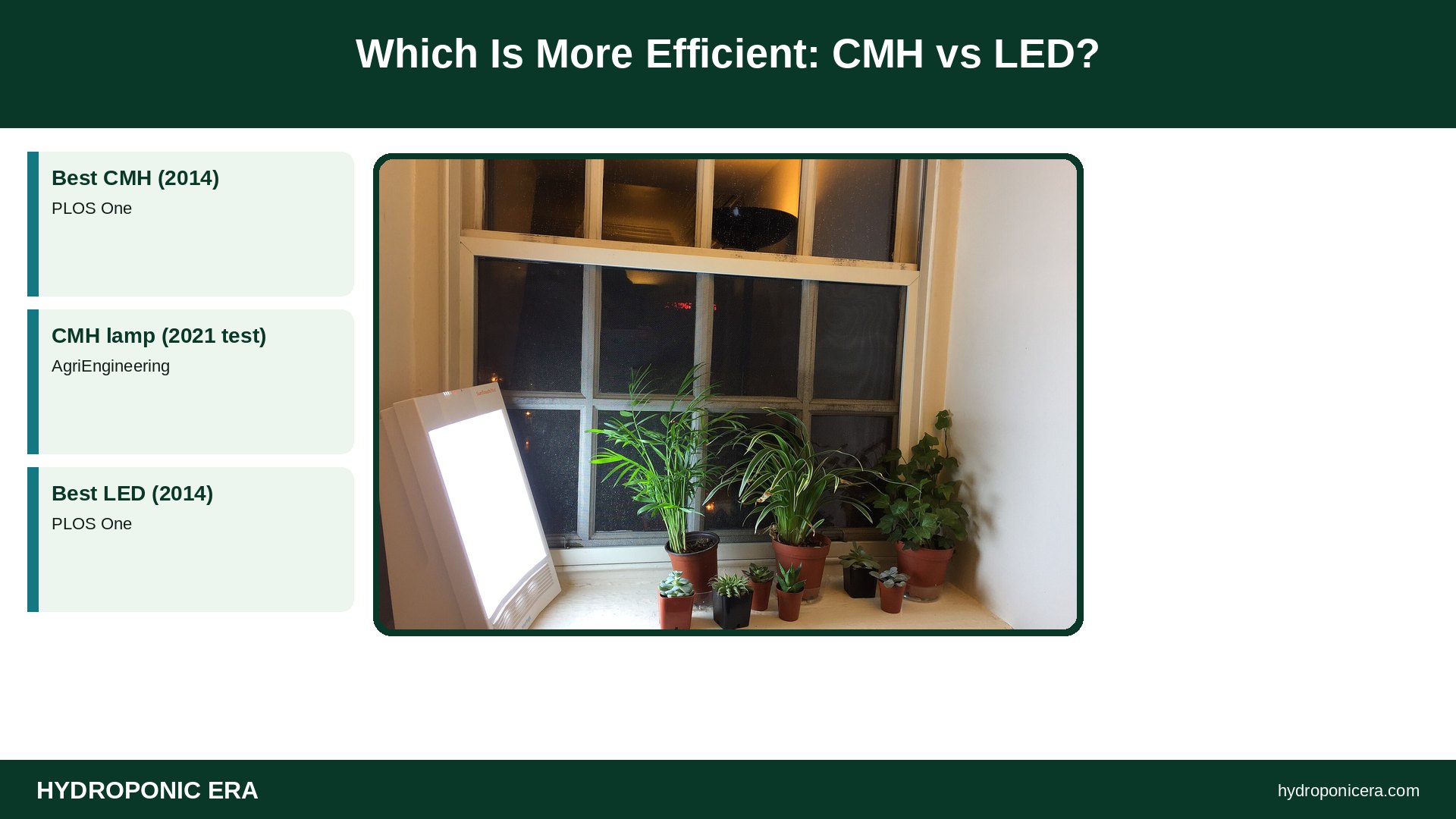
Is CMH Spectrum Better for Plants Than LED?
Not necessarily. CMH has a broad, continuous spectrum that looks natural and includes small amounts of UV and far-red, which some growers like. But in CMH vs LED comparisons, a good full-spectrum white LED also gives plants the light they need for photosynthesis, and the University of Kentucky notes white LEDs improve color rendering for people working around plants.
- Red LEDs are about 30% more efficient than blue LEDs, per the Kentucky review.
- Blue LEDs are about 20–25% more efficient than white LEDs.
- White-heavy fixtures trade a little efficacy for easier viewing.
For basics on light color, see our grow lights guide.
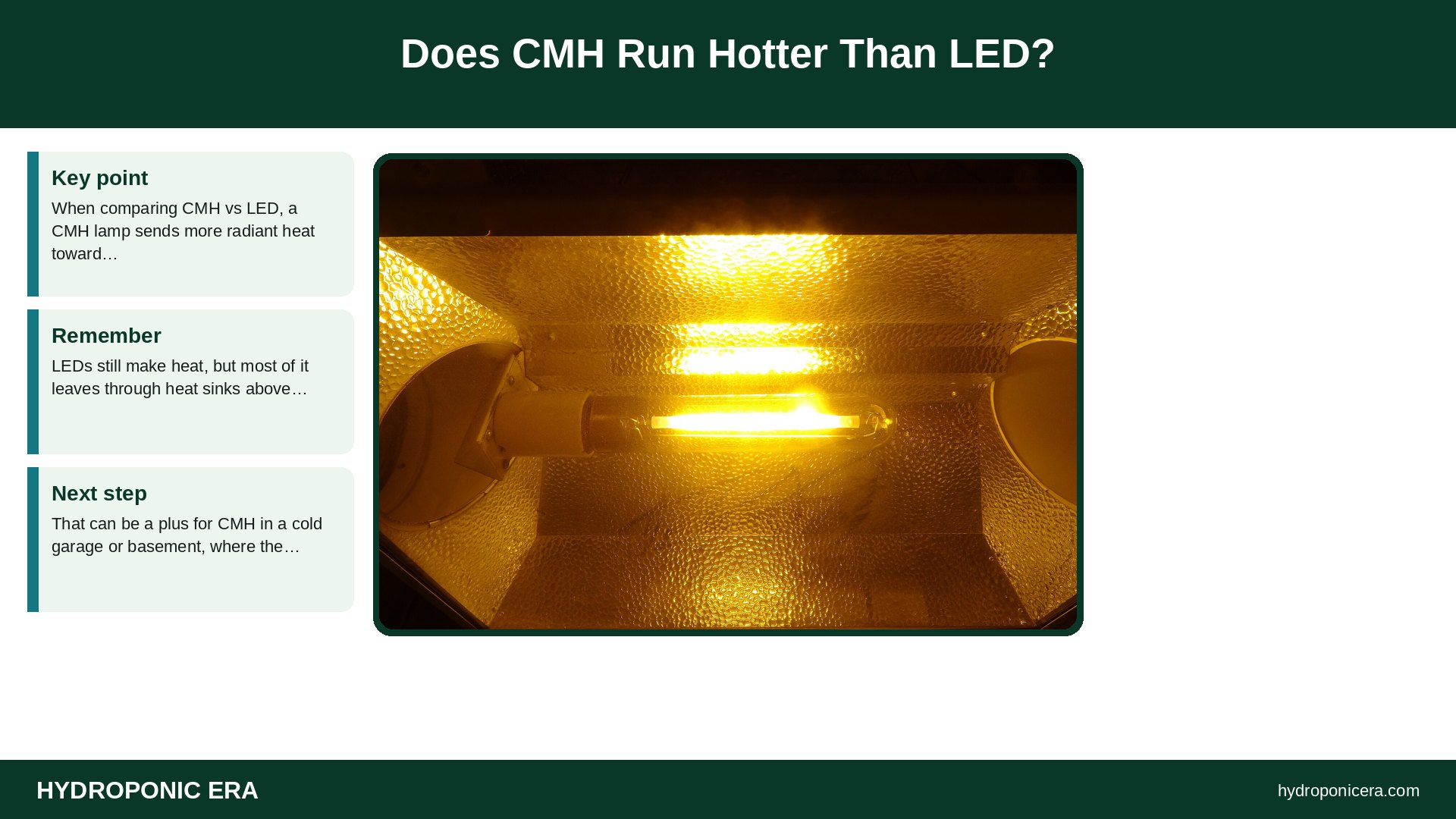
Does CMH Run Hotter Than LED?
Yes, at the plant level. When comparing CMH vs LED, a CMH lamp sends more radiant heat toward the canopy, so you usually hang it higher and may need more ventilation. LEDs still make heat, but most of it leaves through heat sinks above the light, so leaves stay cooler at the same light level.
That can be a plus for CMH in a cold garage or basement, where the extra warmth helps. In a small tent or hot climate, the heat becomes a cost because you need fans or air conditioning. Our guide to hydroponic airflow and fans helps size ventilation.
Which Costs Less Over Time: CMH vs LED?
Usually LED, over several years. The 2014 PLOS One analysis found LEDs then cost five to ten times more per photon up front, making five-year costs higher. Since then, LED efficacy has risen to well above CMH and prices have dropped, so the CMH vs LED cost gap has narrowed or reversed for most home growers.
- Find each fixture’s PPF (µmol/s) and input watts.
- Divide PPF by watts to get µmol/J.
- Estimate yearly power: watts × hours per day × 365 ÷ 1,000 = kWh.
- Multiply by your electric rate and add bulb replacements for CMH.
- Add cooling costs if you live somewhere hot.
When Does CMH Still Make Sense?
CMH still makes sense if you already own good fixtures, need some radiant heat in a cool space, or want a broad spectrum on a tight up-front budget. In those CMH vs LED cases, a 315 W CMH can grow healthy herbs, greens and fruiting plants. Replace lamps on the maker’s schedule, since output drops as they age.
For a new build, an LED with a high, published efficacy is the safer long-term choice. Look for fixtures listed by the DesignLights Consortium if you want verified numbers.
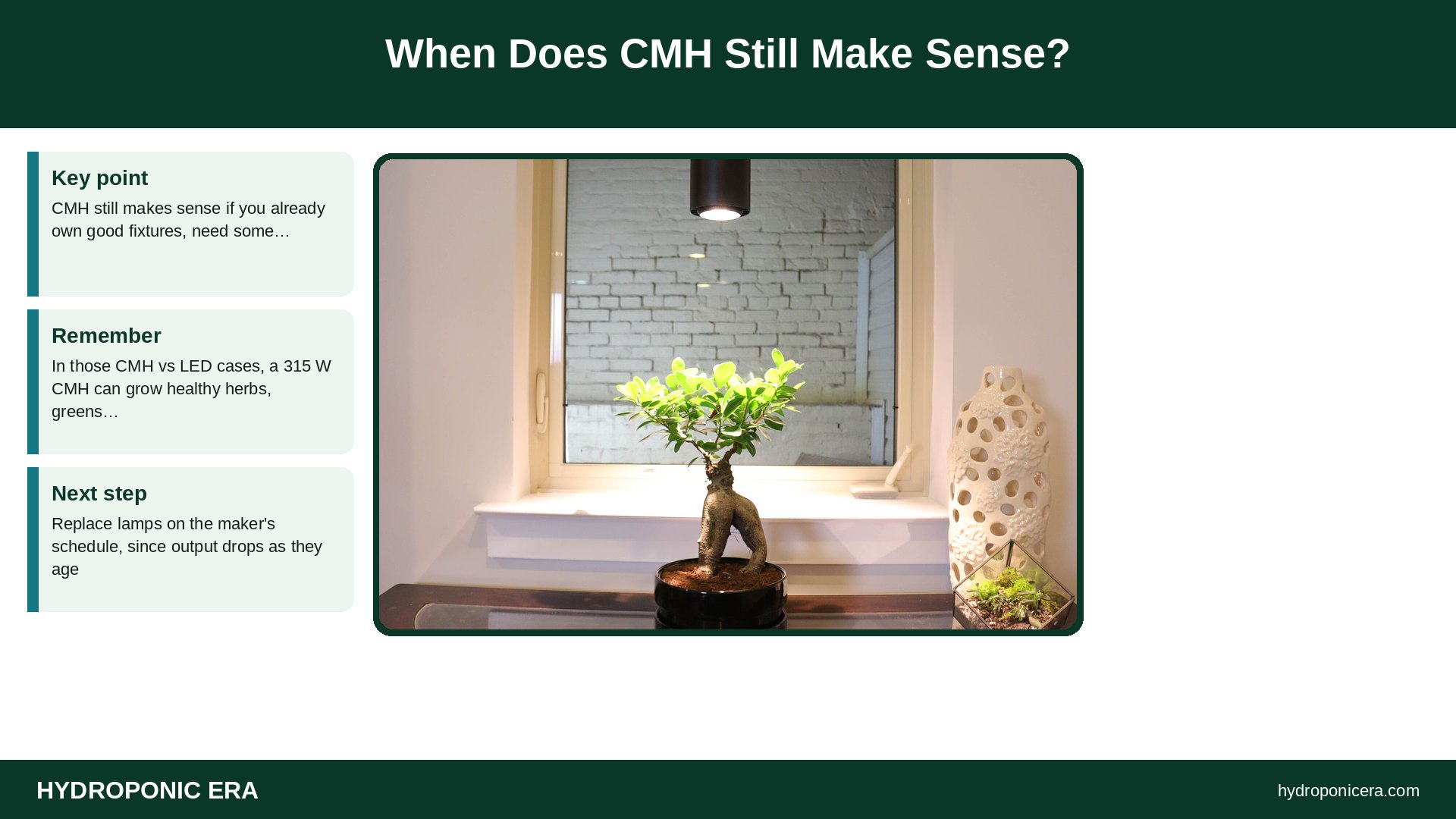
How Do You Choose Between CMH and LED?
Choose by your space, budget and climate. Measure your grow area, decide your target light level, and compare fixtures by µmol/J and PPF. For small tents, shelves and hot rooms, LED is usually best. For cold spaces where you already own a CMH, it can keep working well until you upgrade.
| Your situation | Better pick |
|---|---|
| New setup, any size | LED |
| Hot climate or small tent | LED |
| Cold garage, existing CMH | CMH until replacement |
| Need tunable spectrum | LED |
Set height with our light distance guide.
How Long Do CMH and LED Grow Lights Last?
LED fixtures usually last much longer than CMH lamps because there is no bulb to burn out; output fades slowly over many years. CMH lamps lose output as they age and need periodic replacement. The 2014 PLOS One analysis found long-term maintenance costs were small for both, so in CMH vs LED decisions, electricity usually matters more than parts.
- Check the warranty: good LED makers publish lifetime and warranty terms.
- Keep LEDs cool: the Kentucky review notes efficacy drops as temperature rises.
- Track lamp hours on CMH so you can replace bulbs on schedule.
FAQ About CMH vs LED
Is CMH the same as metal halide?
It is a type of metal halide with a ceramic arc tube; it is more efficient than older quartz MH.
Do CMH lights emit UV?
Some UV, yes. Follow the maker’s safety notes.
Can I mix CMH and LED?
Yes. Some growers add CMH for spectrum or heat.
Is a 315 W CMH enough for a 3 x 3 ft (0.9 x 0.9 m) tent?
Check the fixture’s PPF and footprint chart.
What does µmol/J mean?
Micromoles of plant-usable light per joule of electricity.
Sources
- Nelson & Bugbee (2014), PLOS One — Economic Analysis of Greenhouse Lighting: LEDs vs. HID Fixtures
- University of Kentucky Greenhouse Horticulture (2022) — A Closer Look at LED Efficacy
- AgriEngineering (2021) — On the Technical Performance Characteristics of Horticultural Lamps
- DesignLights Consortium — Horticultural Lighting Qualified Products List
- Photo credits (Wikimedia Commons, edited with titles): Closeup Metal Halide Lamp by Dave H. Ozguy89 at en.wikipedia (Public domain); Potted plants succulents under grow light Nov 2016 by Asdfjrjjj (CC BY-SA 4.0); HPS (High Pressure Sodium) grow light bulb by Plantlady223 (CC BY-SA 4.0); Aspect Black 20W Growlight over Bonsai by Hotmilk400 (CC BY-SA 4.0)