
When should you use potassium sulfate in hydroponics? Use potassium sulfate, also called sulfate of potash (SOP), when you need potassium without extra nitrogen or chloride, plus some sulfur. It contains about 40–44% K and 17–18% S and dissolves at roughly 120 g/L. Never mix it with calcium nitrate in the same concentrated stock tank, because calcium sulfate will precipitate.
Key takeaway: SOP is a chloride-free potassium source that adds sulfur and less salinity per unit of K. It is less soluble than other potash salts, so dissolve it fully in warm, stirred water.
| Property | Potassium sulfate (K2SO4) | Source |
|---|---|---|
| Label grade | 0-0-50 | Texas A&M AgriLife |
| Potassium content | 40–44% K (48–53% K2O) | IPNI via USDA NRCS |
| Sulfur content | 17–18% S | IPNI via USDA NRCS |
| Solubility at 77°F (25°C) | About 120 g/L | IPNI via USDA NRCS |
| 1 g per gallon gives | About 110 ppm K and 45 ppm S | Texas A&M AgriLife |
| Stock tank rule | Keep away from calcium (Tank A) | Purdue, Ohio State |
What Is Potassium Sulfate?
Potassium sulfate (K2SO4) is a potash fertilizer commonly called sulfate of potash, or SOP. An International Plant Nutrition Institute fact sheet hosted by USDA NRCS says the K in it is no different from other potash fertilizers, but it also supplies sulfur, which plants need for protein synthesis and enzyme function. It is rarely found pure in nature.
Potassium drives fruit quality and water regulation. If leaves show scorched edges, read our potassium deficiency guide.
Why Choose SOP Over Potassium Nitrate?
Choose SOP when you need more potassium but not more nitrogen. Potassium nitrate adds both K and N, so raising K with it also raises N. The Ohio State tomato recipe uses this idea: its stage 1 stock contains no potassium nitrate but 20.7 g/L of K2SO4, because young tomatoes need limited N to avoid overly vegetative growth.
In later stages the same recipe adds potassium nitrate as N demand rises. SOP lets you adjust K and S independently. Compare with calcium nitrate and Epsom salt, the other common salts in a two-part mix.
Why Is SOP Better Than Potassium Chloride for Some Crops?
The IPNI fact sheet says K2SO4 is a very suitable source where chloride should be avoided. Its partial salt index is lower than some other potash fertilizers, so it adds less total salinity per unit of K. At 10 mmol/L, a K2SO4 solution has an EC less than a third of a KCl solution at the same concentration.
Texas A&M AgriLife data shows the difference clearly: 1 gram per gallon of muriate of potash (KCl) adds about 119 ppm chloride, while SOP adds none. In recirculating systems, unwanted ions build up over time, so a low-chloride source helps.
How Do You Dissolve Potassium Sulfate?
Dissolve it slowly in warm, stirred water. IPNI notes it is only one-third as soluble as KCl and lists about 120 g/L at 77°F (25°C). Fine particles under 0.015 mm dissolve faster for irrigation use. Purdue Extension says lukewarm to hot water speeds dissolving, and stock tanks need stirring by hand or with an electric agitator.
- Fill the tank partway with warm water.
- Add SOP gradually while stirring.
- Stay well below its solubility limit in concentrated stock.
- Allow a few hours to clear; Purdue notes anti-caking sludge may settle.
- Top up to final volume and stir again.
Can You Mix Potassium Sulfate With Calcium Nitrate?
Not in concentrated form. Purdue Extension warns that mixing calcium nitrate with magnesium sulfate or potassium sulfate forms insoluble calcium sulfate. Use a two-tank system: Purdue puts calcium, iron and half the potassium nitrate in one tank, with the remaining nutrients in the other. Ohio State’s tomato recipe also keeps K2SO4 and calcium nitrate in separate stock tanks.
The two stocks are diluted separately, so the ions only meet at low concentration in the reservoir. See stock tanks vs mixing per reservoir.
How Much Potassium Sulfate Do You Need?
It depends on your target. Texas A&M AgriLife lists that 1 gram dissolved in 1 gallon (3.8 L) gives about 110 ppm K and 45 ppm S. For a 100x tomato stock, Ohio State uses 20.7, 49.6 and 24.1 g/L of K2SO4 for stages 1, 2 and 3, alongside potassium nitrate and monopotassium phosphate.
- Check your target ppm in our hydroponic ppm chart.
- Recalculate S, because SOP and Epsom salt both add sulfate.
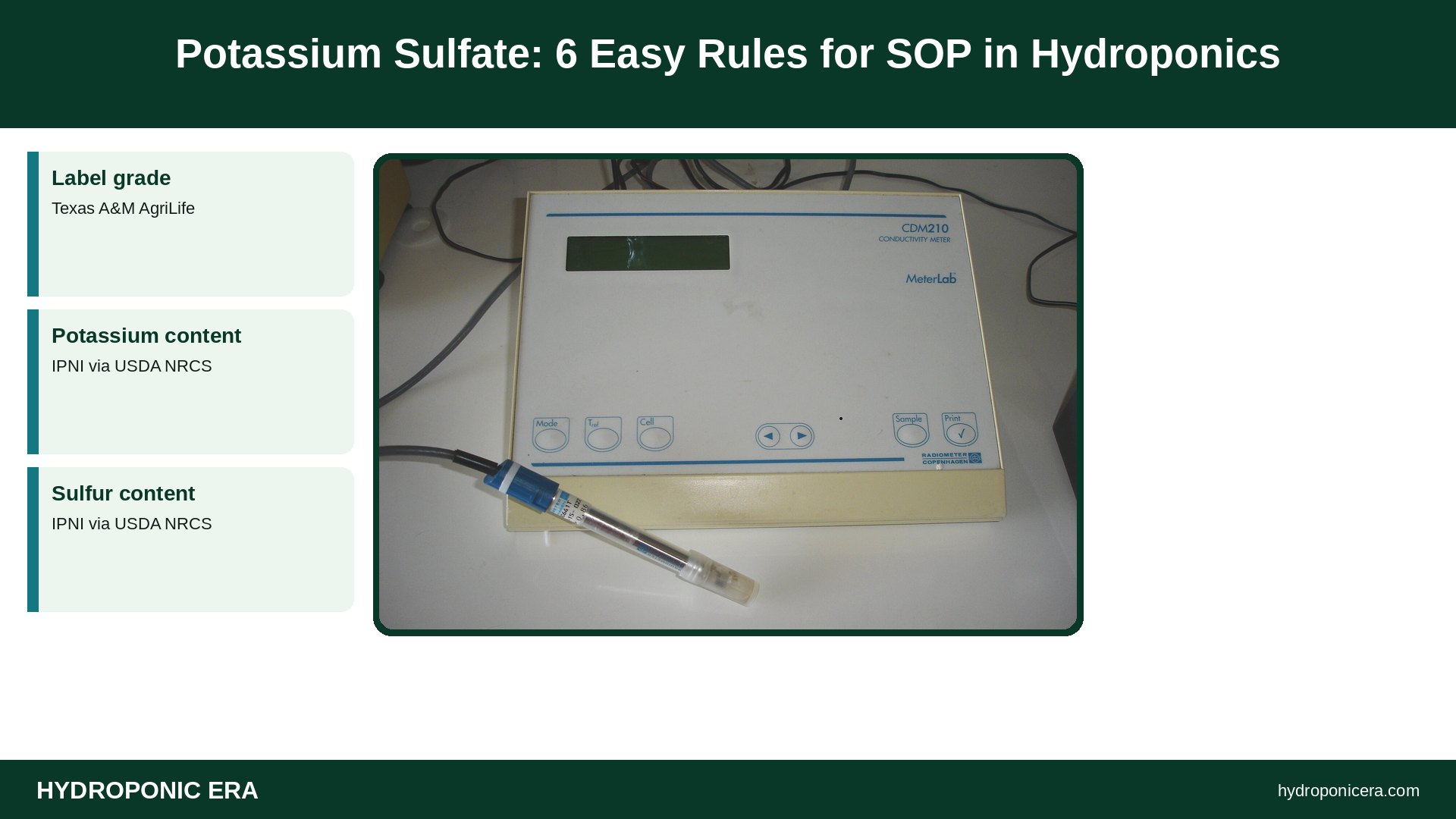
- Confirm the final mix with an EC meter.
What Are the Downsides of SOP?
Lower solubility is the main one. IPNI says it is not as commonly dissolved for irrigation unless extra sulfur is needed. Very high sulfate levels may be unnecessary for many crops, and the calcium sulfate risk demands careful tank separation. Product grades vary too, so buy a soluble or solution grade made for fertigation, as Purdue recommends.
If your water already carries sulfate, test it before adding SOP. Purdue Extension says it is very helpful to know what minerals are in your start water, and that EC only shows total salts, so use a lab to measure individual elements.
FAQ About Sulfate of Potash
Is potassium sulfate the same as potash?
Potash usually means potassium chloride, but the term covers all K fertilizers, including SOP.
What is the NPK of potassium sulfate?
It is labeled 0-0-50, with about 17–18% sulfur.
Does SOP change pH?
IPNI lists a solution pH of about 7.
Can I use SOP in the bloom stage?
Yes; it raises K without raising N.
Why is my stock tank cloudy?
Calcium may be mixing with sulfate; separate the tanks.
Sources
- IPNI Nutrient Source Specifics via USDA NRCS — Potassium Sulfate
- Ohio State University CFAES — Hydroponic Nutrient Solution for Greenhouse Tomato
- Purdue University Vegetable Crops Hotline — Fertilizer and Nutrient Solution Mixing Tips
- Texas A&M AgriLife — Fertilizing Greenhouse Crops
- Photo credits (Wikimedia Commons, edited with titles): Electrical conductivity meter by Nuno Nogueira (Nmnogueira) (CC BY-SA 2.5); Epsomite by WTucker (talk) (CC BY-SA 3.0); 20160617-AMS-LSC-9000 (61-sec.) (27334710733) by U.S. Department of Agriculture (Public domain); Pepper No. 30 by Edward Weston (Public domain)