
How do you grow romaine lettuce hydroponically? Romaine lettuce hydroponics works best in a cool room, about 65–75°F (18–24°C), with solution EC near 1.2–1.8 mS/cm and pH around 5.5–6.0. Start seeds in 1-inch (2.5 cm) plugs, transplant at 3–4 true leaves, then harvest about 30–40 days later. Strong airflow helps prevent tipburn, romaine’s most common problem.
Key takeaway: Romaine lettuce hydroponics is slower and fussier than leaf lettuce indoors. Keep temperatures cool, feed at a moderate EC, move air across the canopy, and harvest a little early if you see tipburn.
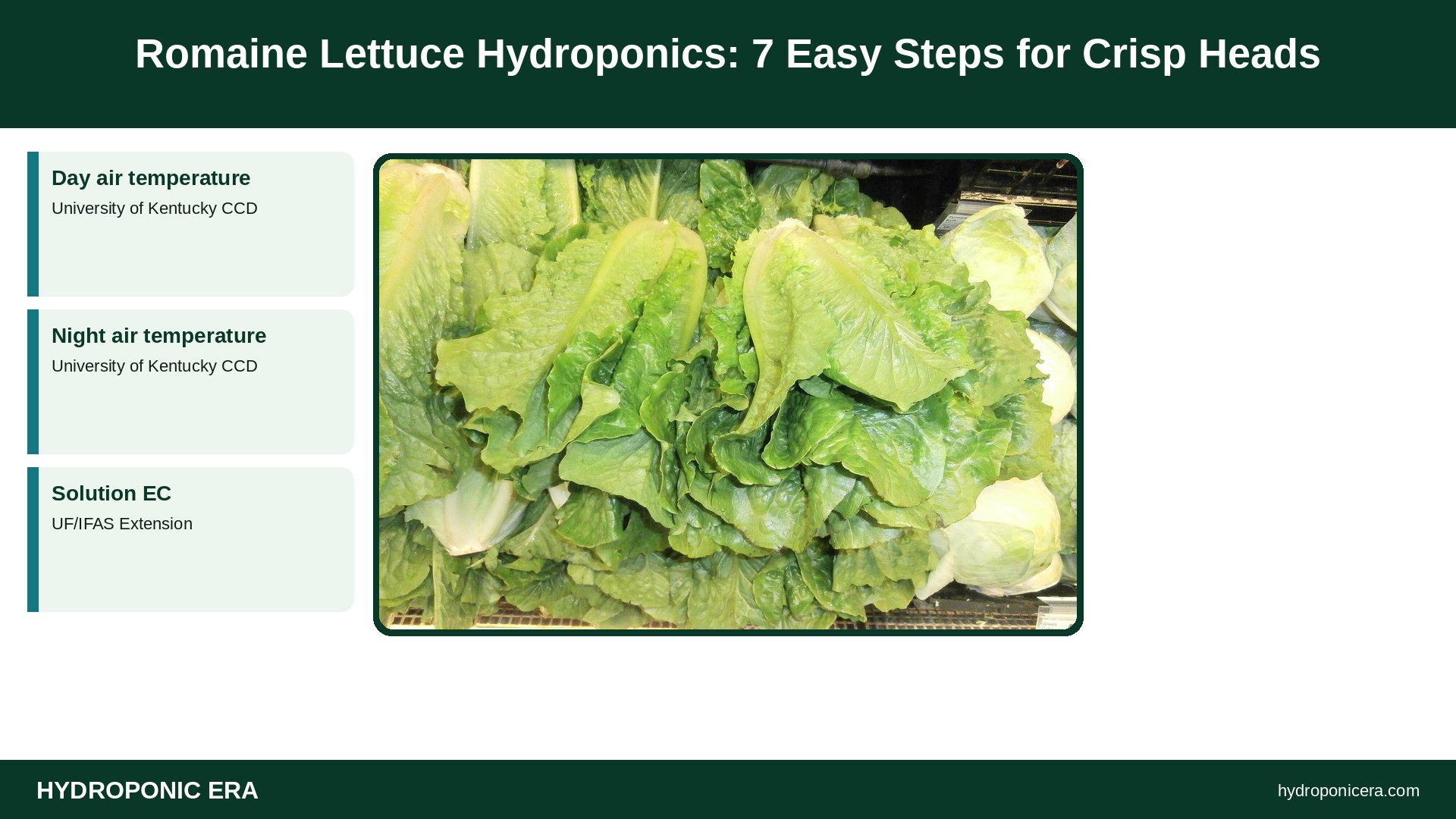
| Romaine target | Range | Source |
|---|---|---|
| Day air temperature | At or below 75°F (24°C) | University of Kentucky CCD |
| Night air temperature | About 65°F (18°C) | University of Kentucky CCD |
| Solution EC | 1.2–1.8 mS/cm (560–840 ppm) | UF/IFAS Extension |
| Solution pH | 5.5–6.0 | University of Kentucky CCD |
| Solution temperature | 65–80°F (18–27°C) | UF/IFAS Extension |
| Daily light integral | 12–17 mol/m²/day | University of Kentucky CCD |
Is Romaine Lettuce Hydroponics Hard for Beginners?
Romaine lettuce hydroponics is a bit harder than growing leaf or butterhead lettuce. The University of Kentucky Center for Crop Diversification says romaine-type lettuce is generally more challenging in controlled environments than leaf and butterhead types. Its tall, tight heart grows fast and is prone to tipburn, so romaine rewards cool temperatures, good airflow and steady nutrients.
The good news for romaine lettuce hydroponics is that seed companies now breed romaine cultivars for hydroponics. Choose a variety listed for greenhouse or indoor use, and consider a compact type like Little Gem lettuce if space is tight.
What EC and pH Does Romaine Lettuce Hydroponics Need?
In romaine lettuce hydroponics, plants do well at an EC of about 1.2–1.8 mS/cm, which UF/IFAS Extension lists as 560–840 ppm. Kentucky’s example lettuce recipe runs near 1.5 mS/cm. Aim for a solution pH of 5.5–6.0, the range Kentucky recommends for nutrient uptake. Check both readings every few days and top up with fresh solution as plants drink.
Seedlings need less. Kentucky suggests pre-charging plugs with a balanced solution at an EC of 1.0 mS/cm and a pH of 5.5–6.0. For more detail, see our guide to hydroponic lettuce EC.
How Do You Start Romaine Seeds for Hydroponics?
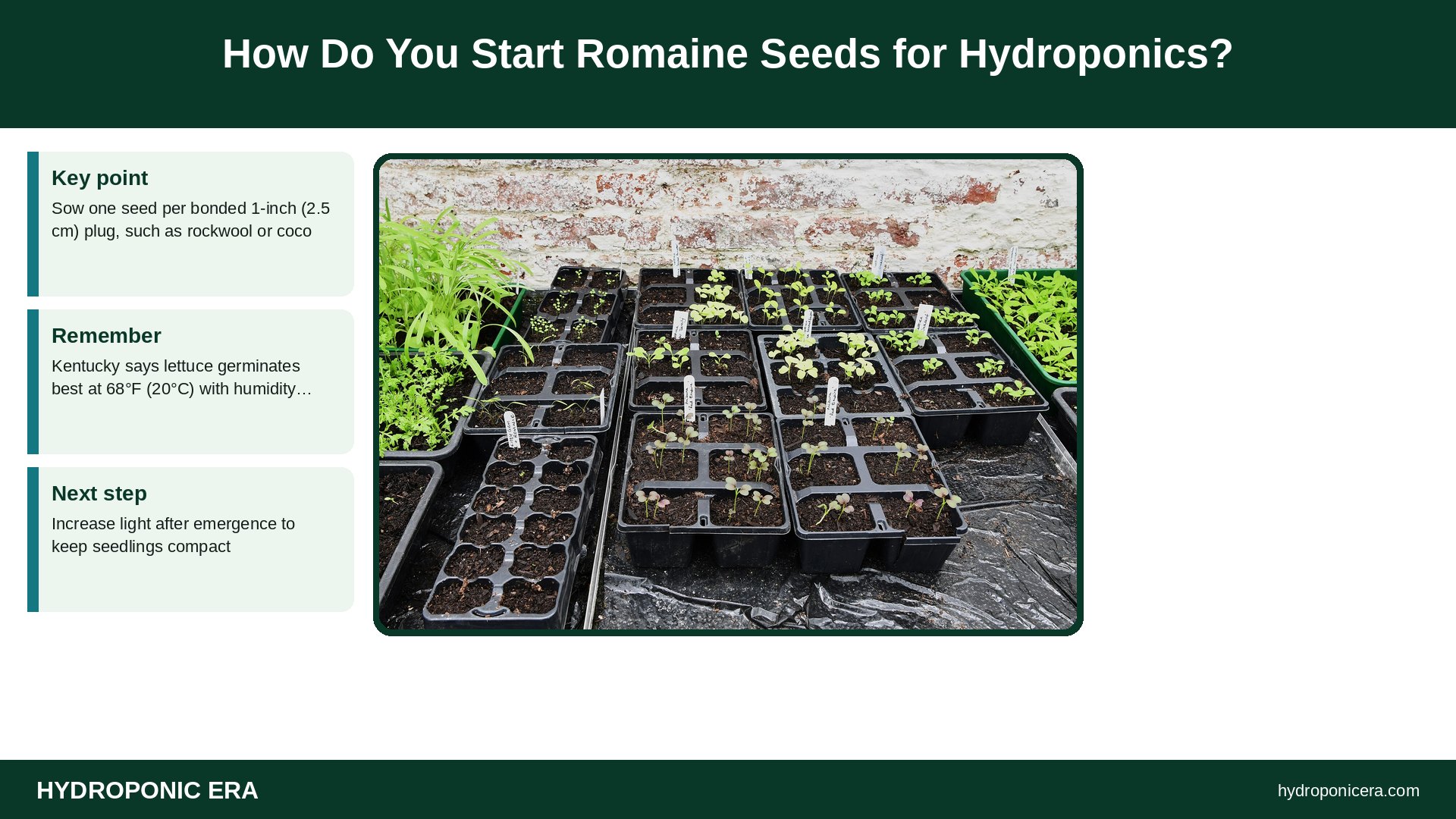
Sow one seed per bonded 1-inch (2.5 cm) plug, such as rockwool or coco. Kentucky says lettuce germinates best at 68°F (20°C) with humidity over 88%, so use a dome for the first two days. Increase light after emergence to keep seedlings compact. Transplant when plants have three to four true leaves and roots show, usually 14–21 days after seeding.
- Soak rockwool plugs in solution at EC 1.0 and pH 5.5–6.0.
- Place one pelleted or raw seed per plug.
- Keep plugs at about 68°F (20°C) under a humidity dome.
- Remove the dome once seeds emerge, around day 2.
- Raise light gradually as seedlings grow.
- Transplant at 3–4 true leaves, with roots touching the solution.
Bonded plugs keep their shape in water systems. Our rockwool guide covers soaking and pH.
Which System Is Best for Romaine Lettuce Hydroponics?
Deep water culture, NFT and drip systems all work for romaine lettuce hydroponics. Kentucky’s guide covers all three for lettuce. DWC holds a large, stable volume of solution, which buffers temperature and pH swings. NFT uses less water but needs reliable pumps and wider channel spacing for tall heads. Home growers often start with a raft or tote.
- DWC raft or tote: forgiving and simple; see deep water culture for beginners.
- NFT channels: efficient for many heads; see NFT hydroponics for beginners.
- Kratky jars: fine for a few plants with no pump.
How Do You Prevent Tipburn on Romaine?
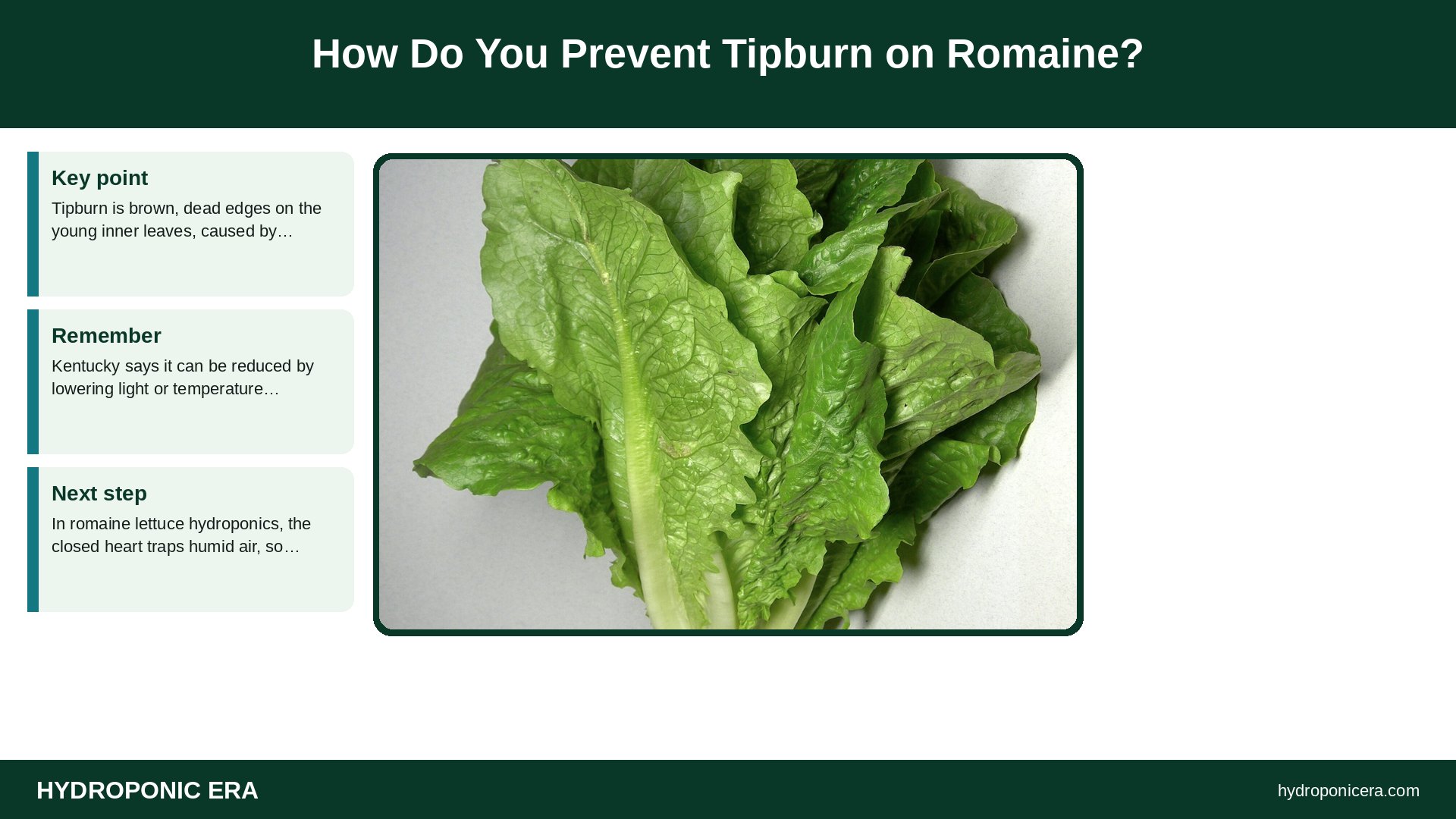
Tipburn is brown, dead edges on the young inner leaves, caused by poor calcium delivery to fast-growing tissue. Kentucky says it can be reduced by lowering light or temperature, shortening the crop cycle, raising airflow to 0.7–2.2 mph (0.3–1.0 m/s) and choosing tolerant varieties. In romaine lettuce hydroponics, the closed heart traps humid air, so blow fans across and into the canopy.
- Keep relative humidity at 50–70%, as Kentucky recommends.
- Avoid pushing growth with very high light and heat.
- Harvest a few days early if inner leaf tips start to brown.
Calcium in the solution matters too; see our calcium nitrate guide.
When Do You Harvest Hydroponic Romaine?
In romaine lettuce hydroponics, most heads are ready about 30 to 40 days after transplant, according to Kentucky’s lettuce timeline, which also allows about 3 days for germination and 10 days of seedling growth. Harvest when heads are full and upright but before the center stretches. Cut at the base, or pull the whole plant with roots for longer shelf life.
Heat speeds bolting and bitterness. If a stalk starts to rise from the center, harvest right away. Our lettuce bitterness and bolting timeline explains the warning signs.
Why Is My Hydroponic Romaine Bolting or Bitter?
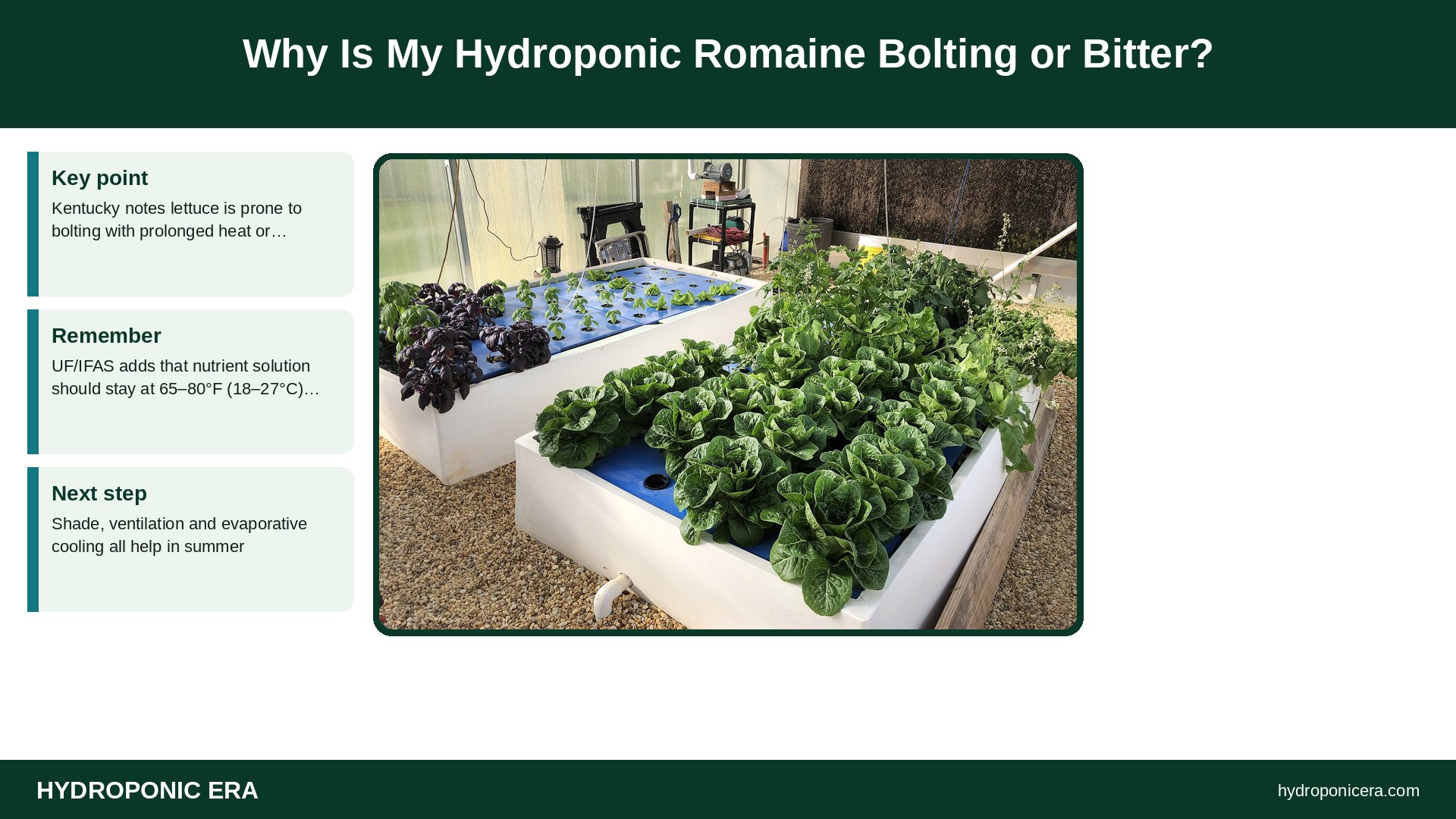
Heat is the main cause. Kentucky notes lettuce is prone to bolting with prolonged heat or large temperature swings, and that fluctuating temperatures can be worse than steady warmth. UF/IFAS adds that nutrient solution should stay at 65–80°F (18–27°C), with good oxygenation. Shade, ventilation and evaporative cooling all help in summer.
Choose heat-tolerant cultivars for summer and faster ones for low-light winter months, as Kentucky suggests.
FAQ About Romaine Lettuce Hydroponics
How long does romaine lettuce hydroponics take?
About 30–40 days after transplant, plus roughly two weeks as a seedling.
What spacing does romaine need?
UC Davis suggests 6–8 in (15–20 cm) apart for cos types in the garden; give similar room in rafts.
Can romaine grow in a Kratky jar?
Yes, for a few heads, if the jar is large and kept cool.
Why are my romaine leaf tips brown?
That is usually tipburn from poor calcium movement; add airflow and lower heat.
Is romaine the same as cos lettuce?
Yes. UC Davis notes romaine is also known as cos.
Sources
- University of Kentucky Center for Crop Diversification — Hydroponic Lettuce Production in Controlled Environments
- UF/IFAS Extension — Growing Lettuce in Small Hydroponic Systems (HS1422)
- UC Davis Vegetable Research and Information Center — Lettuce
- Photo credits (Wikimedia Commons, edited with titles): Stack of romaine lettuce heads by Jeffery Martin (CC0); Temple Sowerby, Acorn Bank, Mizuna and lettuce seedlings – geograph.org.uk – 7625183 by Michael Garlick (CC BY-SA 2.0); Romaine lettuce by Rainer Zenz (CC BY-SA 3.0); Deepwater Aquaponics Floating Rafts Growing Lettuce, Basil and Arugula by Alabama Extension (CC0)