
Can you grow sea asparagus hydroponically? Yes. Sea asparagus hydroponics works because Salicornia, also called samphire or glasswort, is a salt-loving succulent that grows well in nutrient solution with added sodium chloride. A HortScience study found Salicornia bigelovii grew far better hydroponically at 200 mM NaCl than at low salt, and a 2023 indoor NFT trial found S. europaea gained fresh mass at 50 and 200 mM.
Key takeaway: Sea asparagus is a true halophyte, so plain hydroponic solution is not ideal. Grow it in its own system, add measured salt after establishment, keep temperatures mild, and harvest the tender green tips before they turn woody.
| Factor | What research reports | Source |
|---|---|---|
| Species grown as a vegetable | Salicornia bigelovii, S. europaea and others | HortScience; Frontiers |
| S. bigelovii salt response | Much better growth at 200 mM than at 6–10 mM NaCl | HortScience 2014 |
| S. europaea indoors | More fresh mass at 50 and 200 mM NaCl | Frontiers 2023 |
| Trial climate | 72°F (22°C) day, 64°F (18°C) night, 65% humidity | Frontiers 2023 |
| 200 mM NaCl | About 11.7 g per liter, or 44 g per gallon | Conversion |
| Edible part | Young succulent tips | FAO webinar |
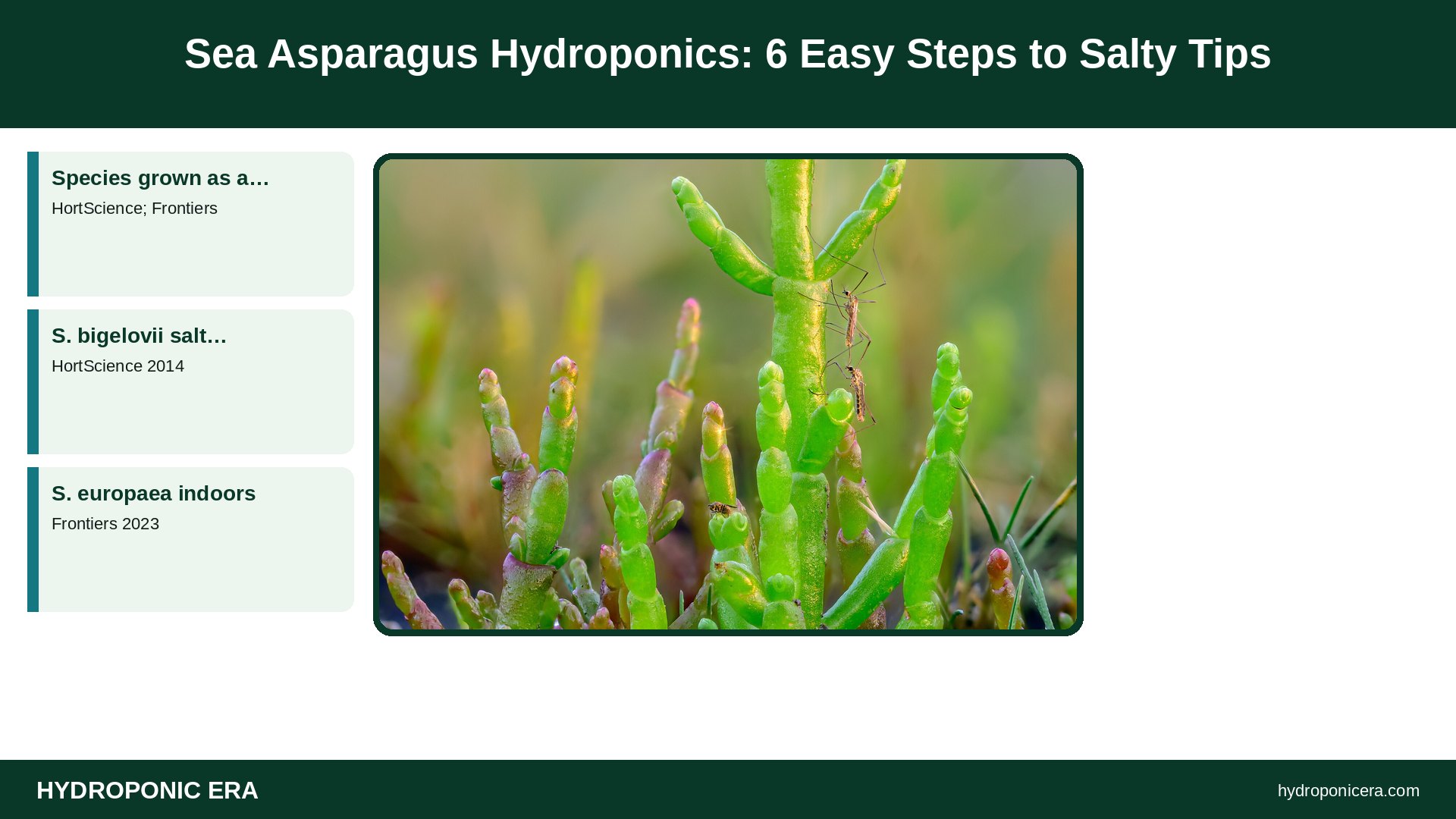
What Is Sea Asparagus?
Sea asparagus is the young, jointed green stem of Salicornia, a leafless succulent that grows in salt marshes. It is also sold as samphire, sea beans, glasswort or pickleweed. The tips are crisp and naturally salty, and chefs blanch them, pickle them or serve them raw with fish. An FAO-hosted presentation shows dried Salicornia tips used in fish stock and as a powdered garnish.
The plant stores salt in its fleshy stems. The Frontiers in Plant Science study describes S. europaea as a salt-accumulating plant, which explains both its flavor and why it needs salt in the root zone to grow well.
Why Does Sea Asparagus Hydroponics Need Salt?
Sea asparagus hydroponics needs salt because Salicornia is a halophyte that grows best with sodium chloride around its roots. In a HortScience study, S. bigelovii grown hydroponically at only 6–10 mM NaCl had much lower growth and marketable yield than plants at 200 mM. Low-salt solutions simply do not suit this crop.
The 2023 Frontiers study grew S. europaea in NFT indoors and in a greenhouse with no salt, 50, 200 or 600 mM NaCl. Indoors, fresh mass rose at 50 and 200 mM compared with no salt. That makes roughly 50–200 mM a sensible working range for home trials.
| NaCl level | Grams per liter | Grams per gallon |
|---|---|---|
| 50 mM | 2.9 | 11 |
| 100 mM | 5.8 | 22 |
| 200 mM | 11.7 | 44 |
These are simple conversions for plain sodium chloride (58.4 g per mole), not a recipe from either study.
How Do You Set Up Sea Asparagus Hydroponics?
Set up sea asparagus hydroponics in a dedicated NFT or deep water culture system with plastic fittings. Germinate seeds in plugs or a low-nutrient substrate, establish seedlings in a normal nutrient solution, then add salt gradually. The Frontiers researchers acclimated plants to NFT for one week before starting salt treatment.
- Germinate seeds in moist plugs or seed mix.
- Transplant seedlings into net cups once roots show.
- Run a standard vegetable nutrient solution for about a week.
- Add dissolved plain salt to reach about 50 mM, then raise toward 200 mM if plants respond well.
- Record the EC after each salt addition as your new baseline.
- Change the whole reservoir on a schedule instead of adding more salt.
Salt pushes EC far above normal, so track nutrient strength before adding salt. Our hydroponic EC guide explains how to measure solution strength.
What Climate Does Sea Asparagus Need Indoors?
Give sea asparagus mild temperatures, good light and steady humidity. In the Frontiers indoor trial, both rooms ran at 72°F (22°C) by day and 64°F (18°C) at night with 65% humidity. Those settings are a reasonable target for a home grow room or tent.
- Temperature: about 64–72°F (18–22°C), as in the indoor trial.
- Humidity: about 65%.
- Light: strong LEDs; in the trial, the halophytes produced more fresh mass under artificial light indoors than in the greenhouse.
- Airflow: a small fan prevents stagnant, humid pockets.
For help with humidity, see our humidity and VPD guide.
When Do You Harvest Sea Asparagus?
Harvest sea asparagus when the tips are bright green, plump and snap cleanly. Cut the top few inches of each branch and leave the lower plant to branch again. Older stems turn woody from the base up, so frequent cutting keeps harvests tender. Grow it in salty solution from the start of the main growth phase, since the HortScience authors found low-salt plants gave much lower marketable yield.
Rinse tips before eating, since they can taste very salty. Blanch them briefly to soften the salt, or serve them raw in small amounts.
What Problems Affect Sea Asparagus Hydroponics?
Common problems include poor growth from too little salt, weak plants from too much salt, root rot in warm water and corrosion of metal parts. Because it is grown in brine, sea asparagus hydroponics also needs separate tools and reservoirs from other crops. Keep notes so you can repeat the salt level that works.
- Slow, pale growth: increase salt gradually within the 50–200 mM range.
- Shriveling or stunting: reduce salt.
- Brown roots: add aeration and cool the solution.
- Rusty fittings: switch to plastic or stainless parts.
For a related salt-tolerant leaf, see our New Zealand spinach hydroponics guide.
Is Sea Asparagus Hydroponics Worth It for Home Growers?
Sea asparagus hydroponics is worth it if you enjoy samphire and can dedicate a small system to brine. Fresh Salicornia is hard to find in many US stores, and home-grown tips can be cut a few at a time. The trade-off is extra care: separate equipment, careful salt measuring and regular full reservoir changes.
- Good fit: cooks who want fresh samphire for fish, salads and pickles.
- Space: a single NFT channel or small tub is enough for a household.
- Learning curve: sea asparagus hydroponics rewards careful notes on salt dose and harvest timing.
- Poor fit: growers who want one shared reservoir for every crop.
Start small with a few plants at about 50 mM salt, record growth for several weeks, and only then decide whether to raise the salt or expand the system. Keep a logbook of salt grams per gallon, EC after mixing and harvest dates so each new batch of sea asparagus starts from what worked last time.
FAQ About Sea Asparagus Hydroponics
Is sea asparagus related to asparagus?
No. It only looks similar. Salicornia is a salt-marsh succulent.
Can I use seawater for sea asparagus hydroponics?
Some growers do, but plain salt lets you control the dose precisely.
Can sea asparagus grow without salt?
In sea asparagus hydroponics it survives, but research shows much better growth with added salt.
Is sea asparagus the same as samphire?
Yes. Samphire, glasswort and sea beans are common names for Salicornia.
Can sea asparagus hydroponics share a system with lettuce?
Not in the same reservoir. Salt would damage most leafy greens.
Sources
- HortScience — Potential of Producing Salicornia bigelovii Hydroponically as a Vegetable at Moderate NaCl Salinity
- Frontiers in Plant Science — Salinity and light regime in edible halophytes in greenhouse and indoor farming
- FAO Global Soil Partnership — Salicornia bigelovii: a halophytic case study from farm to fork
- Photo credits (Wikimedia Commons, edited with titles): Europäischer Queller (Salicornia europaea) by Stephan Sprinz (CC BY 4.0)